Retail & E-commerce
Talabat Commission vs Your Own App in Dubai (2026)

By
Anh Nguyen, Founder
·
11 min

Talabat and the other delivery platforms set each restaurant's commission in its own contract, and Dubai's 2025 rules now require it on an itemised monthly statement. Your own ordering channel pays when the commission saved on direct orders covers what those orders cost you instead: card fees, delivery and the channel itself.
Key takeaways
Each restaurant has its own commission. The rate sits in your contract, and Dubai's 2025 circular requires an itemised statement every month.
The commission pays for more than the listing. Riders, card payments, marketing and customer service come out of it, so a direct order carries those costs instead.
Ready-made ordering tools charge no commission. Foodics Online and Zyda sell branded ordering websites that connect to your POS.
Collected orders pay back fastest. A direct order with no courier to pay keeps most of the commission it saves.
You can run both. The platforms bring new customers; your own channel serves the regulars.
Planning a shopping, marketplace or loyalty app? See how we build e-commerce and retail apps for UAE brands.

Each channel moves a different cost onto the restaurant: commission, a tool's fees, or a build.
How much do Talabat, Deliveroo, Careem, noon and Keeta charge restaurants?
Each restaurant's commission is set in its contract with the platform, usually as a percentage of every order, with marketing fees on top when you choose them.
Talabat and Careem compete in the UAE with Deliveroo, noon and Keeta (The National, July 2026). Keeta, the newest, launched in Dubai in September 2025, reached all seven emirates within 90 days and lists more than 10,000 restaurant and merchant brands, according to the company. Each platform agrees its own terms with each restaurant; talabat's partner page, for one, gives no standard rate.
Talabat explains what its commission pays for. Its partner page says the commission pays the delivery riders and the platform's ordering services, and that the remainder covers costs such as rider insurance, card payment costs, marketing and customer service. When an order comes to you directly, those costs move to you.
One public example shows what a schedule can look like. Under a partnership announced in April 2026, noon Food offers Emirati-owned food and beverage SMEs nominated by Dubai SME a commission of 10% in the first year, rising to 20% by the fifth, with onboarding fees waived (Government of Dubai Media Office). That schedule is specific to the programme; your own rate is the one on your statement.
Dubai's 2025 rules give restaurants clearer numbers:
An itemised statement every month. Circular No. 2 of 2025 from the Dubai Corporation for Consumer Protection and Fair Trade requires transparent commission structures, with monthly statements listing sales, commissions, refunds and deductions (Gulf News, September 2025).
Optional advertising. Promotional and advertising fees must be optional and clearly disclosed.
Access to your sales data. Restaurants get fair access to non-personal customer data, such as order history and sales reports.
Notice before changes. Contract changes need 30 days' notice, and a restaurant that disagrees can end the contract. Hidden or retroactive charges are prohibited.
What are your three options?
You can stay on the platforms, add a ready-made ordering tool, or build your own ordering app; each one moves a different cost onto the restaurant.
Ready-made ordering tools give a restaurant its own ordering website, and sometimes an app, connected to its POS. Foodics describes Foodics Online as "a commission-free platform" with a branded website and app, and Zyda builds direct ordering websites with 0% commission that connect to more than 100 POS systems. An app of your own goes further: your brand, your loyalty scheme, your integrations and the customer relationship.
Option | What you pay | What you run yourself |
|---|---|---|
The platforms | A commission on every order, plus the marketing you choose | Cooking and packing; the platform brings customers, takes payment and delivers with its riders |
A ready-made ordering tool | The tool's own fees; no commission on orders | Your menu and offers, card payments and delivery |
Your own ordering app | A build, then maintenance | Your brand, loyalty, customer data and delivery |
How many direct orders does it take to pay?
A direct order saves the commission, minus what you now pay yourself: the card fee, the delivery and a share of the channel's monthly cost.
Two lines of arithmetic decide it:
Saving per direct order = the commission you would have paid − (card fee + delivery cost).
Orders a month to break even = the monthly cost of your channel ÷ the saving per direct order.
A worked example, with example figures to replace with your own. The average UAE delivery order was about AED 77 in the first half of 2026 (AED 76.97, Syrve transaction data, July 2026). At an example commission of 25%, that order costs AED 19.25 on a platform. Ordered directly, it costs an example AED 2.31 in card fees (3%) plus an example AED 15 for delivery by a delivery company.
What the example gives:
A delivered direct order saves AED 1.94. With an example channel cost of AED 3,000 a month, covering the tool or app and the marketing that moves customers, the break-even is 1,547 delivered direct orders a month.
A collected order saves AED 16.94. The same AED 3,000 is covered by 178 collections a month.
Your own riders change the delivery line. When riders already on your payroll have spare capacity, an extra delivery costs far less than a courier's fee per drop.
Delivery decides the answer. The platform's commission includes its riders, so the comparison only holds when the direct order includes delivery too. Put in the rate from your monthly statement and your own delivery cost; the result tells you which option pays for your restaurant.

A direct order pays when the commission it saves is larger than its card fee and delivery.
When is staying on the platforms the right call?
When your direct orders would stay below the break-even, the platforms remain the lower-cost way to sell delivery.
The platforms carry the customers, the riders and the marketing. Delivery made up 30.5% of all UAE restaurant ordersin the first half of 2026 and more than a third this summer (Syrve, 2026), and talabat alone processed USD 9.5 billion of orders across its eight markets in 2025, according to its annual results.
The platforms stay right in these situations:
A new restaurant building its first customers. The platforms bring discovery while few people know your name.
Few repeat customers. A restaurant whose customers change every day, such as one serving mostly visitors, has few regulars to move to a direct channel.
Delivery that costs close to the commission. When a courier's fee per drop takes most of the commission saved, delivered direct orders save little, and the platforms' riders remain the better deal.
Low monthly volume. Below the break-even, a direct channel costs more than it saves.
Can you run the platforms and your own channel together?
Yes: the platforms bring new customers, and your own channel serves the people who already know you.
Your regulars, your dine-in guests and your corporate customers are the easiest orders to move. They know the restaurant, they order often, and a loyalty scheme gives them a reason to order from you. Check your platform contract before you market to customers you met through a platform.
What a direct channel for regulars usually includes:
Your ordering website or app. Menu, payment by card or Apple Pay, collection and delivery slots, and order tracking.
Loyalty. Points, member prices or a free item after a set number of orders, kept in the customer's account.
Re-orders on WhatsApp. Regulars send "the usual" and get it confirmed with a payment link. Our guide to the WhatsApp Business API in the UAE covers the setup and Meta's rates, and an AI agent can take those orders at any hour.
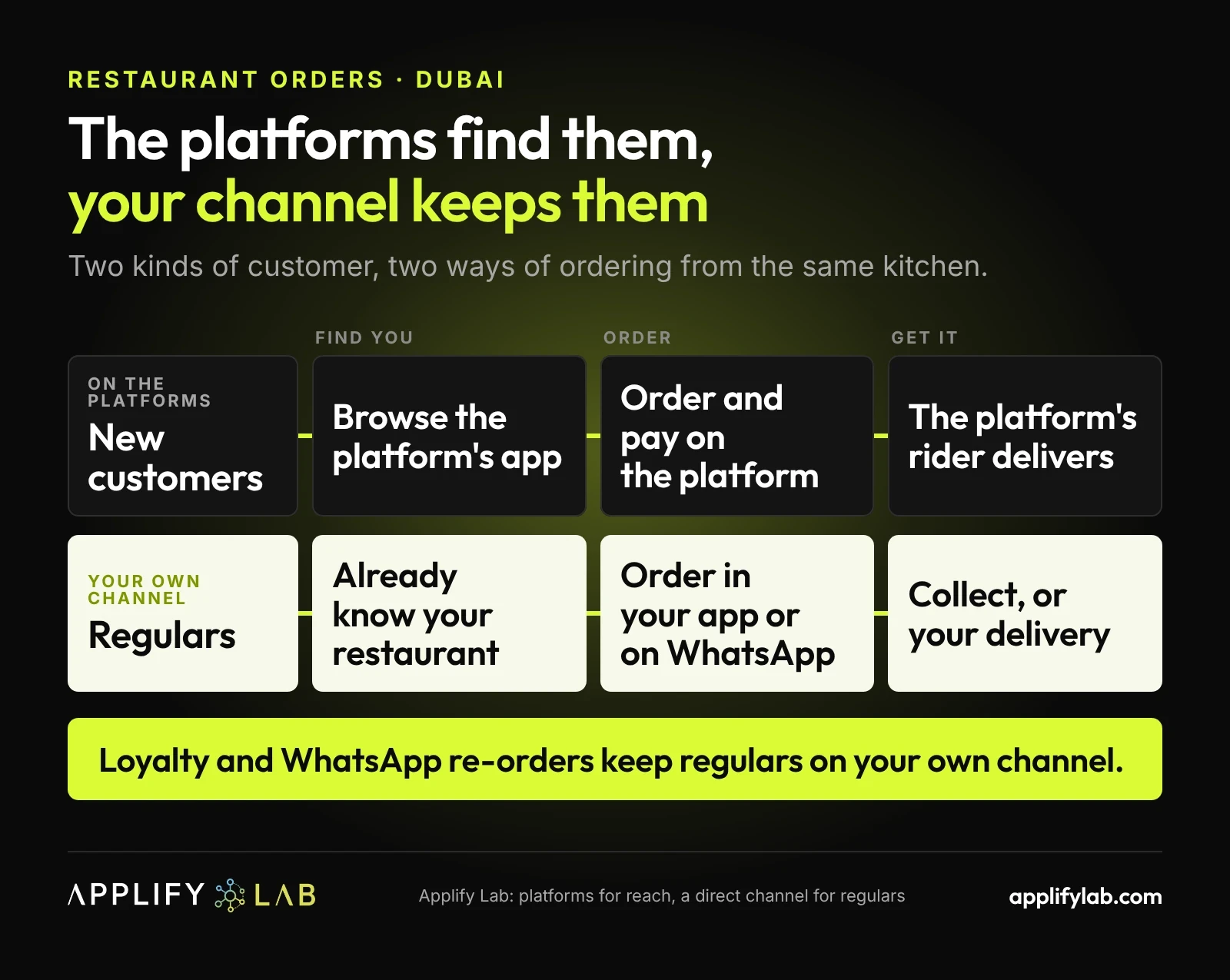
The platforms find new customers; your own channel keeps the ones who come back.
How many delivery orders do you take a month?
Tell us your monthly orders and how you deliver them, and we'll tell you which option pays for your restaurant.
What does your own ordering app need, and what does it cost?
The first version needs the menu, checkout, collection and delivery, order status and a link to your POS; loyalty and WhatsApp re-orders can follow.
What usually goes in version one:
Menu and checkout. Items with options and extras, branch selection, and payment by card or Apple Pay.
Collection and delivery. Time slots, delivery zones and order status from kitchen to door.
A POS link. Orders land in the kitchen with your other orders, through your POS or your ordering tool.
Arabic and English. Both languages, right-to-left screens included.
Food ordered in an app is a physical product, so Apple's guidelines send it to payment methods outside in-app purchase, such as Apple Pay or card entry (guideline 3.1.3(e)), and Apple takes no commission on it. Clutch puts most app projects between USD 10,000 and 49,999 (about AED 36,700–183,600), the band where an ordering app connected to a POS usually starts; apps for several brands or with deeper integrations sit in the next band, USD 50,000–199,999. These are market ranges; Applify Lab scopes every project after a diagnosis.
Start with the tool that matches your volume. A single restaurant below the break-even is often well served by a ready-made ordering tool; a group with several branches, a loyalty scheme and its own POS rules is where an app of its own earns its cost. Our guides to app development costs in Dubai and to Foodics, Odoo or a custom system go further.
Who delivers the orders that come to you directly?
On the platforms, their riders are paid out of the commission; on your own channel, delivery becomes your cost, per rider or per drop.
That line is the largest one in the break-even, so it deserves its own decision.
Three ways to deliver direct orders:
Your own riders. Salaries, bikes, insurance and scheduling are yours. It suits groups with steady volume across the day, where riders stay busy.
A rider company. Rider outsourcing companies in the UAE charge a monthly rate per rider or a fee per delivery. Paid per delivery, you pay nothing between orders, which suits restaurants whose direct volume varies.
Collection. The customer picks up the order, and the whole commission saving stays with you. A collection discount in your app gives nearby regulars a reason to pick up.
FAQ
How much commission does Talabat charge restaurants?
Talabat doesn't publish a standard rate: each restaurant's commission is set in its contract. Its partner page says the commission pays the riders and platform services, plus costs such as rider insurance, card payments, marketing and customer service. In Dubai, Circular No. 2 of 2025 requires platforms to send restaurants an itemised statement of sales, commissions, refunds and deductions every month.
Is it worth building my own restaurant app in Dubai?
It is when your direct orders pass the break-even: the monthly cost of your channel divided by what each direct order saves after card fees and delivery. More branches and more regulars mean more direct orders, so groups reach it sooner; a single restaurant with few repeat customers may stay below it, and then the platforms and a ready-made ordering tool cost less.
How much does a restaurant ordering app cost in the UAE?
According to Clutch's September 2026 data, most app projects cost AED 36,700–183,600, the band where an ordering app connected to a POS usually starts. Apps for several brands or deeper integrations start at AED 183,600–734,500. Ready-made ordering tools such as Foodics Online and Zyda charge their own fees with no commission on orders. These are market ranges; Applify Lab scopes every project after a diagnosis.
Can I take orders on WhatsApp?
Yes. The free WhatsApp Business app works for a few orders a day answered by hand. For more volume, the WhatsApp Business API connects WhatsApp to your ordering system, sends payment links and order updates, and can be answered by an AI agent at any hour. Meta charges for some messages businesses send; our guide to the WhatsApp Business API in the UAE sets out the rates.
Can I use third-party riders with my own app?
Yes. Rider outsourcing companies in the UAE supply riders to restaurants and other businesses, at a monthly rate per rider or a fee per delivery; paid per delivery, you pay nothing between orders. Put that cost into the break-even: in the worked example above, delivery is the largest cost of a direct order, well above the card fee.
To go further
Discover how we build ordering and loyalty apps for UAE restaurants and retailers.
Find out how we approach custom apps and AI for Dubai businesses.
See how we built a two-sided marketplace that connects people with local cafes and businesses.
Talabat and the other delivery platforms set each restaurant's commission in its own contract, and Dubai's 2025 rules now require it on an itemised monthly statement. Your own ordering channel pays when the commission saved on direct orders covers what those orders cost you instead: card fees, delivery and the channel itself.
Key takeaways
Each restaurant has its own commission. The rate sits in your contract, and Dubai's 2025 circular requires an itemised statement every month.
The commission pays for more than the listing. Riders, card payments, marketing and customer service come out of it, so a direct order carries those costs instead.
Ready-made ordering tools charge no commission. Foodics Online and Zyda sell branded ordering websites that connect to your POS.
Collected orders pay back fastest. A direct order with no courier to pay keeps most of the commission it saves.
You can run both. The platforms bring new customers; your own channel serves the regulars.
Planning a shopping, marketplace or loyalty app? See how we build e-commerce and retail apps for UAE brands.
Each channel moves a different cost onto the restaurant: commission, a tool's fees, or a build.
How much do Talabat, Deliveroo, Careem, noon and Keeta charge restaurants?
Each restaurant's commission is set in its contract with the platform, usually as a percentage of every order, with marketing fees on top when you choose them.
Talabat and Careem compete in the UAE with Deliveroo, noon and Keeta (The National, July 2026). Keeta, the newest, launched in Dubai in September 2025, reached all seven emirates within 90 days and lists more than 10,000 restaurant and merchant brands, according to the company. Each platform agrees its own terms with each restaurant; talabat's partner page, for one, gives no standard rate.
Talabat explains what its commission pays for. Its partner page says the commission pays the delivery riders and the platform's ordering services, and that the remainder covers costs such as rider insurance, card payment costs, marketing and customer service. When an order comes to you directly, those costs move to you.
One public example shows what a schedule can look like. Under a partnership announced in April 2026, noon Food offers Emirati-owned food and beverage SMEs nominated by Dubai SME a commission of 10% in the first year, rising to 20% by the fifth, with onboarding fees waived (Government of Dubai Media Office). That schedule is specific to the programme; your own rate is the one on your statement.
Dubai's 2025 rules give restaurants clearer numbers:
An itemised statement every month. Circular No. 2 of 2025 from the Dubai Corporation for Consumer Protection and Fair Trade requires transparent commission structures, with monthly statements listing sales, commissions, refunds and deductions (Gulf News, September 2025).
Optional advertising. Promotional and advertising fees must be optional and clearly disclosed.
Access to your sales data. Restaurants get fair access to non-personal customer data, such as order history and sales reports.
Notice before changes. Contract changes need 30 days' notice, and a restaurant that disagrees can end the contract. Hidden or retroactive charges are prohibited.
What are your three options?
You can stay on the platforms, add a ready-made ordering tool, or build your own ordering app; each one moves a different cost onto the restaurant.
Ready-made ordering tools give a restaurant its own ordering website, and sometimes an app, connected to its POS. Foodics describes Foodics Online as "a commission-free platform" with a branded website and app, and Zyda builds direct ordering websites with 0% commission that connect to more than 100 POS systems. An app of your own goes further: your brand, your loyalty scheme, your integrations and the customer relationship.
Option | What you pay | What you run yourself |
|---|---|---|
The platforms | A commission on every order, plus the marketing you choose | Cooking and packing; the platform brings customers, takes payment and delivers with its riders |
A ready-made ordering tool | The tool's own fees; no commission on orders | Your menu and offers, card payments and delivery |
Your own ordering app | A build, then maintenance | Your brand, loyalty, customer data and delivery |
How many direct orders does it take to pay?
A direct order saves the commission, minus what you now pay yourself: the card fee, the delivery and a share of the channel's monthly cost.
Two lines of arithmetic decide it:
Saving per direct order = the commission you would have paid − (card fee + delivery cost).
Orders a month to break even = the monthly cost of your channel ÷ the saving per direct order.
A worked example, with example figures to replace with your own. The average UAE delivery order was about AED 77 in the first half of 2026 (AED 76.97, Syrve transaction data, July 2026). At an example commission of 25%, that order costs AED 19.25 on a platform. Ordered directly, it costs an example AED 2.31 in card fees (3%) plus an example AED 15 for delivery by a delivery company.
What the example gives:
A delivered direct order saves AED 1.94. With an example channel cost of AED 3,000 a month, covering the tool or app and the marketing that moves customers, the break-even is 1,547 delivered direct orders a month.
A collected order saves AED 16.94. The same AED 3,000 is covered by 178 collections a month.
Your own riders change the delivery line. When riders already on your payroll have spare capacity, an extra delivery costs far less than a courier's fee per drop.
Delivery decides the answer. The platform's commission includes its riders, so the comparison only holds when the direct order includes delivery too. Put in the rate from your monthly statement and your own delivery cost; the result tells you which option pays for your restaurant.
A direct order pays when the commission it saves is larger than its card fee and delivery.
When is staying on the platforms the right call?
When your direct orders would stay below the break-even, the platforms remain the lower-cost way to sell delivery.
The platforms carry the customers, the riders and the marketing. Delivery made up 30.5% of all UAE restaurant ordersin the first half of 2026 and more than a third this summer (Syrve, 2026), and talabat alone processed USD 9.5 billion of orders across its eight markets in 2025, according to its annual results.
The platforms stay right in these situations:
A new restaurant building its first customers. The platforms bring discovery while few people know your name.
Few repeat customers. A restaurant whose customers change every day, such as one serving mostly visitors, has few regulars to move to a direct channel.
Delivery that costs close to the commission. When a courier's fee per drop takes most of the commission saved, delivered direct orders save little, and the platforms' riders remain the better deal.
Low monthly volume. Below the break-even, a direct channel costs more than it saves.
Can you run the platforms and your own channel together?
Yes: the platforms bring new customers, and your own channel serves the people who already know you.
Your regulars, your dine-in guests and your corporate customers are the easiest orders to move. They know the restaurant, they order often, and a loyalty scheme gives them a reason to order from you. Check your platform contract before you market to customers you met through a platform.
What a direct channel for regulars usually includes:
Your ordering website or app. Menu, payment by card or Apple Pay, collection and delivery slots, and order tracking.
Loyalty. Points, member prices or a free item after a set number of orders, kept in the customer's account.
Re-orders on WhatsApp. Regulars send "the usual" and get it confirmed with a payment link. Our guide to the WhatsApp Business API in the UAE covers the setup and Meta's rates, and an AI agent can take those orders at any hour.
The platforms find new customers; your own channel keeps the ones who come back.
How many delivery orders do you take a month?
Tell us your monthly orders and how you deliver them, and we'll tell you which option pays for your restaurant.
What does your own ordering app need, and what does it cost?
The first version needs the menu, checkout, collection and delivery, order status and a link to your POS; loyalty and WhatsApp re-orders can follow.
What usually goes in version one:
Menu and checkout. Items with options and extras, branch selection, and payment by card or Apple Pay.
Collection and delivery. Time slots, delivery zones and order status from kitchen to door.
A POS link. Orders land in the kitchen with your other orders, through your POS or your ordering tool.
Arabic and English. Both languages, right-to-left screens included.
Food ordered in an app is a physical product, so Apple's guidelines send it to payment methods outside in-app purchase, such as Apple Pay or card entry (guideline 3.1.3(e)), and Apple takes no commission on it. Clutch puts most app projects between USD 10,000 and 49,999 (about AED 36,700–183,600), the band where an ordering app connected to a POS usually starts; apps for several brands or with deeper integrations sit in the next band, USD 50,000–199,999. These are market ranges; Applify Lab scopes every project after a diagnosis.
Start with the tool that matches your volume. A single restaurant below the break-even is often well served by a ready-made ordering tool; a group with several branches, a loyalty scheme and its own POS rules is where an app of its own earns its cost. Our guides to app development costs in Dubai and to Foodics, Odoo or a custom system go further.
Who delivers the orders that come to you directly?
On the platforms, their riders are paid out of the commission; on your own channel, delivery becomes your cost, per rider or per drop.
That line is the largest one in the break-even, so it deserves its own decision.
Three ways to deliver direct orders:
Your own riders. Salaries, bikes, insurance and scheduling are yours. It suits groups with steady volume across the day, where riders stay busy.
A rider company. Rider outsourcing companies in the UAE charge a monthly rate per rider or a fee per delivery. Paid per delivery, you pay nothing between orders, which suits restaurants whose direct volume varies.
Collection. The customer picks up the order, and the whole commission saving stays with you. A collection discount in your app gives nearby regulars a reason to pick up.
FAQ
How much commission does Talabat charge restaurants?
Talabat doesn't publish a standard rate: each restaurant's commission is set in its contract. Its partner page says the commission pays the riders and platform services, plus costs such as rider insurance, card payments, marketing and customer service. In Dubai, Circular No. 2 of 2025 requires platforms to send restaurants an itemised statement of sales, commissions, refunds and deductions every month.
Is it worth building my own restaurant app in Dubai?
It is when your direct orders pass the break-even: the monthly cost of your channel divided by what each direct order saves after card fees and delivery. More branches and more regulars mean more direct orders, so groups reach it sooner; a single restaurant with few repeat customers may stay below it, and then the platforms and a ready-made ordering tool cost less.
How much does a restaurant ordering app cost in the UAE?
According to Clutch's September 2026 data, most app projects cost AED 36,700–183,600, the band where an ordering app connected to a POS usually starts. Apps for several brands or deeper integrations start at AED 183,600–734,500. Ready-made ordering tools such as Foodics Online and Zyda charge their own fees with no commission on orders. These are market ranges; Applify Lab scopes every project after a diagnosis.
Can I take orders on WhatsApp?
Yes. The free WhatsApp Business app works for a few orders a day answered by hand. For more volume, the WhatsApp Business API connects WhatsApp to your ordering system, sends payment links and order updates, and can be answered by an AI agent at any hour. Meta charges for some messages businesses send; our guide to the WhatsApp Business API in the UAE sets out the rates.
Can I use third-party riders with my own app?
Yes. Rider outsourcing companies in the UAE supply riders to restaurants and other businesses, at a monthly rate per rider or a fee per delivery; paid per delivery, you pay nothing between orders. Put that cost into the break-even: in the worked example above, delivery is the largest cost of a direct order, well above the card fee.
To go further
Discover how we build ordering and loyalty apps for UAE restaurants and retailers.
Find out how we approach custom apps and AI for Dubai businesses.
See how we built a two-sided marketplace that connects people with local cafes and businesses.
Ready to run the numbers for your restaurant?
In 30 minutes, we'll put the figures from your own statement into the break-even and tell you which option pays. Book 30 minutes to run your numbers
RELATED GUIDES

Retail & E-commerce
Ecommerce App Development Dubai: Cost and Features (2026)
10 min

AI Agents & AI Automation
WhatsApp Business API in the UAE: Cost and Setup (2026)
16 min

App Development
App Maintenance Cost in Dubai: What It Covers (2026)
13 min

App Development
App Development Cost in Dubai (2026): Prices by App Type
13 min

Retail & E-commerce
AI Inventory Management for Multi-Location Restaurants in Dubai
6 min

Retail & E-commerce
AI Automation for Restaurants in Dubai: Workflows, Real Costs & Where to Start
7 min

Retail & E-commerce
Mobile Payment Integration for Ecommerce Apps in the UAE (2026)
8 min

Retail & E-commerce
Foodics vs Odoo vs Custom AI: Best System for Dubai Restaurants
7 min

Retail & E-commerce
Grocery Delivery App Development in Dubai: Business Model & Cost
7 min