Grocery Delivery App Development in Dubai: Business Model & Cost
If you already sell groceries in the UAE — a shop, a small delivery run on WhatsApp, or a listing on Talabat or Instashop — the first real decision is bigger than which features to build. It's whether to build your own app at all, or keep relying on marketplaces that take 20-30% of every order and own the customer relationship in your place.
The UAE online grocery market is growing fast (roughly USD 4.1 billion in 2025, projected at a ~19.7% CAGR through 2034), so this is a category where owning your channel compounds over time rather than one to sit out.
Key takeaways
The first decision is channel, not features: build your own app, or keep paying 20-30% per order to a marketplace that owns your customer.
Build your own when three signals show up: you already have repeat customers, your margins are thin, and you want your own data. If you're still validating demand, staying on a marketplace is the right stage.
The two can work together: marketplace for discovery, your own app for retention — as long as inventory syncs in real time so you don't oversell.
Start single-vendor (like Carrefour Now) unless running a marketplace of other stores' stock is genuinely your business (the model Instashop built — now Talabat-owned).
Grocery-specific features carry the app: real-time inventory sync, substitution handling, and scheduled/recurring orders. Cost follows custom-ecommerce ranges, at the higher end.
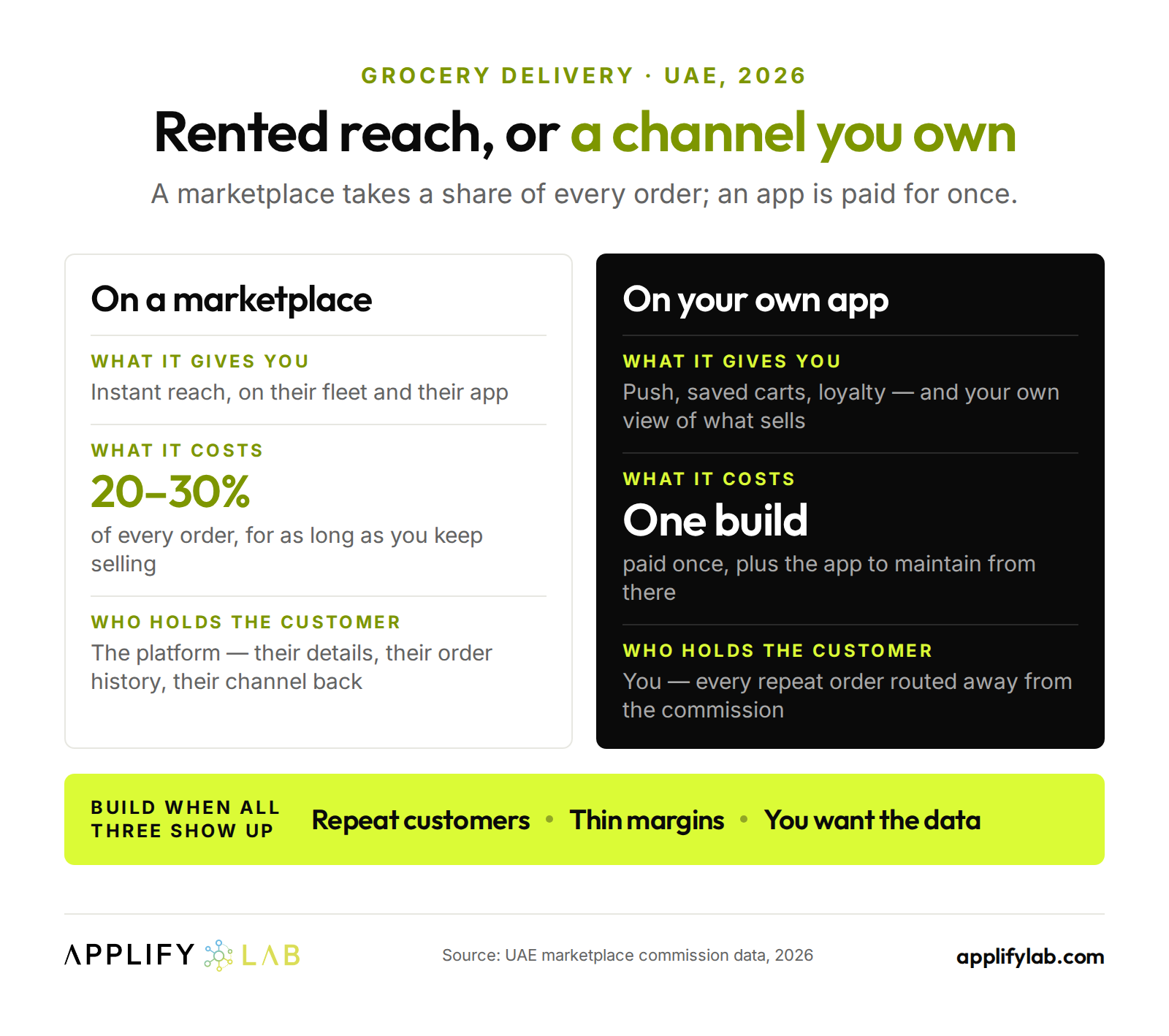
The real first decision: keep paying 20-30% forever, or own the channel — and the three signals that it's time to build.
Build your own app, or stay on marketplaces?
Marketplaces like Talabat and Instashop solve real problems — instant reach, no delivery fleet to manage, no app to maintain. That's a legitimate place to start, especially before you know your order volume.
The trade-off is concrete: Talabat's marketplace commission runs roughly 15-35% per order, averaging 20-30% — a cost that scales with every sale you make, forever, where an app build is a one-time cost.
On top of the commission, the customer relationship belongs to the platform: their contact details, their order history, and a direct channel to bring them back all sit with the marketplace, and reaching them again means paying again for the privilege.
A few signals that it's worth building your own app rather than staying marketplace-only:
You have repeat customers already. If people reorder from you weekly (the norm for groceries, where most retail is occasional), owning that relationship — push notifications, a saved cart, a loyalty program — pays for itself faster than in almost any other retail category.
Your margins are already thin. Grocery runs on volume and low margin per order; a 20-30% commission on top of that is a bigger bite than it would be on a higher-margin category.
You want the data. Your own app means your own view of what sells, when, and to whom — useful for stock decisions and marketing in a way an aggregator's dashboard will keep from you.
If none of those apply yet — you're pre-launch, or still validating that people want to buy groceries from you specifically — staying on a marketplace a while longer is genuinely the right call for now.
The two can also work together: plenty of UAE grocery businesses keep a marketplace listing for one job (discovery — new customers finding you who wouldn't otherwise) and use their own app for a different job (retention — every repeat order routed away from a 20-30% commission, usually nudged along with a receipt insert or a small first-order-on-the-app discount).
The practical guardrail is stock: if both channels pull from the same inventory, you need real-time sync between them to avoid overselling — which is exactly why real-time inventory (below) becomes essential once you're running both.
The marketplace-vs-own-app math runs on numbers only you have
Share your order volume and repeat-purchase rate with us and we'll run the actual math on your numbers.
If you're building custom: which model fits?
Assuming you've decided to build, the UAE market has real, working examples of each of the main models — worth knowing before you default to copying whichever app you personally use:
Single-vendor: you sell your own inventory through your own app — the model behind Carrefour Now, Majid Al Futtaim's UAE delivery service, which picks orders directly from Carrefour's own Hyper/Market/Express stores rather than listing through a marketplace. Simplest to build and operate since there's no vendor-management layer, and it fits when you're the retailer selling your own stock.
Multi-vendor marketplace: you connect multiple grocery stores or vendors on one platform and take a cut of each order — the model Instashop popularized in the UAE (worth noting: Instashop is now a wholly-owned subsidiary of Talabat, which acquired it from Delivery Hero for $32M in February 2025, so it's a Talabat-owned platform now if you're studying it as a model). This is a heavier build — vendor onboarding, per-vendor inventory, commission logic — and it fits when running the marketplace itself is your business. Our dedicated marketplace guide covers the vendor-onboarding and commission mechanics in depth if this is genuinely your model.
Subscription: a recurring membership (free delivery, member pricing, early access to promotions) layered on top of either model above once you have proven repeat demand — best added after launch rather than as a standalone starting point.
Commission-based: functionally the monetization layer under the multi-vendor model above — worth understanding as "how multi-vendor makes money," and it works as a revenue mechanic rather than its own build path.
Most first-time grocery app builders in the UAE should start single-vendor, reserving the marketplace model for when running other people's inventory from day one is the deliberate plan.
The four models at a glance
Model | What you're running | Build weight | Fits when |
|---|---|---|---|
Single-vendor | Your own inventory, your own app (e.g. Carrefour Now) | Lightest — no vendor layer | You're the retailer — the default first build |
Multi-vendor | A marketplace of other stores (e.g. Instashop, now Talabat-owned) | Heaviest — onboarding, per-vendor stock, commission logic | Running the marketplace isthe business |
Subscription | Membership layer on top of either above | Add-on | You have proven repeat demand |
Commission | The revenue mechanic under multi-vendor | Part of multi-vendor | How multi-vendor earns, rather than a separate build |
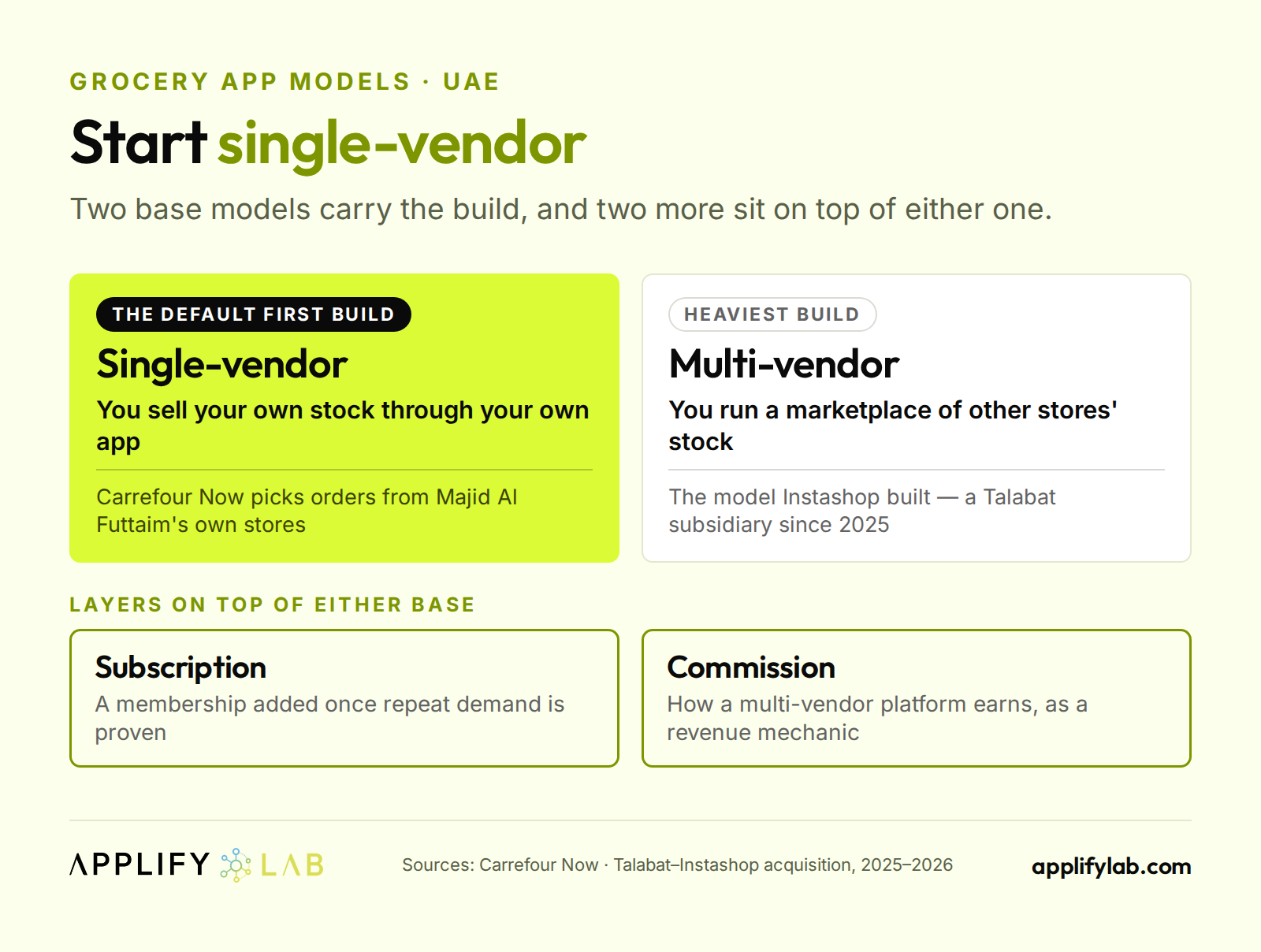
Which model fits — start single-vendor unless running a marketplace of other stores is the actual business.
The UAE-specific features that actually matter
Skip the generic feature list (search, cart, checkout — every app has those) and focus on what's genuinely grocery-specific and UAE-relevant:
Real-time inventory sync. Grocery stock changes hour to hour where fashion or electronics inventory stays put — an app showing items as available that sold out an hour ago is a fast way to lose trust.
Substitution management. When an item's out of stock, letting the customer pre-approve a substitute (or pick from alternatives) at checkout heads off the worse outcome: a driver calling mid-delivery or an order arriving incomplete.
Scheduled and recurring orders. Groceries are a repeat purchase where most retail is occasional — a "reorder last week's basket" or weekly-recurring-order feature fits how people actually shop and is one of the highest-leverage features for the repeat-customer value described above.
Local payments done right. Apple Pay, Google Pay, cards, Tabby and Tamara for buy-now-pay-later, and cash on delivery for lower-trust or first-time orders — full breakdown in our payments integration guide. (One correction worth flagging: some older UAE app guides list "STC Pay" as a supported wallet here — that's a Saudi payment method, not a UAE one, and shouldn't be in your build.)
Arabic and English across the whole flow — homepage, checkout, order tracking, and delivery notifications all included.
Cost: the short version
Grocery apps generally land in the same range as other custom ecommerce builds, with two things pushing them toward the higher end: real-time inventory sync (more backend complexity than a static catalog) and delivery/logistics integration if you're managing your own drivers rather than using a third-party fleet.
For the full, sourced 2026 cost breakdown by build type, see our custom ecommerce app cost guide rather than us repeating the same ranges here.
FAQ
Should I build my own grocery delivery app, or just stay on Talabat/Instashop?
Depends on whether you already have repeat customers and thin-enough margins that a 20-30% marketplace commission meaningfully hurts. If you're still validating demand, marketplaces are the right starting point; many UAE grocery businesses eventually run both — marketplace for reach, own app for the customers worth keeping off the commission.
What's the difference between a single-vendor and multi-vendor grocery app?
Single-vendor means you're selling your own inventory (like Carrefour UAE's own delivery app); multi-vendor means you're running a marketplace connecting other stores' inventory and taking a commission (the model Instashop built, now owned by Talabat). Build single-vendor unless running the marketplace itself is genuinely your business.
What features does a grocery app need that a general ecommerce app doesn't?
Real-time inventory sync, substitution handling for out-of-stock items, and scheduled/recurring orders — grocery is a repeat-purchase category where most retail is occasional, and the features that matter most reflect that.
How much does a grocery delivery app cost to build in Dubai?
It follows the same cost drivers as any custom ecommerce build, landing at the higher end of that range due to inventory-sync complexity and any delivery-logistics integration — see our full cost guide for exact 2026 ranges by build type.
Is cash on delivery still worth supporting for grocery orders?
Yes, alongside the full local digital stack (Apple Pay, Google Pay, Tabby, Tamara) — COD remains relevant for first-time customers and lower-trust orders even as digital payment volume grows.
Ready to build rather than keep weighing it?
Book 30 minutes with us and bring your order volume and repeat-purchase rate — that's really all we need to start scoping.
Related guides
If you already sell groceries in the UAE — a shop, a small delivery run on WhatsApp, or a listing on Talabat or Instashop — the first real decision is bigger than which features to build. It's whether to build your own app at all, or keep relying on marketplaces that take 20-30% of every order and own the customer relationship in your place.
The UAE online grocery market is growing fast (roughly USD 4.1 billion in 2025, projected at a ~19.7% CAGR through 2034), so this is a category where owning your channel compounds over time rather than one to sit out.
Key takeaways
The first decision is channel, not features: build your own app, or keep paying 20-30% per order to a marketplace that owns your customer.
Build your own when three signals show up: you already have repeat customers, your margins are thin, and you want your own data. If you're still validating demand, staying on a marketplace is the right stage.
The two can work together: marketplace for discovery, your own app for retention — as long as inventory syncs in real time so you don't oversell.
Start single-vendor (like Carrefour Now) unless running a marketplace of other stores' stock is genuinely your business (the model Instashop built — now Talabat-owned).
Grocery-specific features carry the app: real-time inventory sync, substitution handling, and scheduled/recurring orders. Cost follows custom-ecommerce ranges, at the higher end.
The real first decision: keep paying 20-30% forever, or own the channel — and the three signals that it's time to build.
Build your own app, or stay on marketplaces?
Marketplaces like Talabat and Instashop solve real problems — instant reach, no delivery fleet to manage, no app to maintain. That's a legitimate place to start, especially before you know your order volume.
The trade-off is concrete: Talabat's marketplace commission runs roughly 15-35% per order, averaging 20-30% — a cost that scales with every sale you make, forever, where an app build is a one-time cost.
On top of the commission, the customer relationship belongs to the platform: their contact details, their order history, and a direct channel to bring them back all sit with the marketplace, and reaching them again means paying again for the privilege.
A few signals that it's worth building your own app rather than staying marketplace-only:
You have repeat customers already. If people reorder from you weekly (the norm for groceries, where most retail is occasional), owning that relationship — push notifications, a saved cart, a loyalty program — pays for itself faster than in almost any other retail category.
Your margins are already thin. Grocery runs on volume and low margin per order; a 20-30% commission on top of that is a bigger bite than it would be on a higher-margin category.
You want the data. Your own app means your own view of what sells, when, and to whom — useful for stock decisions and marketing in a way an aggregator's dashboard will keep from you.
If none of those apply yet — you're pre-launch, or still validating that people want to buy groceries from you specifically — staying on a marketplace a while longer is genuinely the right call for now.
The two can also work together: plenty of UAE grocery businesses keep a marketplace listing for one job (discovery — new customers finding you who wouldn't otherwise) and use their own app for a different job (retention — every repeat order routed away from a 20-30% commission, usually nudged along with a receipt insert or a small first-order-on-the-app discount).
The practical guardrail is stock: if both channels pull from the same inventory, you need real-time sync between them to avoid overselling — which is exactly why real-time inventory (below) becomes essential once you're running both.
The marketplace-vs-own-app math runs on numbers only you have
Share your order volume and repeat-purchase rate with us and we'll run the actual math on your numbers.
If you're building custom: which model fits?
Assuming you've decided to build, the UAE market has real, working examples of each of the main models — worth knowing before you default to copying whichever app you personally use:
Single-vendor: you sell your own inventory through your own app — the model behind Carrefour Now, Majid Al Futtaim's UAE delivery service, which picks orders directly from Carrefour's own Hyper/Market/Express stores rather than listing through a marketplace. Simplest to build and operate since there's no vendor-management layer, and it fits when you're the retailer selling your own stock.
Multi-vendor marketplace: you connect multiple grocery stores or vendors on one platform and take a cut of each order — the model Instashop popularized in the UAE (worth noting: Instashop is now a wholly-owned subsidiary of Talabat, which acquired it from Delivery Hero for $32M in February 2025, so it's a Talabat-owned platform now if you're studying it as a model). This is a heavier build — vendor onboarding, per-vendor inventory, commission logic — and it fits when running the marketplace itself is your business. Our dedicated marketplace guide covers the vendor-onboarding and commission mechanics in depth if this is genuinely your model.
Subscription: a recurring membership (free delivery, member pricing, early access to promotions) layered on top of either model above once you have proven repeat demand — best added after launch rather than as a standalone starting point.
Commission-based: functionally the monetization layer under the multi-vendor model above — worth understanding as "how multi-vendor makes money," and it works as a revenue mechanic rather than its own build path.
Most first-time grocery app builders in the UAE should start single-vendor, reserving the marketplace model for when running other people's inventory from day one is the deliberate plan.
The four models at a glance
Model | What you're running | Build weight | Fits when |
|---|---|---|---|
Single-vendor | Your own inventory, your own app (e.g. Carrefour Now) | Lightest — no vendor layer | You're the retailer — the default first build |
Multi-vendor | A marketplace of other stores (e.g. Instashop, now Talabat-owned) | Heaviest — onboarding, per-vendor stock, commission logic | Running the marketplace isthe business |
Subscription | Membership layer on top of either above | Add-on | You have proven repeat demand |
Commission | The revenue mechanic under multi-vendor | Part of multi-vendor | How multi-vendor earns, rather than a separate build |
Which model fits — start single-vendor unless running a marketplace of other stores is the actual business.
The UAE-specific features that actually matter
Skip the generic feature list (search, cart, checkout — every app has those) and focus on what's genuinely grocery-specific and UAE-relevant:
Real-time inventory sync. Grocery stock changes hour to hour where fashion or electronics inventory stays put — an app showing items as available that sold out an hour ago is a fast way to lose trust.
Substitution management. When an item's out of stock, letting the customer pre-approve a substitute (or pick from alternatives) at checkout heads off the worse outcome: a driver calling mid-delivery or an order arriving incomplete.
Scheduled and recurring orders. Groceries are a repeat purchase where most retail is occasional — a "reorder last week's basket" or weekly-recurring-order feature fits how people actually shop and is one of the highest-leverage features for the repeat-customer value described above.
Local payments done right. Apple Pay, Google Pay, cards, Tabby and Tamara for buy-now-pay-later, and cash on delivery for lower-trust or first-time orders — full breakdown in our payments integration guide. (One correction worth flagging: some older UAE app guides list "STC Pay" as a supported wallet here — that's a Saudi payment method, not a UAE one, and shouldn't be in your build.)
Arabic and English across the whole flow — homepage, checkout, order tracking, and delivery notifications all included.
Cost: the short version
Grocery apps generally land in the same range as other custom ecommerce builds, with two things pushing them toward the higher end: real-time inventory sync (more backend complexity than a static catalog) and delivery/logistics integration if you're managing your own drivers rather than using a third-party fleet.
For the full, sourced 2026 cost breakdown by build type, see our custom ecommerce app cost guide rather than us repeating the same ranges here.
FAQ
Should I build my own grocery delivery app, or just stay on Talabat/Instashop?
Depends on whether you already have repeat customers and thin-enough margins that a 20-30% marketplace commission meaningfully hurts. If you're still validating demand, marketplaces are the right starting point; many UAE grocery businesses eventually run both — marketplace for reach, own app for the customers worth keeping off the commission.
What's the difference between a single-vendor and multi-vendor grocery app?
Single-vendor means you're selling your own inventory (like Carrefour UAE's own delivery app); multi-vendor means you're running a marketplace connecting other stores' inventory and taking a commission (the model Instashop built, now owned by Talabat). Build single-vendor unless running the marketplace itself is genuinely your business.
What features does a grocery app need that a general ecommerce app doesn't?
Real-time inventory sync, substitution handling for out-of-stock items, and scheduled/recurring orders — grocery is a repeat-purchase category where most retail is occasional, and the features that matter most reflect that.
How much does a grocery delivery app cost to build in Dubai?
It follows the same cost drivers as any custom ecommerce build, landing at the higher end of that range due to inventory-sync complexity and any delivery-logistics integration — see our full cost guide for exact 2026 ranges by build type.
Is cash on delivery still worth supporting for grocery orders?
Yes, alongside the full local digital stack (Apple Pay, Google Pay, Tabby, Tamara) — COD remains relevant for first-time customers and lower-trust orders even as digital payment volume grows.
Ready to build rather than keep weighing it?
Book 30 minutes with us and bring your order volume and repeat-purchase rate — that's really all we need to start scoping.