Retail & E-commerce
Mobile Payment Integration for Ecommerce Apps in the UAE (2026)

By
Anh Nguyen, Founder
·
8 min

You don't need to become a payments expert to get this right — you need enough to be part of the decision and recognize a good answer when you hear one.
UAE shoppers expect to check out with a card, Apple Pay or Google Pay, and increasingly a buy-now-pay-later option, all in one tap and in AED by default. The gateway your developer integrates to make that happen should follow your transaction volume and your customers — the deciding factors are your business, not whichever gateway your developer already knows best.
The wrong call here shows up later as overpaid fees, weak local support, or a checkout that quietly loses you sales. This is what to know so you can tell the difference, and ask the right questions before you sign off on anything.
Key takeaways
The gateway follows your volume, not the brand name. Telr for most UAE-focused stores under ~AED 200k/month, PayTabs if Saudi is a real share, Network International past ~AED 500k/month, HyperPay for broad MENA coverage in one integration.
Support fewer, better methods. Cards + Apple Pay + Google Pay is the baseline; add BNPL (Tabby, Tamara) when your average order value is high enough to benefit.
Match the integration to the stage. Start with hosted checkout + wallets to launch fast and keep PCI scope low; move to direct API and native SDKs once conversion data justifies the extra build and compliance work.
Two security must-haves: tokenization (your app never stores raw card numbers) and 3-D Secure 2 (shifts fraud liability away from you). Confirm both out loud.
Budget past the headline rate: setup fees, monthly platform fees, cross-border fees, and chargeback fees all add up — ask for a fee schedule modeled on your real basket size.
Planning a shopping, marketplace or loyalty app? See how we build e-commerce and retail apps for UAE brands.

Which gateway fits your stage — matched to volume and market, not brand recognition.
What UAE shoppers actually expect to pay with
Cards (Visa, Mastercard, Amex) are still the base layer, and they now work best alongside a wallet and a BNPL option.
Since December 2024, Apple's Tap to Pay on iPhone has been live in the UAE (Apple Newsroom, Dec 2024) — letting merchants accept contactless payments directly on an iPhone with no extra hardware, first rolled out through Adyen, Magnati, and Network International.
Google Pay has been standard for Android users for years.
On top of that, BNPL (buy-now-pay-later) providers like Tabby and Tamara now cover a meaningful share of UAE ecommerce transactions and tend to lift average order values on higher-consideration purchases.
The UAE government is targeting a 90% cashless economy by the end of 2026 (widely cited across 2026 UAE payments coverage), which is the direction every piece of this is moving — supporting fewer, better payment options that cover the vast majority of your customers beats trying to support every option that exists.
Which gateway actually fits your stage
This is the question the generic advice usually dodges — and it's the one worth asking your development partner directly, so you get "we use X because…" with a reason attached.
Realistically, the right answer comes down to your monthly transaction volume and where your customers are, and brand recognition matters far less:
Under roughly AED 200,000/month, mostly UAE customers: Telr is a strong starting point — local support, pre-integrated BNPL options, and predictable pricing (indicatively around AED 99/month plus 2.49% + AED 0.50 per transaction on its Pro plan).
Saudi Arabia is a meaningful share of your revenue too: PayTabs covers Mada and KNET alongside UAE methods through one regional acquirer, which simplifies reconciliation if you're selling across both markets (indicatively around 2.90% + AED 1 per local transaction, 3.9% for international).
AED 500,000+/month: Network International becomes worth evaluating — better suited to negotiated enterprise rates than the SME-focused gateways above.
Broad MENA reach, many local methods in one integration: HyperPay supports 80+ payment methods across the region, useful once you're selling beyond the UAE.
These figures are indicative — gathered from current UAE payment-gateway comparison sources (affmaven.com, scaleupally.io, 2026) rather than quoted directly from each provider — so always request a live quote before committing, since fee structures shift.
Gateway comparison at a glance
Gateway | Best fit | Indicative 2026 pricing | Standout strength |
|---|---|---|---|
Telr | UAE-focused, under ~AED 200k/month | ~AED 99/mo + 2.49% + AED 0.50/txn (Pro) | Local support, pre-integrated BNPL, predictable fees |
PayTabs | Selling across UAE + Saudi | ~2.90% + AED 1 local, 3.9% international | Mada/KNET + UAE methods through one regional acquirer |
Network International | AED 500k+/month | Negotiated enterprise rates | Enterprise-grade, first-wave Tap to Pay support |
HyperPay | Broad MENA, many local methods | Quote-based | 80+ payment methods across MENA in one integration |
Pricing is indicative (2026 comparison sources) — request a live quote against your real volume before committing.
Every gateway rep will tell you their pricing fits your volume
Send us your actual monthly transaction number and we'll tell you, plainly, which tier you're really in — no sales pitch attached.
Hosted checkout, direct API, or native SDK — a call your developer makes with you
This is a technical-sounding decision with a very non-technical consequence: how fast you launch, and how much of your budget goes to compliance work instead of features. You can leave the implementation detail to your developer — and it helps to recognize enough here to know which one you're being sold, and why:
Hosted checkout (redirect to the gateway's page): the fastest to launch, and it keeps most of the compliance burden (PCI scope) on the gateway's side rather than yours. The trade-off is less control over the checkout look and feel. Right for an MVP or a marketplace that wants to be live quickly; a brand where checkout UX is the differentiator will outgrow it.
Direct API integration: full control over the checkout flow, saved cards, and subscriptions — in exchange for more compliance responsibility on your own build (a higher PCI tier), which means more engineering and security work upfront. Worth it once conversion optimization on your own checkout genuinely matters to the business.
Native SDKs (iOS/Android): the right choice specifically when a one-tap, in-app Apple Pay/Google Pay experience is the point — best native performance, at the cost of keeping the SDKs updated as the gateway ships new versions.
The practical pattern for most first builds: start with hosted checkout plus wallet support to get to market fast, then move to direct API and native SDKs once you have real transaction volume and a specific reason (usually conversion data) to invest in a more custom flow.
If a partner proposes jumping straight to the most complex option for a first build, that's worth a direct question about why.
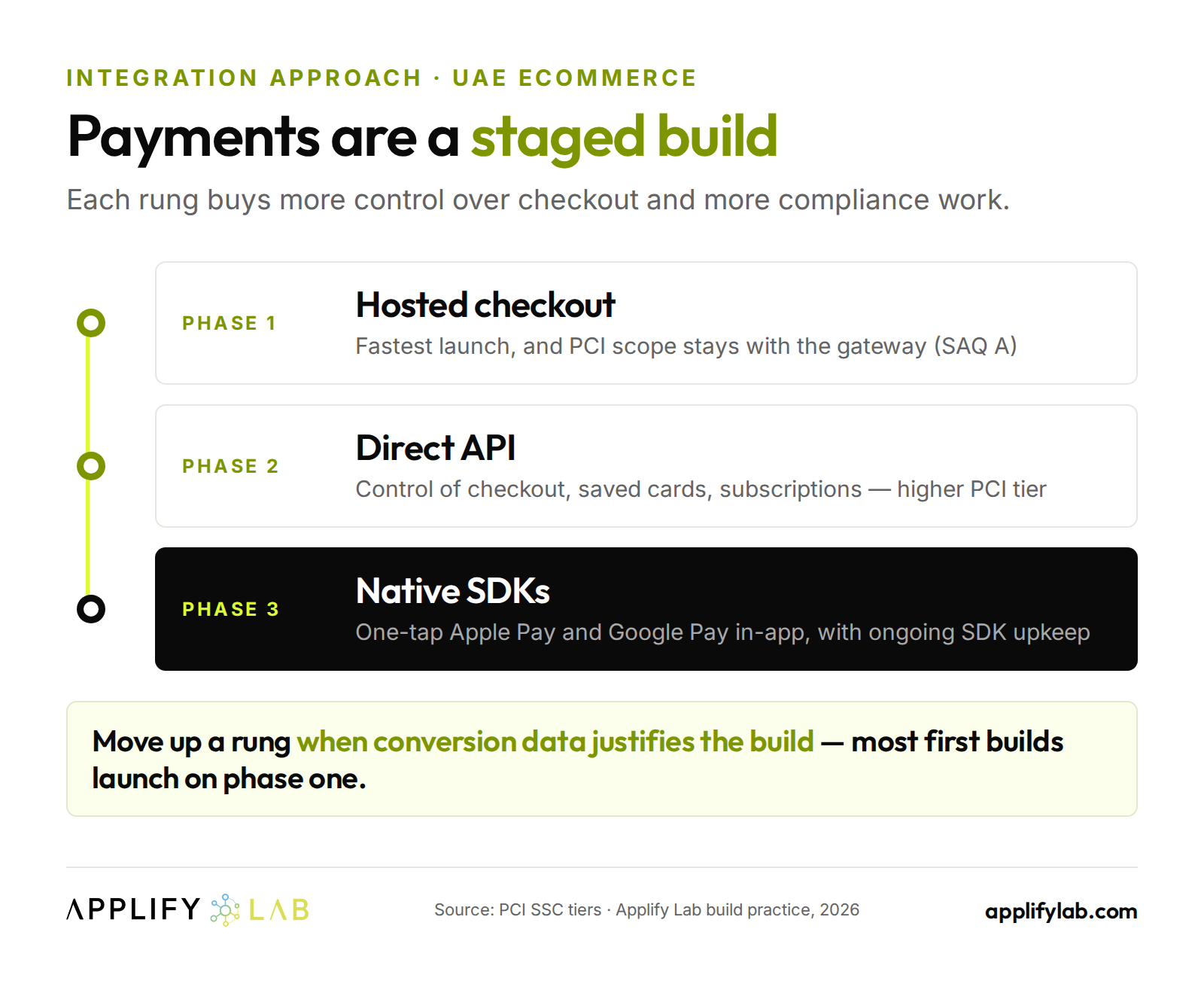
Match the integration approach to your stage — start simple, add control when conversion data earns it
Security in plain terms — what your partner should already have covered
Two things matter more than the rest combined, and both are worth confirming out loud with whoever builds this rather than assuming they're handled.
First, tokenization: your app should never touch or store a customer's actual card number — the gateway issues a token that stands in for it, so even if something goes wrong on your end, there's no raw card data to lose.
Second, 3-D Secure (3DS2): this is the extra authentication step (often biometric on mobile) that shifts fraud liability away from you and is now expected for card payments, not optional.
Beyond that, whichever gateway you choose should offer built-in fraud monitoring (device fingerprinting, velocity checks, chargeback alerts) — ask directly what's included versus what you'd need to add separately. None of this requires you to become a security expert; it requires knowing what to ask so a vague answer stands out.
What this actually costs
Beyond the gateway's own percentage-plus-fixed-fee structure (see the tier breakdown above), budget for: a possible setup fee, monthly platform fees on some gateways, cross-border fees if a meaningful share of your customers pay with non-UAE-issued cards, and chargeback fees.
Local UAE gateways generally offer better AED settlement terms and lower cross-border costs than global processors for a UAE-majority customer base — ask for a sample fee schedule modeled against your actual expected basket size and refund rate, rather than a generic rate card.
Common mistakes that cost real conversions
Burying Apple Pay/Google Pay when they're available — one-tap wallets should be the default option shown, sitting above the card form rather than below it.
No fallback plan. If a wallet payment fails or isn't available, the next step should be a saved card or hosted checkout, so the customer always has a way forward.
Asking for more than necessary at checkout. Every extra field is a chance for someone to abandon the cart; autofill what you can.
Skipping reconciliation testing. Refunds, partial refunds, and settlement edge cases are where real disputes happen — test them before launch, not after the first customer complaint.
FAQ
Do I need to understand all of this myself, or is this my developer's job?
It's genuinely your developer's job to implement — and it's worth knowing enough to recognize whether the choice they're making actually fits your business, or is just the gateway they default to on every project. You don't need to become a payments expert; you need enough to ask "why this one, for my volume and my customers" and get a real answer.
Which payment gateway is best for a UAE ecommerce app?
It depends on your monthly volume and customer base more than any single "best" answer: Telr for most UAE-focused stores under ~AED 200k/month, PayTabs if Saudi Arabia is a meaningful part of your business, Network International once you're past ~AED 500k/month, and HyperPay for broad MENA coverage in one integration.
Do I need Apple Pay and Google Pay, or are cards enough?
Cards alone leave conversion on the table. Apple's Tap to Pay has been live in the UAE since December 2024, and one-tap wallet checkout is now a baseline expectation — support both if your customer base skews toward either iOS or Android usage, which in the UAE typically means both.
Do I need full PCI compliance if I use a hosted checkout?
Hosted checkout typically keeps you in the lowest PCI tier (SAQ A) since card data never touches your servers. Moving to a direct API integration with saved cards pushes you into a higher compliance tier — factor that into which integration approach you choose, alongside the UX trade-off.
Is BNPL (buy-now-pay-later) worth integrating?
If your average order value is on the higher side, yes — BNPL providers active in the UAE tend to lift both average order value and conversion on higher-consideration purchases. For low-ticket items it matters less.
How long does payment integration take?
A hosted-checkout-plus-wallets MVP is typically a matter of weeks, not months. Moving to direct API with tokenized saved cards and native SDK integrations is a longer, second-phase investment — worth sequencing that way rather than trying to build the full version on day one.
To go further
You don't need to become a payments expert to get this right — you need enough to be part of the decision and recognize a good answer when you hear one.
UAE shoppers expect to check out with a card, Apple Pay or Google Pay, and increasingly a buy-now-pay-later option, all in one tap and in AED by default. The gateway your developer integrates to make that happen should follow your transaction volume and your customers — the deciding factors are your business, not whichever gateway your developer already knows best.
The wrong call here shows up later as overpaid fees, weak local support, or a checkout that quietly loses you sales. This is what to know so you can tell the difference, and ask the right questions before you sign off on anything.
Key takeaways
The gateway follows your volume, not the brand name. Telr for most UAE-focused stores under ~AED 200k/month, PayTabs if Saudi is a real share, Network International past ~AED 500k/month, HyperPay for broad MENA coverage in one integration.
Support fewer, better methods. Cards + Apple Pay + Google Pay is the baseline; add BNPL (Tabby, Tamara) when your average order value is high enough to benefit.
Match the integration to the stage. Start with hosted checkout + wallets to launch fast and keep PCI scope low; move to direct API and native SDKs once conversion data justifies the extra build and compliance work.
Two security must-haves: tokenization (your app never stores raw card numbers) and 3-D Secure 2 (shifts fraud liability away from you). Confirm both out loud.
Budget past the headline rate: setup fees, monthly platform fees, cross-border fees, and chargeback fees all add up — ask for a fee schedule modeled on your real basket size.
Planning a shopping, marketplace or loyalty app? See how we build e-commerce and retail apps for UAE brands.
Which gateway fits your stage — matched to volume and market, not brand recognition.
What UAE shoppers actually expect to pay with
Cards (Visa, Mastercard, Amex) are still the base layer, and they now work best alongside a wallet and a BNPL option.
Since December 2024, Apple's Tap to Pay on iPhone has been live in the UAE (Apple Newsroom, Dec 2024) — letting merchants accept contactless payments directly on an iPhone with no extra hardware, first rolled out through Adyen, Magnati, and Network International.
Google Pay has been standard for Android users for years.
On top of that, BNPL (buy-now-pay-later) providers like Tabby and Tamara now cover a meaningful share of UAE ecommerce transactions and tend to lift average order values on higher-consideration purchases.
The UAE government is targeting a 90% cashless economy by the end of 2026 (widely cited across 2026 UAE payments coverage), which is the direction every piece of this is moving — supporting fewer, better payment options that cover the vast majority of your customers beats trying to support every option that exists.
Which gateway actually fits your stage
This is the question the generic advice usually dodges — and it's the one worth asking your development partner directly, so you get "we use X because…" with a reason attached.
Realistically, the right answer comes down to your monthly transaction volume and where your customers are, and brand recognition matters far less:
Under roughly AED 200,000/month, mostly UAE customers: Telr is a strong starting point — local support, pre-integrated BNPL options, and predictable pricing (indicatively around AED 99/month plus 2.49% + AED 0.50 per transaction on its Pro plan).
Saudi Arabia is a meaningful share of your revenue too: PayTabs covers Mada and KNET alongside UAE methods through one regional acquirer, which simplifies reconciliation if you're selling across both markets (indicatively around 2.90% + AED 1 per local transaction, 3.9% for international).
AED 500,000+/month: Network International becomes worth evaluating — better suited to negotiated enterprise rates than the SME-focused gateways above.
Broad MENA reach, many local methods in one integration: HyperPay supports 80+ payment methods across the region, useful once you're selling beyond the UAE.
These figures are indicative — gathered from current UAE payment-gateway comparison sources (affmaven.com, scaleupally.io, 2026) rather than quoted directly from each provider — so always request a live quote before committing, since fee structures shift.
Gateway comparison at a glance
Gateway | Best fit | Indicative 2026 pricing | Standout strength |
|---|---|---|---|
Telr | UAE-focused, under ~AED 200k/month | ~AED 99/mo + 2.49% + AED 0.50/txn (Pro) | Local support, pre-integrated BNPL, predictable fees |
PayTabs | Selling across UAE + Saudi | ~2.90% + AED 1 local, 3.9% international | Mada/KNET + UAE methods through one regional acquirer |
Network International | AED 500k+/month | Negotiated enterprise rates | Enterprise-grade, first-wave Tap to Pay support |
HyperPay | Broad MENA, many local methods | Quote-based | 80+ payment methods across MENA in one integration |
Pricing is indicative (2026 comparison sources) — request a live quote against your real volume before committing.
Every gateway rep will tell you their pricing fits your volume
Send us your actual monthly transaction number and we'll tell you, plainly, which tier you're really in — no sales pitch attached.
Hosted checkout, direct API, or native SDK — a call your developer makes with you
This is a technical-sounding decision with a very non-technical consequence: how fast you launch, and how much of your budget goes to compliance work instead of features. You can leave the implementation detail to your developer — and it helps to recognize enough here to know which one you're being sold, and why:
Hosted checkout (redirect to the gateway's page): the fastest to launch, and it keeps most of the compliance burden (PCI scope) on the gateway's side rather than yours. The trade-off is less control over the checkout look and feel. Right for an MVP or a marketplace that wants to be live quickly; a brand where checkout UX is the differentiator will outgrow it.
Direct API integration: full control over the checkout flow, saved cards, and subscriptions — in exchange for more compliance responsibility on your own build (a higher PCI tier), which means more engineering and security work upfront. Worth it once conversion optimization on your own checkout genuinely matters to the business.
Native SDKs (iOS/Android): the right choice specifically when a one-tap, in-app Apple Pay/Google Pay experience is the point — best native performance, at the cost of keeping the SDKs updated as the gateway ships new versions.
The practical pattern for most first builds: start with hosted checkout plus wallet support to get to market fast, then move to direct API and native SDKs once you have real transaction volume and a specific reason (usually conversion data) to invest in a more custom flow.
If a partner proposes jumping straight to the most complex option for a first build, that's worth a direct question about why.
Match the integration approach to your stage — start simple, add control when conversion data earns it
Security in plain terms — what your partner should already have covered
Two things matter more than the rest combined, and both are worth confirming out loud with whoever builds this rather than assuming they're handled.
First, tokenization: your app should never touch or store a customer's actual card number — the gateway issues a token that stands in for it, so even if something goes wrong on your end, there's no raw card data to lose.
Second, 3-D Secure (3DS2): this is the extra authentication step (often biometric on mobile) that shifts fraud liability away from you and is now expected for card payments, not optional.
Beyond that, whichever gateway you choose should offer built-in fraud monitoring (device fingerprinting, velocity checks, chargeback alerts) — ask directly what's included versus what you'd need to add separately. None of this requires you to become a security expert; it requires knowing what to ask so a vague answer stands out.
What this actually costs
Beyond the gateway's own percentage-plus-fixed-fee structure (see the tier breakdown above), budget for: a possible setup fee, monthly platform fees on some gateways, cross-border fees if a meaningful share of your customers pay with non-UAE-issued cards, and chargeback fees.
Local UAE gateways generally offer better AED settlement terms and lower cross-border costs than global processors for a UAE-majority customer base — ask for a sample fee schedule modeled against your actual expected basket size and refund rate, rather than a generic rate card.
Common mistakes that cost real conversions
Burying Apple Pay/Google Pay when they're available — one-tap wallets should be the default option shown, sitting above the card form rather than below it.
No fallback plan. If a wallet payment fails or isn't available, the next step should be a saved card or hosted checkout, so the customer always has a way forward.
Asking for more than necessary at checkout. Every extra field is a chance for someone to abandon the cart; autofill what you can.
Skipping reconciliation testing. Refunds, partial refunds, and settlement edge cases are where real disputes happen — test them before launch, not after the first customer complaint.
FAQ
Do I need to understand all of this myself, or is this my developer's job?
It's genuinely your developer's job to implement — and it's worth knowing enough to recognize whether the choice they're making actually fits your business, or is just the gateway they default to on every project. You don't need to become a payments expert; you need enough to ask "why this one, for my volume and my customers" and get a real answer.
Which payment gateway is best for a UAE ecommerce app?
It depends on your monthly volume and customer base more than any single "best" answer: Telr for most UAE-focused stores under ~AED 200k/month, PayTabs if Saudi Arabia is a meaningful part of your business, Network International once you're past ~AED 500k/month, and HyperPay for broad MENA coverage in one integration.
Do I need Apple Pay and Google Pay, or are cards enough?
Cards alone leave conversion on the table. Apple's Tap to Pay has been live in the UAE since December 2024, and one-tap wallet checkout is now a baseline expectation — support both if your customer base skews toward either iOS or Android usage, which in the UAE typically means both.
Do I need full PCI compliance if I use a hosted checkout?
Hosted checkout typically keeps you in the lowest PCI tier (SAQ A) since card data never touches your servers. Moving to a direct API integration with saved cards pushes you into a higher compliance tier — factor that into which integration approach you choose, alongside the UX trade-off.
Is BNPL (buy-now-pay-later) worth integrating?
If your average order value is on the higher side, yes — BNPL providers active in the UAE tend to lift both average order value and conversion on higher-consideration purchases. For low-ticket items it matters less.
How long does payment integration take?
A hosted-checkout-plus-wallets MVP is typically a matter of weeks, not months. Moving to direct API with tokenized saved cards and native SDK integrations is a longer, second-phase investment — worth sequencing that way rather than trying to build the full version on day one.
To go further
Already picked a gateway and just need it built right?
That's a scoping conversation, not another comparison article. Book 30 minutes with us — bring your volume, your customer mix, and we'll map out the integration approach before you commit to anything.

