Retail & E-commerce
AI Automation for Restaurants in Dubai: Workflows, Real Costs & Where to Start

By
Anh Nguyen, Founder
·
7 min

87% of UAE restaurant owners already use AI in some form — this isn't a future-facing pitch, it's already how a majority of the market operates.
The real question isn't whether to adopt AI automation, it's which of the real workflows earns its cost first for your specific operation, and what a realistic rollout actually costs.
Key takeaways
87% of UAE restaurant owners already use AI — the question is which workflow first, not whether.
The seven workflows map to real P&L lines: labor ~30-35% of revenue, food ~28-35% (prime cost 55-65% combined).
Don't do all seven at once. Start with the one that hits your biggest cost pressure, prove it, then extend.
Only the customer-engagement workflow is a natural fit for an AI agent — and it needs an existing customer base to message.
Real costs: ~AED 55-130k for a single workflow up to AED 400-900k+ for a full multi-branch platform — and you own 100% of the code.
Want this handled automatically? See how our AI agents for UAE businesses work.
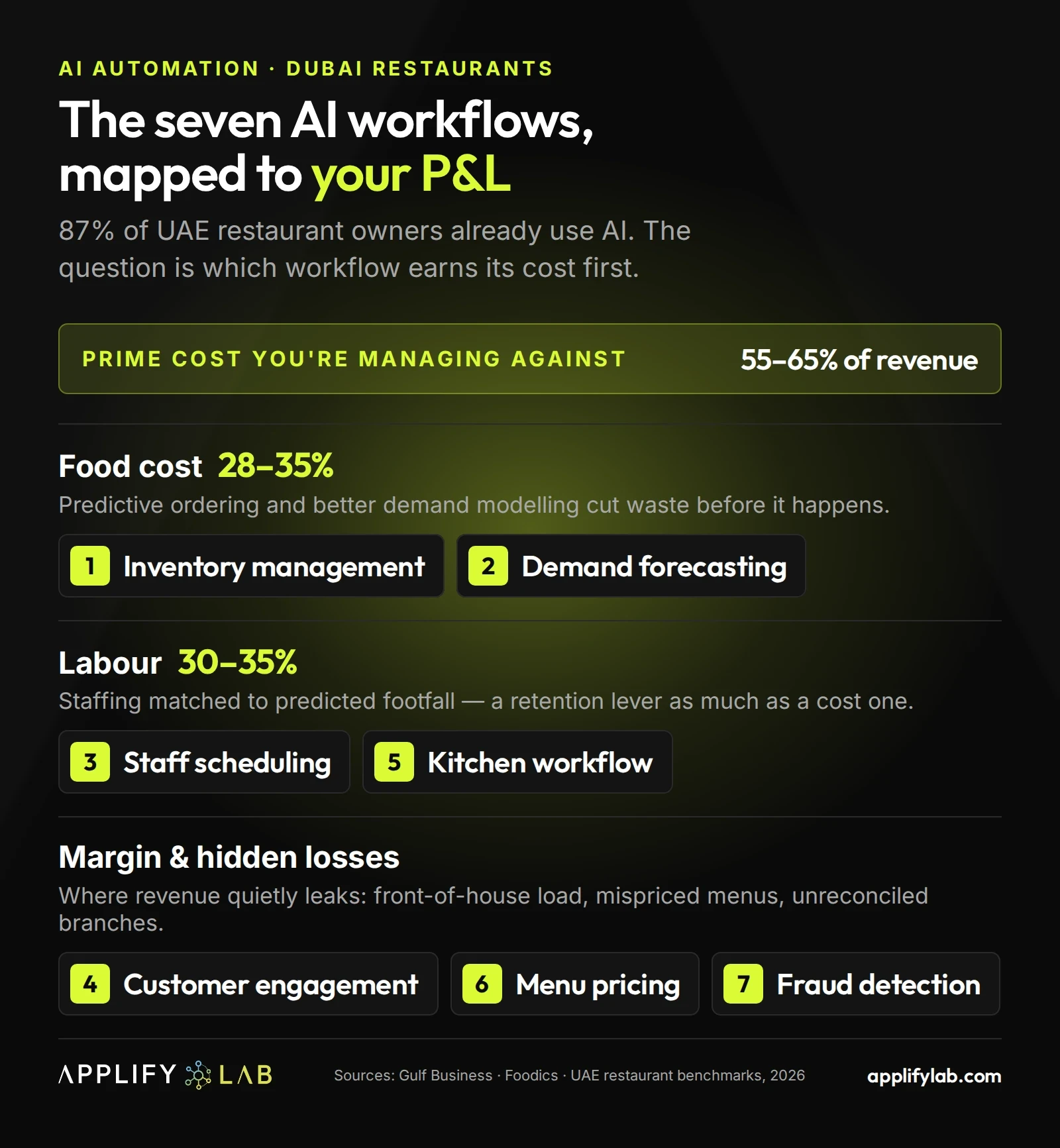
Each workflow targets a specific line on your P&L — that's how you decide which one earns its cost first.
# | Workflow | What it does | Cost line it targets |
|---|---|---|---|
1 | Inventory management | Predictive ordering, low-stock alerts, waste/expiry tracking | Food cost & waste |
2 | Demand forecasting | Sales + seasonality + local events drive procurement | Food cost, prep planning |
3 | Staff scheduling | Match staffing to predicted footfall | Labor (30-35%) + retention |
4 | Customer engagement (AI agent) | Bilingual WhatsApp handles ~80% of routine queries 24/7 | Front-of-house load, conversion |
5 | Kitchen workflow | Ticket routing, prep-time optimization, fewer errors | Table turnover, accuracy |
6 | Menu engineering & pricing | Data decides what to promote, reprice, or cut | Margin |
7 | Fraud detection & financial | Void/billing anomaly detection, cross-system reconciliation | Hidden losses, admin time |
The real cost pressure this solves
Labor typically runs 30-35% of revenue for a well-managed Dubai restaurant, food costs another 28-35%, and prime cost (both combined) of 55-65% is the actual number every operator is managing against.
Layer on kitchen staff turnover running around 22% across the sector, and the case for automation isn't abstract efficiency — it's specific line items on your P&L.
The seven workflows below map directly onto those numbers.
Workflow 1: AI-driven inventory management
Predictive ordering based on real sales trends (not fixed par levels), automated low-stock alerts, and shelf-life/expiration tracking to cut waste before it happens.
Foodics — the MENA region's leading restaurant operations platform — reports AI-powered forecasting and inventory tools driving up to a 10% sales boost and 20% profit-margin improvement for restaurants already using this kind of system, which is a real, checkable benchmark for what this workflow can realistically deliver.
Workflow 2: Automated demand forecasting
Sales data, seasonal patterns, and local events drive procurement and menu planning decisions. This matters more in tourist-heavy areas like Downtown Dubai or JBR, where demand spikes around events and holidays are real and predictable if you're modeling for them — most restaurants still aren't.
Workflow 3: Smart staff scheduling
AI-optimized scheduling against predicted footfall directly targets the 30-35% labor-cost line, reducing overtime and matching staffing to actual demand rather than fixed shift patterns.
With kitchen staff turnover already around 22% sector-wide, better scheduling is also a retention lever, not just a cost one — overworked or under-scheduled staff are part of why turnover is that high.
Workflow 4: AI-powered customer engagement
This is the one workflow where an AI agent is the natural fit — and where Applify Lab's AI customer-engagement capability applies, since it requires an existing customer base to message.
UAE businesses are already using bilingual (Arabic/English) AI agents across WhatsApp to handle up to 80% of routine queries — reservations, delivery status updates, and simple FAQs — 24/7, without a call center.
The same approach can also run personalized promotions to repeat customers and scan reviews across platforms for real sentiment trends.
Pricing for an AI-agent layer depends on your query volume and channels — scoped on a call rather than a fixed number here, since a generic package would mean either overselling capability you don't need or underscoping what actually handles your query volume.
Not sure which workflow would actually move your numbers first?
Tell us your branch count, current biggest cost pain point, and what systems you already run, and we'll tell you honestly which workflow earns its cost fastest for your operation.
Workflow 5: Automated kitchen workflow management
AI-driven ticket routing to the right station, prep-time optimization, and error reduction on complex or multi-item orders — this is where table turnover and order accuracy actually improve, not just back-office reporting.
Workflow 6: AI menu engineering and pricing
Real sales, cost, and margin data identifies which items to promote, reprice, or cut, and supports demand-based pricing adjustments during peak hours or events.
This is a genuinely data-driven version of what most restaurants still do by gut feel.
Workflow 7: AI fraud detection and financial automation
Automated detection of billing errors, void manipulation, and unusual transaction patterns, plus reconciliation across POS, supplier invoices, and accounting systems — this matters most for multi-branch operations in high-volume areas like DIFC or Dubai Mall, where manual reconciliation across locations is where real losses hide.
Which workflow should you actually start with?

Your biggest cost pressure points straight at the first workflow worth building.
Match your biggest cost pressure to the workflow to start with:
Labour cost (30-35% of revenue, plus ~22% kitchen-staff turnover) → start with Workflow 3, staff scheduling.
Waste and multi-branch margin (food cost 28-35%, losses spread across locations) → start with Workflows 1 and 2, inventory and demand forecasting.
Front-of-house query volume straining your team, with an existing customer base to message → start with Workflow 4, the AI customer-engagement agent.
Prove one workflow, then extend from evidence.
Do not start with all workflows at once — that's the mistake a "revolutionize your entire operation" pitch leads to.
We diagnose your specific cost pressure first:
if labor is your biggest line item, scheduling earns its cost fastest;
if you're a multi-branch operation losing margin to waste, inventory and forecasting come first;
if customer volume is straining your front-of-house team, the AI-agent layer on workflow 4 is often the fastest win since it doesn't require touching your kitchen or back-office systems at all.
Start with whichever workflow addresses your actual biggest cost pressure, prove it, then extend — not a single all-at-once rollout across all seven.
Callout: The most common way this goes wrong is trying to do all seven at once. Pick the one workflow that touches your biggest cost line, prove it earns back its cost, then extend from a position of evidence — not a big-bang rollout you can't measure.
Compliance and data handling
Customer data (loyalty history, contact details, order patterns) and staff data (schedules, payroll-linked hours) both fall under the UAE's PDPL — encryption, access controls, and clear data-handling policies are baseline regardless of which workflow you start with.
If workflow 7's financial automation touches payment reconciliation directly, standard PCI-DSS practices around cardholder data apply on top of PDPL — worth confirming explicitly with any partner rather than assuming it's covered by general data-protection language.
What it costs
Real 2026 UAE benchmarks: general custom software development here runs AED 40,000-300,000, restaurant-specific apps run AED 20,000-150,000+, and AI/ML capability typically adds 10-20% to a project's cost, with PDPL-compliant architecture adding another 15-20%. Scoped to restaurant AI automation specifically:
Single-workflow pilot (e.g., AI inventory forecasting integrated into your existing POS, or the AI customer-engagement agent alone): roughly AED 55,000–130,000.
Multi-workflow rollout (inventory, forecasting, and staff scheduling together for one or a few branches): roughly AED 150,000–350,000.
Full multi-branch AI operations platform (all seven workflows, centralized dashboards, POS/ERP/CRM integration across locations): AED 400,000–900,000+.
The width of that range is the same diagnose-first principle as everywhere else in how we scope projects: a single fixed number here would mean either overselling workflows you don't need yet or underscoping the multi-branch integration work a larger operation actually requires.
Book a quick conversation with us to explain your project and get a real feedback on the price and scope you should start with.
Questions worth asking any partner
Have they integrated with the POS systems you actually use (not just a generic API claim)?
How do they decide which workflow to build first for a given operation?
How do they handle a phased rollout instead of pricing everything as one big-bang build?
Always confirm with them that you own 100% of the code once it's built, with no proprietary lock-in.
FAQ
Is AI automation actually common in UAE restaurants, or is this still early?
Common — 87% of UAE restaurant owners already use AI in some form. The real question isn't whether to adopt it, it's which workflow to prioritize for your specific operation.
How much does AI automation cost for a restaurant in the UAE?
Roughly AED 55,000–130,000 for a single-workflow pilot, up to AED 400,000–900,000+ for a full multi-branch platform covering all seven workflows. AI/ML capability typically adds 10-20% on top of standard custom software costs, with PDPL-compliant architecture adding another 15-20%.
Which AI workflow should a restaurant start with?
Whichever addresses your biggest actual cost pressure — labor scheduling if staffing is your largest line item, inventory/forecasting if waste is the bigger issue for a multi-branch operation, or the AI customer-engagement layer if front-of-house query volume is straining your team. Not all seven at once.
Can an AI agent really handle customer queries in Arabic and English?
Yes — this is already a real, operating pattern for UAE businesses, with bilingual AI agents handling up to 80% of routine queries across WhatsApp 24/7. It requires an existing customer base to message, so it's not relevant if you're still pre-launch.
Do I need all seven workflows to see real results?
No. Most restaurants see measurable results from one or two well-scoped workflows before it makes sense to extend further — a phased rollout starting with your biggest cost pressure is the realistic path, not an all-at-once implementation.
To go further
87% of UAE restaurant owners already use AI in some form — this isn't a future-facing pitch, it's already how a majority of the market operates.
The real question isn't whether to adopt AI automation, it's which of the real workflows earns its cost first for your specific operation, and what a realistic rollout actually costs.
Key takeaways
87% of UAE restaurant owners already use AI — the question is which workflow first, not whether.
The seven workflows map to real P&L lines: labor ~30-35% of revenue, food ~28-35% (prime cost 55-65% combined).
Don't do all seven at once. Start with the one that hits your biggest cost pressure, prove it, then extend.
Only the customer-engagement workflow is a natural fit for an AI agent — and it needs an existing customer base to message.
Real costs: ~AED 55-130k for a single workflow up to AED 400-900k+ for a full multi-branch platform — and you own 100% of the code.
Want this handled automatically? See how our AI agents for UAE businesses work.
Each workflow targets a specific line on your P&L — that's how you decide which one earns its cost first.
# | Workflow | What it does | Cost line it targets |
|---|---|---|---|
1 | Inventory management | Predictive ordering, low-stock alerts, waste/expiry tracking | Food cost & waste |
2 | Demand forecasting | Sales + seasonality + local events drive procurement | Food cost, prep planning |
3 | Staff scheduling | Match staffing to predicted footfall | Labor (30-35%) + retention |
4 | Customer engagement (AI agent) | Bilingual WhatsApp handles ~80% of routine queries 24/7 | Front-of-house load, conversion |
5 | Kitchen workflow | Ticket routing, prep-time optimization, fewer errors | Table turnover, accuracy |
6 | Menu engineering & pricing | Data decides what to promote, reprice, or cut | Margin |
7 | Fraud detection & financial | Void/billing anomaly detection, cross-system reconciliation | Hidden losses, admin time |
The real cost pressure this solves
Labor typically runs 30-35% of revenue for a well-managed Dubai restaurant, food costs another 28-35%, and prime cost (both combined) of 55-65% is the actual number every operator is managing against.
Layer on kitchen staff turnover running around 22% across the sector, and the case for automation isn't abstract efficiency — it's specific line items on your P&L.
The seven workflows below map directly onto those numbers.
Workflow 1: AI-driven inventory management
Predictive ordering based on real sales trends (not fixed par levels), automated low-stock alerts, and shelf-life/expiration tracking to cut waste before it happens.
Foodics — the MENA region's leading restaurant operations platform — reports AI-powered forecasting and inventory tools driving up to a 10% sales boost and 20% profit-margin improvement for restaurants already using this kind of system, which is a real, checkable benchmark for what this workflow can realistically deliver.
Workflow 2: Automated demand forecasting
Sales data, seasonal patterns, and local events drive procurement and menu planning decisions. This matters more in tourist-heavy areas like Downtown Dubai or JBR, where demand spikes around events and holidays are real and predictable if you're modeling for them — most restaurants still aren't.
Workflow 3: Smart staff scheduling
AI-optimized scheduling against predicted footfall directly targets the 30-35% labor-cost line, reducing overtime and matching staffing to actual demand rather than fixed shift patterns.
With kitchen staff turnover already around 22% sector-wide, better scheduling is also a retention lever, not just a cost one — overworked or under-scheduled staff are part of why turnover is that high.
Workflow 4: AI-powered customer engagement
This is the one workflow where an AI agent is the natural fit — and where Applify Lab's AI customer-engagement capability applies, since it requires an existing customer base to message.
UAE businesses are already using bilingual (Arabic/English) AI agents across WhatsApp to handle up to 80% of routine queries — reservations, delivery status updates, and simple FAQs — 24/7, without a call center.
The same approach can also run personalized promotions to repeat customers and scan reviews across platforms for real sentiment trends.
Pricing for an AI-agent layer depends on your query volume and channels — scoped on a call rather than a fixed number here, since a generic package would mean either overselling capability you don't need or underscoping what actually handles your query volume.
Not sure which workflow would actually move your numbers first?
Tell us your branch count, current biggest cost pain point, and what systems you already run, and we'll tell you honestly which workflow earns its cost fastest for your operation.
Workflow 5: Automated kitchen workflow management
AI-driven ticket routing to the right station, prep-time optimization, and error reduction on complex or multi-item orders — this is where table turnover and order accuracy actually improve, not just back-office reporting.
Workflow 6: AI menu engineering and pricing
Real sales, cost, and margin data identifies which items to promote, reprice, or cut, and supports demand-based pricing adjustments during peak hours or events.
This is a genuinely data-driven version of what most restaurants still do by gut feel.
Workflow 7: AI fraud detection and financial automation
Automated detection of billing errors, void manipulation, and unusual transaction patterns, plus reconciliation across POS, supplier invoices, and accounting systems — this matters most for multi-branch operations in high-volume areas like DIFC or Dubai Mall, where manual reconciliation across locations is where real losses hide.
Which workflow should you actually start with?
Your biggest cost pressure points straight at the first workflow worth building.
Match your biggest cost pressure to the workflow to start with:
Labour cost (30-35% of revenue, plus ~22% kitchen-staff turnover) → start with Workflow 3, staff scheduling.
Waste and multi-branch margin (food cost 28-35%, losses spread across locations) → start with Workflows 1 and 2, inventory and demand forecasting.
Front-of-house query volume straining your team, with an existing customer base to message → start with Workflow 4, the AI customer-engagement agent.
Prove one workflow, then extend from evidence.
Do not start with all workflows at once — that's the mistake a "revolutionize your entire operation" pitch leads to.
We diagnose your specific cost pressure first:
if labor is your biggest line item, scheduling earns its cost fastest;
if you're a multi-branch operation losing margin to waste, inventory and forecasting come first;
if customer volume is straining your front-of-house team, the AI-agent layer on workflow 4 is often the fastest win since it doesn't require touching your kitchen or back-office systems at all.
Start with whichever workflow addresses your actual biggest cost pressure, prove it, then extend — not a single all-at-once rollout across all seven.
Callout: The most common way this goes wrong is trying to do all seven at once. Pick the one workflow that touches your biggest cost line, prove it earns back its cost, then extend from a position of evidence — not a big-bang rollout you can't measure.
Compliance and data handling
Customer data (loyalty history, contact details, order patterns) and staff data (schedules, payroll-linked hours) both fall under the UAE's PDPL — encryption, access controls, and clear data-handling policies are baseline regardless of which workflow you start with.
If workflow 7's financial automation touches payment reconciliation directly, standard PCI-DSS practices around cardholder data apply on top of PDPL — worth confirming explicitly with any partner rather than assuming it's covered by general data-protection language.
What it costs
Real 2026 UAE benchmarks: general custom software development here runs AED 40,000-300,000, restaurant-specific apps run AED 20,000-150,000+, and AI/ML capability typically adds 10-20% to a project's cost, with PDPL-compliant architecture adding another 15-20%. Scoped to restaurant AI automation specifically:
Single-workflow pilot (e.g., AI inventory forecasting integrated into your existing POS, or the AI customer-engagement agent alone): roughly AED 55,000–130,000.
Multi-workflow rollout (inventory, forecasting, and staff scheduling together for one or a few branches): roughly AED 150,000–350,000.
Full multi-branch AI operations platform (all seven workflows, centralized dashboards, POS/ERP/CRM integration across locations): AED 400,000–900,000+.
The width of that range is the same diagnose-first principle as everywhere else in how we scope projects: a single fixed number here would mean either overselling workflows you don't need yet or underscoping the multi-branch integration work a larger operation actually requires.
Book a quick conversation with us to explain your project and get a real feedback on the price and scope you should start with.
Questions worth asking any partner
Have they integrated with the POS systems you actually use (not just a generic API claim)?
How do they decide which workflow to build first for a given operation?
How do they handle a phased rollout instead of pricing everything as one big-bang build?
Always confirm with them that you own 100% of the code once it's built, with no proprietary lock-in.
FAQ
Is AI automation actually common in UAE restaurants, or is this still early?
Common — 87% of UAE restaurant owners already use AI in some form. The real question isn't whether to adopt it, it's which workflow to prioritize for your specific operation.
How much does AI automation cost for a restaurant in the UAE?
Roughly AED 55,000–130,000 for a single-workflow pilot, up to AED 400,000–900,000+ for a full multi-branch platform covering all seven workflows. AI/ML capability typically adds 10-20% on top of standard custom software costs, with PDPL-compliant architecture adding another 15-20%.
Which AI workflow should a restaurant start with?
Whichever addresses your biggest actual cost pressure — labor scheduling if staffing is your largest line item, inventory/forecasting if waste is the bigger issue for a multi-branch operation, or the AI customer-engagement layer if front-of-house query volume is straining your team. Not all seven at once.
Can an AI agent really handle customer queries in Arabic and English?
Yes — this is already a real, operating pattern for UAE businesses, with bilingual AI agents handling up to 80% of routine queries across WhatsApp 24/7. It requires an existing customer base to message, so it's not relevant if you're still pre-launch.
Do I need all seven workflows to see real results?
No. Most restaurants see measurable results from one or two well-scoped workflows before it makes sense to extend further — a phased rollout starting with your biggest cost pressure is the realistic path, not an all-at-once implementation.
To go further
Ready to scope this for your restaurant?
Book a discovery call — bring your branch count and current biggest cost pain point, and we'll map out which workflow to start with.
RELATED GUIDES

AI Agents & AI Automation
WhatsApp Business API in the UAE: Cost and Setup (2026)
16 min

Retail & E-commerce
AI Inventory Management for Multi-Location Restaurants in Dubai
6 min

AI Agents & AI Automation
AI Automation for UAE Clinics & Retail Stores: What It Actually Means
6 min

Retail & E-commerce
Foodics vs Odoo vs Custom AI: Best System for Dubai Restaurants
7 min