Custom Ecommerce App Development in Dubai: What It Actually Costs in 2026
A custom ecommerce app in Dubai typically costs somewhere between AED 25,000 and AED 300,000+, and the honest answer to "which end of that range am I on" depends less on how fancy the app looks and more on three things:
how many vendors it needs to support
how many third-party systems it has to talk to
and how much of the build is genuinely custom versus wrapped around an existing platform.
This guide breaks down exactly what drives that number, what most cost guides leave out, and how to avoid the two most common ways founders overpay — quoting the wrong app type, and forgetting the costs that show up after launch.
Key takeaways
Realistic 2026 range: AED 25,000–300,000+. Where you land is driven by vendors, integrations, and custom-vs-wrapped — more than by design polish.
The app type is the single biggest cost driver — single-vendor, marketplace, branded, or niche. Get it right before any quote.
The cost that sinks budgets is after launch: hidden year-one costs add 45–70% on top of the build (maintenance, hosting, gateway fees, marketing).
Build the payment stack around how UAE shoppers actually pay — Network International, plus Tabby/Tamara BNPL (~30-35% of volume, +20-30% AOV).
You own 100% of the code and IP — full rights on final payment, and freedom to move teams later.
What kind of app are you actually building?
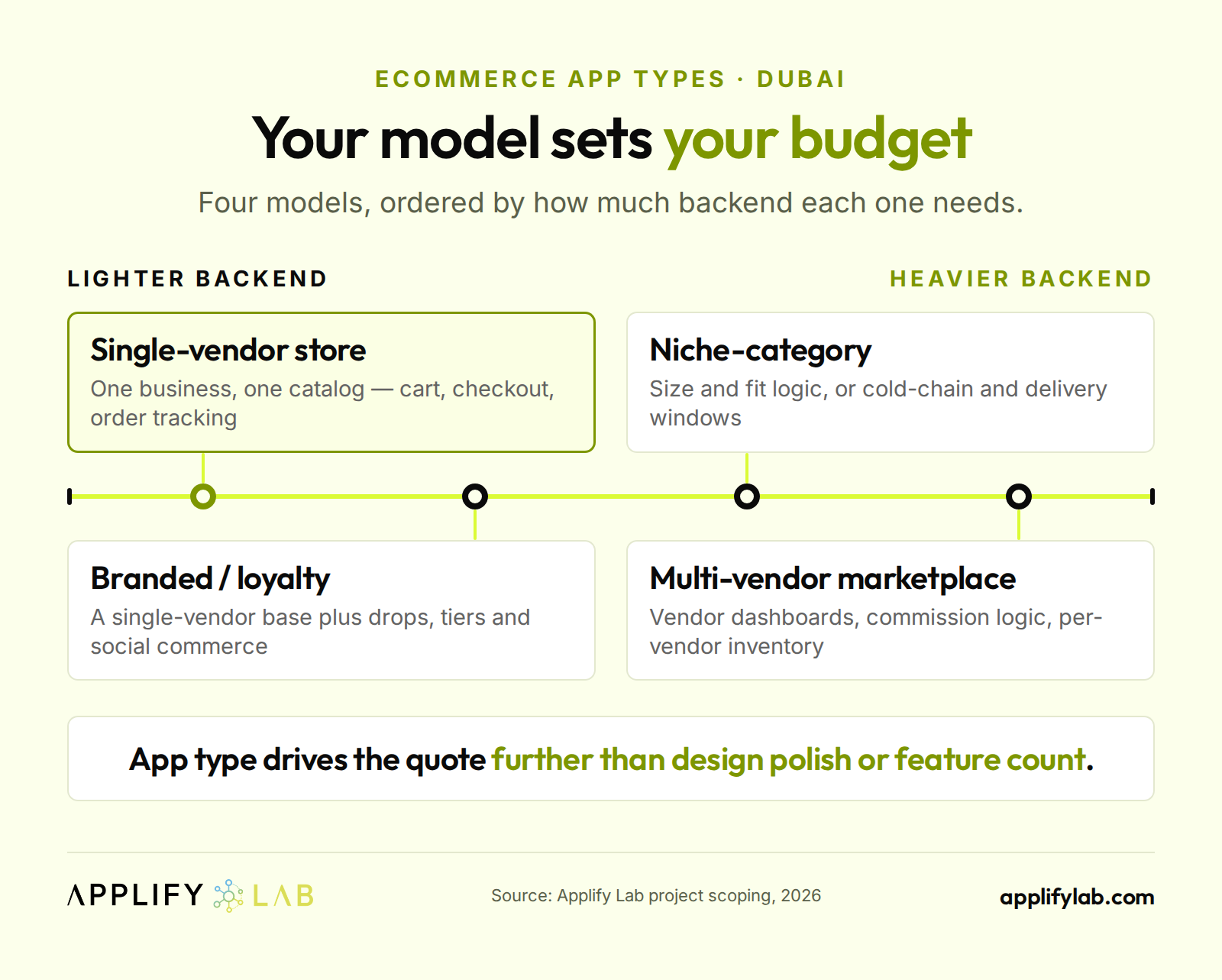
App type is the single biggest driver of cost — bigger than design polish or feature count.
Before a single AED figure means anything, the app type has to be clear — this is the single biggest driver of cost, bigger than design polish or feature count.
Single-vendor store app. One business, one catalog. Product listing, cart, checkout, order tracking. This is the leanest build and the right starting point for most first-time founders.
Multi-vendor marketplace. Multiple sellers on one platform (think Noon-style) — needs vendor dashboards, commission logic, and per-vendor inventory. Meaningfully more backend work than a single-vendor app, and the reason "marketplace" quotes run higher than "store app" quotes for what looks like a similar feature list on paper. If this is genuinely your model, our dedicated marketplace guide covers vendor onboarding, commission benchmarks, and dispute handling in depth.
Branded/loyalty-driven app. A single retailer wanting deeper brand experience — exclusive drops, loyalty tiers, social commerce touches — layered on top of a single-vendor base.
Niche-category app. Fashion, grocery, beauty, electronics — same core, but with category-specific needs (size/fit logic for fashion, cold-chain/delivery-window logic for grocery) that change the backend more than the UI.
If you're still deciding between a Shopify/Salla/Zid-based storefront and a fully custom build, that's a separate decision worth making first — see our platform comparison guide. This post assumes you've landed on (or are seriously considering) a custom build.
Get this one wrong and you overpay in either direction
Tell us your business model and rough order volume, and we'll tell you plainly whether you need single-vendor, marketplace, or something in between — before any quote gets drawn up.
What it costs: realistic 2026 Dubai ranges
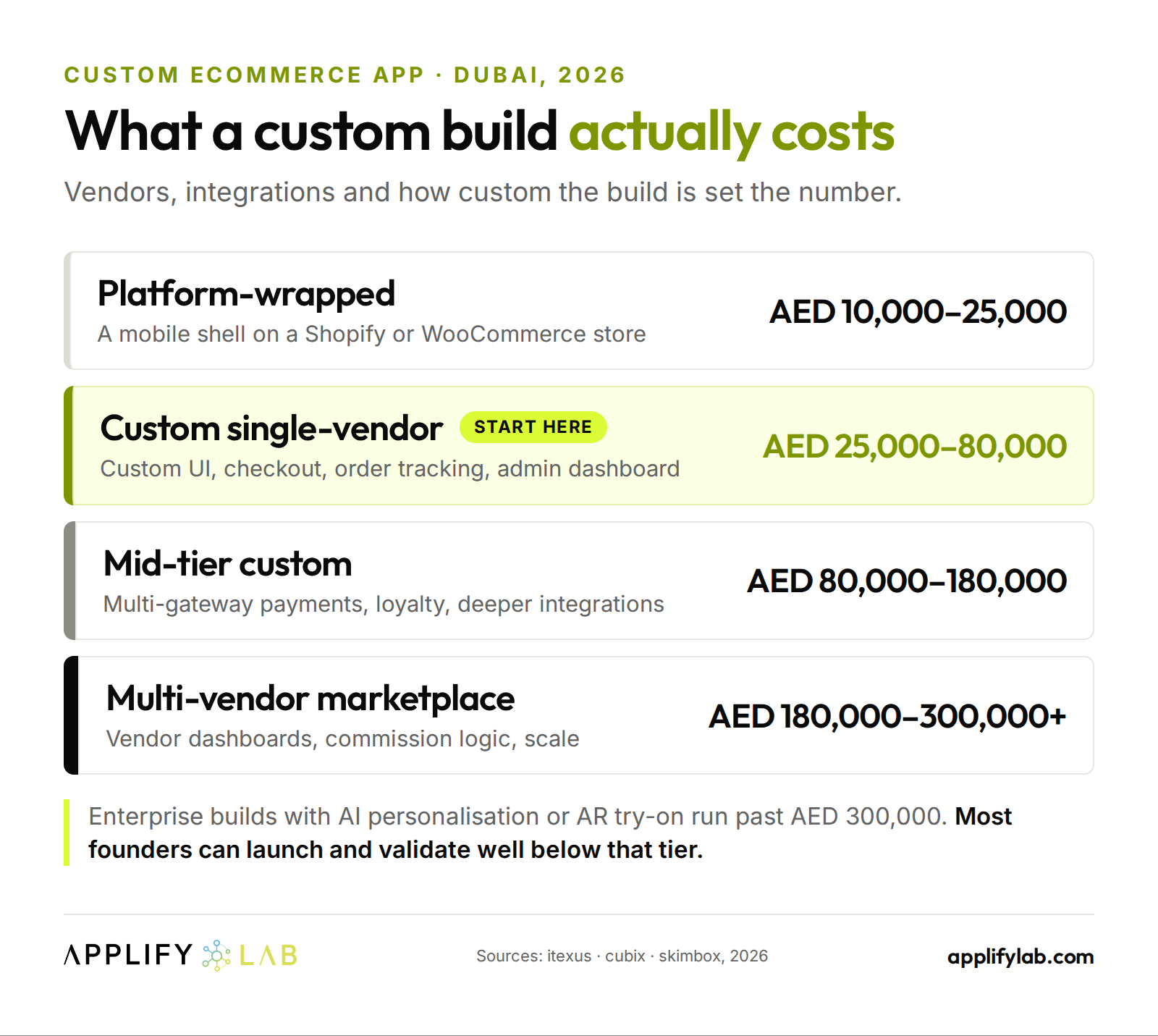
Driven by vendors, integrations and how custom the build is.
Based on current UAE market data across multiple development shops — including sources beyond us (itexus.com, cubix.co, skimbox.ae, 2026) — here's roughly where budgets land:
Build type | Typical AED range | What's included |
|---|---|---|
Single-vendor app on an existing platform (Shopify/WooCommerce wrapper) | AED 10,000–25,000 | Lean mobile wrapper, core catalog/cart/checkout, limited customization |
Custom single-vendor app | AED 25,000–80,000 | Fully custom UI, product catalog, secure checkout, order tracking, admin dashboard |
Mid-tier custom app | AED 80,000–180,000 | Multi-gateway payments, loyalty/coupons, richer admin analytics, deeper integrations |
Multi-vendor marketplace | AED 180,000–300,000+ | Vendor dashboards, commission handling, advanced search, AI recommendations, high scalability |
Callout: Enterprise-grade builds with AI personalization, AR/VR try-on, or real-time analytics at scale can exceed AED 300,000 — but most first-time founders can launch and validate below that tier. Starting leaner and proving demand first is usually the better bet.
These ranges hold up across independent 2026 sources (itexus.com, cubix.co, skimbox.ae) — worth cross-checking any quote you receive against a range like this rather than taking a single number at face value.
What it costs beyond the build (the part most quotes leave out)
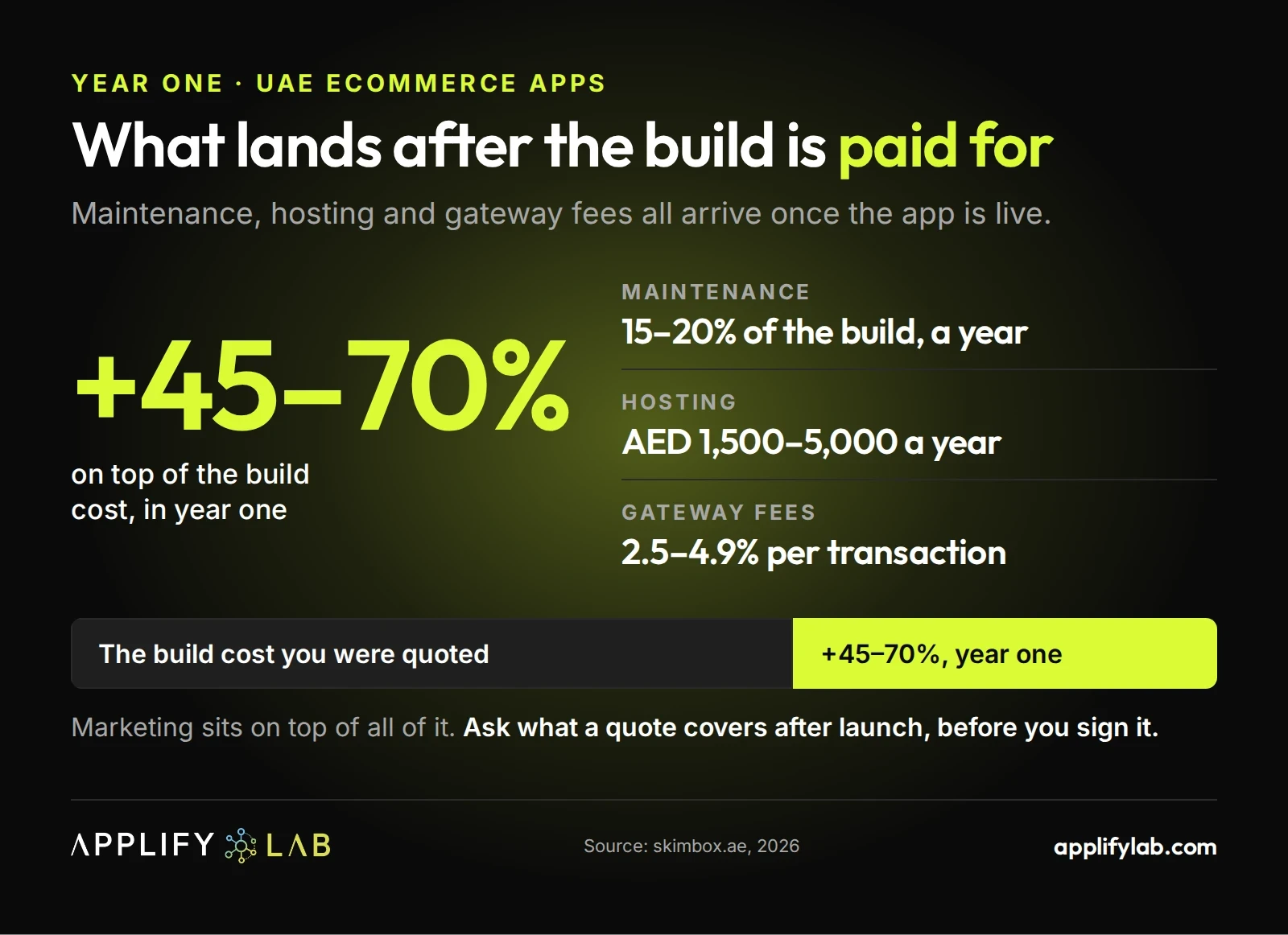
The initial quote is the visible part. Maintenance, hosting, gateway fees and marketing add 45–70% in the first year.
This is where budgets actually go wrong — in the twelve months after launch, long after the initial quote is signed. Year-one hidden costs commonly add 45–70% on top of the initial development cost (skimbox.ae, 2026) once you factor in:
Maintenance: typically 15–20% of the build cost annually — bug fixes, OS updates, security patches. This is also where a "we stay on after launch" promise proves out. It's our answer, and a line item worth pinning down with anyone: we stay on as your technical partner after you ship — through fixes, updates, and scaling. Whoever you build with, ask exactly what post-launch support includes and for how long.
Hosting & infrastructure: roughly AED 1,500–5,000/year for a lean setup, scaling with traffic.
Payment gateway fees: 2.5–4.9% per transaction, on top of whatever gateway you choose.
Marketing & app store optimization: highly variable, but budget for it — an app with no users is an app with no revenue, regardless of build quality.
A quote that covers only the build and stays silent on these isn't necessarily dishonest — but it is incomplete, and it's worth asking about explicitly before you sign anything.
One proof point worth knowing about, even outside ecommerce specifically: we structure builds as fixed-price two-week sprints rather than open-ended estimates, precisely to avoid the budget surprises above.
On a GCC wellness-marketplace build we've been running this way for 8 months, the founder has shipped 30+ features on a fully predictable monthly budget, with no scope-creep renegotiations. (That case study isn't public — ask us directly if you want the specifics.)
Payments: what actually works for UAE shoppers
Get this wrong and you'll see it in your cart-abandonment numbers before anything else. The UAE payment landscape in 2026 looks different from a generic "credit card + PayPal" setup:
Network International processes the majority of UAE card transactions and is the default choice for many local merchants.
Tabby and Tamara (buy-now-pay-later) now cover roughly 30–35% of UAE ecommerce transaction volume between them (blyntl.com, 2026) — BNPL integrations are associated with 20–30% higher average order values, particularly on purchases between AED 500–5,000.
Apple Pay and Google Pay round out the digital-wallet share.
Card-on-file gateways worth comparing for a UAE build: Checkout.com, Network International, Telr, and PayTabs.
A generic international payment stack will work technically. It just won't convert as well as one built around how UAE shoppers actually pay.
For the full breakdown — which gateway fits your volume, hosted checkout vs. direct API vs. native SDK, and what each approach actually costs you in compliance work — see our dedicated payments integration guide.
Native, cross-platform, or platform-wrapped?
For most single-vendor and mid-tier builds in 2026, cross-platform frameworks (React Native, Flutter) are the default — over 60% of new Dubai apps are built this way, for a real 25–45% cost saving with a performance gap that's imperceptible for typical ecommerce use cases.
Native (separate iOS/Android codebases) still earns its cost for apps with heavy real-time or hardware-dependent features, which most ecommerce apps simply don't have.
If you're earlier-stage and unsure a full custom app is even the right first move, a platform-wrapped storefront can be a legitimate way to test demand before committing to a custom build.
Compliance and data handling
UAE ecommerce apps need to account for the PDPL (the UAE's federal data protection law) from day one, before a regulator or a customer complaint forces the issue.
In practice, that means concrete things a development partner should be able to speak to specifically:
where customer data is hosted and whether that satisfies your data-residency obligations,
whether payment details are tokenized through your gateway rather than stored on your own servers,
how customer consent for marketing messages is captured and logged,
and what your breach-notification process actually is if something goes wrong.
If a partner's answer to any of these is vague, treat that as a signal worth acting on.
Who owns your code after launch?
This question rarely comes up during the sales conversation, and it's exactly the kind of thing worth asking before you sign.
Ownership terms vary by provider — some hand over full source code and IP on final payment, others retain rights to reusable components or lock you into their own proprietary framework, which can make switching providers later expensive or impossible.
Our answer here is simple: you own 100% of the code once it's built. We retain no rights to it and lock you into no proprietary stack — if you ever want to move to another team, the code is fully yours to take with you.
What proof to ask for before you commit
The honest question to ask any partner isn't "have you built ecommerce apps before" — almost everyone will say yes. Ask instead: what happened on your hardest project, and what did you do when scope changed mid-build?
We rebuilt a UAE fashion marketplace from scratch after another agency spent close to a year without shipping anything usable — and delivered a production-ready app in 6 weeks. That kind of story tells you more about how a team handles real complexity than any feature list — ask any partner you're considering for their version of it.
FAQ
How much does it cost to build an ecommerce app in Dubai?
Realistically, AED 25,000–80,000 for a custom single-vendor app, AED 80,000–180,000 for a mid-tier build with multi-gateway payments and loyalty features, and AED 180,000–300,000+ for a multi-vendor marketplace. Platform-wrapped storefronts (Shopify/WooCommerce-based) can start lower, around AED 10,000–25,000, when a fully custom build is the right first step later rather than now.
What's the difference between a custom app and a Shopify/Salla/Zid-based one?
A platform-based app wraps your existing storefront in a mobile shell — faster and cheaper, but limited in how far you can customize checkout logic, vendor handling, or unique features. A custom app gives you full control over UX, backend logic, and integrations, at a higher cost and longer timeline. See our platform comparison for a fuller breakdown.
What costs should I budget for beyond development?
Plan for maintenance (15–20% of build cost annually), hosting (AED 1,500–5,000/year for a lean setup), payment processing fees (2.5–4.9% per transaction), and ongoing marketing. Together these commonly add 45–70% on top of the initial build cost in year one — budget for it upfront rather than discovering it after launch.
Should I build native or cross-platform?
For most ecommerce apps, cross-platform (React Native or Flutter) is the practical default in 2026 — a real cost saving with little performance trade-off for typical shopping-app use cases. Native is worth the extra cost mainly for apps with heavy real-time or hardware-dependent features.
Do I need a marketplace, or is a single-vendor app enough?
If you're one business selling your own products, a single-vendor app is the leaner, faster, and cheaper path — and the right starting point for most first-time founders. Multi-vendor marketplaces (multiple sellers, commission logic, vendor dashboards) are a meaningfully bigger build; take that on when your business model genuinely requires multiple sellers from day one.
How long does a custom ecommerce app take to build?
A focused single-vendor build typically takes 8-12 weeks; more complex marketplace builds run longer depending on integrations and vendor-management complexity. Timelines that sound too fast for the stated scope are worth a direct question.
Who owns the code and IP once the app is built?
This depends entirely on the provider's contract terms — some transfer full ownership on final payment, others retain rights to parts of the build, so get it in writing before you sign. With Applify Lab specifically: you own 100% of the code after development, with full rights on your side and no lock-in to a proprietary stack.
Ready to scope this out?
If you're past "should I build an app" and into "who do I build it with," a call is faster than another week of research. Book 30 minutes with us — bring your rough scope and budget, and we'll tell you honestly where you'd land.
Related guides
A custom ecommerce app in Dubai typically costs somewhere between AED 25,000 and AED 300,000+, and the honest answer to "which end of that range am I on" depends less on how fancy the app looks and more on three things:
how many vendors it needs to support
how many third-party systems it has to talk to
and how much of the build is genuinely custom versus wrapped around an existing platform.
This guide breaks down exactly what drives that number, what most cost guides leave out, and how to avoid the two most common ways founders overpay — quoting the wrong app type, and forgetting the costs that show up after launch.
Key takeaways
Realistic 2026 range: AED 25,000–300,000+. Where you land is driven by vendors, integrations, and custom-vs-wrapped — more than by design polish.
The app type is the single biggest cost driver — single-vendor, marketplace, branded, or niche. Get it right before any quote.
The cost that sinks budgets is after launch: hidden year-one costs add 45–70% on top of the build (maintenance, hosting, gateway fees, marketing).
Build the payment stack around how UAE shoppers actually pay — Network International, plus Tabby/Tamara BNPL (~30-35% of volume, +20-30% AOV).
You own 100% of the code and IP — full rights on final payment, and freedom to move teams later.
What kind of app are you actually building?
App type is the single biggest driver of cost — bigger than design polish or feature count.
Before a single AED figure means anything, the app type has to be clear — this is the single biggest driver of cost, bigger than design polish or feature count.
Single-vendor store app. One business, one catalog. Product listing, cart, checkout, order tracking. This is the leanest build and the right starting point for most first-time founders.
Multi-vendor marketplace. Multiple sellers on one platform (think Noon-style) — needs vendor dashboards, commission logic, and per-vendor inventory. Meaningfully more backend work than a single-vendor app, and the reason "marketplace" quotes run higher than "store app" quotes for what looks like a similar feature list on paper. If this is genuinely your model, our dedicated marketplace guide covers vendor onboarding, commission benchmarks, and dispute handling in depth.
Branded/loyalty-driven app. A single retailer wanting deeper brand experience — exclusive drops, loyalty tiers, social commerce touches — layered on top of a single-vendor base.
Niche-category app. Fashion, grocery, beauty, electronics — same core, but with category-specific needs (size/fit logic for fashion, cold-chain/delivery-window logic for grocery) that change the backend more than the UI.
If you're still deciding between a Shopify/Salla/Zid-based storefront and a fully custom build, that's a separate decision worth making first — see our platform comparison guide. This post assumes you've landed on (or are seriously considering) a custom build.
Get this one wrong and you overpay in either direction
Tell us your business model and rough order volume, and we'll tell you plainly whether you need single-vendor, marketplace, or something in between — before any quote gets drawn up.
What it costs: realistic 2026 Dubai ranges
Driven by vendors, integrations and how custom the build is.
Based on current UAE market data across multiple development shops — including sources beyond us (itexus.com, cubix.co, skimbox.ae, 2026) — here's roughly where budgets land:
Build type | Typical AED range | What's included |
|---|---|---|
Single-vendor app on an existing platform (Shopify/WooCommerce wrapper) | AED 10,000–25,000 | Lean mobile wrapper, core catalog/cart/checkout, limited customization |
Custom single-vendor app | AED 25,000–80,000 | Fully custom UI, product catalog, secure checkout, order tracking, admin dashboard |
Mid-tier custom app | AED 80,000–180,000 | Multi-gateway payments, loyalty/coupons, richer admin analytics, deeper integrations |
Multi-vendor marketplace | AED 180,000–300,000+ | Vendor dashboards, commission handling, advanced search, AI recommendations, high scalability |
Callout: Enterprise-grade builds with AI personalization, AR/VR try-on, or real-time analytics at scale can exceed AED 300,000 — but most first-time founders can launch and validate below that tier. Starting leaner and proving demand first is usually the better bet.
These ranges hold up across independent 2026 sources (itexus.com, cubix.co, skimbox.ae) — worth cross-checking any quote you receive against a range like this rather than taking a single number at face value.
What it costs beyond the build (the part most quotes leave out)
The initial quote is the visible part. Maintenance, hosting, gateway fees and marketing add 45–70% in the first year.
This is where budgets actually go wrong — in the twelve months after launch, long after the initial quote is signed. Year-one hidden costs commonly add 45–70% on top of the initial development cost (skimbox.ae, 2026) once you factor in:
Maintenance: typically 15–20% of the build cost annually — bug fixes, OS updates, security patches. This is also where a "we stay on after launch" promise proves out. It's our answer, and a line item worth pinning down with anyone: we stay on as your technical partner after you ship — through fixes, updates, and scaling. Whoever you build with, ask exactly what post-launch support includes and for how long.
Hosting & infrastructure: roughly AED 1,500–5,000/year for a lean setup, scaling with traffic.
Payment gateway fees: 2.5–4.9% per transaction, on top of whatever gateway you choose.
Marketing & app store optimization: highly variable, but budget for it — an app with no users is an app with no revenue, regardless of build quality.
A quote that covers only the build and stays silent on these isn't necessarily dishonest — but it is incomplete, and it's worth asking about explicitly before you sign anything.
One proof point worth knowing about, even outside ecommerce specifically: we structure builds as fixed-price two-week sprints rather than open-ended estimates, precisely to avoid the budget surprises above.
On a GCC wellness-marketplace build we've been running this way for 8 months, the founder has shipped 30+ features on a fully predictable monthly budget, with no scope-creep renegotiations. (That case study isn't public — ask us directly if you want the specifics.)
Payments: what actually works for UAE shoppers
Get this wrong and you'll see it in your cart-abandonment numbers before anything else. The UAE payment landscape in 2026 looks different from a generic "credit card + PayPal" setup:
Network International processes the majority of UAE card transactions and is the default choice for many local merchants.
Tabby and Tamara (buy-now-pay-later) now cover roughly 30–35% of UAE ecommerce transaction volume between them (blyntl.com, 2026) — BNPL integrations are associated with 20–30% higher average order values, particularly on purchases between AED 500–5,000.
Apple Pay and Google Pay round out the digital-wallet share.
Card-on-file gateways worth comparing for a UAE build: Checkout.com, Network International, Telr, and PayTabs.
A generic international payment stack will work technically. It just won't convert as well as one built around how UAE shoppers actually pay.
For the full breakdown — which gateway fits your volume, hosted checkout vs. direct API vs. native SDK, and what each approach actually costs you in compliance work — see our dedicated payments integration guide.
Native, cross-platform, or platform-wrapped?
For most single-vendor and mid-tier builds in 2026, cross-platform frameworks (React Native, Flutter) are the default — over 60% of new Dubai apps are built this way, for a real 25–45% cost saving with a performance gap that's imperceptible for typical ecommerce use cases.
Native (separate iOS/Android codebases) still earns its cost for apps with heavy real-time or hardware-dependent features, which most ecommerce apps simply don't have.
If you're earlier-stage and unsure a full custom app is even the right first move, a platform-wrapped storefront can be a legitimate way to test demand before committing to a custom build.
Compliance and data handling
UAE ecommerce apps need to account for the PDPL (the UAE's federal data protection law) from day one, before a regulator or a customer complaint forces the issue.
In practice, that means concrete things a development partner should be able to speak to specifically:
where customer data is hosted and whether that satisfies your data-residency obligations,
whether payment details are tokenized through your gateway rather than stored on your own servers,
how customer consent for marketing messages is captured and logged,
and what your breach-notification process actually is if something goes wrong.
If a partner's answer to any of these is vague, treat that as a signal worth acting on.
Who owns your code after launch?
This question rarely comes up during the sales conversation, and it's exactly the kind of thing worth asking before you sign.
Ownership terms vary by provider — some hand over full source code and IP on final payment, others retain rights to reusable components or lock you into their own proprietary framework, which can make switching providers later expensive or impossible.
Our answer here is simple: you own 100% of the code once it's built. We retain no rights to it and lock you into no proprietary stack — if you ever want to move to another team, the code is fully yours to take with you.
What proof to ask for before you commit
The honest question to ask any partner isn't "have you built ecommerce apps before" — almost everyone will say yes. Ask instead: what happened on your hardest project, and what did you do when scope changed mid-build?
We rebuilt a UAE fashion marketplace from scratch after another agency spent close to a year without shipping anything usable — and delivered a production-ready app in 6 weeks. That kind of story tells you more about how a team handles real complexity than any feature list — ask any partner you're considering for their version of it.
FAQ
How much does it cost to build an ecommerce app in Dubai?
Realistically, AED 25,000–80,000 for a custom single-vendor app, AED 80,000–180,000 for a mid-tier build with multi-gateway payments and loyalty features, and AED 180,000–300,000+ for a multi-vendor marketplace. Platform-wrapped storefronts (Shopify/WooCommerce-based) can start lower, around AED 10,000–25,000, when a fully custom build is the right first step later rather than now.
What's the difference between a custom app and a Shopify/Salla/Zid-based one?
A platform-based app wraps your existing storefront in a mobile shell — faster and cheaper, but limited in how far you can customize checkout logic, vendor handling, or unique features. A custom app gives you full control over UX, backend logic, and integrations, at a higher cost and longer timeline. See our platform comparison for a fuller breakdown.
What costs should I budget for beyond development?
Plan for maintenance (15–20% of build cost annually), hosting (AED 1,500–5,000/year for a lean setup), payment processing fees (2.5–4.9% per transaction), and ongoing marketing. Together these commonly add 45–70% on top of the initial build cost in year one — budget for it upfront rather than discovering it after launch.
Should I build native or cross-platform?
For most ecommerce apps, cross-platform (React Native or Flutter) is the practical default in 2026 — a real cost saving with little performance trade-off for typical shopping-app use cases. Native is worth the extra cost mainly for apps with heavy real-time or hardware-dependent features.
Do I need a marketplace, or is a single-vendor app enough?
If you're one business selling your own products, a single-vendor app is the leaner, faster, and cheaper path — and the right starting point for most first-time founders. Multi-vendor marketplaces (multiple sellers, commission logic, vendor dashboards) are a meaningfully bigger build; take that on when your business model genuinely requires multiple sellers from day one.
How long does a custom ecommerce app take to build?
A focused single-vendor build typically takes 8-12 weeks; more complex marketplace builds run longer depending on integrations and vendor-management complexity. Timelines that sound too fast for the stated scope are worth a direct question.
Who owns the code and IP once the app is built?
This depends entirely on the provider's contract terms — some transfer full ownership on final payment, others retain rights to parts of the build, so get it in writing before you sign. With Applify Lab specifically: you own 100% of the code after development, with full rights on your side and no lock-in to a proprietary stack.
Ready to scope this out?
If you're past "should I build an app" and into "who do I build it with," a call is faster than another week of research. Book 30 minutes with us — bring your rough scope and budget, and we'll tell you honestly where you'd land.