App Development
App Maintenance Cost in Dubai: What It Covers (2026)

By
Anh Nguyen, Founder
·
13 min

Most app studios budget maintenance at 15–20% of the build cost a year, paid as a monthly retainer of hours. That buys the updates Apple and Google require, bug fixes, security, monitoring and backups. Twelve questions show whether your app is properly maintained, and how to move it to a new team if it is not.
Key takeaways
Budget 15–20% of the build cost a year. It is the rule of thumb most studios use, usually paid as a monthly retainer of hours.
Maintenance keeps your app in the stores. Apple and Google raise their technical requirements every year, and an app without updates falls behind them.
Running costs sit outside the fee. Hosting, store accounts and third-party services are billed separately.
Count the warning signs. 0–3 is normal, 4–7 calls for a review, 8 or more means act now.
Ownership comes first when you switch. With the accounts and the code in your company's name, a handover becomes a list you can ask for.
Planning a custom app? See how we approach custom app and AI development in Dubai.

Twelve questions in five areas: an afternoon's check on how your app is maintained.
What does app maintenance cost per month in Dubai?
Most studios budget maintenance at 15–20% of the app's build cost a year, and bill it as a monthly retainer of hours.
The 15–20% figure is a rule of thumb repeated across the industry; no official survey sits behind it. The hours give a firmer check: app developers listed for the UAE on Clutch mostly charge USD 25–49 an hour (about AED 92–180, in the directory's October 2026 ratings), so the monthly bill depends on how many hours your app needs.
What an app needs each month, in hours, at UAE rates:
About 10 hours a month: AED 920–1,800. A stable app with few changes: store and phone-software updates, security patches, monitoring and the occasional fix.
About 20 hours a month: AED 1,840–3,600. An app your customers use every day: the same work, plus a regular release and the bug list worked through in order.
About 40 hours a month: AED 3,680–7,200. An app that is still growing: small new features each month and connections to other systems kept up to date.
Both methods land in the same place. An app that cost AED 150,000 to build would need AED 22,500–30,000 a year at 15–20%, or about AED 1,900–2,500 a month: the 20-hour line above. We convert at the dirham's fixed rate of AED 3.6725 to the US dollar, set by the Central Bank of the UAE. These are market ranges; Applify Lab scopes every project after a diagnosis.
A retainer suits an app your business runs on. It comes with agreed response times and a team that already knows the code. Hourly billing for one-off fixes suits an app that rarely changes, and larger new features are usually scoped and priced on their own.
What should monthly maintenance cover?
Maintenance keeps your app accepted by the stores, working on new phones, secure and backed up.
Apple and Google raise their technical requirements every year, and an app that misses them stops moving. Since 28 April 2026, Apple only accepts apps built with Xcode 26 or later and the iOS 26 SDK, so an app last updated before then has to be rebuilt before its next release. From 31 August 2026, Google Play requires new apps and updates to target Android 16, and existing apps must target Android 15 to stay available to new users on newer phones; developers can request an extension to 1 November 2026.
What a maintenance retainer should include:
Store and phone-software updates. Each new iOS and Android version tested, and the app rebuilt to the stores' current requirements.
Bug fixes. A shared list with an owner, worked through in order of impact on your customers.
Security. Libraries and services updated, access reviewed, and every password in a vault your company owns.
Monitoring. Crash rate, store rating and server health watched every week, with alerts when something breaks.
Backups. Taken automatically, and restored as a test at least once.
Small changes. New text, prices, images or a minor screen, live within days.
Which running costs sit outside the maintenance fee?
Hosting, store accounts and third-party services are billed separately, and each one belongs in your company's name.
The store accounts are the smallest line: the Apple Developer Program costs USD 99 a year (about AED 364), and Google Play charges a one-time USD 25 (about AED 92). The larger lines grow with use: hosting and the database, and services such as maps, SMS, email, payments and AI, which bill by volume. Our guide to app development costs in Dubai covers what drives the build itself.
Each of these accounts should sit on your company's card, with your developer added as a user. A service billed to someone else's card is a service you can lose the day the relationship ends.
Is your app properly maintained? 12 questions to check
Twelve questions in five areas show whether your app is in good hands, and you can answer most of them yourself in an afternoon.
Each "no" or "I don't know" counts as a warning sign. The previous or current developer is rarely the problem: most warning signs come from how the project was set up on day one.
Ownership (questions 1 to 4)
1. Whose name is the Apple developer account in?
It should be your company, with your billing details and an email you control. Apple asks a company for a free D-U-N-S number to open an organisation account, and says to allow up to five business days to receive it.
2. Whose name is the Google Play account in?
Same rule. Google Play has required a D-U-N-S number for every organisation account since 2023.
3. Can you download the full source code today, and who has access?
You should be able to open the code repository today, without asking anyone.
4. Who controls the domain, the servers and the admin logins?
Make one list: domain, hosting, database, payment provider, analytics, and the inbox that receives password resets. Each line should show your company as the owner.
Change (questions 5 to 7)
5. How long did the last small change take, from request to live?
Days is healthy. Weeks for a text change is a warning sign.
6. When was the last update released to the stores?
With Apple's and Google's 2026 requirements, an app with no release in six months or more carries a warning sign.
7. Is there a written list of known bugs, and who looks after it?
A shared list with an owner and an order of priority is the healthy answer.
Reliability (question 8)
8. What are the crash rate and the store rating doing over the last six months?
Both sit in App Store Connect and Google Play Console, so you can check them without your developer. Google Play may reduce an app's visibility once its crash rate passes 1.09% of users, according to its Android vitals guidance.
Cost (questions 9 and 10)
9. What do you pay every month, line by line?
Retainer, hosting, store accounts and each third-party service. A total nobody can explain, or services billed to someone else's card, is a warning sign.
10. If your developer disappeared tomorrow, is there documentation someone else could pick up?
At minimum: how to run the app, how to release it, where everything is hosted, and the passwords in a shared vault your company owns.
Data (questions 11 and 12)
The UAE personal data law, Federal Decree-Law No. 45 of 2021, makes your business responsible for how customer data is handled and where it is sent. Health data is stricter: Federal Law No. 2 of 2019 bans storing or processing it outside the UAE unless a health authority allows it, with fines of AED 500,000 to 700,000 (Data Protection Report, 2019).
11. Where is your customers' data stored, and who can access it?
The healthy answer names a provider and a region, plus a short list of people with access, each with their own login.
12. Is there a backup, and has anyone ever restored it?
Ask for the date of the last test restore. A backup that has never been restored is untested.
What do your answers mean?
Count your warning signs: 0–3 is normal for an app in use, 4–7 calls for a review, and 8 or more means act now.
Warning signs | What it means | What to do next |
|---|---|---|
0–3 | Normal for an app in use | Fix them with your current developer, in order of risk |
4–7 | The setup depends on people more than on process | Book a review: the 12 answers, an hour with your developer, a dated plan |
8 or more | The business depends on something it doesn't control | Secure ownership first (questions 1 to 4), then decide on the team |
Fix ownership before anything else. Whatever your score, warning signs on questions 1 to 4 come first, because every other fix depends on having the accounts and the code.
A high score calls for a diagnosis before any rebuild. Two or three blocking problems often explain most of the warning signs, and fixing those can come before any decision to start over. This is how we start every takeover: the same twelve questions, then the fixes that unblock the rest.
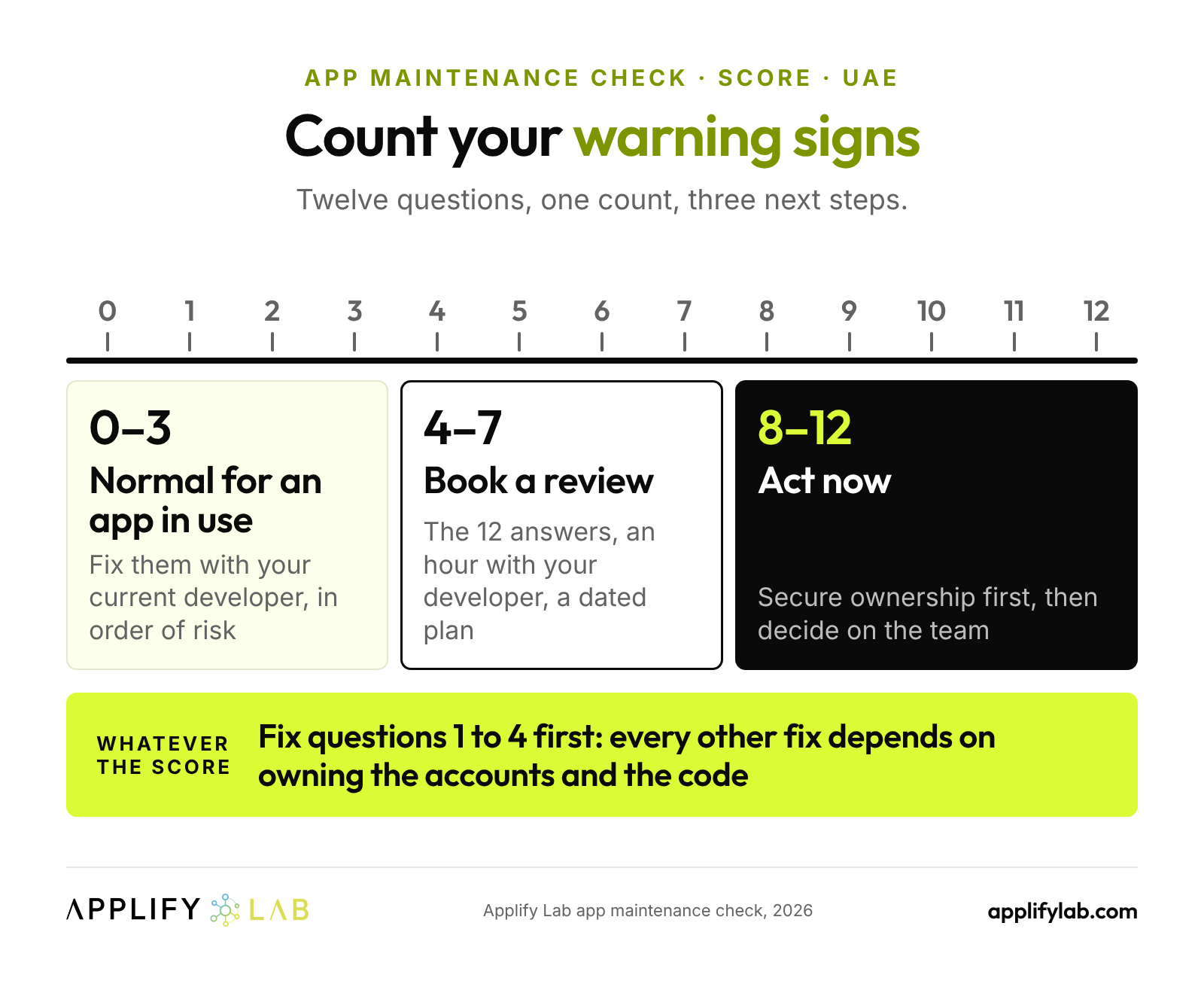
Count the warning signs, fix ownership first, then decide on the team.
Ready to move your app to a new team?
If your check found 4 or more warning signs and you're looking for a team to take over, tell us what the app does and what you found. We'll explain what a takeover involves for your app.
How do you switch developers without losing your app?
Secure ownership first, have the incoming team audit the code, then move the app on a written handover with a date.
The four steps, in order:
Secure the accounts and the code. Answer questions 1 to 4 first, and move anything in the wrong name while the relationship is still good.
Have the incoming team audit the code. A short review shows what can be kept, what must be fixed first and what the next releases involve.
Move the store listings. On Apple, the current Account Holder starts the transfer and yours accepts it; the app needs at least one released version, and both accounts must have accepted Apple's latest agreements. On Google Play, the current owner submits a transfer request with both accounts' registration transaction IDs, and Google says it replies within two business days. Ratings and reviews move with the app on both stores.
Agree the handover list and a date, in writing. The list is in the next section.
The contract matters as much as the accounts. The UAE copyright law, Federal Decree-Law No. 38 of 2021, in force since 2 January 2022, lists apps and computer programs as protected works, and law firms advise businesses to put ownership of commissioned software in writing (Gowling WLG, 2022). Look for three lines in your agreement: intellectual property transfers to you on payment, accounts sit in your name, and a handover clause says what you receive and how fast.
A fair ending protects your app. The outgoing developer knows the app better than anyone, and a clear list with a reasonable notice period keeps that knowledge available while it moves.
What does a proper handover include?
A proper handover gives you the accounts, the code, the knowledge and the data, on an agreed date, in writing.
The handover list:
Store accounts. Apple and Google Play, transferred with their ratings and reviews.
Code. The full repository with its history, moved to your company's account.
Infrastructure. Domain, hosting, database and third-party services transferred or re-billed to your company.
Documentation. How to run, test and release the app, an overview of how it is built, and the list of known bugs.
Credentials. Every password and key in a vault your company owns, changed once the handover is complete.
Data and backups. The storage location confirmed and the latest backup restored once as a test.
A walkthrough. A recorded session where the outgoing developer explains the code to the incoming team.
The same list applies to us. At Applify Lab, every client owns 100% of the code after development, so you keep everything on this list if you ever move on.
Keep what still works. A UAE fashion marketplace came to us after almost a year with another team and no app its customers could use. The first question was what from that year could be kept, such as designs, content, accounts and parts of the code, and the app was live six weeks later. Read how we rebuilt it.
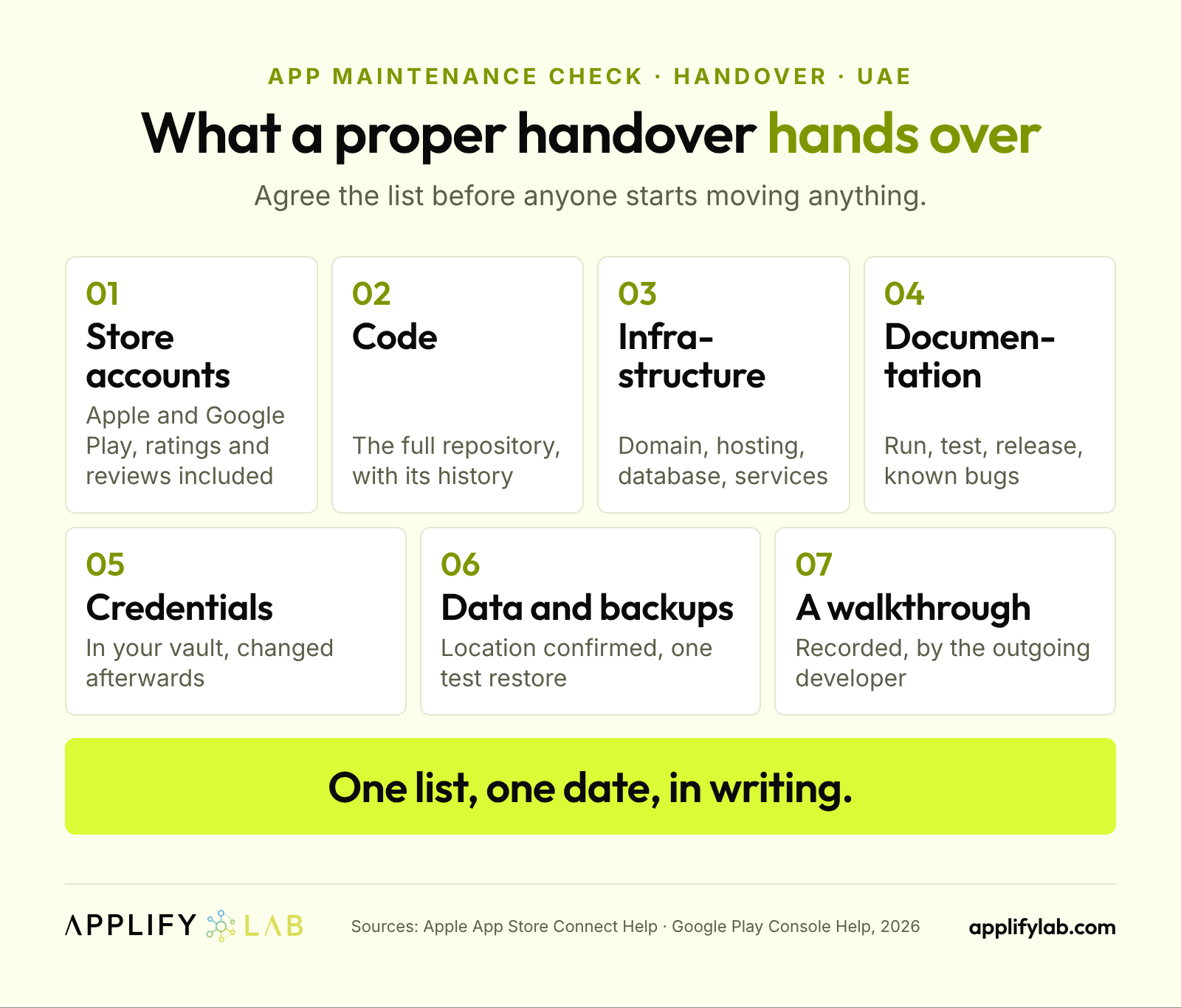
Seven items, one date, in writing: what a proper handover hands over.
FAQ
How much does app maintenance cost per month in the UAE?
Most studios budget 15–20% of the build cost a year, paid as a monthly retainer. At the USD 25–49 hourly rates UAE developers show on Clutch, 10 hours a month comes to AED 920–1,800, 20 hours to AED 1,840–3,600 and 40 hours to AED 3,680–7,200. Hosting, store accounts and third-party services come on top. These are market ranges; Applify Lab scopes every project after a diagnosis.
What is included in app maintenance?
Updates for each new iOS and Android version and for the stores' requirements, bug fixes from a shared list, security updates, weekly monitoring of crashes and servers, tested backups, and small changes such as text, prices or images. Larger new features are usually scoped and priced separately. Ask for the list in writing, with response times, before you sign a retainer.
Can I move my app to a new developer?
Yes. The app keeps its store listing, ratings and reviews: Apple and Google both have a transfer process between accounts, started by the current owner. The rest of the move covers the code repository, hosting, third-party services and documentation. With the accounts already in your name, the switch is mostly a handover of knowledge, which a walkthrough with the outgoing developer makes faster.
Who should own the App Store account, the business or the developer?
The business. Open the Apple and Google Play developer accounts in your company's name, with your billing details and an email you control, then add your developer as a user. Both stores ask a company for a free D-U-N-S number. When the developer owns the account, your app sits on their shelf, and moving it later needs their cooperation.
How do I get my source code back from a developer?
Ask in writing for the full repository, with its history, to be moved to an account your company owns, and check what your contract says about intellectual property. UAE copyright law lists computer programs as protected works, so the contract clause matters. If the contract is silent or the request is refused, speak to a legal adviser. This is general information, not legal advice.
To go further
Moving an app to a new team? See how we handle custom app and AI development in Dubai.
Running a clinic, studio or wellness app? Discover our healthcare and wellness apps.
Running a store or a brand app? Explore our e-commerce and retail apps for UAE brands.
See how we keep shipping a GCC wellness marketplace every two weeks.
Most app studios budget maintenance at 15–20% of the build cost a year, paid as a monthly retainer of hours. That buys the updates Apple and Google require, bug fixes, security, monitoring and backups. Twelve questions show whether your app is properly maintained, and how to move it to a new team if it is not.
Key takeaways
Budget 15–20% of the build cost a year. It is the rule of thumb most studios use, usually paid as a monthly retainer of hours.
Maintenance keeps your app in the stores. Apple and Google raise their technical requirements every year, and an app without updates falls behind them.
Running costs sit outside the fee. Hosting, store accounts and third-party services are billed separately.
Count the warning signs. 0–3 is normal, 4–7 calls for a review, 8 or more means act now.
Ownership comes first when you switch. With the accounts and the code in your company's name, a handover becomes a list you can ask for.
Planning a custom app? See how we approach custom app and AI development in Dubai.
Twelve questions in five areas: an afternoon's check on how your app is maintained.
What does app maintenance cost per month in Dubai?
Most studios budget maintenance at 15–20% of the app's build cost a year, and bill it as a monthly retainer of hours.
The 15–20% figure is a rule of thumb repeated across the industry; no official survey sits behind it. The hours give a firmer check: app developers listed for the UAE on Clutch mostly charge USD 25–49 an hour (about AED 92–180, in the directory's October 2026 ratings), so the monthly bill depends on how many hours your app needs.
What an app needs each month, in hours, at UAE rates:
About 10 hours a month: AED 920–1,800. A stable app with few changes: store and phone-software updates, security patches, monitoring and the occasional fix.
About 20 hours a month: AED 1,840–3,600. An app your customers use every day: the same work, plus a regular release and the bug list worked through in order.
About 40 hours a month: AED 3,680–7,200. An app that is still growing: small new features each month and connections to other systems kept up to date.
Both methods land in the same place. An app that cost AED 150,000 to build would need AED 22,500–30,000 a year at 15–20%, or about AED 1,900–2,500 a month: the 20-hour line above. We convert at the dirham's fixed rate of AED 3.6725 to the US dollar, set by the Central Bank of the UAE. These are market ranges; Applify Lab scopes every project after a diagnosis.
A retainer suits an app your business runs on. It comes with agreed response times and a team that already knows the code. Hourly billing for one-off fixes suits an app that rarely changes, and larger new features are usually scoped and priced on their own.
What should monthly maintenance cover?
Maintenance keeps your app accepted by the stores, working on new phones, secure and backed up.
Apple and Google raise their technical requirements every year, and an app that misses them stops moving. Since 28 April 2026, Apple only accepts apps built with Xcode 26 or later and the iOS 26 SDK, so an app last updated before then has to be rebuilt before its next release. From 31 August 2026, Google Play requires new apps and updates to target Android 16, and existing apps must target Android 15 to stay available to new users on newer phones; developers can request an extension to 1 November 2026.
What a maintenance retainer should include:
Store and phone-software updates. Each new iOS and Android version tested, and the app rebuilt to the stores' current requirements.
Bug fixes. A shared list with an owner, worked through in order of impact on your customers.
Security. Libraries and services updated, access reviewed, and every password in a vault your company owns.
Monitoring. Crash rate, store rating and server health watched every week, with alerts when something breaks.
Backups. Taken automatically, and restored as a test at least once.
Small changes. New text, prices, images or a minor screen, live within days.
Which running costs sit outside the maintenance fee?
Hosting, store accounts and third-party services are billed separately, and each one belongs in your company's name.
The store accounts are the smallest line: the Apple Developer Program costs USD 99 a year (about AED 364), and Google Play charges a one-time USD 25 (about AED 92). The larger lines grow with use: hosting and the database, and services such as maps, SMS, email, payments and AI, which bill by volume. Our guide to app development costs in Dubai covers what drives the build itself.
Each of these accounts should sit on your company's card, with your developer added as a user. A service billed to someone else's card is a service you can lose the day the relationship ends.
Is your app properly maintained? 12 questions to check
Twelve questions in five areas show whether your app is in good hands, and you can answer most of them yourself in an afternoon.
Each "no" or "I don't know" counts as a warning sign. The previous or current developer is rarely the problem: most warning signs come from how the project was set up on day one.
Ownership (questions 1 to 4)
1. Whose name is the Apple developer account in?
It should be your company, with your billing details and an email you control. Apple asks a company for a free D-U-N-S number to open an organisation account, and says to allow up to five business days to receive it.
2. Whose name is the Google Play account in?
Same rule. Google Play has required a D-U-N-S number for every organisation account since 2023.
3. Can you download the full source code today, and who has access?
You should be able to open the code repository today, without asking anyone.
4. Who controls the domain, the servers and the admin logins?
Make one list: domain, hosting, database, payment provider, analytics, and the inbox that receives password resets. Each line should show your company as the owner.
Change (questions 5 to 7)
5. How long did the last small change take, from request to live?
Days is healthy. Weeks for a text change is a warning sign.
6. When was the last update released to the stores?
With Apple's and Google's 2026 requirements, an app with no release in six months or more carries a warning sign.
7. Is there a written list of known bugs, and who looks after it?
A shared list with an owner and an order of priority is the healthy answer.
Reliability (question 8)
8. What are the crash rate and the store rating doing over the last six months?
Both sit in App Store Connect and Google Play Console, so you can check them without your developer. Google Play may reduce an app's visibility once its crash rate passes 1.09% of users, according to its Android vitals guidance.
Cost (questions 9 and 10)
9. What do you pay every month, line by line?
Retainer, hosting, store accounts and each third-party service. A total nobody can explain, or services billed to someone else's card, is a warning sign.
10. If your developer disappeared tomorrow, is there documentation someone else could pick up?
At minimum: how to run the app, how to release it, where everything is hosted, and the passwords in a shared vault your company owns.
Data (questions 11 and 12)
The UAE personal data law, Federal Decree-Law No. 45 of 2021, makes your business responsible for how customer data is handled and where it is sent. Health data is stricter: Federal Law No. 2 of 2019 bans storing or processing it outside the UAE unless a health authority allows it, with fines of AED 500,000 to 700,000 (Data Protection Report, 2019).
11. Where is your customers' data stored, and who can access it?
The healthy answer names a provider and a region, plus a short list of people with access, each with their own login.
12. Is there a backup, and has anyone ever restored it?
Ask for the date of the last test restore. A backup that has never been restored is untested.
What do your answers mean?
Count your warning signs: 0–3 is normal for an app in use, 4–7 calls for a review, and 8 or more means act now.
Warning signs | What it means | What to do next |
|---|---|---|
0–3 | Normal for an app in use | Fix them with your current developer, in order of risk |
4–7 | The setup depends on people more than on process | Book a review: the 12 answers, an hour with your developer, a dated plan |
8 or more | The business depends on something it doesn't control | Secure ownership first (questions 1 to 4), then decide on the team |
Fix ownership before anything else. Whatever your score, warning signs on questions 1 to 4 come first, because every other fix depends on having the accounts and the code.
A high score calls for a diagnosis before any rebuild. Two or three blocking problems often explain most of the warning signs, and fixing those can come before any decision to start over. This is how we start every takeover: the same twelve questions, then the fixes that unblock the rest.
Count the warning signs, fix ownership first, then decide on the team.
Ready to move your app to a new team?
If your check found 4 or more warning signs and you're looking for a team to take over, tell us what the app does and what you found. We'll explain what a takeover involves for your app.
How do you switch developers without losing your app?
Secure ownership first, have the incoming team audit the code, then move the app on a written handover with a date.
The four steps, in order:
Secure the accounts and the code. Answer questions 1 to 4 first, and move anything in the wrong name while the relationship is still good.
Have the incoming team audit the code. A short review shows what can be kept, what must be fixed first and what the next releases involve.
Move the store listings. On Apple, the current Account Holder starts the transfer and yours accepts it; the app needs at least one released version, and both accounts must have accepted Apple's latest agreements. On Google Play, the current owner submits a transfer request with both accounts' registration transaction IDs, and Google says it replies within two business days. Ratings and reviews move with the app on both stores.
Agree the handover list and a date, in writing. The list is in the next section.
The contract matters as much as the accounts. The UAE copyright law, Federal Decree-Law No. 38 of 2021, in force since 2 January 2022, lists apps and computer programs as protected works, and law firms advise businesses to put ownership of commissioned software in writing (Gowling WLG, 2022). Look for three lines in your agreement: intellectual property transfers to you on payment, accounts sit in your name, and a handover clause says what you receive and how fast.
A fair ending protects your app. The outgoing developer knows the app better than anyone, and a clear list with a reasonable notice period keeps that knowledge available while it moves.
What does a proper handover include?
A proper handover gives you the accounts, the code, the knowledge and the data, on an agreed date, in writing.
The handover list:
Store accounts. Apple and Google Play, transferred with their ratings and reviews.
Code. The full repository with its history, moved to your company's account.
Infrastructure. Domain, hosting, database and third-party services transferred or re-billed to your company.
Documentation. How to run, test and release the app, an overview of how it is built, and the list of known bugs.
Credentials. Every password and key in a vault your company owns, changed once the handover is complete.
Data and backups. The storage location confirmed and the latest backup restored once as a test.
A walkthrough. A recorded session where the outgoing developer explains the code to the incoming team.
The same list applies to us. At Applify Lab, every client owns 100% of the code after development, so you keep everything on this list if you ever move on.
Keep what still works. A UAE fashion marketplace came to us after almost a year with another team and no app its customers could use. The first question was what from that year could be kept, such as designs, content, accounts and parts of the code, and the app was live six weeks later. Read how we rebuilt it.
Seven items, one date, in writing: what a proper handover hands over.
FAQ
How much does app maintenance cost per month in the UAE?
Most studios budget 15–20% of the build cost a year, paid as a monthly retainer. At the USD 25–49 hourly rates UAE developers show on Clutch, 10 hours a month comes to AED 920–1,800, 20 hours to AED 1,840–3,600 and 40 hours to AED 3,680–7,200. Hosting, store accounts and third-party services come on top. These are market ranges; Applify Lab scopes every project after a diagnosis.
What is included in app maintenance?
Updates for each new iOS and Android version and for the stores' requirements, bug fixes from a shared list, security updates, weekly monitoring of crashes and servers, tested backups, and small changes such as text, prices or images. Larger new features are usually scoped and priced separately. Ask for the list in writing, with response times, before you sign a retainer.
Can I move my app to a new developer?
Yes. The app keeps its store listing, ratings and reviews: Apple and Google both have a transfer process between accounts, started by the current owner. The rest of the move covers the code repository, hosting, third-party services and documentation. With the accounts already in your name, the switch is mostly a handover of knowledge, which a walkthrough with the outgoing developer makes faster.
Who should own the App Store account, the business or the developer?
The business. Open the Apple and Google Play developer accounts in your company's name, with your billing details and an email you control, then add your developer as a user. Both stores ask a company for a free D-U-N-S number. When the developer owns the account, your app sits on their shelf, and moving it later needs their cooperation.
How do I get my source code back from a developer?
Ask in writing for the full repository, with its history, to be moved to an account your company owns, and check what your contract says about intellectual property. UAE copyright law lists computer programs as protected works, so the contract clause matters. If the contract is silent or the request is refused, speak to a legal adviser. This is general information, not legal advice.
To go further
Moving an app to a new team? See how we handle custom app and AI development in Dubai.
Running a clinic, studio or wellness app? Discover our healthcare and wellness apps.
Running a store or a brand app? Explore our e-commerce and retail apps for UAE brands.
See how we keep shipping a GCC wellness marketplace every two weeks.
Planning the handover?
Bring your 12 answers to a 30-minute call, and we'll map what moving your app to a new team involves, step by step.
RELATED GUIDES

App Development
App Development Cost in Dubai (2026): Prices by App Type
13 min

AI Agents & AI Automation
AI-Powered App Development for Fast-Scaling Businesses
6 min

AI Agents & AI Automation
How Much Does an AI Wrapper App Cost? (2026 UAE Pricing)
6 min

Health & Wellness
Digital Health App Development in UAE: Costs, Features & Compliance
6 min