AI Agents & AI Automation
AI-Powered App Development for Fast-Scaling Businesses

By
Anh Nguyen, Founder
·
6 min

More than 8,000 of roughly 10,000 startups that used AI coding tools to build production apps by end of 2025 needed a partial rebuild or rescue engineering by mid-2026 — real rescue work costing $50,000 to $500,000, depending on how far the app scaled on top of a shaky foundation before the cracks showed.
That's the real risk behind "move fast" for a scaling business right now, and it's why the actual question is whether your architecture can support real growth before you add anything else on top of it — more than whether AI belongs in your app.
Key takeaways
The risk is architecture, not ambition: 8,000+ of ~10,000 AI-tool-built startups needed rescue engineering ($50k-500k each); 45% of mobile app failures trace to poor architecture and technical debt.
Architecture first, AI features second — in that order. Measure before you guess; design for scale from the start rather than retrofitting under pressure.
Match AI capability to stage: instrumentation early, automation at growth, predictive analytics + personalization at scale.
In the UAE this bites harder now — $2B raised in 2025, Dubai taking 96% of tech funding; investors increasingly look under the hood.
PDPL from day one (adds ~15-20% to build cost) beats retrofitting compliance under a growing user base.
Planning a custom app? See how we approach custom app and AI development in Dubai.
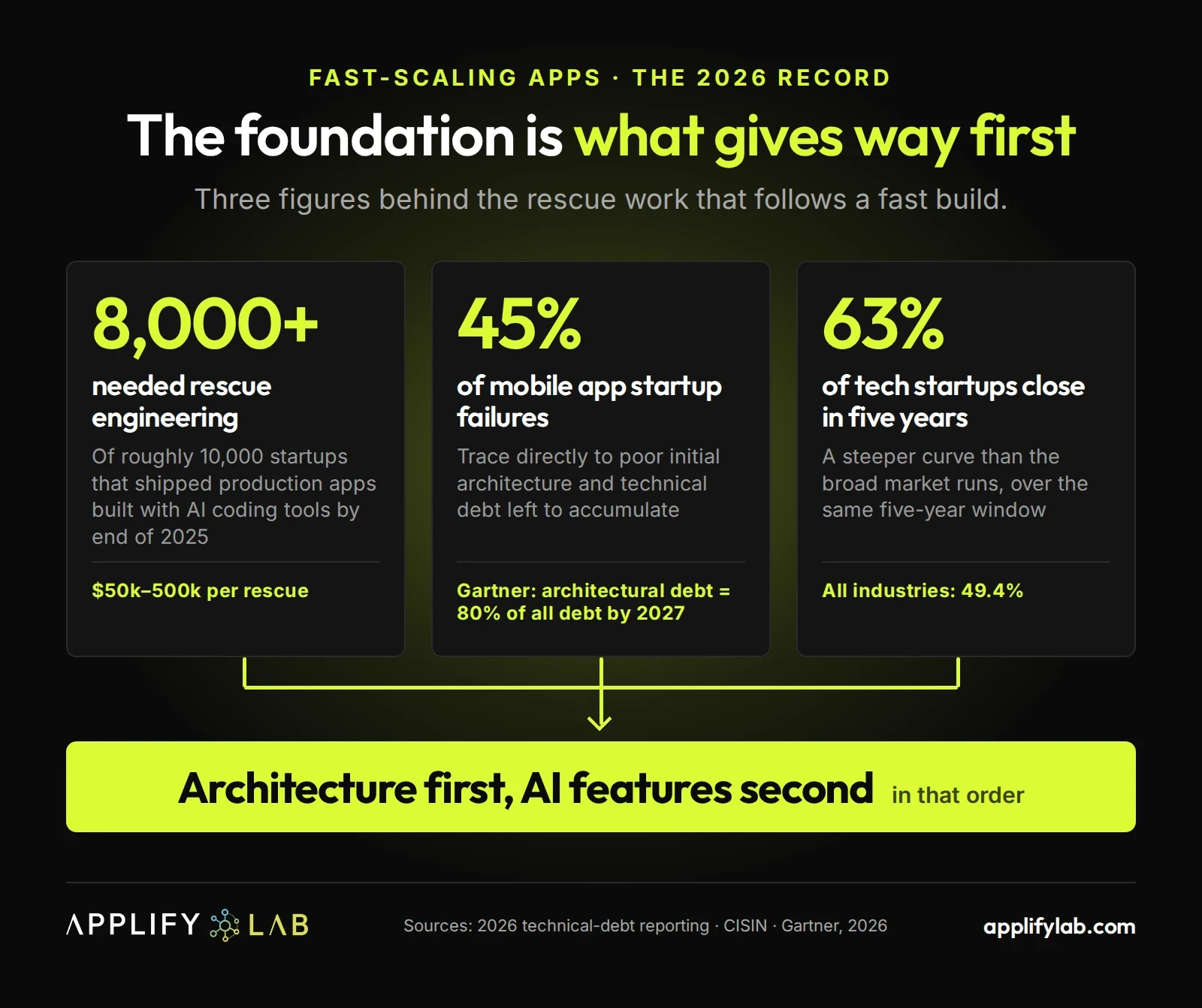
The real risk behind "move fast" — and why architecture comes before AI features.
The risk that's actually in front of you right now
45% of mobile app startup failures trace directly back to poor initial architecture and unmanaged technical debt — the mechanism is a foundation that couldn't hold the weight once real users showed up, more than a bad idea or a bad market.
Tech startups already fail faster than the broad average (63% within five years, against 49.4% across all industries), and Gartner projects architectural technical debt — the kind that lives in the connections between systems rather than inside any single module — will account for 80% of all technical debt by 2027.
If you're scaling fast, this is the risk that's front and center for you right now.
Why this matters more in the UAE right now, specifically
UAE startups raised $2B across 218 deals in 2025, with Q1 tech funding alone jumping 194% quarter-over-quarter to $872M — real, current capital chasing fast-growing businesses, with Dubai capturing 96% of that UAE tech funding. AI-focused startups made up 21% of companies backed by the Dubai Chamber of Digital Economy in 2025, and Enterprise Applications funding specifically jumped 664% quarter-over-quarter to AED 2.5B in the same period.
If you're building or scaling here, you're doing it in a market where investors, partners, and acquirers are increasingly going to look under the hood — a shaky foundation becomes a real liability in a due-diligence conversation, well beyond an engineering inconvenience.
Architecture first, AI features second — in that order
The mistake the rescue-engineering statistics above actually describe: building an AI feature (or a whole app) fast, then thinking about cost, security, and scalability later, once it's already popular and much more expensive to fix.
The better order: measure before you guess — you can't fix what you can't see — and design for scale from the start rather than retrofitting it under pressure.
Identify the one or two things that genuinely matter for your business over the next two to three years, and let the impressive-sounding checklist of every AI capability go.
Which AI capabilities are actually worth building, and when
Early stage (product-market fit not fully proven yet): solid instrumentation and analytics — knowing what users actually do — matter more than any AI feature. A simple classification or recommendation model is often enough; a custom ML pipeline usually waits.
Growth stage (real usage, real load, real support volume): automation earns its cost here — workflow automation, smarter support routing, and predictive alerts for operational issues before they become outages. This is also where architecture decisions made early either pay off or start costing real engineering time to unwind.
Scale stage (meaningful user base, meaningful data): predictive analytics and personalization genuinely earn their cost once you have enough real usage data to train on — building this earlier, on thin data, usually produces the "generic or frustrating" AI features that hype-driven roadmaps are full of.

Match the AI capability to your stage — build each once the data and load justify it.
AI capability by stage
Stage | Where you are | What actually earns its cost |
|---|---|---|
Early | Product-market fit not proven | Instrumentation, analytics; a simple model at most |
Growth | Real usage, load, support volume | Workflow automation, support routing, predictive alerts |
Scale | Meaningful users + data | Predictive analytics, personalization, full ML pipeline |
Unsure which stage your architecture decisions should match?
Tell us where you actually are — pre-traction, growing, or scaling — and what's breaking or about to break, and we'll tell you honestly what's worth building now versus later. Book a discovery call
What real architecture-first development looks like
Machine learning models, automation pipelines, and predictive analytics are only as good as the foundation they sit on — the same discipline applies whether you're adding a recommendation engine or a support chatbot.
We diagnose your actual growth stage, current architecture, and real bottleneck before proposing what to build, rather than proposing every AI capability that exists.
This is the same reason a fixed, one-size-fits-all price doesn't make sense here: a business at product-market-fit stage needs a fundamentally different scope than one already handling real load.
Already seeing cracks in your current app under real growth?
Message us with what's breaking, and we'll give you an honest read on whether it's an architecture problem, an AI-feature-you-don't-need-yet problem, or both.
Compliance and data handling
Whatever your app handles — user data, transaction data, behavioral data feeding an ML model — the UAE's PDPL applies, and architecture built to handle scale should build this in from day one rather than retrofitting compliance under a growing user base.
PDPL-compliant architecture typically adds 15-20% to build cost — real, worth budgeting for upfront rather than as an emergency patch later.
What it costs — including the cost of getting it wrong
Real 2026 UAE custom software benchmarks: general development runs AED 40,000-300,000 depending on complexity, with AI/ML capability typically adding 10-20% on top. Scoped by stage:
Early-stage build (solid architecture, instrumentation, no AI yet): roughly AED 90,000-185,000.
Growth-stage build (automation, workflow AI, predictive alerts): roughly AED 185,000-400,000.
Scale-stage build (personalization, predictive analytics, full ML pipeline): AED 400,000-900,000+.
Compare that to the real cost of getting the order wrong: rescue engineering on a shaky foundation runs $50,000-500,000 (roughly AED 183,000-1.8M) — often more than building it correctly the first time would have cost, on top of the growth momentum lost while it's being fixed.
Questions worth asking any partner
Have they actually rescued a scaling app with real technical debt before (with real rescue work, beyond greenfield projects), how do they decide which AI capabilities are worth building at your specific stage, and how do they design for the load you'll have in a year rather than just the load you have today. You own 100% of the code once it's built, with no proprietary lock-in — confirm this directly.
FAQ
Is AI really necessary for a fast-scaling app, or is this overhyped?
Real value comes from the right AI capability at the right stage, more than a checklist of every impressive-sounding AI feature. Solid architecture matters more early on; automation and predictive features earn their cost later, once you have real usage data to work with.
What's the real risk of scaling on a shaky technical foundation?
It's real and current: 8,000+ of roughly 10,000 startups that used AI coding tools for production apps by end of 2025 needed rescue engineering by mid-2026, at $50,000-500,000 per rescue. 45% of mobile app startup failures trace back to poor architecture and unmanaged technical debt.
How much does it cost to build a scalable app in the UAE?
Roughly AED 90,000-185,000 for an early-stage build with solid architecture, up to AED 400,000-900,000+ for a full scale-stage build with predictive analytics and personalization. AI/ML capability typically adds 10-20% on top of base development cost.
We already have an app and it's struggling under growth — is that a rebuild or a fix?
Depends on where the actual weak point is — sometimes it's a specific bottleneck, sometimes it's the foundation itself. Worth an honest technical read before assuming either a quick fix or a full rebuild is the answer.
When should we add predictive AI or personalization specifically?
Once you have enough real usage data to train on — building this on thin, early-stage data usually produces generic or frustrating results rather than a genuine advantage.
More than 8,000 of roughly 10,000 startups that used AI coding tools to build production apps by end of 2025 needed a partial rebuild or rescue engineering by mid-2026 — real rescue work costing $50,000 to $500,000, depending on how far the app scaled on top of a shaky foundation before the cracks showed.
That's the real risk behind "move fast" for a scaling business right now, and it's why the actual question is whether your architecture can support real growth before you add anything else on top of it — more than whether AI belongs in your app.
Key takeaways
The risk is architecture, not ambition: 8,000+ of ~10,000 AI-tool-built startups needed rescue engineering ($50k-500k each); 45% of mobile app failures trace to poor architecture and technical debt.
Architecture first, AI features second — in that order. Measure before you guess; design for scale from the start rather than retrofitting under pressure.
Match AI capability to stage: instrumentation early, automation at growth, predictive analytics + personalization at scale.
In the UAE this bites harder now — $2B raised in 2025, Dubai taking 96% of tech funding; investors increasingly look under the hood.
PDPL from day one (adds ~15-20% to build cost) beats retrofitting compliance under a growing user base.
Planning a custom app? See how we approach custom app and AI development in Dubai.
The real risk behind "move fast" — and why architecture comes before AI features.
The risk that's actually in front of you right now
45% of mobile app startup failures trace directly back to poor initial architecture and unmanaged technical debt — the mechanism is a foundation that couldn't hold the weight once real users showed up, more than a bad idea or a bad market.
Tech startups already fail faster than the broad average (63% within five years, against 49.4% across all industries), and Gartner projects architectural technical debt — the kind that lives in the connections between systems rather than inside any single module — will account for 80% of all technical debt by 2027.
If you're scaling fast, this is the risk that's front and center for you right now.
Why this matters more in the UAE right now, specifically
UAE startups raised $2B across 218 deals in 2025, with Q1 tech funding alone jumping 194% quarter-over-quarter to $872M — real, current capital chasing fast-growing businesses, with Dubai capturing 96% of that UAE tech funding. AI-focused startups made up 21% of companies backed by the Dubai Chamber of Digital Economy in 2025, and Enterprise Applications funding specifically jumped 664% quarter-over-quarter to AED 2.5B in the same period.
If you're building or scaling here, you're doing it in a market where investors, partners, and acquirers are increasingly going to look under the hood — a shaky foundation becomes a real liability in a due-diligence conversation, well beyond an engineering inconvenience.
Architecture first, AI features second — in that order
The mistake the rescue-engineering statistics above actually describe: building an AI feature (or a whole app) fast, then thinking about cost, security, and scalability later, once it's already popular and much more expensive to fix.
The better order: measure before you guess — you can't fix what you can't see — and design for scale from the start rather than retrofitting it under pressure.
Identify the one or two things that genuinely matter for your business over the next two to three years, and let the impressive-sounding checklist of every AI capability go.
Which AI capabilities are actually worth building, and when
Early stage (product-market fit not fully proven yet): solid instrumentation and analytics — knowing what users actually do — matter more than any AI feature. A simple classification or recommendation model is often enough; a custom ML pipeline usually waits.
Growth stage (real usage, real load, real support volume): automation earns its cost here — workflow automation, smarter support routing, and predictive alerts for operational issues before they become outages. This is also where architecture decisions made early either pay off or start costing real engineering time to unwind.
Scale stage (meaningful user base, meaningful data): predictive analytics and personalization genuinely earn their cost once you have enough real usage data to train on — building this earlier, on thin data, usually produces the "generic or frustrating" AI features that hype-driven roadmaps are full of.
Match the AI capability to your stage — build each once the data and load justify it.
AI capability by stage
Stage | Where you are | What actually earns its cost |
|---|---|---|
Early | Product-market fit not proven | Instrumentation, analytics; a simple model at most |
Growth | Real usage, load, support volume | Workflow automation, support routing, predictive alerts |
Scale | Meaningful users + data | Predictive analytics, personalization, full ML pipeline |
Unsure which stage your architecture decisions should match?
Tell us where you actually are — pre-traction, growing, or scaling — and what's breaking or about to break, and we'll tell you honestly what's worth building now versus later. Book a discovery call
What real architecture-first development looks like
Machine learning models, automation pipelines, and predictive analytics are only as good as the foundation they sit on — the same discipline applies whether you're adding a recommendation engine or a support chatbot.
We diagnose your actual growth stage, current architecture, and real bottleneck before proposing what to build, rather than proposing every AI capability that exists.
This is the same reason a fixed, one-size-fits-all price doesn't make sense here: a business at product-market-fit stage needs a fundamentally different scope than one already handling real load.
Already seeing cracks in your current app under real growth?
Message us with what's breaking, and we'll give you an honest read on whether it's an architecture problem, an AI-feature-you-don't-need-yet problem, or both.
Compliance and data handling
Whatever your app handles — user data, transaction data, behavioral data feeding an ML model — the UAE's PDPL applies, and architecture built to handle scale should build this in from day one rather than retrofitting compliance under a growing user base.
PDPL-compliant architecture typically adds 15-20% to build cost — real, worth budgeting for upfront rather than as an emergency patch later.
What it costs — including the cost of getting it wrong
Real 2026 UAE custom software benchmarks: general development runs AED 40,000-300,000 depending on complexity, with AI/ML capability typically adding 10-20% on top. Scoped by stage:
Early-stage build (solid architecture, instrumentation, no AI yet): roughly AED 90,000-185,000.
Growth-stage build (automation, workflow AI, predictive alerts): roughly AED 185,000-400,000.
Scale-stage build (personalization, predictive analytics, full ML pipeline): AED 400,000-900,000+.
Compare that to the real cost of getting the order wrong: rescue engineering on a shaky foundation runs $50,000-500,000 (roughly AED 183,000-1.8M) — often more than building it correctly the first time would have cost, on top of the growth momentum lost while it's being fixed.
Questions worth asking any partner
Have they actually rescued a scaling app with real technical debt before (with real rescue work, beyond greenfield projects), how do they decide which AI capabilities are worth building at your specific stage, and how do they design for the load you'll have in a year rather than just the load you have today. You own 100% of the code once it's built, with no proprietary lock-in — confirm this directly.
FAQ
Is AI really necessary for a fast-scaling app, or is this overhyped?
Real value comes from the right AI capability at the right stage, more than a checklist of every impressive-sounding AI feature. Solid architecture matters more early on; automation and predictive features earn their cost later, once you have real usage data to work with.
What's the real risk of scaling on a shaky technical foundation?
It's real and current: 8,000+ of roughly 10,000 startups that used AI coding tools for production apps by end of 2025 needed rescue engineering by mid-2026, at $50,000-500,000 per rescue. 45% of mobile app startup failures trace back to poor architecture and unmanaged technical debt.
How much does it cost to build a scalable app in the UAE?
Roughly AED 90,000-185,000 for an early-stage build with solid architecture, up to AED 400,000-900,000+ for a full scale-stage build with predictive analytics and personalization. AI/ML capability typically adds 10-20% on top of base development cost.
We already have an app and it's struggling under growth — is that a rebuild or a fix?
Depends on where the actual weak point is — sometimes it's a specific bottleneck, sometimes it's the foundation itself. Worth an honest technical read before assuming either a quick fix or a full rebuild is the answer.
When should we add predictive AI or personalization specifically?
Once you have enough real usage data to train on — building this on thin, early-stage data usually produces generic or frustrating results rather than a genuine advantage.
Ready to get an honest read on your app's architecture?
Book a discovery call — bring where you actually are in scaling and what's breaking or about to break.


