AI Agents & AI Automation
AI Automation for UAE Clinics & Retail Stores: What It Actually Means

By
Anh Nguyen, Founder
·
6 min

UAE retailers are already using AI agents to analyze pricing across thousands of products and simulate the impact of a markdown before it happens — work UiPath's regional VP for the Middle East and Africa calls a task that "exceeds human capabilities" to do manually.
If you run a clinic or retail store that's already operating, the real question is which part of your actual back-office operations is worth automating first, and what that costs — its reality here is already settled.
Key takeaways
This is about operations, not your customer-facing product. Automating the back-office work behind a clinic or store you already run — the booking app / storefront decisions live in other guides.
Clinics: admin work eats nearly 50% of clinical hours; automating billing reconciliation, claim-status tracking, and documentation cuts that load 40-60%.
Retail: AI agents already run price-elasticity analysis, inventory forecasting, and markdown optimization here, tuned to live stock rather than a fixed calendar.
An AI agent can also handle the conversational layer (front-desk / front-of-store, Arabic + English) — for a business that already has customers or patients to reach.
Governance is the real risk. Ungoverned "shadow AI" connected to ERP and customer data needs an approval-and-audit layer built in from day one.
Planning a custom app? See how we approach custom app and AI development in Dubai.

Where operational AI pays off — a clinic side and a retail side of the same underlying decision.
Two different businesses, one real underlying decision
This post covers operational automation specifically — the back-office work of running a clinic or store you already have, distinct from the customer-facing product decision.
If you're deciding whether to build a booking app or patient portal for your clinic, see our clinic appointment guide instead.
If you're deciding whether to build a custom storefront or marketplace app, see our custom ecommerce or marketplace guides.
What follows is specifically about automating the operations behind whichever front-end you already have — or plan to build separately.
For clinics: where administrative automation actually pays off
Administrative work is where a small clinic loses the most time, more than clinical work — globally, healthcare professionals spend nearly 50% of their working hours on tasks like insurance claims chasing, manual data entry across disconnected systems, and transcribing handwritten notes rather than treating patients.
Automation targeting billing reconciliation, insurance claim status tracking, and structured documentation has been shown to cut that administrative load by 40-60%, reclaiming real physician time — a global benchmark rather than a UAE-verified figure, though the underlying pain point (small clinics handling admin work with minimal support staff) is one we hear directly from UAE clinic owners.
For retail stores: where AI already earns its cost here
This is already real for UAE retail — it's happening now. AI agents connecting to ERP, POS, and e-commerce systems are being used here for real-time price elasticity analysis, inventory replenishment forecasting, and markdown/promotion optimization tuned to current stock levels rather than a fixed calendar.
Globally, inventory shrinkage (theft, fraud, and process error combined) runs around 1.6% of sales industry-wide — a real, if global, number worth benchmarking your own losses against, since a genuine UAE figure stays unverifiable for now.
Clinic vs. retail: where automation lands first
Clinic | Retail store | |
|---|---|---|
Biggest time/loss sink | ~50% of hours on admin | Shrinkage ~1.6% of sales (global) |
What automation targets | Billing reconciliation, claim tracking, documentation | Price elasticity, inventory forecasting, markdown timing |
Connects to | Practice/EMR + billing systems | ERP, POS, e-commerce |
Typical payoff | 40-60% admin-load cut, reclaimed physician hours | Cost reduction in the workflows it touches |
Unsure which part of your operations is worth automating first?
Tell us your business type, current biggest operational headache, and what systems you already run, and we'll tell you honestly which automation earns its cost fastest for you.
The AI-agent option, for both
Beyond back-office automation, an AI agent can handle the front-desk or front-of-store conversational layer — answering routine questions, confirming appointments or order status, and running personalized re-engagement — in Arabic and English, for a clinic or store that already has patients or customers to reach.
This makes sense only when you already have that base to message, which is why we reserve it for operating businesses rather than someone still building from scratch.
Pricing depends on your query volume and channels — scoped on a call rather than a fixed number here, since a generic package would mean either overselling capability you don't need or underscoping what actually handles your volume.
The real risk worth naming honestly
Most AI automation content sells the upside and skips the risk. Here's the one worth taking seriously: as AI agents connect directly to ERP systems, customer data, and transaction processing, ungoverned "shadow AI" — staff using unapproved AI tools outside any oversight — becomes a materially bigger risk than the unauthorized-spreadsheet version of this problem a decade ago, since these systems can process customer information and initiate actions autonomously.
Any automation project worth doing needs a governance layer from day one: who can approve what an agent does, and the ability to reconstruct why it made a given decision — built in before something goes wrong.
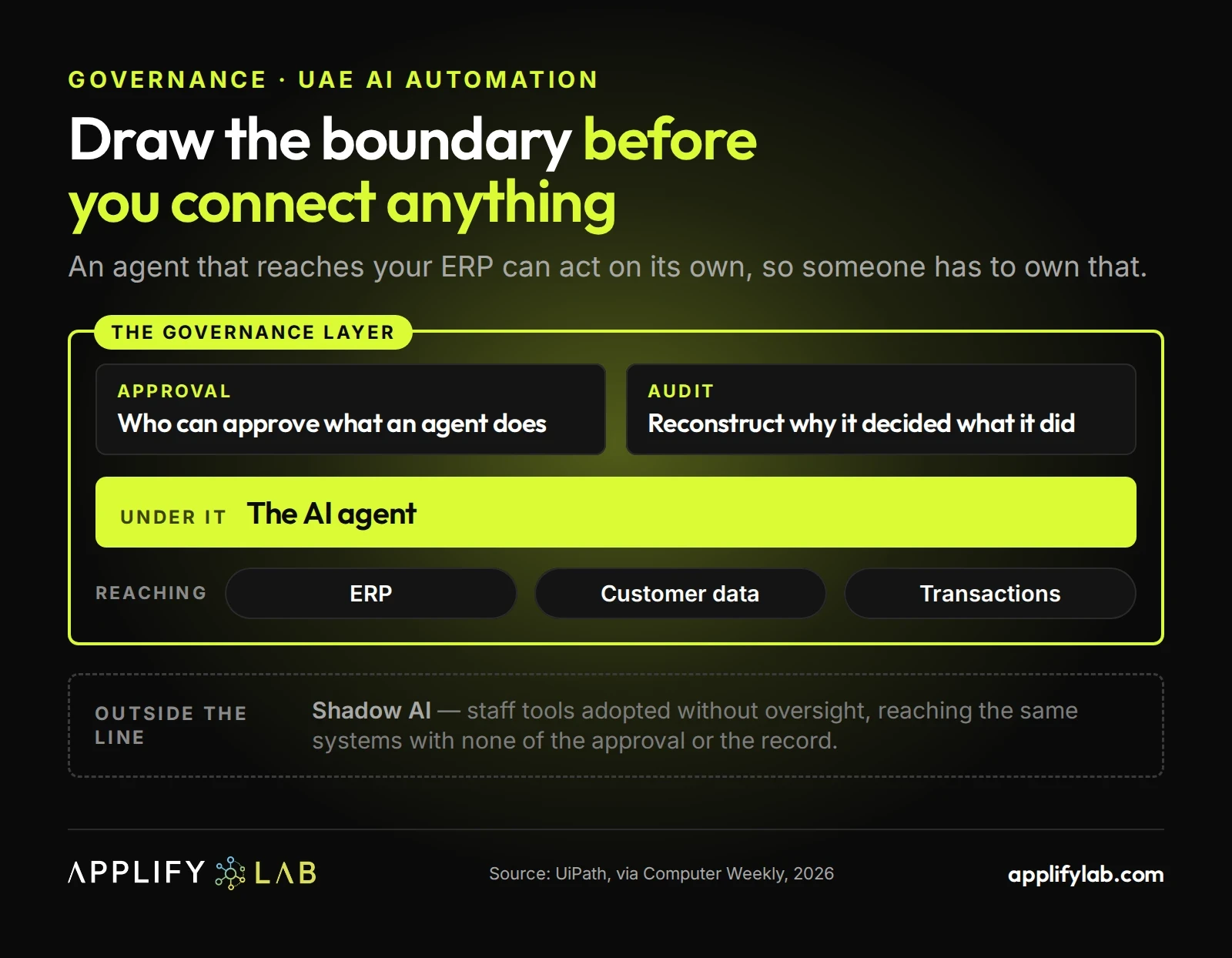
The layer most guides skip: governance built in from day one, not after something goes wrong.
Compliance and data handling
Customer and patient data used in any automation workflow falls under the UAE's PDPL — encryption, access controls, and clear data-handling policies are baseline.
If your clinic is connecting automation to clinical records specifically, see our digital health compliance guide for the fuller DHA/NABIDH picture; a pure operational/back-office automation layer generally sits at a lighter compliance tier than that.
What it costs
Real 2026 UAE benchmarks: general custom software development runs AED 40,000-300,000 here, and AI/ML capability typically adds 10-20% on top, with PDPL-compliant architecture adding another 15-20%. Scoped to clinic and store operational automation specifically:
Single-workflow automation (e.g., AI billing/insurance reconciliation for a clinic, or AI inventory reordering for a store): roughly AED 55,000–130,000.
Multi-workflow rollout (back-office automation plus the AI-agent front-desk/customer layer together): roughly AED 150,000–320,000.
Full operational AI layer across multiple locations: AED 350,000–750,000+.
The range reflects the same principle as everywhere else in how we scope work: a single fixed number would mean either overselling automation you don't need yet or underscoping what a multi-location operation actually requires.
Questions worth asking any partner
Have they built automation that integrates with the specific systems you already run (a real integration, beyond a generic API claim), how do they handle governance and oversight for anything that acts autonomously, and how would they sequence a rollout instead of pricing everything as one project.
You own 100% of the code once it's built, with no proprietary lock-in — confirm this directly.
FAQ
Is AI automation actually happening in UAE clinics and stores, or is this still early?
Real and current for retail specifically — UAE retailers are already using AI agents for pricing, inventory, and promotion decisions as of 2026. For clinics, the administrative-burden problem is well-documented globally; UAE clinic owners report the same pain even where a UAE-specific automation-adoption number stays unverified for now.
How much does operational AI automation cost for a clinic or store in the UAE?
Roughly AED 55,000–130,000 for a single-workflow automation, up to AED 350,000–750,000+ for a full multi-location operational layer. AI/ML capability typically adds 10-20% on top of standard custom software costs.
What's the biggest risk with AI automation most guides don't mention?
Governance — "shadow AI" tools adopted by staff outside any oversight, especially once agents connect to ERP systems or customer data directly. Any real automation project needs a governance layer (who can approve what an agent does) from the start.
Is this the same as building a booking app or online store?
No — this covers automating the operations behind whichever customer-facing product you have. For the booking/patient-portal decision, see our clinic appointment guide; for the storefront decision, see our custom ecommerce or marketplace guides.
Can an AI agent handle customer or patient conversations directly?
Yes, for a clinic or store that already has patients or customers to reach — it can answer routine questions and handle confirmations in Arabic and English. It becomes relevant once you have a customer base, rather than while you're still building it from scratch.
UAE retailers are already using AI agents to analyze pricing across thousands of products and simulate the impact of a markdown before it happens — work UiPath's regional VP for the Middle East and Africa calls a task that "exceeds human capabilities" to do manually.
If you run a clinic or retail store that's already operating, the real question is which part of your actual back-office operations is worth automating first, and what that costs — its reality here is already settled.
Key takeaways
This is about operations, not your customer-facing product. Automating the back-office work behind a clinic or store you already run — the booking app / storefront decisions live in other guides.
Clinics: admin work eats nearly 50% of clinical hours; automating billing reconciliation, claim-status tracking, and documentation cuts that load 40-60%.
Retail: AI agents already run price-elasticity analysis, inventory forecasting, and markdown optimization here, tuned to live stock rather than a fixed calendar.
An AI agent can also handle the conversational layer (front-desk / front-of-store, Arabic + English) — for a business that already has customers or patients to reach.
Governance is the real risk. Ungoverned "shadow AI" connected to ERP and customer data needs an approval-and-audit layer built in from day one.
Planning a custom app? See how we approach custom app and AI development in Dubai.
Where operational AI pays off — a clinic side and a retail side of the same underlying decision.
Two different businesses, one real underlying decision
This post covers operational automation specifically — the back-office work of running a clinic or store you already have, distinct from the customer-facing product decision.
If you're deciding whether to build a booking app or patient portal for your clinic, see our clinic appointment guide instead.
If you're deciding whether to build a custom storefront or marketplace app, see our custom ecommerce or marketplace guides.
What follows is specifically about automating the operations behind whichever front-end you already have — or plan to build separately.
For clinics: where administrative automation actually pays off
Administrative work is where a small clinic loses the most time, more than clinical work — globally, healthcare professionals spend nearly 50% of their working hours on tasks like insurance claims chasing, manual data entry across disconnected systems, and transcribing handwritten notes rather than treating patients.
Automation targeting billing reconciliation, insurance claim status tracking, and structured documentation has been shown to cut that administrative load by 40-60%, reclaiming real physician time — a global benchmark rather than a UAE-verified figure, though the underlying pain point (small clinics handling admin work with minimal support staff) is one we hear directly from UAE clinic owners.
For retail stores: where AI already earns its cost here
This is already real for UAE retail — it's happening now. AI agents connecting to ERP, POS, and e-commerce systems are being used here for real-time price elasticity analysis, inventory replenishment forecasting, and markdown/promotion optimization tuned to current stock levels rather than a fixed calendar.
Globally, inventory shrinkage (theft, fraud, and process error combined) runs around 1.6% of sales industry-wide — a real, if global, number worth benchmarking your own losses against, since a genuine UAE figure stays unverifiable for now.
Clinic vs. retail: where automation lands first
Clinic | Retail store | |
|---|---|---|
Biggest time/loss sink | ~50% of hours on admin | Shrinkage ~1.6% of sales (global) |
What automation targets | Billing reconciliation, claim tracking, documentation | Price elasticity, inventory forecasting, markdown timing |
Connects to | Practice/EMR + billing systems | ERP, POS, e-commerce |
Typical payoff | 40-60% admin-load cut, reclaimed physician hours | Cost reduction in the workflows it touches |
Unsure which part of your operations is worth automating first?
Tell us your business type, current biggest operational headache, and what systems you already run, and we'll tell you honestly which automation earns its cost fastest for you.
The AI-agent option, for both
Beyond back-office automation, an AI agent can handle the front-desk or front-of-store conversational layer — answering routine questions, confirming appointments or order status, and running personalized re-engagement — in Arabic and English, for a clinic or store that already has patients or customers to reach.
This makes sense only when you already have that base to message, which is why we reserve it for operating businesses rather than someone still building from scratch.
Pricing depends on your query volume and channels — scoped on a call rather than a fixed number here, since a generic package would mean either overselling capability you don't need or underscoping what actually handles your volume.
The real risk worth naming honestly
Most AI automation content sells the upside and skips the risk. Here's the one worth taking seriously: as AI agents connect directly to ERP systems, customer data, and transaction processing, ungoverned "shadow AI" — staff using unapproved AI tools outside any oversight — becomes a materially bigger risk than the unauthorized-spreadsheet version of this problem a decade ago, since these systems can process customer information and initiate actions autonomously.
Any automation project worth doing needs a governance layer from day one: who can approve what an agent does, and the ability to reconstruct why it made a given decision — built in before something goes wrong.
The layer most guides skip: governance built in from day one, not after something goes wrong.
Compliance and data handling
Customer and patient data used in any automation workflow falls under the UAE's PDPL — encryption, access controls, and clear data-handling policies are baseline.
If your clinic is connecting automation to clinical records specifically, see our digital health compliance guide for the fuller DHA/NABIDH picture; a pure operational/back-office automation layer generally sits at a lighter compliance tier than that.
What it costs
Real 2026 UAE benchmarks: general custom software development runs AED 40,000-300,000 here, and AI/ML capability typically adds 10-20% on top, with PDPL-compliant architecture adding another 15-20%. Scoped to clinic and store operational automation specifically:
Single-workflow automation (e.g., AI billing/insurance reconciliation for a clinic, or AI inventory reordering for a store): roughly AED 55,000–130,000.
Multi-workflow rollout (back-office automation plus the AI-agent front-desk/customer layer together): roughly AED 150,000–320,000.
Full operational AI layer across multiple locations: AED 350,000–750,000+.
The range reflects the same principle as everywhere else in how we scope work: a single fixed number would mean either overselling automation you don't need yet or underscoping what a multi-location operation actually requires.
Questions worth asking any partner
Have they built automation that integrates with the specific systems you already run (a real integration, beyond a generic API claim), how do they handle governance and oversight for anything that acts autonomously, and how would they sequence a rollout instead of pricing everything as one project.
You own 100% of the code once it's built, with no proprietary lock-in — confirm this directly.
FAQ
Is AI automation actually happening in UAE clinics and stores, or is this still early?
Real and current for retail specifically — UAE retailers are already using AI agents for pricing, inventory, and promotion decisions as of 2026. For clinics, the administrative-burden problem is well-documented globally; UAE clinic owners report the same pain even where a UAE-specific automation-adoption number stays unverified for now.
How much does operational AI automation cost for a clinic or store in the UAE?
Roughly AED 55,000–130,000 for a single-workflow automation, up to AED 350,000–750,000+ for a full multi-location operational layer. AI/ML capability typically adds 10-20% on top of standard custom software costs.
What's the biggest risk with AI automation most guides don't mention?
Governance — "shadow AI" tools adopted by staff outside any oversight, especially once agents connect to ERP systems or customer data directly. Any real automation project needs a governance layer (who can approve what an agent does) from the start.
Is this the same as building a booking app or online store?
No — this covers automating the operations behind whichever customer-facing product you have. For the booking/patient-portal decision, see our clinic appointment guide; for the storefront decision, see our custom ecommerce or marketplace guides.
Can an AI agent handle customer or patient conversations directly?
Yes, for a clinic or store that already has patients or customers to reach — it can answer routine questions and handle confirmations in Arabic and English. It becomes relevant once you have a customer base, rather than while you're still building it from scratch.
Ready to scope this for your clinic or store?
Book a discovery call — bring your biggest operational headache and what systems you already run, and we'll map out what to automate first.
RELATED GUIDES

AI Agents & AI Automation
WhatsApp Business API in the UAE: Cost and Setup (2026)
16 min

Retail & E-commerce
AI Automation for Restaurants in Dubai: Workflows, Real Costs & Where to Start
7 min

Health & Wellness
Digital Health App Development in UAE: Costs, Features & Compliance
6 min

Retail & E-commerce
Custom Ecommerce App Development in Dubai: What It Actually Costs in 2026
10 min

Health & Wellness
Clinic Appointment & Patient Portal App Development in Dubai
7 min

Retail & E-commerce
Foodics vs Odoo vs Custom AI: Best System for Dubai Restaurants
7 min