Health & Wellness
Clinic Appointment & Patient Portal App Development in Dubai

By
Anh Nguyen, Founder
·
7 min

UAE clinics face an estimated 37% no-show rate — Dubai Healthcare City built an entire online appointment system specifically to bring that number down. Automated reminders alone cut no-shows by 40-60%.
If you're running a clinic and still relying on phone-based scheduling, the real decision is how you fix it: build the fix into an app, hand it to an AI agent that handles reminders and rescheduling conversationally, or do both.
And if you want patients to keep using the app after their visit — checking results, messaging you, skipping the phone call — that's a second, related decision: whether you need a full patient portal, and what that adds to scope and compliance.
Key takeaways
The no-show problem is solvable, and it pays back. 37% no-show rate UAE-wide (21% at some facilities); automated reminders cut it 40-60%. Patients mostly forget (50%) or can't call in time to cancel (40%) — a timing problem, fixable.
Three ways to fix it: build booking + reminders into your app, hand reminders/rescheduling to an AI agent, or phase both. The right one depends on whether a full patient app is a long-term investment for your clinic.
Arabic support is a trust signal, designed in from the start — RTL layout, seamless dual-language switching, correct clinical register, and readability for older patients.
A patient portal is the feature that raises your compliance tier. Booking + reminders stays lighter (PDPL-level); exchanging records, results, or prescriptions with clinical systems moves you into NABIDH/Malaffi territory.
Cost tracks scope: ~AED 37k-73k basic, ~AED 73k-150k mid-scale, AED 180k+ once you add a full portal and EMR/EHR integration.
Building a health or wellness product in the UAE? See how we build healthcare and wellness apps.
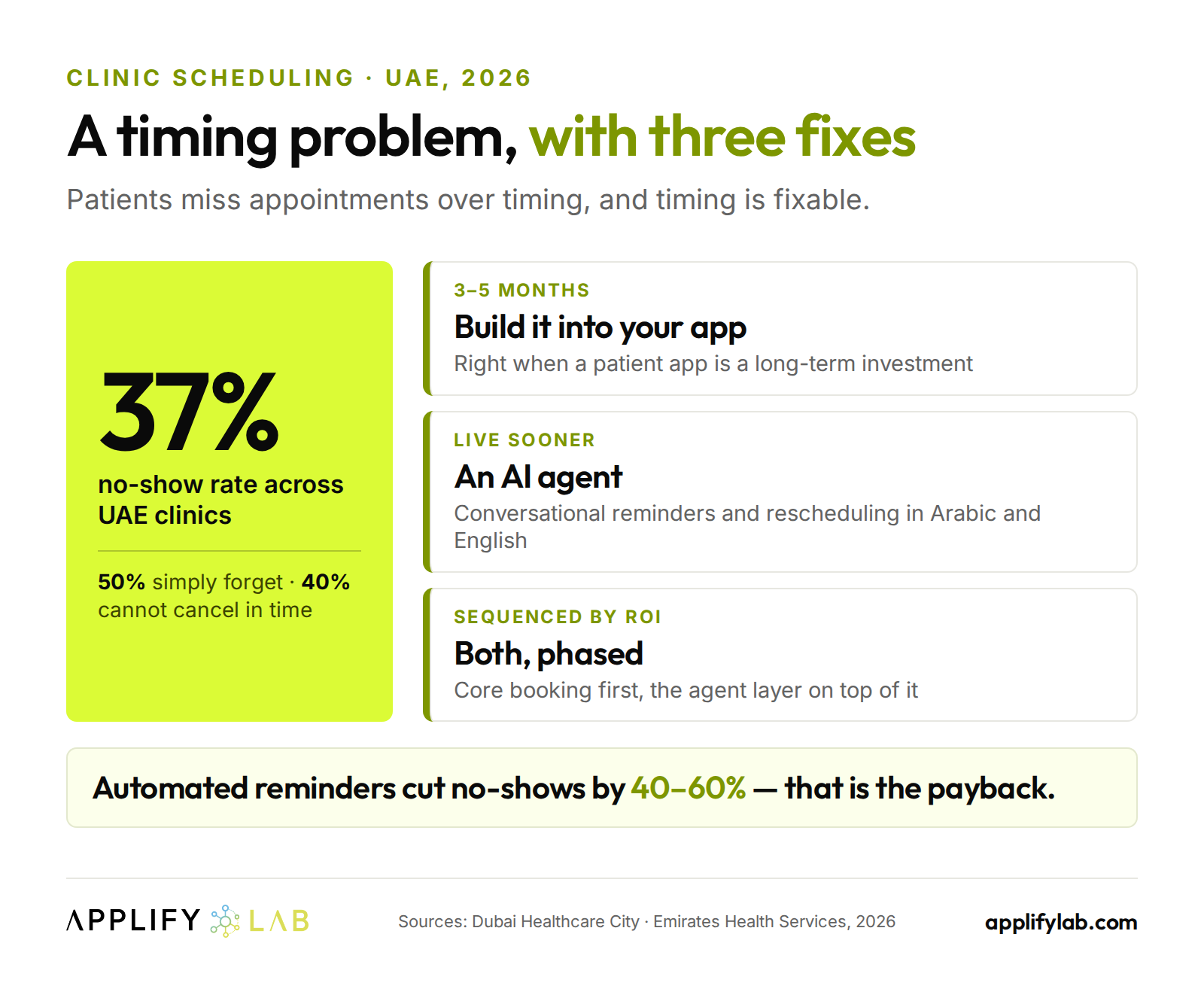
The no-show problem, and the three ways UAE clinics fix it.
Why phone-based scheduling is actually costing you
Phone scheduling consumes front-desk time, creates double-booking errors, and caps your availability to office hours. The real cost shows up in the no-show number: 37% UAE-wide by one estimate, though it varies by facility (Emirates Health Services primary care centers recorded 21%).
Patients are acting reasonably — 50% simply forget, and 40% can't reach you in time to cancel. That's a timing problem the right reminders solve, rather than a patient-behavior problem you're stuck with.
Two ways to actually fix this
Build booking and reminders into your app. Online booking, automated push/SMS/email reminders, rescheduling, and patient profiles — a permanent capability you build once. Cleveland Clinic Abu Dhabi's patient portal is a real example of this done well: same-day booking, secure messaging, multi-lingual support, and test results in one place. This is the right path if a full patient app is a genuine long-term investment for your clinic that goes beyond a scheduling fix.
An AI agent that handles reminders and rescheduling conversationally. Instead of building reminder logic and a booking UI from scratch, an AI customer-engagement agent can message patients in Arabic and English about upcoming appointments, handle simple rescheduling requests, and answer common questions (hours, location, what to bring) — 24/7, with front-desk staff freed from the volume. It's a genuinely faster way to capture most of the same no-show reduction while a full app waits for the right time. Pricing depends on your patient volume and which channels you need — scoped on a call rather than a fixed number here.
Both, phased. Build the core booking experience and let an AI agent handle the proactive reminder and rescheduling layer on top — start with whichever fixes your no-show problem fastest, then extend.
Fix paths at a glance
Path | Best when | What it delivers | Speed to live |
|---|---|---|---|
Build into your app | A full patient app is a long-term investment | Owned booking, reminders, rescheduling, profiles | Slower (3-5 months) |
AI agent | You want the no-show win fast, app can wait | Conversational reminders + rescheduling in AR/EN, 24/7 | Faster (no patient app to build first) |
Both, phased | You want both, sequenced by ROI | Core booking now, agent layer on top | Start with the faster win, then extend |
Unsure whether a full app or a lighter agent-based fix makes more sense for your clinic?
Tell us your patient volume and current no-show rate, and we'll tell you honestly which path earns its cost first.
Arabic support: more than a translation toggle
Arabic remains the primary language of comfort for many UAE patients, especially older ones, and getting this right is a genuine trust signal that patients feel:
RTL layout has to be designed in from the start — it affects navigation, button placement, and form layout throughout, well beyond text direction.
Dual-language switching should be seamless, since most Dubai clinics serve both Arabic- and English-speaking patients in the same day.
Medical terminology and tone matter as much as translation accuracy. A literal translation that misses the appropriate clinical register or cultural tone undermines the trust this feature is supposed to build.
Readability for older patients specifically — larger touch targets, clear typography, simple navigation — matters more here than in a general consumer app, since older Arabic-speaking patients are disproportionately the ones avoiding phone scheduling in the first place.
Core features, by who's using them
Patients: online booking with real-time doctor availability, automated reminders, rescheduling/cancellation, secure profiles with appointment history, digital pre-visit forms, and secure messaging for updates.
Doctors and front desk: daily schedule dashboards, patient history access, and staff tools to block/adjust availability and manage cancellations without phone tag.
Patient portal: records, results, and messaging between visits
A patient portal is the secure area of the app where patients view their own health information after they log in — medical history, lab results, prescriptions, and secure messaging with your clinic — instead of calling for every follow-up.
Cleveland Clinic Abu Dhabi's app is a real example of this working well: patients view health history and medication, message their doctor with non-urgent questions, check test results, and request prescription refills, all in the same app they use to book.
This is genuinely worth building if you want the app to be something patients open between visits, as a real retention and trust mechanism rather than an admin convenience. What it requires, specifically:
Authentication that matches the sensitivity of what's behind it — multi-factor authentication, role-based access (patient vs. doctor vs. staff see different things), and session timeouts, going well beyond a simple login screen.
Encryption at rest and in transit for everything in the portal, on top of the baseline security any clinic app needs.
Design that builds trust as it displays data — confirmation messages for actions taken, plain language in place of clinical jargon, and a calm, uncluttered layout. Patients are more likely to actually use a portal that feels approachable rather than like reading a lab report cold.
The important trade-off: a patient portal is exactly the feature that triggers the higher compliance tier. The moment your app exchanges medical records, lab results, or prescriptions with the clinic's clinical systems, you're generally in NABIDH/Malaffi territory (Dubai/Abu Dhabi respectively) if connecting to licensed facilities — beyond PDPL-level data handling. That's a real scope and cost decision to make deliberately, rather than a feature to add because it sounds valuable.

The line that changes your scope: a patient portal is what pushes a clinic app into the higher compliance tier.
Compliance and data security, briefly
A pure booking-and-reminders app sits at a lighter compliance tier than one with a patient portal — you're generally free of the NABIDH or Malaffi connection unless you're handling e-prescriptions, lab results, or medical records through the app (which a patient portal typically does).
You do still need PDPL-compliant data handling, encryption, and role-based access at every scope. If you're adding a patient portal or any clinical-record exchange, see our full digital health compliance guide for the complete NABIDH/Malaffi breakdown rather than us repeating it here.
What it costs
A clinic-appointment app is typically a lighter build than a full digital health platform:
Basic (booking, reminders, Arabic support): roughly AED 37,000–73,000.
Mid-scale (patient profiles, digital forms, doctor dashboards, staff tools): roughly AED 73,000–150,000.
Advanced (patient portal with records/results access, EMR/EHR integration, multi-location, deeper compliance): AED 180,000+ — at this point you're closer to the digital-health platform tier covered in our cost and compliance guide.
We'd rather tell you honestly which tier your clinic actually needs — and whether an AI agent gets you most of the way there faster — than quote a number before we know your patient volume and current setup.
FAQ
Do clinic apps in Dubai need Arabic support?
Yes, genuinely — as a trust signal rather than a translation checkbox, especially for older patients who are disproportionately the ones avoiding phone-based scheduling today.
How much does a clinic appointment app cost in Dubai?
Roughly AED 37,000–73,000 for a basic booking-and-reminders app, up to AED 150,000 for a mid-scale build with patient profiles and staff tools. Anything requiring EMR integration moves into full digital-health-platform pricing.
Will an AI agent actually reduce our no-show rate?
Automated reminders (SMS, push, or conversational) are shown to reduce no-shows by 40-60% — the mechanism that matters is consistent, well-timed reminders reaching the patient before they forget or run out of time to cancel, which an AI agent can handle without a full app build.
Does our app need to connect to NABIDH or Malaffi?
Only if you're exchanging clinical data (e-prescriptions, lab results, medical records) with other facilities — a pure booking-and-reminders app generally stays clear of this. See our digital health compliance guide if you're planning to add clinical features later.
How long does it take to build?
A basic clinic appointment app typically takes 3-5 months. An AI-agent-based fix for reminders and rescheduling can be live faster, since there's no patient-facing app to build first. Adding a full patient portal extends the timeline, mainly due to the security and compliance work rather than the UI.
Do I need a full patient portal, or is booking + reminders enough?
Depends on whether you want patients using the app between visits (checking results, messaging you) or just for booking. A portal is a real retention and trust feature, and it's also what triggers NABIDH/Malaffi-level compliance if you're exchanging clinical data — worth deciding deliberately rather than adding by default.
Is patient data safe in a portal like this?
Yes, when built with proper authentication (MFA, role-based access), encryption at rest and in transit, and UAE PDPL-compliant data handling — security has to be built into every layer from the start.
To go further
UAE clinics face an estimated 37% no-show rate — Dubai Healthcare City built an entire online appointment system specifically to bring that number down. Automated reminders alone cut no-shows by 40-60%.
If you're running a clinic and still relying on phone-based scheduling, the real decision is how you fix it: build the fix into an app, hand it to an AI agent that handles reminders and rescheduling conversationally, or do both.
And if you want patients to keep using the app after their visit — checking results, messaging you, skipping the phone call — that's a second, related decision: whether you need a full patient portal, and what that adds to scope and compliance.
Key takeaways
The no-show problem is solvable, and it pays back. 37% no-show rate UAE-wide (21% at some facilities); automated reminders cut it 40-60%. Patients mostly forget (50%) or can't call in time to cancel (40%) — a timing problem, fixable.
Three ways to fix it: build booking + reminders into your app, hand reminders/rescheduling to an AI agent, or phase both. The right one depends on whether a full patient app is a long-term investment for your clinic.
Arabic support is a trust signal, designed in from the start — RTL layout, seamless dual-language switching, correct clinical register, and readability for older patients.
A patient portal is the feature that raises your compliance tier. Booking + reminders stays lighter (PDPL-level); exchanging records, results, or prescriptions with clinical systems moves you into NABIDH/Malaffi territory.
Cost tracks scope: ~AED 37k-73k basic, ~AED 73k-150k mid-scale, AED 180k+ once you add a full portal and EMR/EHR integration.
Building a health or wellness product in the UAE? See how we build healthcare and wellness apps.
The no-show problem, and the three ways UAE clinics fix it.
Why phone-based scheduling is actually costing you
Phone scheduling consumes front-desk time, creates double-booking errors, and caps your availability to office hours. The real cost shows up in the no-show number: 37% UAE-wide by one estimate, though it varies by facility (Emirates Health Services primary care centers recorded 21%).
Patients are acting reasonably — 50% simply forget, and 40% can't reach you in time to cancel. That's a timing problem the right reminders solve, rather than a patient-behavior problem you're stuck with.
Two ways to actually fix this
Build booking and reminders into your app. Online booking, automated push/SMS/email reminders, rescheduling, and patient profiles — a permanent capability you build once. Cleveland Clinic Abu Dhabi's patient portal is a real example of this done well: same-day booking, secure messaging, multi-lingual support, and test results in one place. This is the right path if a full patient app is a genuine long-term investment for your clinic that goes beyond a scheduling fix.
An AI agent that handles reminders and rescheduling conversationally. Instead of building reminder logic and a booking UI from scratch, an AI customer-engagement agent can message patients in Arabic and English about upcoming appointments, handle simple rescheduling requests, and answer common questions (hours, location, what to bring) — 24/7, with front-desk staff freed from the volume. It's a genuinely faster way to capture most of the same no-show reduction while a full app waits for the right time. Pricing depends on your patient volume and which channels you need — scoped on a call rather than a fixed number here.
Both, phased. Build the core booking experience and let an AI agent handle the proactive reminder and rescheduling layer on top — start with whichever fixes your no-show problem fastest, then extend.
Fix paths at a glance
Path | Best when | What it delivers | Speed to live |
|---|---|---|---|
Build into your app | A full patient app is a long-term investment | Owned booking, reminders, rescheduling, profiles | Slower (3-5 months) |
AI agent | You want the no-show win fast, app can wait | Conversational reminders + rescheduling in AR/EN, 24/7 | Faster (no patient app to build first) |
Both, phased | You want both, sequenced by ROI | Core booking now, agent layer on top | Start with the faster win, then extend |
Unsure whether a full app or a lighter agent-based fix makes more sense for your clinic?
Tell us your patient volume and current no-show rate, and we'll tell you honestly which path earns its cost first.
Arabic support: more than a translation toggle
Arabic remains the primary language of comfort for many UAE patients, especially older ones, and getting this right is a genuine trust signal that patients feel:
RTL layout has to be designed in from the start — it affects navigation, button placement, and form layout throughout, well beyond text direction.
Dual-language switching should be seamless, since most Dubai clinics serve both Arabic- and English-speaking patients in the same day.
Medical terminology and tone matter as much as translation accuracy. A literal translation that misses the appropriate clinical register or cultural tone undermines the trust this feature is supposed to build.
Readability for older patients specifically — larger touch targets, clear typography, simple navigation — matters more here than in a general consumer app, since older Arabic-speaking patients are disproportionately the ones avoiding phone scheduling in the first place.
Core features, by who's using them
Patients: online booking with real-time doctor availability, automated reminders, rescheduling/cancellation, secure profiles with appointment history, digital pre-visit forms, and secure messaging for updates.
Doctors and front desk: daily schedule dashboards, patient history access, and staff tools to block/adjust availability and manage cancellations without phone tag.
Patient portal: records, results, and messaging between visits
A patient portal is the secure area of the app where patients view their own health information after they log in — medical history, lab results, prescriptions, and secure messaging with your clinic — instead of calling for every follow-up.
Cleveland Clinic Abu Dhabi's app is a real example of this working well: patients view health history and medication, message their doctor with non-urgent questions, check test results, and request prescription refills, all in the same app they use to book.
This is genuinely worth building if you want the app to be something patients open between visits, as a real retention and trust mechanism rather than an admin convenience. What it requires, specifically:
Authentication that matches the sensitivity of what's behind it — multi-factor authentication, role-based access (patient vs. doctor vs. staff see different things), and session timeouts, going well beyond a simple login screen.
Encryption at rest and in transit for everything in the portal, on top of the baseline security any clinic app needs.
Design that builds trust as it displays data — confirmation messages for actions taken, plain language in place of clinical jargon, and a calm, uncluttered layout. Patients are more likely to actually use a portal that feels approachable rather than like reading a lab report cold.
The important trade-off: a patient portal is exactly the feature that triggers the higher compliance tier. The moment your app exchanges medical records, lab results, or prescriptions with the clinic's clinical systems, you're generally in NABIDH/Malaffi territory (Dubai/Abu Dhabi respectively) if connecting to licensed facilities — beyond PDPL-level data handling. That's a real scope and cost decision to make deliberately, rather than a feature to add because it sounds valuable.
The line that changes your scope: a patient portal is what pushes a clinic app into the higher compliance tier.
Compliance and data security, briefly
A pure booking-and-reminders app sits at a lighter compliance tier than one with a patient portal — you're generally free of the NABIDH or Malaffi connection unless you're handling e-prescriptions, lab results, or medical records through the app (which a patient portal typically does).
You do still need PDPL-compliant data handling, encryption, and role-based access at every scope. If you're adding a patient portal or any clinical-record exchange, see our full digital health compliance guide for the complete NABIDH/Malaffi breakdown rather than us repeating it here.
What it costs
A clinic-appointment app is typically a lighter build than a full digital health platform:
Basic (booking, reminders, Arabic support): roughly AED 37,000–73,000.
Mid-scale (patient profiles, digital forms, doctor dashboards, staff tools): roughly AED 73,000–150,000.
Advanced (patient portal with records/results access, EMR/EHR integration, multi-location, deeper compliance): AED 180,000+ — at this point you're closer to the digital-health platform tier covered in our cost and compliance guide.
We'd rather tell you honestly which tier your clinic actually needs — and whether an AI agent gets you most of the way there faster — than quote a number before we know your patient volume and current setup.
FAQ
Do clinic apps in Dubai need Arabic support?
Yes, genuinely — as a trust signal rather than a translation checkbox, especially for older patients who are disproportionately the ones avoiding phone-based scheduling today.
How much does a clinic appointment app cost in Dubai?
Roughly AED 37,000–73,000 for a basic booking-and-reminders app, up to AED 150,000 for a mid-scale build with patient profiles and staff tools. Anything requiring EMR integration moves into full digital-health-platform pricing.
Will an AI agent actually reduce our no-show rate?
Automated reminders (SMS, push, or conversational) are shown to reduce no-shows by 40-60% — the mechanism that matters is consistent, well-timed reminders reaching the patient before they forget or run out of time to cancel, which an AI agent can handle without a full app build.
Does our app need to connect to NABIDH or Malaffi?
Only if you're exchanging clinical data (e-prescriptions, lab results, medical records) with other facilities — a pure booking-and-reminders app generally stays clear of this. See our digital health compliance guide if you're planning to add clinical features later.
How long does it take to build?
A basic clinic appointment app typically takes 3-5 months. An AI-agent-based fix for reminders and rescheduling can be live faster, since there's no patient-facing app to build first. Adding a full patient portal extends the timeline, mainly due to the security and compliance work rather than the UI.
Do I need a full patient portal, or is booking + reminders enough?
Depends on whether you want patients using the app between visits (checking results, messaging you) or just for booking. A portal is a real retention and trust feature, and it's also what triggers NABIDH/Malaffi-level compliance if you're exchanging clinical data — worth deciding deliberately rather than adding by default.
Is patient data safe in a portal like this?
Yes, when built with proper authentication (MFA, role-based access), encryption at rest and in transit, and UAE PDPL-compliant data handling — security has to be built into every layer from the start.
To go further
Ready to fix your no-show problem?
Book a discovery call — bring your current patient volume and no-show rate, and we'll map out whether a full app, an AI agent, or both gets you there fastest.
RELATED GUIDES

Health & Wellness
Clinic No-Shows in Dubai: The Real Cost and the Fix (2026)
9 min

Health & Wellness
Wellness App Development in Dubai: Costs & Which Category to Build (2026)
6 min

Health & Wellness
Hospital Management App Development in Dubai: Complete Breakdown
6 min

Health & Wellness
Digital Health App Development in UAE: Costs, Features & Compliance
6 min