Marketplace App Development in the UAE: Noon-Style Platforms (2026)
Wanting to build "the next Noon" is a scope decision before it's a feature decision. A marketplace app is a genuinely different business from a bigger single-vendor app — you're now managing other people's inventory, other people's money, and other people's disputes, well beyond your own catalog.
Before any feature list or cost estimate matters, the real question is whether you actually have what a marketplace needs to work: vendors ready to sell through you, or a real plan to recruit them.
Key takeaways
A marketplace is a different business, not a bigger app. You take on other people's inventory, money, and disputes — build single-vendor unless that's genuinely your model.
Three signals it's really a marketplace: you have (or can recruit) vendors, your business is curation and distribution, and you're ready to own trust and disputes as an ongoing job.
Launch small on vendors. A handful of personally-recruited sellers proves the buyer-seller loop; treating vendor count as a launch gate is how projects stall.
Trust mechanics decide it: trade-license verification upfront, verified-purchase reviews, payment holds until delivery, and a staffed dispute process.
Off-the-shelf isn't equally UAE-ready: CS-Cart handles Arabic/RTL, AED, and local gateways out of the box; Dokan and Sharetribe generally need custom work to get there.
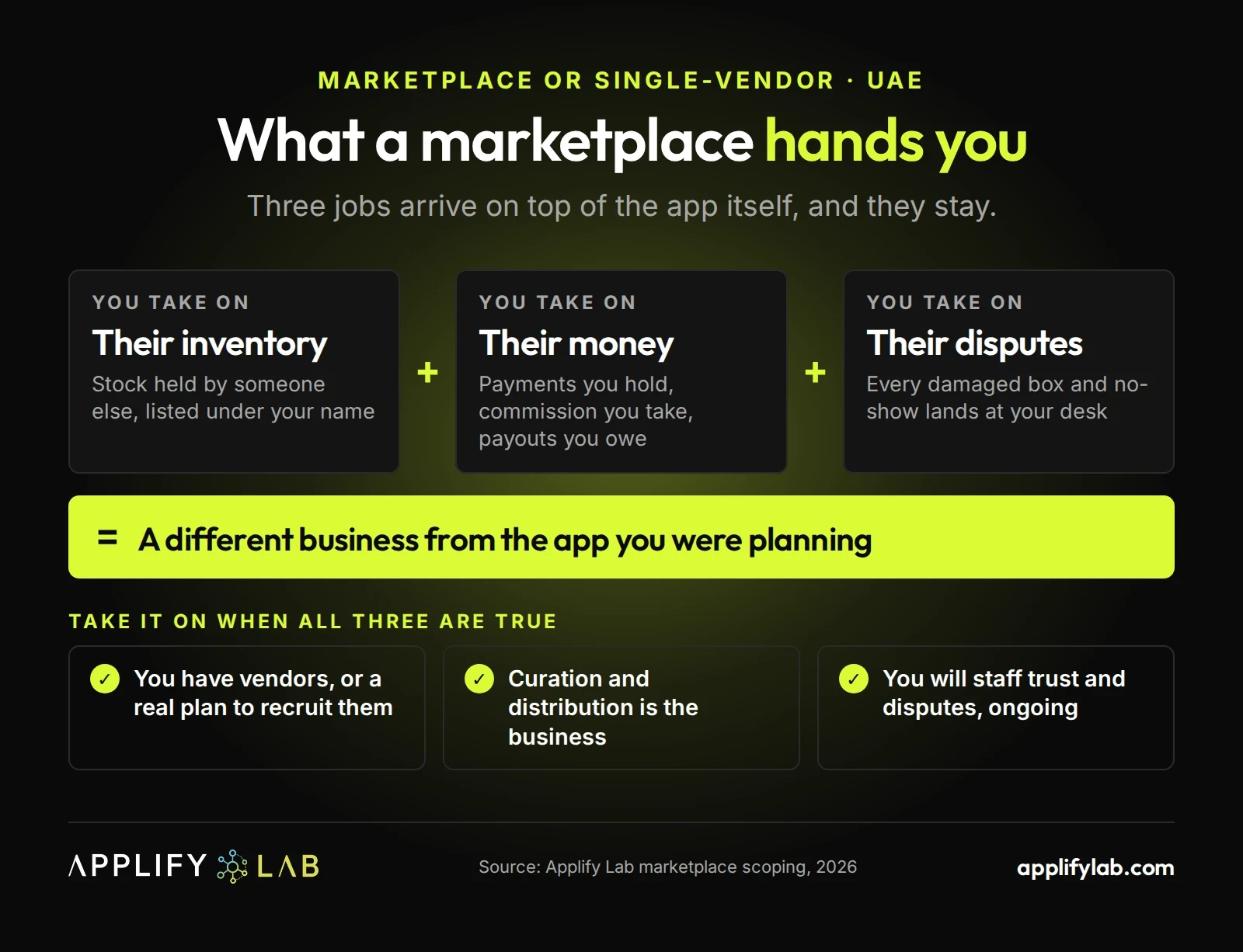
A marketplace is a different business — the three signals that separate it from a single-vendor app.
Marketplace or single-vendor — which one are you actually building?
A single-vendor app (your own products, your own catalog) and a multi-vendor marketplace (other sellers' products, on your platform, for a cut) solve different problems, and the second one is a meaningfully bigger operational commitment on top of a bigger build:
You already have vendor relationships, or a concrete plan to get them. Noon and Amazon.ae recruited their sellers deliberately from the start. If "vendors will probably join once it launches" is your plan, that's a warning sign, not a strategy.
Your actual business is curation and distribution. If you're building your own thing and selling it, a single-vendor app is faster, cheaper, and the right starting point — see our custom ecommerce app guide for that path.
You're prepared to own trust and disputes as much as technology. A marketplace makes you the referee between buyers and sellers whenever something goes wrong — an ongoing operational job that continues well beyond the build.
A UAE fashion marketplace we rebuilt from scratch after another agency spent close to a year without shipping anything usable is a real example of this model working — see how that project actually went. It worked because the business itself was genuinely a marketplace, rather than because a marketplace sounded more ambitious than a single-vendor app.
One practical note on getting started: a handful of vendors is enough to launch, and waiting for dozens is a common way marketplace projects stall before they ever ship.
The consistent advice from marketplace-specific MVP guidance is to launch with a small, personally-recruited set of vendors you can actually support well — enough to prove the buyer-seller loop works end to end — then grow vendor count once that loop is validated, treating vendor count as a growth lever rather than a launch gate.
Marketplace and single-vendor solve different problems — pick based on what you actually have
Tell us your vendor situation right now, real or planned, and we'll tell you honestly which model fits — before you scope (or pay for) the wrong one.
What vendor onboarding and commission actually look like
This is the part most generic guides skip past with "vendor dashboard" as a bullet point. In practice, running the vendor side of a marketplace means:
Verification before onboarding. UAE marketplace sellers are generally expected to hold a valid trade license — a real compliance step your onboarding flow needs to actively check for.
A commission structure that actually reflects category economics. Noon's own seller commissions range roughly 4-27% depending on category — electronics sit lower (~5-8%), fashion and beauty run higher (~12-18%), grocery/FMCG lands in between (~8-15%). That range is a useful reality check for what you might charge your own vendors: flat-rate-everything is simpler to build, and it usually undercharges high-margin categories while overcharging thin-margin ones.
Payout visibility vendors can actually trust. A vendor dashboard showing real-time order status, commission taken, and payout timing — vague payout terms are one of the fastest ways to lose sellers once they have another option.
Local payments done right on the buyer side too: Apple Pay, Google Pay, cards, and Tabby/Tamara for buy-now-pay-later, plus cash on delivery for lower-trust or first-time orders. (One correction worth flagging: some older UAE marketplace guides list "STC Pay" here — that's a Saudi payment method, not a UAE one, and shouldn't be in your build.)
Trust and dispute resolution — the part that actually decides if this works
A single bad vendor experience on a marketplace reflects on you as much as on them, which is why this deserves more attention than a "ratings and reviews" bullet point usually gets:
Ratings and verified-purchase reviews build buyer confidence, as long as they're hard to game — verify each review is tied to a real completed order.
Payment holds until delivery confirmation protect buyers while keeping vendor cash flow moving — a middle ground worth designing deliberately rather than defaulting to either extreme.
A clear, fast dispute process for damaged items, no-shows, or counterfeit concerns — genuinely an operational commitment that goes beyond building a feature once. Whoever runs the marketplace day-to-day needs to actually staff this.
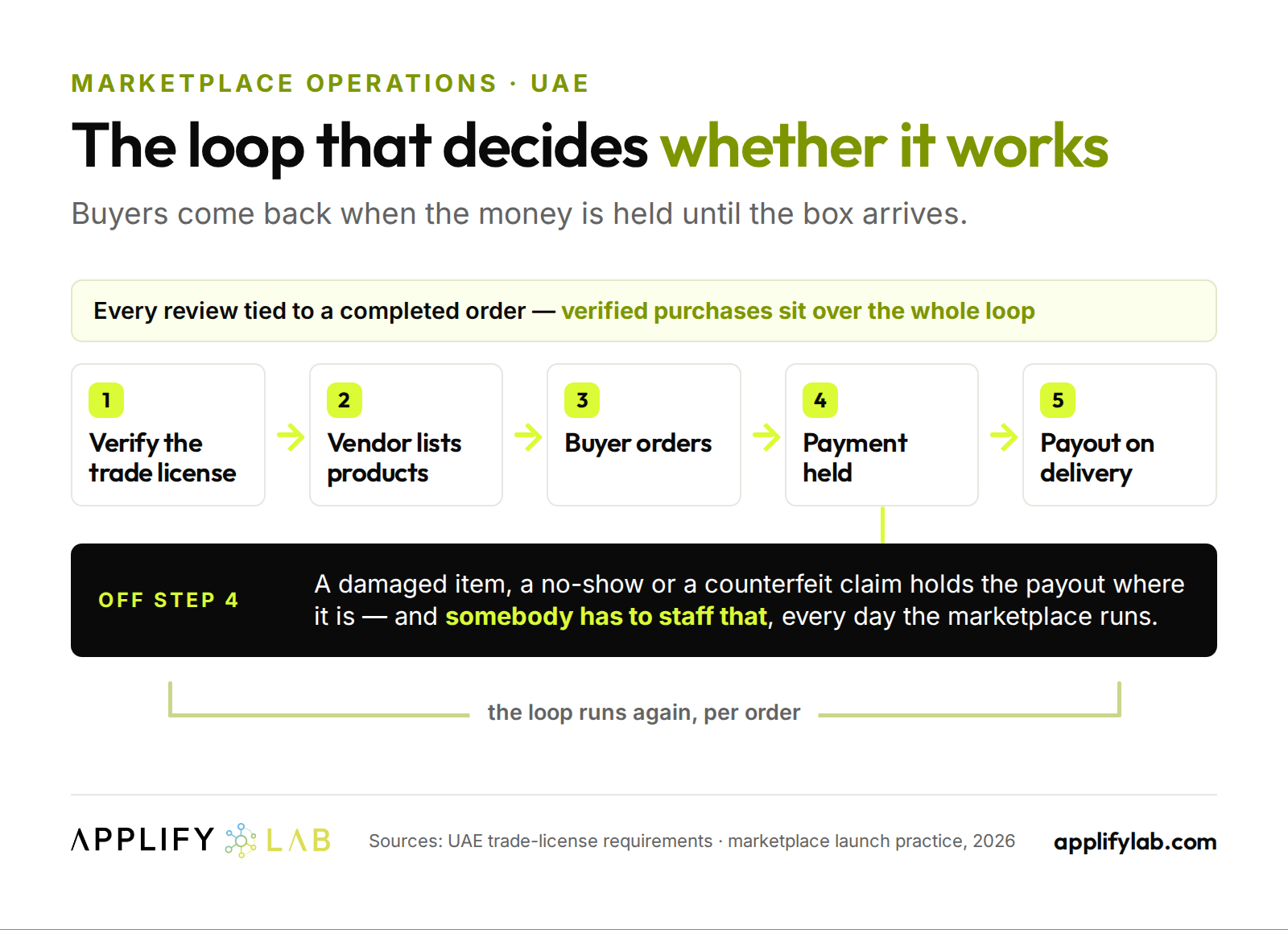
The loop that decides if a marketplace works — verification, escrow-style holds, payout, and a real dispute process.
Build fully custom, or start on existing marketplace software?
This is a real fork, and it's a different question from the general SaaS-vs-custom decision — see our platform comparison guide for that broader framework.
For marketplaces specifically, the off-the-shelf options vary widely in UAE-readiness, which matters more here than it does for most SaaS storefronts:
CS-Cart has native Arabic/RTL support, AED handling, and local payment-gateway integrations built in, making it a genuinely viable starting point for a UAE marketplace.
Dokan and Sharetribe are both capable platforms that generally need custom development work to cover the same UAE-specific ground (Arabic RTL, AED, local gateways) — worth knowing before you assume any off-the-shelf option gets you there out of the box.
A custom build earns its cost once your commission logic, vendor tiers, or dispute workflow outgrow every template — which, for a marketplace with real UAE-specific vendor verification and localized payment needs, happens sooner than it does for a single-vendor app.
Off-the-shelf marketplace platforms: UAE-readiness at a glance
Platform | Arabic / RTL | AED + local gateways | Practical starting point |
|---|---|---|---|
CS-Cart | Native | Built in | Viable out of the box for a UAE marketplace |
Dokan | Needs custom work | Needs custom work | Capable, but budget UAE-localization dev |
Sharetribe | Needs custom work | Needs custom work | Capable, but budget UAE-localization dev |
Fully custom | Built to spec | Built to spec | Once commission/vendor/dispute logic outgrows templates |
Cost: the short version
A multi-vendor marketplace typically lands at AED 180,000–300,000+, the same range our full cost breakdown gives for this build type — meaningfully more than a single-vendor app, for the same reason marketplaces are operationally harder: vendor dashboards, commission logic, payout handling, and dispute tooling are all additional backend work a single-vendor app doesn't need. See the full breakdown for how that compares across every build type and what drives the range.
FAQ
Should I build a marketplace or a single-vendor app?
Build single-vendor unless you already have vendor relationships lined up or a concrete recruitment plan — a marketplace without vendors is a different, harder problem than a smaller version of the model. See the signals above before deciding based on ambition alone.
How much commission should I charge my vendors?
Noon's own rates (roughly 4-27% depending on category — lower for electronics, higher for fashion and beauty) are a useful real-world benchmark to adapt rather than a rule to copy exactly. The right number depends on your category mix and what value you're actually adding for vendors beyond just listing them.
Do I need a trade license check for marketplace vendors?
Yes — UAE marketplace sellers are generally expected to hold a valid trade license, and your onboarding flow should verify this upfront. This is a real compliance step to build in.
Should I use existing marketplace software or build custom?
It depends on the specific platform, beyond a general "off-the-shelf vs. custom" framing — CS-Cart has native Arabic/RTL, AED, and local gateway support, making it a real option for a UAE marketplace, while Dokan and Sharetribe generally need custom development to cover the same ground. Custom becomes worth it once your commission structure, vendor tiers, or dispute process outgrow every template — which tends to happen sooner for marketplaces than for single-vendor apps.
How much does a marketplace app cost compared to a single-vendor app?
Typically AED 180,000–300,000+, meaningfully more than a single-vendor app, because of the added vendor-management, commission, and dispute-handling backend work — see our full cost guide for how that compares across every build type.
How many vendors do I need before launching?
Fewer than most founders assume. The consistent advice from marketplace-specific launch guidance is to start with a small, personally-recruited set you can support well and prove the buyer-seller loop works, then grow vendor count from there — treating vendor count as a launch gate is a common way marketplace projects stall before shipping.
Bring your vendor count and category mix
Multi-vendor builds have their own cost and timeline math, different from a single-vendor app. Ready to run the actual numbers for yours? Book 30 minutes with us
Related guides
Wanting to build "the next Noon" is a scope decision before it's a feature decision. A marketplace app is a genuinely different business from a bigger single-vendor app — you're now managing other people's inventory, other people's money, and other people's disputes, well beyond your own catalog.
Before any feature list or cost estimate matters, the real question is whether you actually have what a marketplace needs to work: vendors ready to sell through you, or a real plan to recruit them.
Key takeaways
A marketplace is a different business, not a bigger app. You take on other people's inventory, money, and disputes — build single-vendor unless that's genuinely your model.
Three signals it's really a marketplace: you have (or can recruit) vendors, your business is curation and distribution, and you're ready to own trust and disputes as an ongoing job.
Launch small on vendors. A handful of personally-recruited sellers proves the buyer-seller loop; treating vendor count as a launch gate is how projects stall.
Trust mechanics decide it: trade-license verification upfront, verified-purchase reviews, payment holds until delivery, and a staffed dispute process.
Off-the-shelf isn't equally UAE-ready: CS-Cart handles Arabic/RTL, AED, and local gateways out of the box; Dokan and Sharetribe generally need custom work to get there.
A marketplace is a different business — the three signals that separate it from a single-vendor app.
Marketplace or single-vendor — which one are you actually building?
A single-vendor app (your own products, your own catalog) and a multi-vendor marketplace (other sellers' products, on your platform, for a cut) solve different problems, and the second one is a meaningfully bigger operational commitment on top of a bigger build:
You already have vendor relationships, or a concrete plan to get them. Noon and Amazon.ae recruited their sellers deliberately from the start. If "vendors will probably join once it launches" is your plan, that's a warning sign, not a strategy.
Your actual business is curation and distribution. If you're building your own thing and selling it, a single-vendor app is faster, cheaper, and the right starting point — see our custom ecommerce app guide for that path.
You're prepared to own trust and disputes as much as technology. A marketplace makes you the referee between buyers and sellers whenever something goes wrong — an ongoing operational job that continues well beyond the build.
A UAE fashion marketplace we rebuilt from scratch after another agency spent close to a year without shipping anything usable is a real example of this model working — see how that project actually went. It worked because the business itself was genuinely a marketplace, rather than because a marketplace sounded more ambitious than a single-vendor app.
One practical note on getting started: a handful of vendors is enough to launch, and waiting for dozens is a common way marketplace projects stall before they ever ship.
The consistent advice from marketplace-specific MVP guidance is to launch with a small, personally-recruited set of vendors you can actually support well — enough to prove the buyer-seller loop works end to end — then grow vendor count once that loop is validated, treating vendor count as a growth lever rather than a launch gate.
Marketplace and single-vendor solve different problems — pick based on what you actually have
Tell us your vendor situation right now, real or planned, and we'll tell you honestly which model fits — before you scope (or pay for) the wrong one.
What vendor onboarding and commission actually look like
This is the part most generic guides skip past with "vendor dashboard" as a bullet point. In practice, running the vendor side of a marketplace means:
Verification before onboarding. UAE marketplace sellers are generally expected to hold a valid trade license — a real compliance step your onboarding flow needs to actively check for.
A commission structure that actually reflects category economics. Noon's own seller commissions range roughly 4-27% depending on category — electronics sit lower (~5-8%), fashion and beauty run higher (~12-18%), grocery/FMCG lands in between (~8-15%). That range is a useful reality check for what you might charge your own vendors: flat-rate-everything is simpler to build, and it usually undercharges high-margin categories while overcharging thin-margin ones.
Payout visibility vendors can actually trust. A vendor dashboard showing real-time order status, commission taken, and payout timing — vague payout terms are one of the fastest ways to lose sellers once they have another option.
Local payments done right on the buyer side too: Apple Pay, Google Pay, cards, and Tabby/Tamara for buy-now-pay-later, plus cash on delivery for lower-trust or first-time orders. (One correction worth flagging: some older UAE marketplace guides list "STC Pay" here — that's a Saudi payment method, not a UAE one, and shouldn't be in your build.)
Trust and dispute resolution — the part that actually decides if this works
A single bad vendor experience on a marketplace reflects on you as much as on them, which is why this deserves more attention than a "ratings and reviews" bullet point usually gets:
Ratings and verified-purchase reviews build buyer confidence, as long as they're hard to game — verify each review is tied to a real completed order.
Payment holds until delivery confirmation protect buyers while keeping vendor cash flow moving — a middle ground worth designing deliberately rather than defaulting to either extreme.
A clear, fast dispute process for damaged items, no-shows, or counterfeit concerns — genuinely an operational commitment that goes beyond building a feature once. Whoever runs the marketplace day-to-day needs to actually staff this.
The loop that decides if a marketplace works — verification, escrow-style holds, payout, and a real dispute process.
Build fully custom, or start on existing marketplace software?
This is a real fork, and it's a different question from the general SaaS-vs-custom decision — see our platform comparison guide for that broader framework.
For marketplaces specifically, the off-the-shelf options vary widely in UAE-readiness, which matters more here than it does for most SaaS storefronts:
CS-Cart has native Arabic/RTL support, AED handling, and local payment-gateway integrations built in, making it a genuinely viable starting point for a UAE marketplace.
Dokan and Sharetribe are both capable platforms that generally need custom development work to cover the same UAE-specific ground (Arabic RTL, AED, local gateways) — worth knowing before you assume any off-the-shelf option gets you there out of the box.
A custom build earns its cost once your commission logic, vendor tiers, or dispute workflow outgrow every template — which, for a marketplace with real UAE-specific vendor verification and localized payment needs, happens sooner than it does for a single-vendor app.
Off-the-shelf marketplace platforms: UAE-readiness at a glance
Platform | Arabic / RTL | AED + local gateways | Practical starting point |
|---|---|---|---|
CS-Cart | Native | Built in | Viable out of the box for a UAE marketplace |
Dokan | Needs custom work | Needs custom work | Capable, but budget UAE-localization dev |
Sharetribe | Needs custom work | Needs custom work | Capable, but budget UAE-localization dev |
Fully custom | Built to spec | Built to spec | Once commission/vendor/dispute logic outgrows templates |
Cost: the short version
A multi-vendor marketplace typically lands at AED 180,000–300,000+, the same range our full cost breakdown gives for this build type — meaningfully more than a single-vendor app, for the same reason marketplaces are operationally harder: vendor dashboards, commission logic, payout handling, and dispute tooling are all additional backend work a single-vendor app doesn't need. See the full breakdown for how that compares across every build type and what drives the range.
FAQ
Should I build a marketplace or a single-vendor app?
Build single-vendor unless you already have vendor relationships lined up or a concrete recruitment plan — a marketplace without vendors is a different, harder problem than a smaller version of the model. See the signals above before deciding based on ambition alone.
How much commission should I charge my vendors?
Noon's own rates (roughly 4-27% depending on category — lower for electronics, higher for fashion and beauty) are a useful real-world benchmark to adapt rather than a rule to copy exactly. The right number depends on your category mix and what value you're actually adding for vendors beyond just listing them.
Do I need a trade license check for marketplace vendors?
Yes — UAE marketplace sellers are generally expected to hold a valid trade license, and your onboarding flow should verify this upfront. This is a real compliance step to build in.
Should I use existing marketplace software or build custom?
It depends on the specific platform, beyond a general "off-the-shelf vs. custom" framing — CS-Cart has native Arabic/RTL, AED, and local gateway support, making it a real option for a UAE marketplace, while Dokan and Sharetribe generally need custom development to cover the same ground. Custom becomes worth it once your commission structure, vendor tiers, or dispute process outgrow every template — which tends to happen sooner for marketplaces than for single-vendor apps.
How much does a marketplace app cost compared to a single-vendor app?
Typically AED 180,000–300,000+, meaningfully more than a single-vendor app, because of the added vendor-management, commission, and dispute-handling backend work — see our full cost guide for how that compares across every build type.
How many vendors do I need before launching?
Fewer than most founders assume. The consistent advice from marketplace-specific launch guidance is to start with a small, personally-recruited set you can support well and prove the buyer-seller loop works, then grow vendor count from there — treating vendor count as a launch gate is a common way marketplace projects stall before shipping.
Bring your vendor count and category mix
Multi-vendor builds have their own cost and timeline math, different from a single-vendor app. Ready to run the actual numbers for yours? Book 30 minutes with us