AI Agents & AI Automation
WhatsApp Business API in the UAE: Cost and Setup (2026)

By
Anh Nguyen, Founder
·
16 min

Any UAE business can use the WhatsApp Business API, directly through Meta or through a provider. Since 1 October 2026, Meta also charges for replies: AED 0.0576 for a reply or an update and AED 0.2115 for a marketing message, with the first 1,000 replies each month free on every number. An AI agent can then answer on top.
Key takeaways
The API is open to any UAE business. You sign up directly with Meta or through a provider, verify the company, and start with a limit of 250 people a day.
Replies have been charged since 1 October 2026. Meta bills per message, in dirhams, and only the first 1,000 replies a month on each number stay free.
Meta sets the rules. Customers opt in, messages outside the 24-hour window use approved templates, and every automated chat keeps a route to a person.
There are two kinds of AI agent. Meta's own agent is quick to switch on; your own agent works inside your calendar, payments and records.
Consent comes first in the UAE. The PDPL asks for clear consent that customers can withdraw easily, and clinics keep health data in the UAE.
Want this handled automatically? See how our AI agents for UAE businesses work.
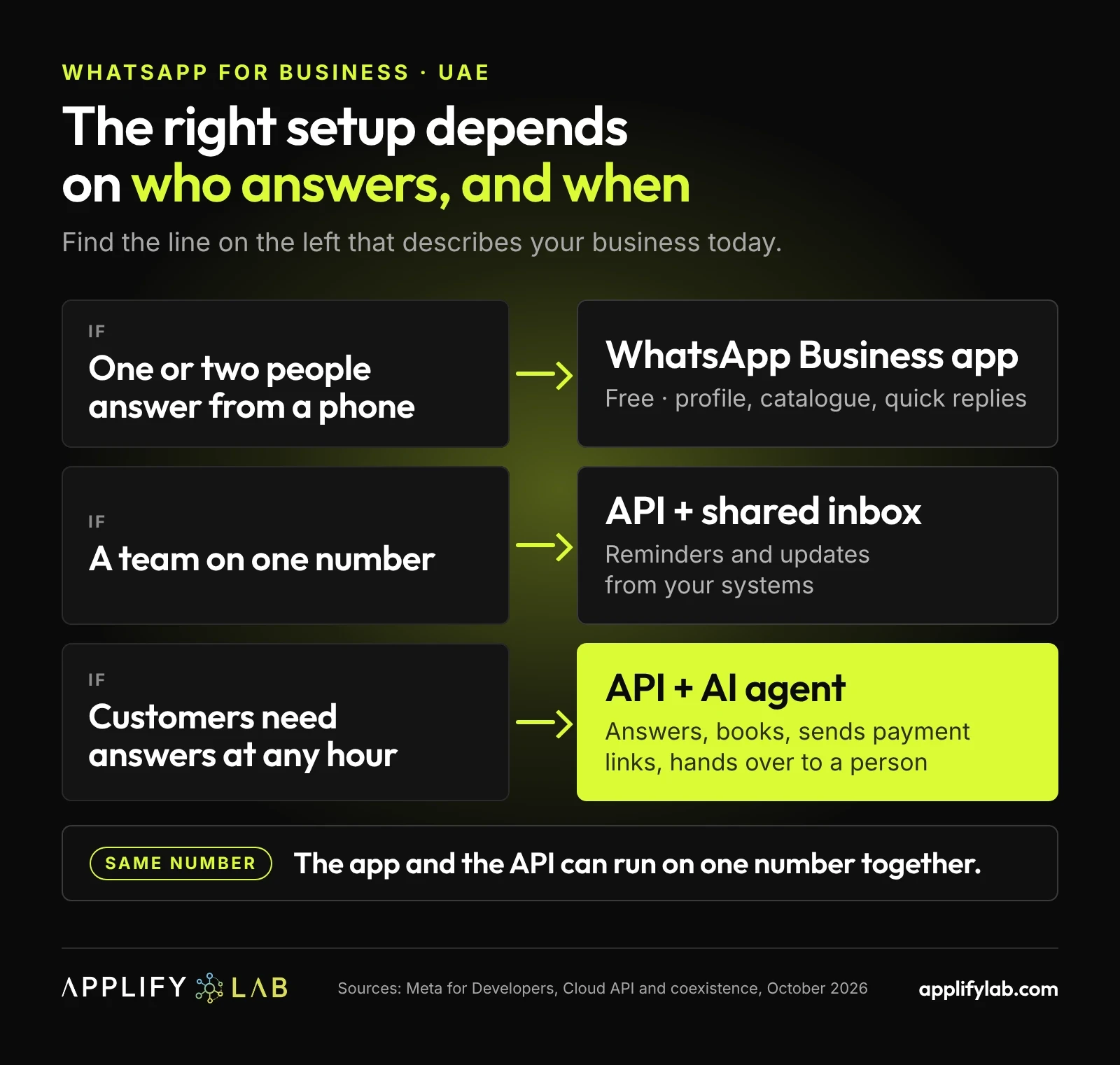
The app suits one person answering from a phone; the API suits a team, automated messages and an AI agent.
Is the WhatsApp Business API available in the UAE, and how do you get it?
Yes: any UAE business can get the WhatsApp Business API, directly from Meta or through a provider.
Meta's Cloud API is open to direct sign-up, so a provider is optional. A provider adds a shared inbox, help with verification and its own support, and many businesses choose one for that. The inbox and the AI agent are software you can get either way.
What you need to start:
A Meta business portfolio in your company's name. It holds the WhatsApp account, the phone numbers, the billing and the people with access.
Business verification. Meta checks the company against official documents such as your trade licence, and verification lifts your daily limit.
A phone number for the API. A new number, or the one you already use on the WhatsApp Business app (see the next section).
A display name. Your business name as customers see it, reviewed by Meta as your limits grow.
A payment method. Meta has offered billing in dirhams since 1 April 2026, when it added AED as a billing currency.
New accounts start small and grow with their quality. A newly created business portfolio can message 250 people in 24 hours outside an open conversation, and business verification lifts that to 2,000. Meta then raises the limit to 10,000, 100,000 and unlimited, within six hours, once your messages keep a high quality rating and you have used at least half your limit in the past seven days (Meta for Developers, messaging limits).
WhatsApp Business app or the API: which one do you need?
The free WhatsApp Business app suits one or two people answering from a phone; the API suits a team, automated messages and an AI agent.
The app gives you a business profile, a catalogue, quick replies and labels at no cost, and it works well while one person answers. Its limits show when several people need to answer the same number, or when messages should go out from your own systems.
Signs you need the API:
Several people answer the same number. The API connects one number to a shared inbox, with each conversation assigned to a person.
Messages should go out on their own. Appointment reminders, order updates and payment confirmations, sent by your booking or order system the moment something changes.
You want an AI agent to answer. An agent reads and sends messages through the API, at any hour.
Your systems need the conversation. Bookings, orders and customer records updated from the chat, without anyone copying details across.
You can keep your current number. Meta lets one number run on the WhatsApp Business app and the API at the same time, which it calls coexistence, set up through a Meta partner. Up to six months of chat history syncs, while group chats stay on the phone and broadcast lists stop working (Meta for Developers).
What does the WhatsApp Business API cost in the UAE?
Meta charges per delivered message, in dirhams, by message type: AED 0.2115 for a marketing message and AED 0.0576 for an update, a login code or a reply, under its UAE rate card effective 1 October 2026.
Meta's UAE rates per delivered message:
Message type | What it covers | Price per message |
|---|---|---|
Marketing | Offers, launches, invitations to come back | AED 0.2115 |
Utility | Booking confirmations, order and delivery updates, receipts | AED 0.0576 |
Authentication | One-time login codes | AED 0.0576 |
Service | Replies inside the 24-hour window, by a person or a third-party AI agent | AED 0.0576, after the first 1,000 a month |
Meta Business Agent | Replies written by Meta's own AI agent | USD 2 per million tokens, about 4–5 US cents a message |
Source: Meta for Developers, AED rate card effective 1 October 2026.
Replies stopped being free on 1 October 2026. Until 30 September, replies inside the 24-hour window cost nothing, and neither did updates sent while a customer's conversation was open. Meta now charges both at the utility rate, and gives each business phone number 1,000 free replies a month, which don't roll over. Many guides and AI answers still describe the old rules, so check the date on any WhatsApp price you read.
What stays free:
Messages your customers send you. Meta charges only for what the business sends.
The first 1,000 replies each month, on every number. Charges start at the 1,001st reply. Without a payment method on file, Meta stops delivering replies once the free 1,000 are used.
Every message in the 72 hours after a click-to-WhatsApp ad. When a customer writes to you from a click-to-WhatsApp ad or a Facebook Page button on their phone and you answer within 24 hours, Meta opens a 72-hour window in which all messages are free, except replies written by Meta's own AI agent.

Meta charges for what a business sends; customers' messages and the first 1,000 replies a month stay free.
Two example monthly bills at Meta's list rates, on one number:
A clinic sending 1,500 appointment reminders and 2,000 replies: about AED 144. The reminders cost AED 86.40; the first 1,000 replies are free and the next 1,000 cost AED 57.60.
A store sending 4,000 offers, 2,500 order updates and 3,000 replies: about AED 1,105. The offers cost AED 846, the updates AED 144, and the 2,000 paid replies AED 115.20.
Marketing messages make up most of the bill. That is why who you message, and how often, matters more than the price of a single message. At high volumes, Meta's utility and authentication rates also drop in monthly tiers; marketing rates stay flat.
Provider fees come on top. Published plans from four WhatsApp software providers start at about AED 290–550 a month and reach about AED 2,300 a month for larger teams (pricing pages, October 2026). Some add a monthly fee per phone number, so ask whether Meta's rates are passed on at cost. These are market ranges; Applify Lab scopes every project after a diagnosis.
The AI agent is its own line. What it costs depends on whose agent it is, which the next two sections cover.
What does Meta allow on WhatsApp in 2026?
Meta allows a business to message customers who opted in, with approved templates outside the 24-hour window, and with a route to a person whenever automation answers.
The rules that shape every setup:
Opt-in first. WhatsApp's Business Messaging Policy lets a business contact people who gave it their number and agreed to receive its messages. Every request to stop must be respected, whether it reaches you on WhatsApp or elsewhere (policy updated 23 September 2026).
The 24-hour window. When a customer messages you, a 24-hour window opens for free-form replies. Outside it, only templates Meta has approved can be sent, and Meta says review can take up to 24 hours.
Templates are charged by category. Meta assigns each template to marketing, utility or authentication, and the category sets the price. Writing an offer into an order update moves it to marketing.
A route to a person. Automation is allowed, and the policy asks for "prompt, clear, and direct escalation paths" to a human: a transfer in the chat, a phone number, an email or a store visit.
AI that serves your own customers. Since 15 January 2026, WhatsApp's terms for businesses keep general-purpose AI assistants, the ChatGPT kind, off the platform. An agent that answers your customers about your business is the use Meta supports, and it now sells its own.
Quality decides how far you can grow. Meta raises your daily limit only while your messages keep a high quality rating, and blocks and reports from customers pull it down. Messaging people who asked to hear from you is the surest way to keep your number in good standing.
Meta's own AI agent or your own: which one fits?
Meta's agent suits a business that wants answers from its existing information quickly; your own agent suits a business whose replies depend on its calendar, prices, stock, payments or records.
Meta launched Meta Business Agent worldwide on 3 June 2026, on WhatsApp, Instagram and Messenger (Quartz), and opened it to developers on 1 July 2026. Meta hosts it: you add your business information, FAQs, files and website, write its instructions and set when a person takes over. Since 1 August 2026, Meta charges USD 2 per million tokens, which it estimates at about 4–5 US cents a message, roughly AED 0.15–0.18.
The setup decides the quality. Meta's agent can be switched on with very little filled in, and that is where it goes wrong. In a demonstration we built for an AI workshop at Hub47, the agent answered a customer's first questions well from its knowledge base. When the customer then typed "Human" three times, it gave the same polite refusal each time, because its handover settings were empty.
Your own agent runs on the Cloud API, with Meta carrying the messages. The logic and the data stay with you: the agent reads your calendar and prices, sends a payment link, writes the booking into your system and passes the chat to the right person.
Meta's agent | Your own agent | |
|---|---|---|
Who runs it | Meta, on its platform | You, or the team that builds it for you |
What it knows | The business information, FAQs, files and website you add | Your knowledge base, plus live data from your systems |
Calendar, payments, records | Through connectors you build for Meta's platform | Connected directly |
Where conversations sit | With Meta | Where you decide |
Cost per AI reply | USD 2 per million tokens, about 4–5 US cents | Meta's service rate, plus the AI model's usage |
Fits | Answers from information you already publish | Replies that depend on live data, or data you must control |
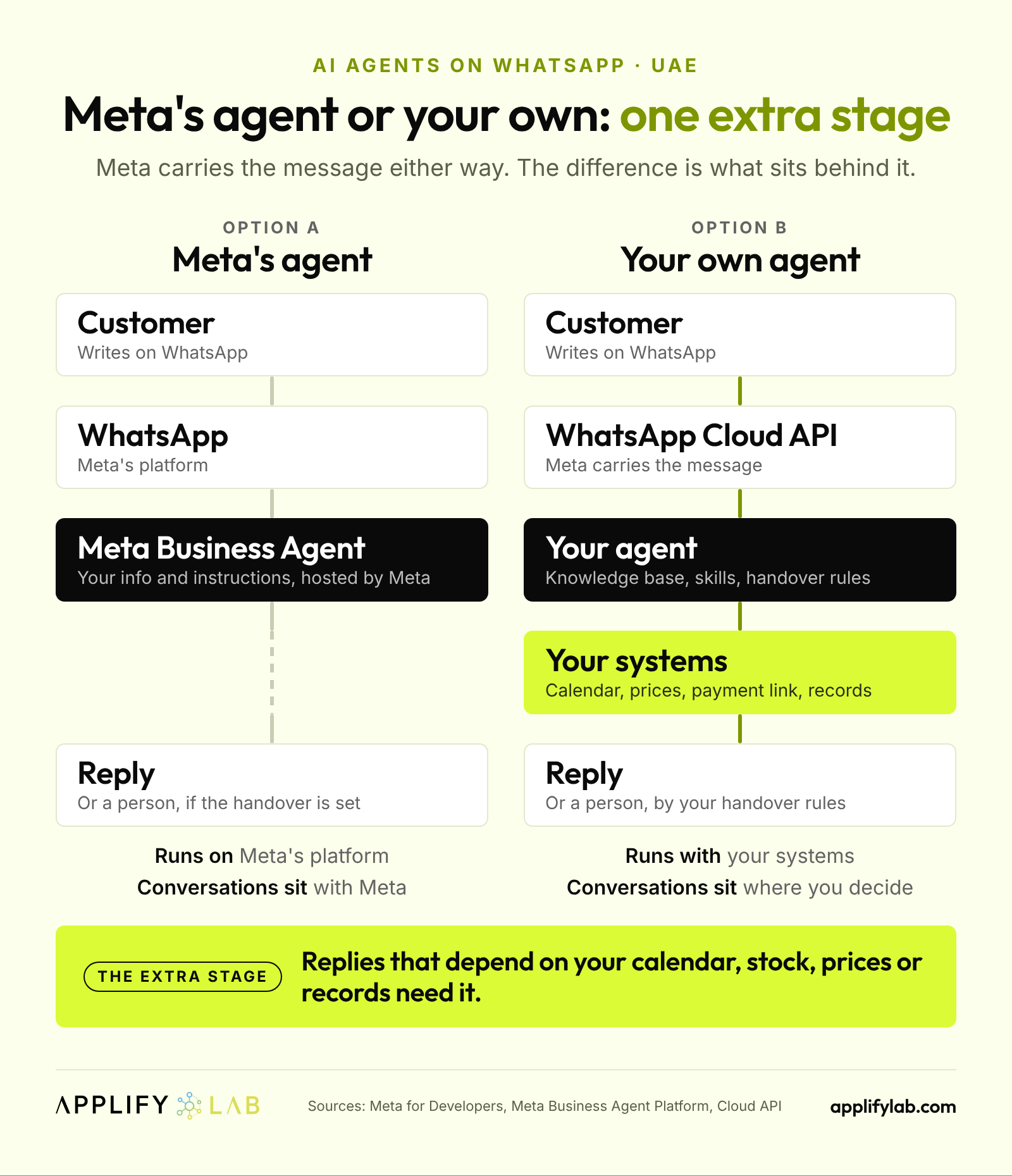
Meta's agent lives on Meta's platform; your own agent lives with your systems, and Meta carries the messages.
What can an AI agent do on WhatsApp for a UAE business?
An AI agent on WhatsApp answers questions, books appointments, sends updates and payment links, follows up on unfinished orders, and hands the chat to a person when it should.
What it handles, by type of business:
Clinics: bookings and reminders. It offers free slots, books, reschedules and sends reminders in Arabic and English. Our guide to clinic no-shows in Dubai shows what reminders change, and how we build for clinics is on our healthcare and wellness apps page.
Stores: order status and abandoned carts. Baymard Institute puts the average documented cart abandonment rate at 70.22%, across 50 studies. A follow-up on WhatsApp reaches the customer where they already chat; it is a marketing template, so it needs their opt-in and costs AED 0.2115.
Restaurants and regular buyers: re-orders. A reminder when a customer usually orders again, with the last order ready to repeat.
Service businesses: enquiries at any hour. It asks the questions your team would ask, collects the details, and books a call or passes a quote request to the right person.
Payments. It sends a payment link from your gateway and confirms the booking or order once the payment arrives.
Arabic and English, written for each language. Customers in the UAE move between Arabic and English, often in the same conversation. An agent answers best when its knowledge base is authored in both languages and checked by native speakers, and Gulf dialect needs its own testing on real customer messages.
The handover is part of the design. Decide in advance which requests go to a person, such as a complaint, a refund or a medical question, and who receives them during and after working hours.
Already answering customers on WhatsApp?
Send us roughly how many messages you get a week and what people ask most, and we'll tell you which setup fits, from the Business app to an AI agent.
What do opt-in and the UAE PDPL require?
The UAE PDPL requires a customer's clear consent before you use their data for marketing, and the right to withdraw it as easily as they gave it.
Federal Decree-Law No. 45 of 2021, the UAE's personal data law, has been in force since 2 January 2022 and makes consent the main basis for using personal data. Under its Article 6, consent must be clear and unambiguous, the business must be able to prove it, and the customer can withdraw it at any time through an easy route.
The UAE's telemarketing rules add a layer for marketing messages. Cabinet Decision No. 56 of 2024, in force since 27 August 2024, covers marketing calls, SMS and messages sent through social media apps. Penalties under Cabinet Decision No. 57 of 2024 range from warnings and fines to suspended activities and a revoked commercial licence (Morgan Lewis, 2024).
What this means on WhatsApp:
Ask for each type of message. Agreement to booking reminders covers booking reminders; offers need their own yes, asked at a moment that makes sense, such as checkout.
Record it. Keep the date, the channel and the wording the customer agreed to, so you can show the consent if anyone asks.
Make stopping easy. A reply such as "STOP" or a button that works, honoured on every channel.
Know where conversations are stored. For clinics, Federal Law No. 2 of 2019 keeps health data inside the UAE unless a health authority allows otherwise, so ask any provider where patient messages are stored and processed.
This is general information, not legal advice; a UAE lawyer can confirm what applies to your business.
How do you go live on the WhatsApp Business API, step by step?
Going live takes six steps, from choosing what WhatsApp should handle to launching with a person ready to take over.
Decide what WhatsApp handles first. List the questions customers ask most and the task that takes your team the most time. That becomes version one.
Set up the Meta side. A business portfolio in your company's name, business verification, the phone number, the display name and a payment method in dirhams.
Collect opt-ins. Add consent to your booking form, your checkout and your in-store sign-up before the first template goes out.
Write and submit templates. Reminders, order updates and offers, in Arabic and English, each in the right category.
Build the replies and the handover. The knowledge base, the actions the agent may take, and who takes over a chat, by hour and by topic.
Test, launch on a small group, then widen. Run real customer questions through it, start with one service or one branch, read the conversations daily in the first weeks, then extend.
The first version should earn its cost fastest. For a clinic, that is often bookings and reminders; for a store, order status and abandoned carts. The rest follows once the first part works, which keeps both Meta's bill and the build in proportion to what WhatsApp brings in.
FAQ
Is the WhatsApp Business API free?
Connecting to Meta's Cloud API is free, and so are the messages customers send you. Meta charges for what your business sends: templates sent outside the 24-hour window, and, since 1 October 2026, replies beyond the first 1,000 a month on each number. A provider that supplies an inbox or automation adds its own monthly fee.
How much does the WhatsApp Business API cost in the UAE?
Under Meta's UAE rate card effective 1 October 2026, a marketing message costs AED 0.2115, and a utility message, a login code or a reply costs AED 0.0576, with 1,000 free replies a month per number. Provider plans start at about AED 290–550 a month. These are market ranges; Applify Lab scopes every project after a diagnosis.
How do I get the WhatsApp Business API in the UAE?
Create a Meta business portfolio in your company's name, verify the business, add a phone number and a display name, and set a payment method in dirhams. You can sign up directly with Meta's Cloud API or through a provider. A number already on the WhatsApp Business app can be connected too, keeping up to six months of chat history.
How can I send 10,000 messages on WhatsApp?
Through the API, to customers who opted in, using approved templates. A new business portfolio starts at 250 people in 24 hours, and business verification lifts it to 2,000. Meta raises the limit to 10,000 within six hours once your messages keep a high quality rating and you have used at least half your limit in the past seven days.
Can a WhatsApp AI agent take bookings and payments?
Yes, when it is connected to your booking system and your payment gateway. It offers free slots, books or reschedules, sends a payment link and confirms once the payment arrives. Requests that need a person, such as complaints, refunds or medical questions, go to your team, and WhatsApp's policy requires that route to a human.
Does a WhatsApp AI agent work in Arabic and English?
Yes. An agent can answer in the language the customer writes in and switch when they do. It answers best when its knowledge base is written in both Arabic and English and checked by native speakers. Gulf dialect needs its own testing on real customer messages before launch.
To go further
Discover how our AI agents for UAE businesses answer, book and follow up on WhatsApp.
Clinics and wellness businesses can see how we build healthcare and wellness apps.
Stores and brands can explore our e-commerce and retail apps for UAE brands.
Any UAE business can use the WhatsApp Business API, directly through Meta or through a provider. Since 1 October 2026, Meta also charges for replies: AED 0.0576 for a reply or an update and AED 0.2115 for a marketing message, with the first 1,000 replies each month free on every number. An AI agent can then answer on top.
Key takeaways
The API is open to any UAE business. You sign up directly with Meta or through a provider, verify the company, and start with a limit of 250 people a day.
Replies have been charged since 1 October 2026. Meta bills per message, in dirhams, and only the first 1,000 replies a month on each number stay free.
Meta sets the rules. Customers opt in, messages outside the 24-hour window use approved templates, and every automated chat keeps a route to a person.
There are two kinds of AI agent. Meta's own agent is quick to switch on; your own agent works inside your calendar, payments and records.
Consent comes first in the UAE. The PDPL asks for clear consent that customers can withdraw easily, and clinics keep health data in the UAE.
Want this handled automatically? See how our AI agents for UAE businesses work.
The app suits one person answering from a phone; the API suits a team, automated messages and an AI agent.
Is the WhatsApp Business API available in the UAE, and how do you get it?
Yes: any UAE business can get the WhatsApp Business API, directly from Meta or through a provider.
Meta's Cloud API is open to direct sign-up, so a provider is optional. A provider adds a shared inbox, help with verification and its own support, and many businesses choose one for that. The inbox and the AI agent are software you can get either way.
What you need to start:
A Meta business portfolio in your company's name. It holds the WhatsApp account, the phone numbers, the billing and the people with access.
Business verification. Meta checks the company against official documents such as your trade licence, and verification lifts your daily limit.
A phone number for the API. A new number, or the one you already use on the WhatsApp Business app (see the next section).
A display name. Your business name as customers see it, reviewed by Meta as your limits grow.
A payment method. Meta has offered billing in dirhams since 1 April 2026, when it added AED as a billing currency.
New accounts start small and grow with their quality. A newly created business portfolio can message 250 people in 24 hours outside an open conversation, and business verification lifts that to 2,000. Meta then raises the limit to 10,000, 100,000 and unlimited, within six hours, once your messages keep a high quality rating and you have used at least half your limit in the past seven days (Meta for Developers, messaging limits).
WhatsApp Business app or the API: which one do you need?
The free WhatsApp Business app suits one or two people answering from a phone; the API suits a team, automated messages and an AI agent.
The app gives you a business profile, a catalogue, quick replies and labels at no cost, and it works well while one person answers. Its limits show when several people need to answer the same number, or when messages should go out from your own systems.
Signs you need the API:
Several people answer the same number. The API connects one number to a shared inbox, with each conversation assigned to a person.
Messages should go out on their own. Appointment reminders, order updates and payment confirmations, sent by your booking or order system the moment something changes.
You want an AI agent to answer. An agent reads and sends messages through the API, at any hour.
Your systems need the conversation. Bookings, orders and customer records updated from the chat, without anyone copying details across.
You can keep your current number. Meta lets one number run on the WhatsApp Business app and the API at the same time, which it calls coexistence, set up through a Meta partner. Up to six months of chat history syncs, while group chats stay on the phone and broadcast lists stop working (Meta for Developers).
What does the WhatsApp Business API cost in the UAE?
Meta charges per delivered message, in dirhams, by message type: AED 0.2115 for a marketing message and AED 0.0576 for an update, a login code or a reply, under its UAE rate card effective 1 October 2026.
Meta's UAE rates per delivered message:
Message type | What it covers | Price per message |
|---|---|---|
Marketing | Offers, launches, invitations to come back | AED 0.2115 |
Utility | Booking confirmations, order and delivery updates, receipts | AED 0.0576 |
Authentication | One-time login codes | AED 0.0576 |
Service | Replies inside the 24-hour window, by a person or a third-party AI agent | AED 0.0576, after the first 1,000 a month |
Meta Business Agent | Replies written by Meta's own AI agent | USD 2 per million tokens, about 4–5 US cents a message |
Source: Meta for Developers, AED rate card effective 1 October 2026.
Replies stopped being free on 1 October 2026. Until 30 September, replies inside the 24-hour window cost nothing, and neither did updates sent while a customer's conversation was open. Meta now charges both at the utility rate, and gives each business phone number 1,000 free replies a month, which don't roll over. Many guides and AI answers still describe the old rules, so check the date on any WhatsApp price you read.
What stays free:
Messages your customers send you. Meta charges only for what the business sends.
The first 1,000 replies each month, on every number. Charges start at the 1,001st reply. Without a payment method on file, Meta stops delivering replies once the free 1,000 are used.
Every message in the 72 hours after a click-to-WhatsApp ad. When a customer writes to you from a click-to-WhatsApp ad or a Facebook Page button on their phone and you answer within 24 hours, Meta opens a 72-hour window in which all messages are free, except replies written by Meta's own AI agent.
Meta charges for what a business sends; customers' messages and the first 1,000 replies a month stay free.
Two example monthly bills at Meta's list rates, on one number:
A clinic sending 1,500 appointment reminders and 2,000 replies: about AED 144. The reminders cost AED 86.40; the first 1,000 replies are free and the next 1,000 cost AED 57.60.
A store sending 4,000 offers, 2,500 order updates and 3,000 replies: about AED 1,105. The offers cost AED 846, the updates AED 144, and the 2,000 paid replies AED 115.20.
Marketing messages make up most of the bill. That is why who you message, and how often, matters more than the price of a single message. At high volumes, Meta's utility and authentication rates also drop in monthly tiers; marketing rates stay flat.
Provider fees come on top. Published plans from four WhatsApp software providers start at about AED 290–550 a month and reach about AED 2,300 a month for larger teams (pricing pages, October 2026). Some add a monthly fee per phone number, so ask whether Meta's rates are passed on at cost. These are market ranges; Applify Lab scopes every project after a diagnosis.
The AI agent is its own line. What it costs depends on whose agent it is, which the next two sections cover.
What does Meta allow on WhatsApp in 2026?
Meta allows a business to message customers who opted in, with approved templates outside the 24-hour window, and with a route to a person whenever automation answers.
The rules that shape every setup:
Opt-in first. WhatsApp's Business Messaging Policy lets a business contact people who gave it their number and agreed to receive its messages. Every request to stop must be respected, whether it reaches you on WhatsApp or elsewhere (policy updated 23 September 2026).
The 24-hour window. When a customer messages you, a 24-hour window opens for free-form replies. Outside it, only templates Meta has approved can be sent, and Meta says review can take up to 24 hours.
Templates are charged by category. Meta assigns each template to marketing, utility or authentication, and the category sets the price. Writing an offer into an order update moves it to marketing.
A route to a person. Automation is allowed, and the policy asks for "prompt, clear, and direct escalation paths" to a human: a transfer in the chat, a phone number, an email or a store visit.
AI that serves your own customers. Since 15 January 2026, WhatsApp's terms for businesses keep general-purpose AI assistants, the ChatGPT kind, off the platform. An agent that answers your customers about your business is the use Meta supports, and it now sells its own.
Quality decides how far you can grow. Meta raises your daily limit only while your messages keep a high quality rating, and blocks and reports from customers pull it down. Messaging people who asked to hear from you is the surest way to keep your number in good standing.
Meta's own AI agent or your own: which one fits?
Meta's agent suits a business that wants answers from its existing information quickly; your own agent suits a business whose replies depend on its calendar, prices, stock, payments or records.
Meta launched Meta Business Agent worldwide on 3 June 2026, on WhatsApp, Instagram and Messenger (Quartz), and opened it to developers on 1 July 2026. Meta hosts it: you add your business information, FAQs, files and website, write its instructions and set when a person takes over. Since 1 August 2026, Meta charges USD 2 per million tokens, which it estimates at about 4–5 US cents a message, roughly AED 0.15–0.18.
The setup decides the quality. Meta's agent can be switched on with very little filled in, and that is where it goes wrong. In a demonstration we built for an AI workshop at Hub47, the agent answered a customer's first questions well from its knowledge base. When the customer then typed "Human" three times, it gave the same polite refusal each time, because its handover settings were empty.
Your own agent runs on the Cloud API, with Meta carrying the messages. The logic and the data stay with you: the agent reads your calendar and prices, sends a payment link, writes the booking into your system and passes the chat to the right person.
Meta's agent | Your own agent | |
|---|---|---|
Who runs it | Meta, on its platform | You, or the team that builds it for you |
What it knows | The business information, FAQs, files and website you add | Your knowledge base, plus live data from your systems |
Calendar, payments, records | Through connectors you build for Meta's platform | Connected directly |
Where conversations sit | With Meta | Where you decide |
Cost per AI reply | USD 2 per million tokens, about 4–5 US cents | Meta's service rate, plus the AI model's usage |
Fits | Answers from information you already publish | Replies that depend on live data, or data you must control |
Meta's agent lives on Meta's platform; your own agent lives with your systems, and Meta carries the messages.
What can an AI agent do on WhatsApp for a UAE business?
An AI agent on WhatsApp answers questions, books appointments, sends updates and payment links, follows up on unfinished orders, and hands the chat to a person when it should.
What it handles, by type of business:
Clinics: bookings and reminders. It offers free slots, books, reschedules and sends reminders in Arabic and English. Our guide to clinic no-shows in Dubai shows what reminders change, and how we build for clinics is on our healthcare and wellness apps page.
Stores: order status and abandoned carts. Baymard Institute puts the average documented cart abandonment rate at 70.22%, across 50 studies. A follow-up on WhatsApp reaches the customer where they already chat; it is a marketing template, so it needs their opt-in and costs AED 0.2115.
Restaurants and regular buyers: re-orders. A reminder when a customer usually orders again, with the last order ready to repeat.
Service businesses: enquiries at any hour. It asks the questions your team would ask, collects the details, and books a call or passes a quote request to the right person.
Payments. It sends a payment link from your gateway and confirms the booking or order once the payment arrives.
Arabic and English, written for each language. Customers in the UAE move between Arabic and English, often in the same conversation. An agent answers best when its knowledge base is authored in both languages and checked by native speakers, and Gulf dialect needs its own testing on real customer messages.
The handover is part of the design. Decide in advance which requests go to a person, such as a complaint, a refund or a medical question, and who receives them during and after working hours.
Already answering customers on WhatsApp?
Send us roughly how many messages you get a week and what people ask most, and we'll tell you which setup fits, from the Business app to an AI agent.
What do opt-in and the UAE PDPL require?
The UAE PDPL requires a customer's clear consent before you use their data for marketing, and the right to withdraw it as easily as they gave it.
Federal Decree-Law No. 45 of 2021, the UAE's personal data law, has been in force since 2 January 2022 and makes consent the main basis for using personal data. Under its Article 6, consent must be clear and unambiguous, the business must be able to prove it, and the customer can withdraw it at any time through an easy route.
The UAE's telemarketing rules add a layer for marketing messages. Cabinet Decision No. 56 of 2024, in force since 27 August 2024, covers marketing calls, SMS and messages sent through social media apps. Penalties under Cabinet Decision No. 57 of 2024 range from warnings and fines to suspended activities and a revoked commercial licence (Morgan Lewis, 2024).
What this means on WhatsApp:
Ask for each type of message. Agreement to booking reminders covers booking reminders; offers need their own yes, asked at a moment that makes sense, such as checkout.
Record it. Keep the date, the channel and the wording the customer agreed to, so you can show the consent if anyone asks.
Make stopping easy. A reply such as "STOP" or a button that works, honoured on every channel.
Know where conversations are stored. For clinics, Federal Law No. 2 of 2019 keeps health data inside the UAE unless a health authority allows otherwise, so ask any provider where patient messages are stored and processed.
This is general information, not legal advice; a UAE lawyer can confirm what applies to your business.
How do you go live on the WhatsApp Business API, step by step?
Going live takes six steps, from choosing what WhatsApp should handle to launching with a person ready to take over.
Decide what WhatsApp handles first. List the questions customers ask most and the task that takes your team the most time. That becomes version one.
Set up the Meta side. A business portfolio in your company's name, business verification, the phone number, the display name and a payment method in dirhams.
Collect opt-ins. Add consent to your booking form, your checkout and your in-store sign-up before the first template goes out.
Write and submit templates. Reminders, order updates and offers, in Arabic and English, each in the right category.
Build the replies and the handover. The knowledge base, the actions the agent may take, and who takes over a chat, by hour and by topic.
Test, launch on a small group, then widen. Run real customer questions through it, start with one service or one branch, read the conversations daily in the first weeks, then extend.
The first version should earn its cost fastest. For a clinic, that is often bookings and reminders; for a store, order status and abandoned carts. The rest follows once the first part works, which keeps both Meta's bill and the build in proportion to what WhatsApp brings in.
FAQ
Is the WhatsApp Business API free?
Connecting to Meta's Cloud API is free, and so are the messages customers send you. Meta charges for what your business sends: templates sent outside the 24-hour window, and, since 1 October 2026, replies beyond the first 1,000 a month on each number. A provider that supplies an inbox or automation adds its own monthly fee.
How much does the WhatsApp Business API cost in the UAE?
Under Meta's UAE rate card effective 1 October 2026, a marketing message costs AED 0.2115, and a utility message, a login code or a reply costs AED 0.0576, with 1,000 free replies a month per number. Provider plans start at about AED 290–550 a month. These are market ranges; Applify Lab scopes every project after a diagnosis.
How do I get the WhatsApp Business API in the UAE?
Create a Meta business portfolio in your company's name, verify the business, add a phone number and a display name, and set a payment method in dirhams. You can sign up directly with Meta's Cloud API or through a provider. A number already on the WhatsApp Business app can be connected too, keeping up to six months of chat history.
How can I send 10,000 messages on WhatsApp?
Through the API, to customers who opted in, using approved templates. A new business portfolio starts at 250 people in 24 hours, and business verification lifts it to 2,000. Meta raises the limit to 10,000 within six hours once your messages keep a high quality rating and you have used at least half your limit in the past seven days.
Can a WhatsApp AI agent take bookings and payments?
Yes, when it is connected to your booking system and your payment gateway. It offers free slots, books or reschedules, sends a payment link and confirms once the payment arrives. Requests that need a person, such as complaints, refunds or medical questions, go to your team, and WhatsApp's policy requires that route to a human.
Does a WhatsApp AI agent work in Arabic and English?
Yes. An agent can answer in the language the customer writes in and switch when they do. It answers best when its knowledge base is written in both Arabic and English and checked by native speakers. Gulf dialect needs its own testing on real customer messages before launch.
To go further
Discover how our AI agents for UAE businesses answer, book and follow up on WhatsApp.
Clinics and wellness businesses can see how we build healthcare and wellness apps.
Stores and brands can explore our e-commerce and retail apps for UAE brands.
Planning your WhatsApp setup?
Bring the questions your customers ask most to a 30-minute call, and we'll map what goes on WhatsApp first, within Meta's rules and the PDPL. Book 30 minutes to map your WhatsApp setup
RELATED GUIDES

Health & Wellness
Clinic No-Shows in Dubai: The Real Cost and the Fix (2026)
9 min

AI Agents & AI Automation
AI Automation for UAE Clinics & Retail Stores: What It Actually Means
6 min

Retail & E-commerce
Salla vs Zid vs Shopify vs Custom App: A Dubai Guide (2026)
7 min

Retail & E-commerce
AI Automation for Restaurants in Dubai: Workflows, Real Costs & Where to Start
7 min

Retail & E-commerce
Mobile Payment Integration for Ecommerce Apps in the UAE (2026)
8 min