Retail & E-commerce
Salla vs Zid vs Shopify vs Custom App: A Dubai Guide (2026)

By
Anh Nguyen, Founder
·
7 min

For most UAE retailers, the honest starting point is Shopify, not Salla or Zid — one UAE agency that's built 30+ local stores reports Shopify was the right fit for roughly 80% of them, and it now reportedly beats WooCommerce on 9 of 14 UAE-specific criteria including Arabic RTL and GCC multi-currency support.
Salla and Zid are real, credible platforms — Salla alone powers 68,000-80,000+ merchants on $130M in pre-IPO funding — but they're Saudi-founded and Saudi-dominant, expanding into the UAE rather than built around it first.
A custom app earns its cost only once a specific business need — deep integrations, a marketplace model, or a workflow no template supports — makes the SaaS ceiling a real problem, not a hypothetical one.
Key takeaways
For most UAE retailers, start on Shopify — Salla and Zid are strong but Saudi-first.
The decision that matters isn't the platform, it's SaaS or custom — and that's decided by four signals: project, stage, deadline, budget.
Custom earns its cost only when a specific need hits a real wall (marketplace, deep ERP/POS integration, a workflow no template supports) — not general ambition.
With a custom build you own 100% of the code and data; on SaaS the platform owns the infrastructure your store runs on.
Starting on SaaS and migrating to custom later is a normal path — just plan the data export, SEO redirects, and a parallel run.
Planning a shopping, marketplace or loyalty app? See how we build e-commerce and retail apps for UAE brands.

All three SaaS platforms can run a UAE store — the real difference is where they're strongest, and whether you own what you build.
Platform | Origin | Best for | You own the code? | UAE fit |
|---|---|---|---|---|
Salla | Saudi | GCC-wide, Arabic-first stores | No (SaaS) | Expanding into the UAE |
Zid | Saudi | SMEs scaling across the Gulf | No (SaaS) | Present, less UAE-mature |
Shopify | Global | Most UAE DTC brands | No (SaaS) | Strong — RTL, BNPL, GCC multi-currency |
Custom app | Built for you | A specific need SaaS can't meet | Yes, 100% | Built exactly for the UAE |
What each platform actually is (with real numbers, not vibes)
Salla: SaaS store builder, Saudi-founded, the dominant hosted ecommerce platform in Saudi Arabia with 68,000+ merchants and a $130M pre-IPO round behind it. Actively expanding into the UAE and Egypt with localized payments and Arabic-first tooling — a strong fit if your catalog and customer base span the wider GCC, less so if you're UAE-only and want the deepest local integrations.
Zid: Another Saudi-founded SaaS platform, positioned as more flexible than basic builders, with roughly 16,000 active merchants as of the last public figure we could confirm (2022 — treat this as dated, not current). Present across Saudi, UAE, and the Gulf, with POS and logistics integrations.
Shopify: The globally dominant SaaS platform, and per UAE-focused agency data, the more common actual starting point for UAE DTC brands specifically — not because it's more "hyped," but because its UAE-specific feature coverage (Arabic RTL, BNPL, PCI-DSS, GCC multi-currency) is reportedly ahead of the regional alternatives on a feature-by-feature basis.
A custom app: Built from the ground up for one business. You own the code, the data, and the roadmap outright — nothing rented, nothing you lose access to if you switch providers.
The real question: SaaS or custom — and it comes down to four things
Whichever platform you're weighing, the decision that actually matters isn't Salla vs Zid vs Shopify — it's whether you need a custom build at all, or whether a SaaS platform gets you there faster and cheaper right now. That answer comes down to your project, your stage, your deadline, and your budget, not to which platform has the longer feature list.
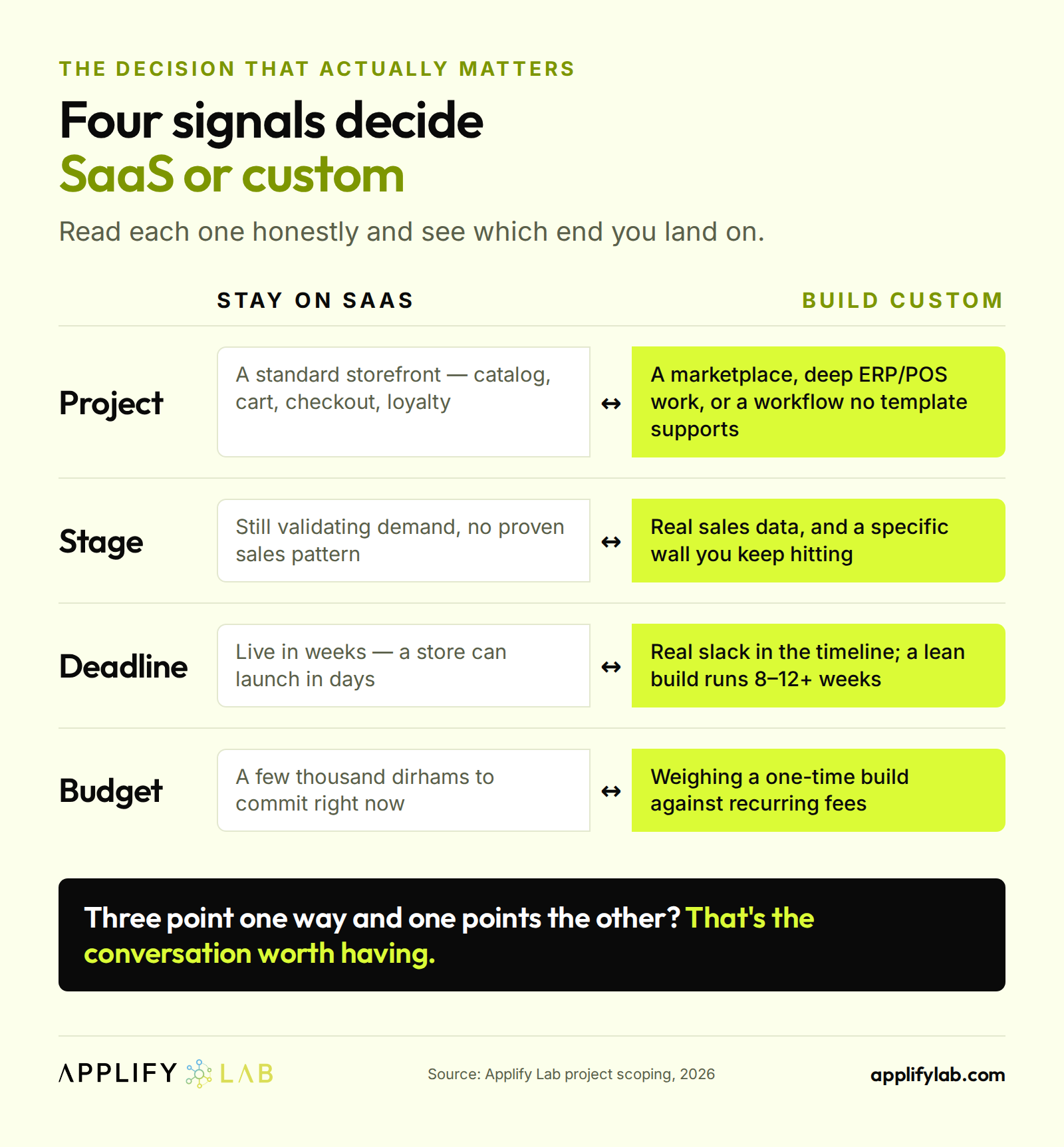
The four signals rarely all point the same way. When three say one thing and one says the other, that's the conversation worth having.
Project: if what you need is a fairly standard storefront — catalog, cart, checkout, basic loyalty — a SaaS platform genuinely does that job well. If your business needs something no template supports (multi-vendor marketplace logic, an unusual operational workflow, deep ERP/POS integration specific to how you run things), that's where custom stops being overkill and starts being the only way to actually build it.
Stage: still validating demand, no proven sales pattern yet — SaaS, every time. You want to learn whether people buy before spending months on infrastructure for a business model you haven't confirmed. Once you have real sales data and a clear, specific sense of what's actually holding growth back, that's when a custom build starts paying for itself.
Deadline: need to be live in weeks — SaaS wins on pure speed; a Shopify or Salla store can launch in days, while even a lean custom build realistically takes 8-12+ weeks. If your timeline has real slack, this constraint disappears and the decision goes back to project and stage.
Budget: if what you can commit right now is a few thousand dirhams rather than tens of thousands, SaaS is the realistic option today — and that's not a lesser choice, it's the right one for where you are. Custom starts making sense once you're weighing a one-time build against what you're already paying in recurring fees and lost flexibility.
These four don't always point the same way — a founder with a big vision (project) but no proof yet (stage) is the classic case that gets talked into custom too early. If three of the four point one way and one doesn't, that's worth a direct conversation, not a guess. And once you know you're staying on SaaS a while longer, the Salla vs Zid vs Shopify comparison above is what should drive the platform pick — not brand recognition.
Callout: The most expensive mistake isn't picking the "wrong" SaaS platform — it's building custom a year before you needed to, or staying on a template two years after you'd outgrown it. Both cost real money. The fix is asking the question honestly at each stage, not defaulting to whichever option sounds more serious.
Three of the four signals point one way and one doesn't?
That's exactly the case worth a real conversation instead of a guess. Tell us your project, stage, deadline, and budget, and we'll tell you honestly which one should win.
Cost: the short version
Salla and Zid run on monthly subscriptions plus transaction and plugin fees — low upfront cost, but cumulative over time. Shopify follows a similar model with its own app-store cost creep.
A custom app is a larger one-time investment with no recurring platform fee, though you'll still budget for hosting and maintenance. For the full, sourced 2026 cost breakdown — including exact AED ranges by build type — see our custom ecommerce app cost guide rather than us repeating the same numbers here.
Who owns your data and code?
This is where the comparison gets concrete instead of theoretical.
On Salla, Zid, or Shopify, the platform controls the infrastructure your store runs on — your data lives inside their system, and if you ever migrate away, you're exporting from someone else's database, not handing off your own codebase.
With a custom app built through Applify Lab, you own 100% of the code outright once it's built — no retained rights on our side, no proprietary lock-in. If a business model depends on that data and that codebase being unambiguously yours (a marketplace, a business you might eventually sell, or one with investors asking about IP), that's a real, practical reason to go custom earlier rather than later — not just a nice-to-have.
Migration: starting on SaaS, moving to custom later
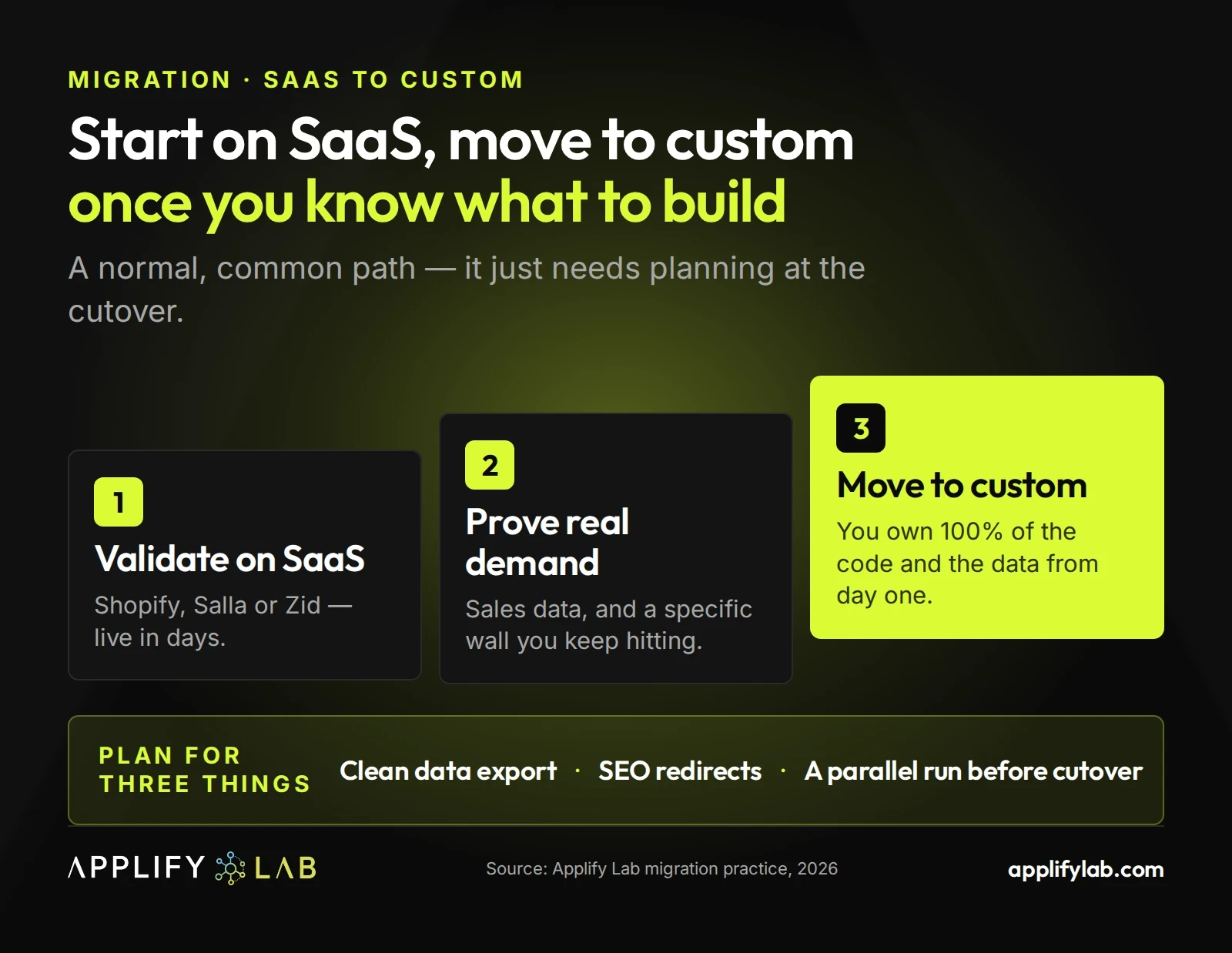
Validate on SaaS, then move to custom once you know exactly what the product needs — planning the export, the redirects, and a parallel run.
This is a legitimate, common path, not a failure to plan ahead: validate the idea on Shopify, Salla, or Zid first, prove there's real demand, then move to a custom build once you know exactly what the product needs to do.
The main things to plan for when you do migrate:
exporting your customer and order data cleanly,
redirecting your existing SEO equity to the new domain/app structure,
and running the custom build in parallel with the SaaS store for a few weeks before full cutover — long enough to confirm payments, inventory sync, and order flow all behave correctly under real traffic, not just in testing.
FAQ
Are Salla and Zid actually available and supported in the UAE, or are they Saudi-only?
Both are usable in the UAE — Zid explicitly covers the Gulf region, and Salla has been actively expanding its UAE and Egypt presence. But both are Saudi-founded and still Saudi-dominant in scale, so UAE-specific support and integrations may be less mature than what you'd get from a platform built UAE-first.
Is Shopify or Salla/Zid better for a UAE retailer?
There's no universal answer, but current UAE-specific comparisons give Shopify an edge on feature coverage (Arabic RTL, BNPL, PCI compliance, GCC multi-currency) for UAE DTC brands specifically. Salla/Zid remain a strong choice if your business is genuinely GCC-wide and Arabic-first rather than UAE-only.
When should I move from a SaaS platform to a custom app?
When a specific business need — not general ambition — hits a real wall: a workflow no plugin supports, a marketplace model with multiple vendors, deep ERP/CRM integration, or growth your template genuinely can't handle. "We've outgrown the vibe of it" isn't a reason; a concrete blocked feature or cost ceiling is.
If I leave a SaaS platform, do I keep my data?
You can typically export your customer, order, and product data, but you're extracting it from someone else's system, not handing off code you own. With a custom build, there's no extraction step — the code and data are yours from day one.
Do I lose my SEO rankings if I migrate from Shopify/Salla/Zid to a custom app?
Not if it's planned properly — with clean redirects and a like-for-like URL/content migration, most of the SEO equity carries over. This is a real project step, not a footnote, so it's worth asking any development partner directly how they handle it.
To go further
For most UAE retailers, the honest starting point is Shopify, not Salla or Zid — one UAE agency that's built 30+ local stores reports Shopify was the right fit for roughly 80% of them, and it now reportedly beats WooCommerce on 9 of 14 UAE-specific criteria including Arabic RTL and GCC multi-currency support.
Salla and Zid are real, credible platforms — Salla alone powers 68,000-80,000+ merchants on $130M in pre-IPO funding — but they're Saudi-founded and Saudi-dominant, expanding into the UAE rather than built around it first.
A custom app earns its cost only once a specific business need — deep integrations, a marketplace model, or a workflow no template supports — makes the SaaS ceiling a real problem, not a hypothetical one.
Key takeaways
For most UAE retailers, start on Shopify — Salla and Zid are strong but Saudi-first.
The decision that matters isn't the platform, it's SaaS or custom — and that's decided by four signals: project, stage, deadline, budget.
Custom earns its cost only when a specific need hits a real wall (marketplace, deep ERP/POS integration, a workflow no template supports) — not general ambition.
With a custom build you own 100% of the code and data; on SaaS the platform owns the infrastructure your store runs on.
Starting on SaaS and migrating to custom later is a normal path — just plan the data export, SEO redirects, and a parallel run.
Planning a shopping, marketplace or loyalty app? See how we build e-commerce and retail apps for UAE brands.
All three SaaS platforms can run a UAE store — the real difference is where they're strongest, and whether you own what you build.
Platform | Origin | Best for | You own the code? | UAE fit |
|---|---|---|---|---|
Salla | Saudi | GCC-wide, Arabic-first stores | No (SaaS) | Expanding into the UAE |
Zid | Saudi | SMEs scaling across the Gulf | No (SaaS) | Present, less UAE-mature |
Shopify | Global | Most UAE DTC brands | No (SaaS) | Strong — RTL, BNPL, GCC multi-currency |
Custom app | Built for you | A specific need SaaS can't meet | Yes, 100% | Built exactly for the UAE |
What each platform actually is (with real numbers, not vibes)
Salla: SaaS store builder, Saudi-founded, the dominant hosted ecommerce platform in Saudi Arabia with 68,000+ merchants and a $130M pre-IPO round behind it. Actively expanding into the UAE and Egypt with localized payments and Arabic-first tooling — a strong fit if your catalog and customer base span the wider GCC, less so if you're UAE-only and want the deepest local integrations.
Zid: Another Saudi-founded SaaS platform, positioned as more flexible than basic builders, with roughly 16,000 active merchants as of the last public figure we could confirm (2022 — treat this as dated, not current). Present across Saudi, UAE, and the Gulf, with POS and logistics integrations.
Shopify: The globally dominant SaaS platform, and per UAE-focused agency data, the more common actual starting point for UAE DTC brands specifically — not because it's more "hyped," but because its UAE-specific feature coverage (Arabic RTL, BNPL, PCI-DSS, GCC multi-currency) is reportedly ahead of the regional alternatives on a feature-by-feature basis.
A custom app: Built from the ground up for one business. You own the code, the data, and the roadmap outright — nothing rented, nothing you lose access to if you switch providers.
The real question: SaaS or custom — and it comes down to four things
Whichever platform you're weighing, the decision that actually matters isn't Salla vs Zid vs Shopify — it's whether you need a custom build at all, or whether a SaaS platform gets you there faster and cheaper right now. That answer comes down to your project, your stage, your deadline, and your budget, not to which platform has the longer feature list.
The four signals rarely all point the same way. When three say one thing and one says the other, that's the conversation worth having.
Project: if what you need is a fairly standard storefront — catalog, cart, checkout, basic loyalty — a SaaS platform genuinely does that job well. If your business needs something no template supports (multi-vendor marketplace logic, an unusual operational workflow, deep ERP/POS integration specific to how you run things), that's where custom stops being overkill and starts being the only way to actually build it.
Stage: still validating demand, no proven sales pattern yet — SaaS, every time. You want to learn whether people buy before spending months on infrastructure for a business model you haven't confirmed. Once you have real sales data and a clear, specific sense of what's actually holding growth back, that's when a custom build starts paying for itself.
Deadline: need to be live in weeks — SaaS wins on pure speed; a Shopify or Salla store can launch in days, while even a lean custom build realistically takes 8-12+ weeks. If your timeline has real slack, this constraint disappears and the decision goes back to project and stage.
Budget: if what you can commit right now is a few thousand dirhams rather than tens of thousands, SaaS is the realistic option today — and that's not a lesser choice, it's the right one for where you are. Custom starts making sense once you're weighing a one-time build against what you're already paying in recurring fees and lost flexibility.
These four don't always point the same way — a founder with a big vision (project) but no proof yet (stage) is the classic case that gets talked into custom too early. If three of the four point one way and one doesn't, that's worth a direct conversation, not a guess. And once you know you're staying on SaaS a while longer, the Salla vs Zid vs Shopify comparison above is what should drive the platform pick — not brand recognition.
Callout: The most expensive mistake isn't picking the "wrong" SaaS platform — it's building custom a year before you needed to, or staying on a template two years after you'd outgrown it. Both cost real money. The fix is asking the question honestly at each stage, not defaulting to whichever option sounds more serious.
Three of the four signals point one way and one doesn't?
That's exactly the case worth a real conversation instead of a guess. Tell us your project, stage, deadline, and budget, and we'll tell you honestly which one should win.
Cost: the short version
Salla and Zid run on monthly subscriptions plus transaction and plugin fees — low upfront cost, but cumulative over time. Shopify follows a similar model with its own app-store cost creep.
A custom app is a larger one-time investment with no recurring platform fee, though you'll still budget for hosting and maintenance. For the full, sourced 2026 cost breakdown — including exact AED ranges by build type — see our custom ecommerce app cost guide rather than us repeating the same numbers here.
Who owns your data and code?
This is where the comparison gets concrete instead of theoretical.
On Salla, Zid, or Shopify, the platform controls the infrastructure your store runs on — your data lives inside their system, and if you ever migrate away, you're exporting from someone else's database, not handing off your own codebase.
With a custom app built through Applify Lab, you own 100% of the code outright once it's built — no retained rights on our side, no proprietary lock-in. If a business model depends on that data and that codebase being unambiguously yours (a marketplace, a business you might eventually sell, or one with investors asking about IP), that's a real, practical reason to go custom earlier rather than later — not just a nice-to-have.
Migration: starting on SaaS, moving to custom later
Validate on SaaS, then move to custom once you know exactly what the product needs — planning the export, the redirects, and a parallel run.
This is a legitimate, common path, not a failure to plan ahead: validate the idea on Shopify, Salla, or Zid first, prove there's real demand, then move to a custom build once you know exactly what the product needs to do.
The main things to plan for when you do migrate:
exporting your customer and order data cleanly,
redirecting your existing SEO equity to the new domain/app structure,
and running the custom build in parallel with the SaaS store for a few weeks before full cutover — long enough to confirm payments, inventory sync, and order flow all behave correctly under real traffic, not just in testing.
FAQ
Are Salla and Zid actually available and supported in the UAE, or are they Saudi-only?
Both are usable in the UAE — Zid explicitly covers the Gulf region, and Salla has been actively expanding its UAE and Egypt presence. But both are Saudi-founded and still Saudi-dominant in scale, so UAE-specific support and integrations may be less mature than what you'd get from a platform built UAE-first.
Is Shopify or Salla/Zid better for a UAE retailer?
There's no universal answer, but current UAE-specific comparisons give Shopify an edge on feature coverage (Arabic RTL, BNPL, PCI compliance, GCC multi-currency) for UAE DTC brands specifically. Salla/Zid remain a strong choice if your business is genuinely GCC-wide and Arabic-first rather than UAE-only.
When should I move from a SaaS platform to a custom app?
When a specific business need — not general ambition — hits a real wall: a workflow no plugin supports, a marketplace model with multiple vendors, deep ERP/CRM integration, or growth your template genuinely can't handle. "We've outgrown the vibe of it" isn't a reason; a concrete blocked feature or cost ceiling is.
If I leave a SaaS platform, do I keep my data?
You can typically export your customer, order, and product data, but you're extracting it from someone else's system, not handing off code you own. With a custom build, there's no extraction step — the code and data are yours from day one.
Do I lose my SEO rankings if I migrate from Shopify/Salla/Zid to a custom app?
Not if it's planned properly — with clean redirects and a like-for-like URL/content migration, most of the SEO equity carries over. This is a real project step, not a footnote, so it's worth asking any development partner directly how they handle it.
To go further
Already know you've outgrown SaaS?
Then the next step is a scoping conversation, not more research. Grab 30 minutes on our calendar — come with your current platform, your monthly volume, and the specific wall you've hit.

