Health & Wellness
Clinic No-Shows in Dubai: The Real Cost and the Fix (2026)

By
Anh Nguyen, Founder
·
9 min

A clinic with 40 bookings a day, a 15% no-show rate and an average booking of AED 250 loses about AED 39,000 a month to empty slots. Most of those patients forgot, or could not reach the clinic in time to move. The first fix is a reminder schedule patients can reply to, run by your current team.
Key takeaways
Do the arithmetic first. Bookings × no-show rate × booking value × working days gives your monthly loss.
Forgetting is the main cause. In the UAE, half of patients who miss forgot; four in ten couldn't cancel in time.
Reminders work best when patients can reply. Send at booking, 48 hours, 24 hours and 2 hours before.
Software earns its cost after closing time. An AI agent can confirm or move a booking while reception is closed.
Building a health or wellness product in the UAE? See how we build healthcare and wellness apps.
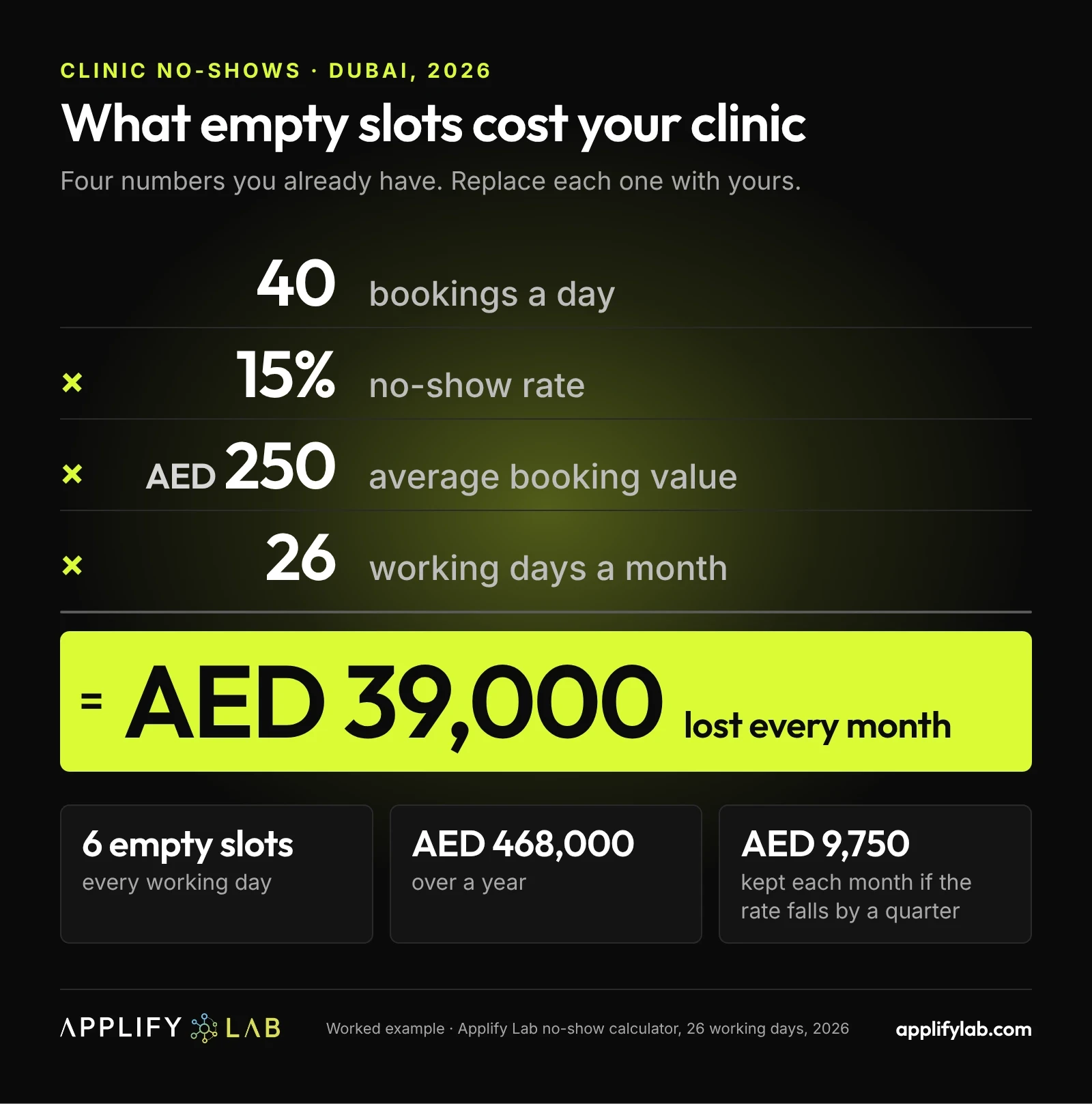
Four numbers you already have tell you what empty slots cost your clinic each month.
What does a no-show cost your clinic?
A no-show costs you the value of the slot, every working day it repeats. The calculation needs four numbers: bookings a day, your no-show rate, your average booking value and your working days in a month.
Worked example: 40 bookings a day × 15% × AED 250 × 26 working days = AED 39,000 a month. That is six empty slots a day, and about AED 468,000 over a year.
Small changes in the rate move large amounts:
If reminders cut the rate by a quarter, from 15% to about 11%, the same clinic keeps around AED 9,750 a month.
If they halve it, as one UAE public-health study below did, it keeps AED 19,500 a month.
The same maths is on our homepage. The no-show calculator takes your three numbers and assumes 26 working days. The loss also reaches the patients who do come.
UAE hospitals described this to Gulf News in 2019 as a "ripple effect": overbooking to cover gaps, delays for punctual patients, and fewer slots for urgent cases.
Why do patients in the UAE miss appointments?
Most missed appointments are a timing problem.
When Okadoc launched its instant booking system with Dubai Healthcare City in 2019, it put the UAE no-show rate at an estimated 37%.
It gave two main causes: 50% of patients forget, and 40% can't call in time to cancel. Rates vary widely by facility. Emirates Health Services recorded a 21% no-show rate across its primary health care centres, which handle more than 140,000 visits a month (JMIR Formative Research, 2025).
In 2019, Mediclinic Middle East told Gulf News its rate sat between 20% and 30%, and RAK Hospital reported about 18%.
The other reasons are ordinary life. UAE clinics quoted by Gulf News in 2019 named time off work, childcare, holidays, and patients who book at several clinics and keep only one appointment.
Each cause points to its own fix:
A patient who forgot needs a reminder at the right moment.
A patient who could not reach you needs a way to move the booking in one reply, at any hour.
A patient who booked twice needs to be asked to confirm, so the slot frees up early.
Which reminder schedule cuts no-shows?
Several reminders work better than one.
A 2016 review of 21 studies in BMJ Open found that patients who received reminders were 25% less likely to miss an appointment (15% against 21%), and that several reminders worked better than a single one.
In the UAE, Emirates Health Services halved its no-show rate, from 20.8% to 10.3% in three months, by predicting which patients were likely to miss and having coordinators contact them first (JMIR Formative Research, 2025).
This is the schedule we recommend to clinics:
When | What the message does | What the patient can reply |
|---|---|---|
At booking | Confirms date, time, doctor and location | "Wrong time? Reply to move it." |
48 hours before | Leaves time to offer the slot to another patient | Confirm, or move |
24 hours before | The main confirmation | 1 to confirm, 2 to move |
2 hours before | A short note on parking and what to bring | "Running late? Tell us." |
A reminder patients can answer turns a likely no-show into a rebooking. Every message carries one simple reply to confirm or move, and someone, or something, answers it.
Send it on the channel patients already read. WhatsApp reaches about 90% of the UAE population, according to Infobip (2026), which makes it the natural first channel. Keep SMS for patients who prefer it.
Write it in the language the patient booked in. Keep an Arabic and an English version of each message, short, with the clinic's name in the first line.
Your team can run this from next week.
Many clinic booking systems include automated reminders; check what yours can send, and when, before buying anything. If yours has none, a daily list of tomorrow's patients and saved replies in the WhatsApp Business app let reception run the full schedule.
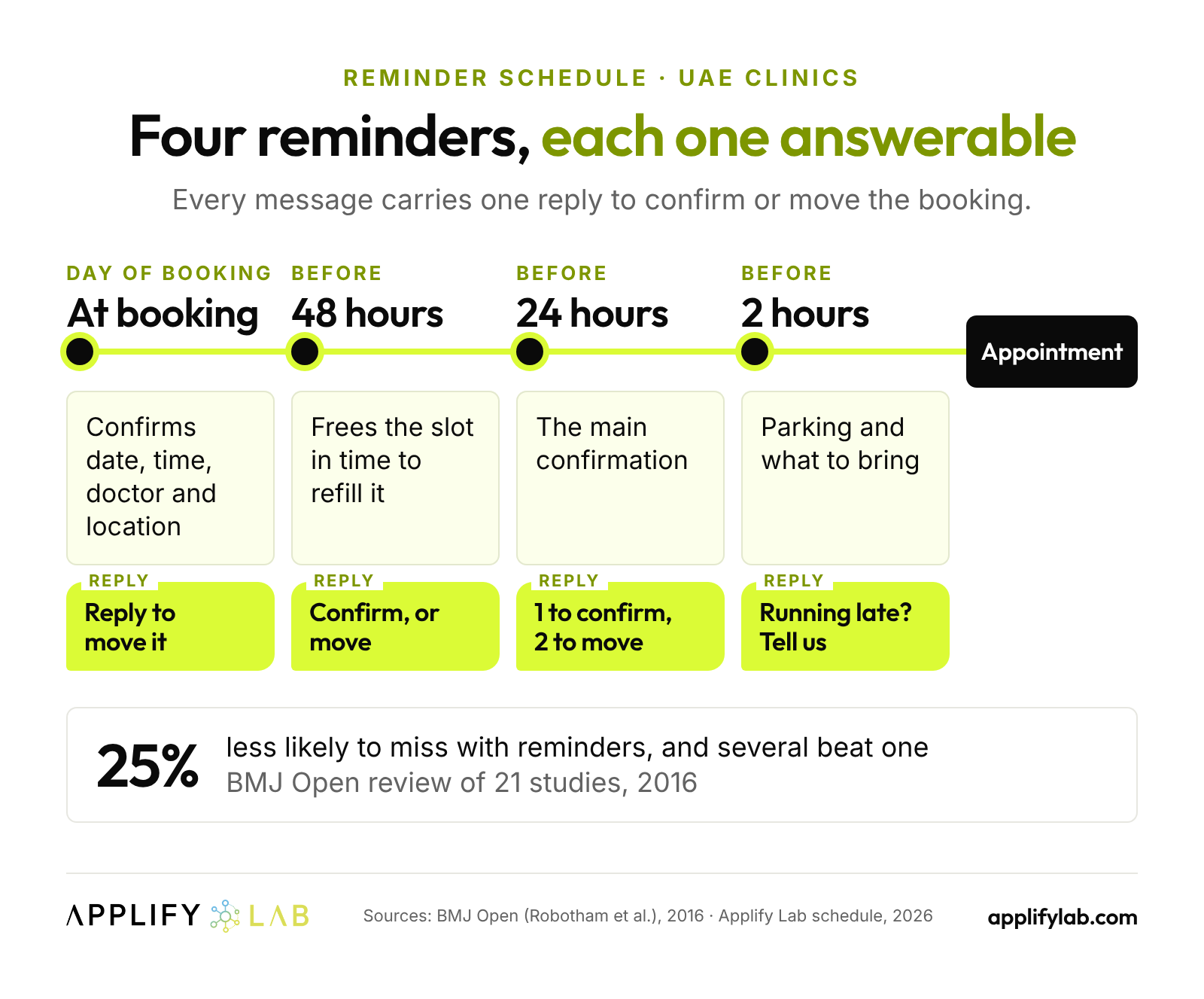
Four reminders, each with one reply to confirm or move: the schedule a reception team can run next week.
Want our reminder templates?
Message us and we'll send our Arabic and English reminder messages for all four moments, ready to paste. Get the templates on WhatsApp
What should you do with the empty slot?
A slot freed 48 hours ahead is a slot you can still fill.
That is why the 48-hour reminder matters most for revenue.
Keep a waiting list.
Patients who wanted an earlier appointment are the fastest fill: when a booking moves, message the first two or three on the list with the free time.
Plan for same-day gaps.
Use them for follow-ups, short reviews or walk-ins, and tell regular patients that short-notice slots exist.
Overbook only with your own data.
Booking two patients into one slot works only where you know the no-show rate for that doctor, service and time of day. Without that data, the patients who come end up waiting.
Write down your no-show policy.
Some Dubai clinics publish a fee for late cancellations or no-shows; others choose to charge nothing (see the FAQ).
Either way, a written policy shown at booking sets expectations before the first missed appointment.
Where does an AI agent help, and where doesn't it?
An AI agent helps when patients reply after the clinic has closed. A message at 10:00 PM asking to move tomorrow's 9:30 AM appointment needs an answer before reception opens. At that point, an agent can offer a real free slot, move the booking and update the calendar, in Arabic or English.
It helps less with the rest. It does nothing for a patient who never reads messages, and it can't fix a calendar that is always overbooked. Medical questions, complaints and anything urgent go to a person, always.
Situation | Your reception team | An AI agent |
|---|---|---|
Sending the four reminders | Runs them with templates and a daily list | Sends them automatically |
Patient replies during opening hours | Handles it | Handles it, or passes it to the team |
Patient replies after closing time | Sees it the next morning | Confirms or moves the booking that night |
Medical question or complaint | Handles it | Hands it to a person |
Freed slot and a waiting list | Messages the list when there's time | Messages the list as soon as the slot frees |

The agent's job starts when reception closes; anything medical still goes to a person.
Start with the reminders, then decide. Run the schedule with your team for one month.
If the numbers show replies arriving after closing and slots lost overnight, that is the piece where an AI agent for UAE businesses earns its cost.
If they don't, you don't need one.
This is how we work on every project: diagnose where the money leaks, then build only the piece that recovers it.
If you're weighing whether booking and reminders belong inside a patient app, our guide to clinic appointment app development in Dubai covers the features and the choice.
What should you measure for one month?
Measure one normal week before you change anything. Write down bookings, no-shows, late cancellations and the value of each.
Then track five numbers every week:
No-show rate, by doctor, service and day of the week.
Reminder replies: the share of patients who confirm or move.
Slots moved against slots lost: a moved booking is a saved booking.
Slots refilled from the waiting list, and their value.
Replies after closing time, and how many of them ended in a lost slot.
After four weeks, the numbers tell you what to do next.
Lower rate and few late-night replies: keep the schedule; there is nothing to buy.
Lower rate but many replies after closing: automation pays for itself here.
No change: check that the reminders reach patients, on the channel they read.
FAQ
What is a normal no-show rate for clinics in the UAE?
Published UAE figures range from about 18% to 37%. Emirates Health Services recorded 21% in its primary care centres (JMIR Formative Research, 2025). Mediclinic Middle East reported 20% to 30% and RAK Hospital about 18% (Gulf News, 2019), and Okadoc estimated 37% across UAE hospitals and clinics in 2019. Your own rate, measured over a normal month, matters more than any average.
Do WhatsApp reminders reduce no-shows?
Reminders do: a 2016 BMJ Open review of 21 studies found patients who received them were 25% less likely to miss appointments, and several reminders worked better than one. WhatsApp reaches about 90% of the UAE population (Infobip, 2026), so it is the channel most patients read. A reminder works best when the patient can reply to confirm or move.
How far ahead should a clinic send reminders?
We recommend four messages: at booking, 48 hours before, 24 hours before and 2 hours before. The 48-hour reminder matters most for revenue, because a slot freed then can still go to another patient. The 24-hour message is the main confirmation, and the 2-hour note covers parking, directions and late arrivals.
Can a clinic in Dubai charge a no-show fee?
Some Dubai clinics publish no-show and late-cancellation fees, charged to the patient and kept separate from insurance. Others choose to charge nothing, worried a fee pushes patients away. If you introduce one, put it in a written policy the patient sees at booking, and check it with your DHA licensing contact or a legal adviser first. This is general information, not legal advice.
Can reminders be automated without new software?
Often, yes. Many clinic booking systems include automated reminders, so check what yours can send, and when, before buying anything. If yours has none, a daily list of tomorrow's patients and saved replies in the WhatsApp Business app let reception run the full schedule. Software becomes worth it when replies arrive after closing time and slots are lost overnight.
To go further
Want your no-show numbers worked through with us?
Bring your bookings, no-show rate and average booking value; in 30 minutes we show you where slots are lost and what to fix first.

