App Development
App Development Cost in Dubai (2026): Prices by App Type

By
Anh Nguyen, Founder
·
13 min

Most app projects cost between AED 36,700 and AED 183,600, according to Clutch's September 2026 data, and the average is about AED 333,400. Where your app lands depends on its type and on six decisions in the scope. Launching a focused first version keeps the cost in the lower part of that range.
Key takeaways
Most projects sit in the second of four budget bands. A few very large builds pull the average far above the typical project.
Six decisions move the number. Features and user types, platforms, payments and integrations, AI, design and Arabic, and compliance.
The type of app sets the starting point. A booking app or a shopping app for one brand starts lower than a marketplace or a health app connected to patient records.
A fixed price before a diagnosis is a guess. It either pays for features you won't use or leaves out work you will need.
Phasing keeps spending under control. Launch the part that earns its cost first, then add the rest in short steps, each priced before it starts.
Planning a custom app? See how we approach custom app and AI development in Dubai.
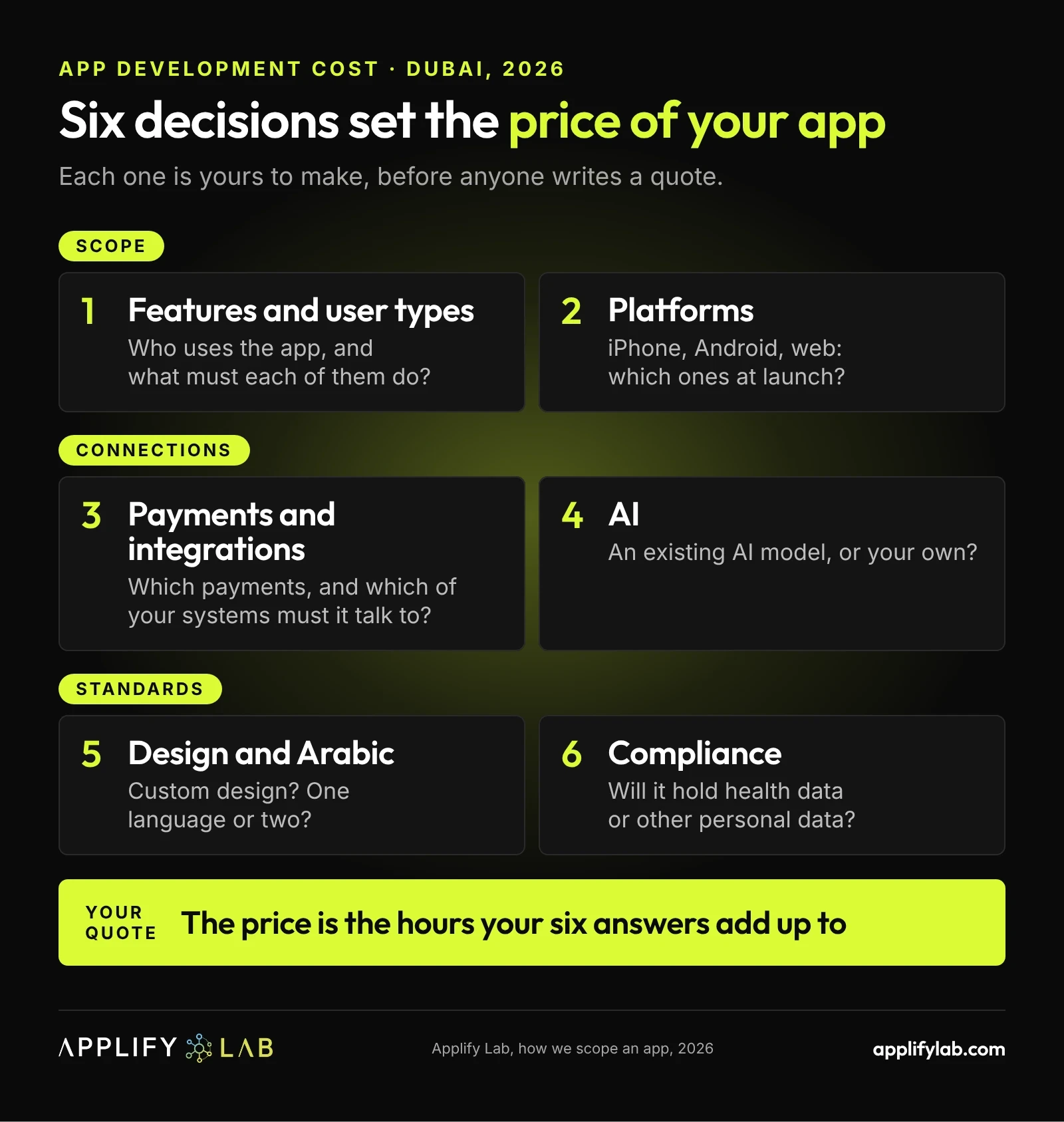
Six decisions set the price of an app, and each one is yours to make.
How much does an app cost in Dubai?
Most app projects cost between AED 36,700 and AED 183,600, and the average is about AED 333,400.
According to Clutch, the B2B review platform, most app projects reviewed on its site fall between USD 10,000 and 49,999, and the average project costs USD 90,780 (data updated September 2026). The average sits far above the typical project because a few very large builds pull it up. We convert at the dirham's fixed rate of AED 3.6725 to the US dollar, set by the Central Bank of the UAE.
UAE studios charge in the same hourly band as most of the market. App developers listed for the UAE on Clutch mostly show USD 25–49 an hour (about AED 92–180) in the directory's October 2026 ratings, the band Clutch reports for many of the countries it tracks. Two quotes at the same rate can still be far apart, because the gap comes from the hours each team puts in the scope.
Clutch's four budget bands, in dirhams, and what usually fits in each:
Under AED 36,700. A clickable prototype, an app built on an existing online store, or a single-purpose tool without accounts or payments.
AED 36,700 to 183,600. A focused first version with accounts, a catalogue or a calendar, payment, notifications and an admin panel. This is where most projects land.
AED 183,600 to 734,500. Two-sided marketplaces, delivery with live tracking, apps connected to clinic or hospital records, and AI features that need your own data prepared.
Above AED 734,500. Large platforms with many user types, deep integrations or their own AI models.
These four bands are the reference for the table by type of app further down.
What drives the cost of an app in Dubai?
Six decisions set most of the price, and each one is yours to make.
An app's price is the time it takes to design, build and test it, and every hour traces back to a decision in the scope. That makes the six drivers below the places where a well-scoped first version saves money.
The six drivers:
Features and user types. Each type of user, such as customer, staff, vendor or admin, needs its own screens and rules. A booking app for one clinic has two user types; a marketplace has at least three.
Platforms. iPhone and Android built from one shared codebase cost less than two separate native apps. In the UAE, Android holds about 73% of the mobile market and iOS about 27% (StatCounter, September 2026), so most businesses launch on both. A web version adds its own share.
Payments and integrations. Card payments, Apple Pay, deposits and refunds take careful work. So does every connection to a system you already run: your POS, ERP, CRM, calendar or delivery partner.
AI. Search, recommendations or a chat assistant built on an existing AI model add integration and testing work, plus a monthly usage bill. Training your own model moves a project into the top bands.
Design and Arabic. A custom design costs more than a standard one. An Arabic version needs right-to-left layouts and its own testing on top of the translation.
Compliance. Health apps carry the most: patient data generally has to stay in the UAE under Federal Law No. 2 of 2019, and Dubai providers that share records connect to NABIDH. Every app that holds personal data follows the UAE PDPL.
How much does each type of app cost in the UAE?
The type of app sets the band its first version usually starts in; the six drivers decide where in the band it lands.
Type of app | First version usually starts in | What moves it up | Our detailed guide |
|---|---|---|---|
Booking app (clinic, salon, studio) | AED 36,700–183,600 | Deposits and packages, staff calendars, a link to your clinic or POS system | |
Shopping app for one brand | Under AED 36,700 on Shopify, Salla or Zid; up to AED 183,600 as a custom app | Loyalty, several payment methods, stock synced with your ERP | |
Ordering and delivery (restaurant, grocery) | AED 36,700–183,600 | Live rider tracking, your own fleet, several branches | |
Marketplace (vendors and buyers) | AED 183,600–734,500 | Vendor payouts and commissions, reviews, dispute handling | |
Healthcare app | AED 36,700–183,600 for booking and video consultations; AED 183,600–734,500 with patient records | NABIDH or EMR connection, e-prescriptions, hosting in the UAE | |
AI-powered app | AED 36,700–183,600 on an existing AI model | Your own data prepared for the AI, custom models |
These are market ranges; Applify Lab scopes every project after a diagnosis. The guides linked in the table go into each type in detail, feature by feature.
Planning to build in the next three months?
Send us the type of app, your must-have features and your launch date. We'll tell you what drives your cost and what we'd scope first.
What goes into a booking app's first version?
A booking app's first version needs nine screens; most of what owners ask for at the start can wait.
From what we have built for wellness, clinic and service businesses, these nine screens take a booking app from launch to its first paying customers. Each one is a line in the quote, which makes the list a quick way to check any scope you receive.
The nine screens of version one:
Sign up and log in. One method to start with.
Find what you're booking. A list you can filter.
The profile or service page. The page that convinces someone to book.
Choose a time. Real availability, nothing else.
Pay. One payment provider, one flow.
Confirmation. The screen people screenshot.
My bookings. Upcoming and past bookings, with cancel and reschedule.
Notifications. Reminders, changes and confirmations.
The admin side. Where your team sees the day and fixes things.
What waits for version two: chat, loyalty, referrals, reviews, a web version, several currencies, analytics dashboards, and a second language unless your customers need it on day one.
Two quick checks follow from the list. A quote with forty screens charges you for version two before you know whether version one works. A quote with fewer than nine usually leaves out the admin side, the part your team uses every day.
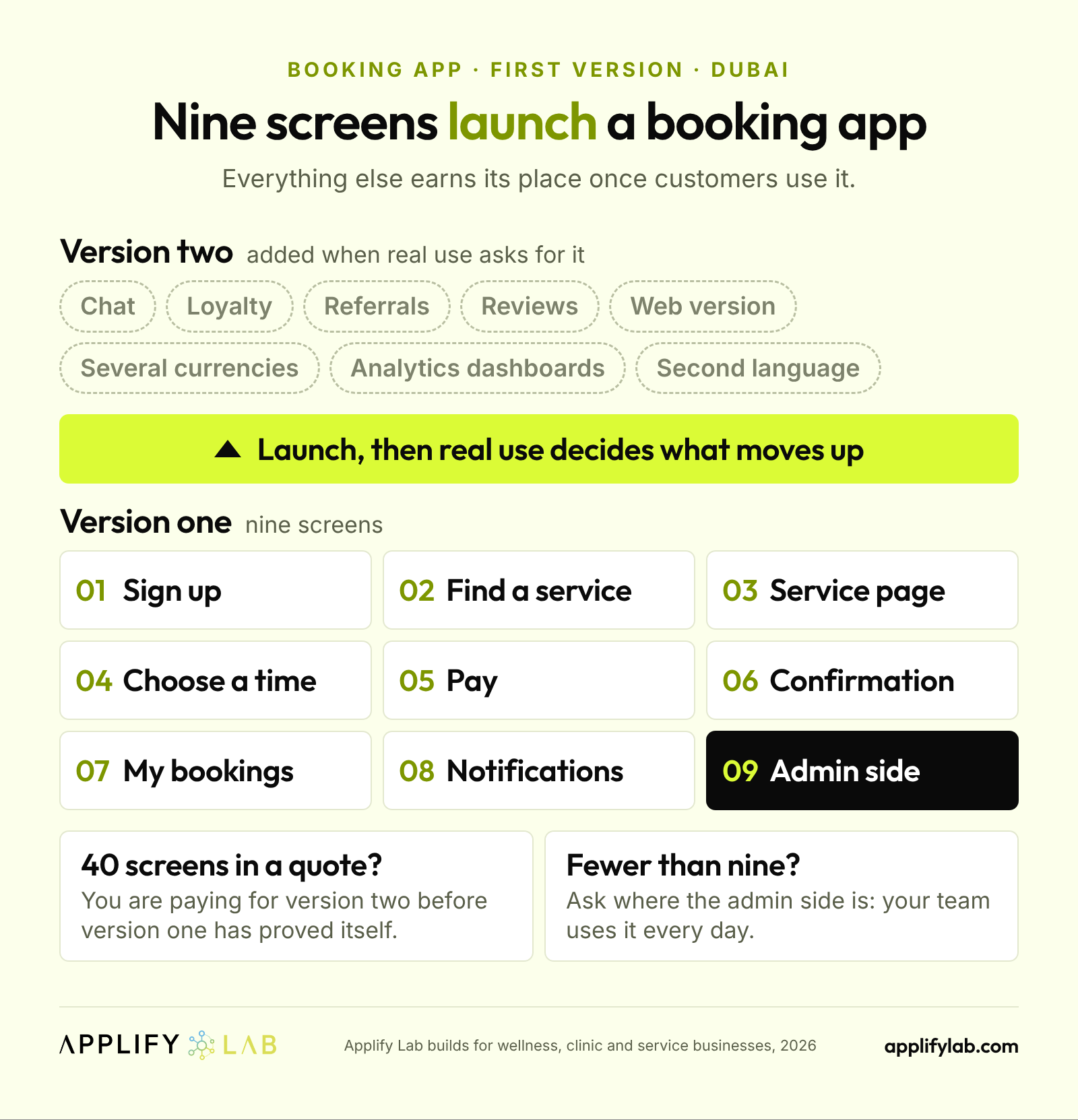
Nine screens launch a booking app; everything else earns its place later.
How long does it take to build an app in Dubai?
A focused first version can reach both app stores in about two months; a build that includes everything from the start often takes close to a year.
Clutch puts the average app project at about 11 months. A GCC wellness marketplace we built went from kickoff to live on both stores in eight weeks, because the first sprints focused on the core marketplace loop: onboarding, practitioner profiles, browsing, booking, payment and the session itself. The other features followed in fortnightly releases.
Time drives cost, because the price is the team's hours. Each extra month of building is another month of the team's time on the invoice, and another month in which the app earns nothing. Store review adds a few days at the end: Apple reviews 50% of submissions in under 24 hours and 90% in under 48 hours, and Google Play warns that reviews for some developer accounts can take up to seven days.
Why is a fixed price before a diagnosis a guess?
A fixed price quoted before anyone understands your business either pays for features you won't use or leaves out work you will need.
A quote is an estimate of hours, and the hours depend on answers that only a conversation brings out: who uses the app, what it connects to, what has to work on day one and what can wait. A team that quotes without those answers either pads the estimate to protect itself, or keeps it low and recovers the difference in change requests later.
We diagnose first, then scope the version that earns its cost fastest. That means understanding the business, the model and the need before proposing anything, and leaving out features that won't pay for themselves. The first conversation takes longer, and the build gets shorter.
Phasing keeps the cost down, and known in advance:
Version one carries the core loop. The smallest set of screens that lets a customer find, book or buy, and pay.
Each next step is scoped and priced before it starts. On the wellness marketplace, we work in two-week sprints, each fixed in scope and price, so the founder knows the development spend before every sprint.
Real use decides what comes next. Features customers ask for move up the list; the ones nobody misses drop off it.
How do you compare two app quotes?
Compare the answers to the same five questions, side by side, before you compare the two prices.
Ask both teams, in writing:
What's in the first release, and what's in phase two? A quote with no phase two hasn't been thought through.
What did you leave out on purpose? Honest quotes name their exclusions: data migration, content, training, the second language, the admin side.
What will it cost to run each month after launch? Servers, third-party services, store fees and support.
What happens when something breaks in month three? Response time, who fixes it and what it costs.
Who owns the code and the accounts at the end? The answer should be you, in writing, with the store accounts in your company's name. Every Applify Lab client owns 100% of the code once it's built.
Most of the gap between two quotes disappears once both describe the same scope. And sometimes the lower quote is simply right: a small, well-defined build by a team that has done it before. Vagueness is the warning sign.
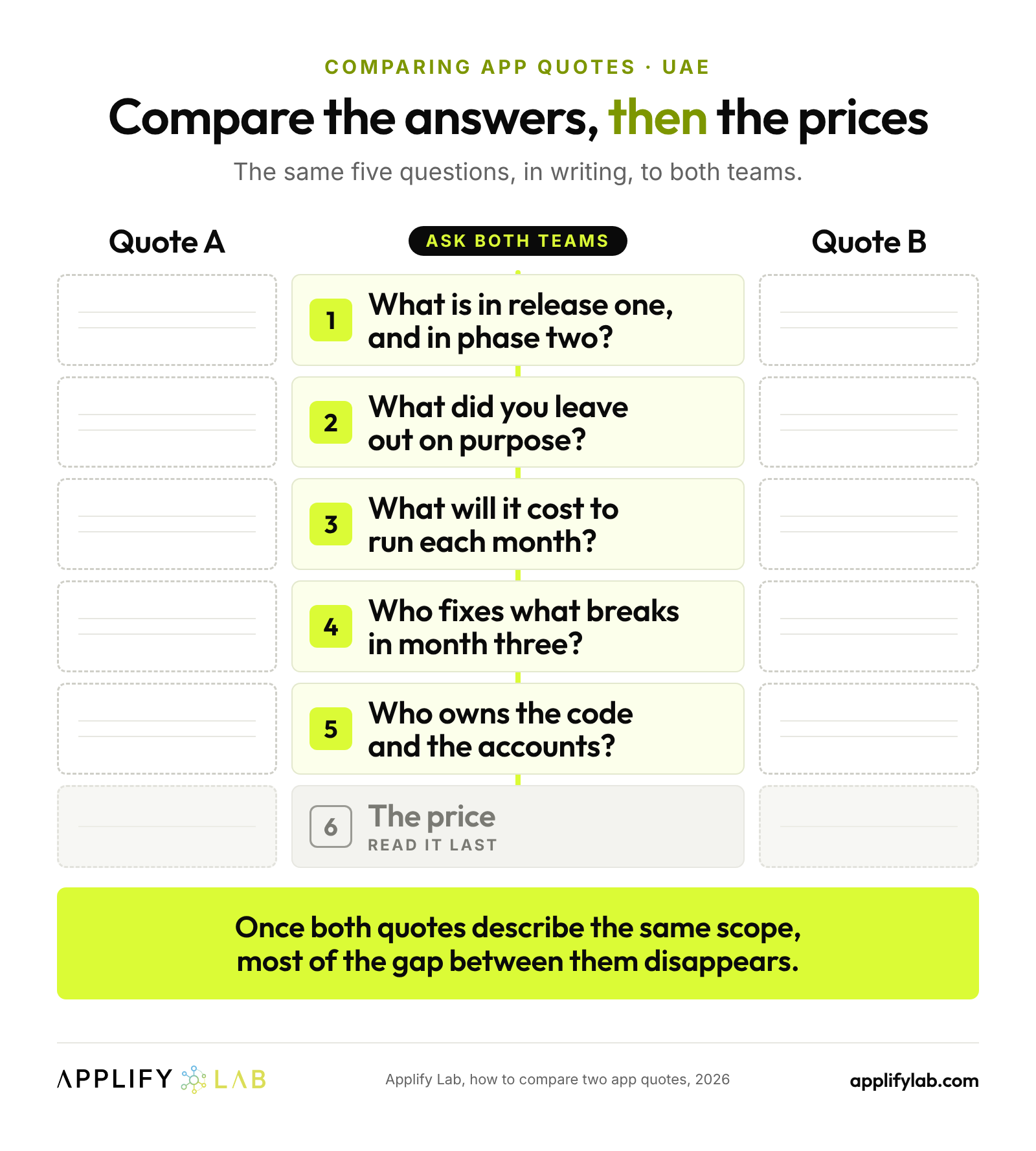
Put the five answers side by side, and most of the gap between two quotes disappears.
What does an app cost after launch?
Running an app has its own monthly bill, separate from the build.
The store accounts are the smallest part: the Apple Developer Program costs USD 99 a year (about AED 364), and Google Play charges a one-time USD 25 (about AED 92). Hosting, third-party services such as payments, maps and messaging, AI usage and the team that keeps the app updated make up the rest.
FAQ
How much does it cost to build an app in Dubai?
Most app projects cost between AED 36,700 and AED 183,600, according to Clutch's September 2026 data, with an average of about AED 333,400 pulled up by large builds. A focused first version with accounts, payment and an admin panel usually sits in that range; marketplaces and apps connected to patient records start higher. These are market ranges; Applify Lab scopes every project after a diagnosis.
How much does an AI app cost in the UAE?
An app that adds AI on an existing model, such as search, recommendations or a chat assistant, usually starts in the same AED 36,700–183,600 band as other first versions, plus a monthly usage bill from the AI provider. Preparing your own data for the AI or training a custom model moves the project into the higher bands. Our AI app cost guide covers the detail.
How much does a healthcare app cost in Dubai?
A first version with booking, video consultations and secure login usually starts in the AED 36,700–183,600 band. Connecting to patient records through NABIDH or an EMR, adding e-prescriptions and meeting UAE hosting rules moves it to AED 183,600–734,500. Health data generally has to stay in the UAE under Federal Law No. 2 of 2019, which shapes the hosting choice from day one.
Why do app quotes in Dubai vary so much?
Most UAE studios charge in the same hourly band, USD 25–49 an hour on Clutch, so the gap between two quotes comes from the hours in the scope. One team may price version two into version one; another may leave out the admin side, data migration or support after launch. Ask both teams the same five questions in writing, then compare the answers before the prices.
Should I build for iPhone or Android first?
With one shared codebase, iPhone and Android cost much less than two separate apps, so most UAE businesses launch on both. Android holds about 73% of the mobile market in the UAE and iOS about 27% (StatCounter, September 2026), so launching on one platform leaves a large share of customers out. A single platform makes sense for a short pilot with a known group of users.
How long does it take to build an app in Dubai?
A focused first version can reach both stores in about eight weeks when it launches the core loop first, as the GCC wellness marketplace we built did. Clutch puts the average project at about 11 months, because many projects build everything before launch. Apple reviews 90% of submissions in under 48 hours; Google Play can take up to seven days for some accounts.
To go further
Find out how we scope custom app and AI development in Dubai.
Building for patients or wellness clients? Discover our healthcare and wellness apps.
Selling online or running a store? See our e-commerce and retail apps for UAE brands.
Read how a GCC wellness marketplace went live on both stores in eight weeks.
Most app projects cost between AED 36,700 and AED 183,600, according to Clutch's September 2026 data, and the average is about AED 333,400. Where your app lands depends on its type and on six decisions in the scope. Launching a focused first version keeps the cost in the lower part of that range.
Key takeaways
Most projects sit in the second of four budget bands. A few very large builds pull the average far above the typical project.
Six decisions move the number. Features and user types, platforms, payments and integrations, AI, design and Arabic, and compliance.
The type of app sets the starting point. A booking app or a shopping app for one brand starts lower than a marketplace or a health app connected to patient records.
A fixed price before a diagnosis is a guess. It either pays for features you won't use or leaves out work you will need.
Phasing keeps spending under control. Launch the part that earns its cost first, then add the rest in short steps, each priced before it starts.
Planning a custom app? See how we approach custom app and AI development in Dubai.
Six decisions set the price of an app, and each one is yours to make.
How much does an app cost in Dubai?
Most app projects cost between AED 36,700 and AED 183,600, and the average is about AED 333,400.
According to Clutch, the B2B review platform, most app projects reviewed on its site fall between USD 10,000 and 49,999, and the average project costs USD 90,780 (data updated September 2026). The average sits far above the typical project because a few very large builds pull it up. We convert at the dirham's fixed rate of AED 3.6725 to the US dollar, set by the Central Bank of the UAE.
UAE studios charge in the same hourly band as most of the market. App developers listed for the UAE on Clutch mostly show USD 25–49 an hour (about AED 92–180) in the directory's October 2026 ratings, the band Clutch reports for many of the countries it tracks. Two quotes at the same rate can still be far apart, because the gap comes from the hours each team puts in the scope.
Clutch's four budget bands, in dirhams, and what usually fits in each:
Under AED 36,700. A clickable prototype, an app built on an existing online store, or a single-purpose tool without accounts or payments.
AED 36,700 to 183,600. A focused first version with accounts, a catalogue or a calendar, payment, notifications and an admin panel. This is where most projects land.
AED 183,600 to 734,500. Two-sided marketplaces, delivery with live tracking, apps connected to clinic or hospital records, and AI features that need your own data prepared.
Above AED 734,500. Large platforms with many user types, deep integrations or their own AI models.
These four bands are the reference for the table by type of app further down.
What drives the cost of an app in Dubai?
Six decisions set most of the price, and each one is yours to make.
An app's price is the time it takes to design, build and test it, and every hour traces back to a decision in the scope. That makes the six drivers below the places where a well-scoped first version saves money.
The six drivers:
Features and user types. Each type of user, such as customer, staff, vendor or admin, needs its own screens and rules. A booking app for one clinic has two user types; a marketplace has at least three.
Platforms. iPhone and Android built from one shared codebase cost less than two separate native apps. In the UAE, Android holds about 73% of the mobile market and iOS about 27% (StatCounter, September 2026), so most businesses launch on both. A web version adds its own share.
Payments and integrations. Card payments, Apple Pay, deposits and refunds take careful work. So does every connection to a system you already run: your POS, ERP, CRM, calendar or delivery partner.
AI. Search, recommendations or a chat assistant built on an existing AI model add integration and testing work, plus a monthly usage bill. Training your own model moves a project into the top bands.
Design and Arabic. A custom design costs more than a standard one. An Arabic version needs right-to-left layouts and its own testing on top of the translation.
Compliance. Health apps carry the most: patient data generally has to stay in the UAE under Federal Law No. 2 of 2019, and Dubai providers that share records connect to NABIDH. Every app that holds personal data follows the UAE PDPL.
How much does each type of app cost in the UAE?
The type of app sets the band its first version usually starts in; the six drivers decide where in the band it lands.
Type of app | First version usually starts in | What moves it up | Our detailed guide |
|---|---|---|---|
Booking app (clinic, salon, studio) | AED 36,700–183,600 | Deposits and packages, staff calendars, a link to your clinic or POS system | |
Shopping app for one brand | Under AED 36,700 on Shopify, Salla or Zid; up to AED 183,600 as a custom app | Loyalty, several payment methods, stock synced with your ERP | |
Ordering and delivery (restaurant, grocery) | AED 36,700–183,600 | Live rider tracking, your own fleet, several branches | |
Marketplace (vendors and buyers) | AED 183,600–734,500 | Vendor payouts and commissions, reviews, dispute handling | |
Healthcare app | AED 36,700–183,600 for booking and video consultations; AED 183,600–734,500 with patient records | NABIDH or EMR connection, e-prescriptions, hosting in the UAE | |
AI-powered app | AED 36,700–183,600 on an existing AI model | Your own data prepared for the AI, custom models |
These are market ranges; Applify Lab scopes every project after a diagnosis. The guides linked in the table go into each type in detail, feature by feature.
Planning to build in the next three months?
Send us the type of app, your must-have features and your launch date. We'll tell you what drives your cost and what we'd scope first.
What goes into a booking app's first version?
A booking app's first version needs nine screens; most of what owners ask for at the start can wait.
From what we have built for wellness, clinic and service businesses, these nine screens take a booking app from launch to its first paying customers. Each one is a line in the quote, which makes the list a quick way to check any scope you receive.
The nine screens of version one:
Sign up and log in. One method to start with.
Find what you're booking. A list you can filter.
The profile or service page. The page that convinces someone to book.
Choose a time. Real availability, nothing else.
Pay. One payment provider, one flow.
Confirmation. The screen people screenshot.
My bookings. Upcoming and past bookings, with cancel and reschedule.
Notifications. Reminders, changes and confirmations.
The admin side. Where your team sees the day and fixes things.
What waits for version two: chat, loyalty, referrals, reviews, a web version, several currencies, analytics dashboards, and a second language unless your customers need it on day one.
Two quick checks follow from the list. A quote with forty screens charges you for version two before you know whether version one works. A quote with fewer than nine usually leaves out the admin side, the part your team uses every day.
Nine screens launch a booking app; everything else earns its place later.
How long does it take to build an app in Dubai?
A focused first version can reach both app stores in about two months; a build that includes everything from the start often takes close to a year.
Clutch puts the average app project at about 11 months. A GCC wellness marketplace we built went from kickoff to live on both stores in eight weeks, because the first sprints focused on the core marketplace loop: onboarding, practitioner profiles, browsing, booking, payment and the session itself. The other features followed in fortnightly releases.
Time drives cost, because the price is the team's hours. Each extra month of building is another month of the team's time on the invoice, and another month in which the app earns nothing. Store review adds a few days at the end: Apple reviews 50% of submissions in under 24 hours and 90% in under 48 hours, and Google Play warns that reviews for some developer accounts can take up to seven days.
Why is a fixed price before a diagnosis a guess?
A fixed price quoted before anyone understands your business either pays for features you won't use or leaves out work you will need.
A quote is an estimate of hours, and the hours depend on answers that only a conversation brings out: who uses the app, what it connects to, what has to work on day one and what can wait. A team that quotes without those answers either pads the estimate to protect itself, or keeps it low and recovers the difference in change requests later.
We diagnose first, then scope the version that earns its cost fastest. That means understanding the business, the model and the need before proposing anything, and leaving out features that won't pay for themselves. The first conversation takes longer, and the build gets shorter.
Phasing keeps the cost down, and known in advance:
Version one carries the core loop. The smallest set of screens that lets a customer find, book or buy, and pay.
Each next step is scoped and priced before it starts. On the wellness marketplace, we work in two-week sprints, each fixed in scope and price, so the founder knows the development spend before every sprint.
Real use decides what comes next. Features customers ask for move up the list; the ones nobody misses drop off it.
How do you compare two app quotes?
Compare the answers to the same five questions, side by side, before you compare the two prices.
Ask both teams, in writing:
What's in the first release, and what's in phase two? A quote with no phase two hasn't been thought through.
What did you leave out on purpose? Honest quotes name their exclusions: data migration, content, training, the second language, the admin side.
What will it cost to run each month after launch? Servers, third-party services, store fees and support.
What happens when something breaks in month three? Response time, who fixes it and what it costs.
Who owns the code and the accounts at the end? The answer should be you, in writing, with the store accounts in your company's name. Every Applify Lab client owns 100% of the code once it's built.
Most of the gap between two quotes disappears once both describe the same scope. And sometimes the lower quote is simply right: a small, well-defined build by a team that has done it before. Vagueness is the warning sign.
Put the five answers side by side, and most of the gap between two quotes disappears.
What does an app cost after launch?
Running an app has its own monthly bill, separate from the build.
The store accounts are the smallest part: the Apple Developer Program costs USD 99 a year (about AED 364), and Google Play charges a one-time USD 25 (about AED 92). Hosting, third-party services such as payments, maps and messaging, AI usage and the team that keeps the app updated make up the rest.
FAQ
How much does it cost to build an app in Dubai?
Most app projects cost between AED 36,700 and AED 183,600, according to Clutch's September 2026 data, with an average of about AED 333,400 pulled up by large builds. A focused first version with accounts, payment and an admin panel usually sits in that range; marketplaces and apps connected to patient records start higher. These are market ranges; Applify Lab scopes every project after a diagnosis.
How much does an AI app cost in the UAE?
An app that adds AI on an existing model, such as search, recommendations or a chat assistant, usually starts in the same AED 36,700–183,600 band as other first versions, plus a monthly usage bill from the AI provider. Preparing your own data for the AI or training a custom model moves the project into the higher bands. Our AI app cost guide covers the detail.
How much does a healthcare app cost in Dubai?
A first version with booking, video consultations and secure login usually starts in the AED 36,700–183,600 band. Connecting to patient records through NABIDH or an EMR, adding e-prescriptions and meeting UAE hosting rules moves it to AED 183,600–734,500. Health data generally has to stay in the UAE under Federal Law No. 2 of 2019, which shapes the hosting choice from day one.
Why do app quotes in Dubai vary so much?
Most UAE studios charge in the same hourly band, USD 25–49 an hour on Clutch, so the gap between two quotes comes from the hours in the scope. One team may price version two into version one; another may leave out the admin side, data migration or support after launch. Ask both teams the same five questions in writing, then compare the answers before the prices.
Should I build for iPhone or Android first?
With one shared codebase, iPhone and Android cost much less than two separate apps, so most UAE businesses launch on both. Android holds about 73% of the mobile market in the UAE and iOS about 27% (StatCounter, September 2026), so launching on one platform leaves a large share of customers out. A single platform makes sense for a short pilot with a known group of users.
How long does it take to build an app in Dubai?
A focused first version can reach both stores in about eight weeks when it launches the core loop first, as the GCC wellness marketplace we built did. Clutch puts the average project at about 11 months, because many projects build everything before launch. Apple reviews 90% of submissions in under 48 hours; Google Play can take up to seven days for some accounts.
To go further
Find out how we scope custom app and AI development in Dubai.
Building for patients or wellness clients? Discover our healthcare and wellness apps.
Selling online or running a store? See our e-commerce and retail apps for UAE brands.
Read how a GCC wellness marketplace went live on both stores in eight weeks.
Want your first version scoped with us?
In 30 minutes, we go through your business, your users and your launch date, and you leave with the first version we'd build and what drives its cost. Book a 30-minute scoping call
RELATED GUIDES

Health & Wellness
Wellness App Development in Dubai: Costs & Which Category to Build (2026)
6 min

AI Agents & AI Automation
How Much Does an AI Wrapper App Cost? (2026 UAE Pricing)
6 min

Health & Wellness
Telemedicine App Development in Dubai for Chronic Disease Management
5 min

Retail & E-commerce
Salla vs Zid vs Shopify vs Custom App: A Dubai Guide (2026)
7 min

Retail & E-commerce
Mobile Payment Integration for Ecommerce Apps in the UAE (2026)
8 min

Health & Wellness
Digital Health App Development in UAE: Costs, Features & Compliance
6 min

Retail & E-commerce
Custom Ecommerce App Development in Dubai: What It Actually Costs in 2026
10 min

Health & Wellness
Clinic Appointment & Patient Portal App Development in Dubai
7 min

Retail & E-commerce
Grocery Delivery App Development in Dubai: Business Model & Cost
7 min