Wellness App Development in Dubai: Costs & Which Category to Build (2026)
The UAE's wellness economy is worth $40.8 billion — the largest in the Middle East, growing faster than anywhere else in the region. But "wellness app" covers four different products, and treating it as one is the fastest way to end up with something that serves no one clearly.
A fitness-tracking app, a nutrition coach, a meditation platform, and a clinic booking app solve genuinely different problems, for different users, under different rules.
This post help you pick the right one before you build anything — then send you to the guide that actually covers your category in depth.
Key takeaways
"Wellness app" is really four businesses: fitness & wearables, nutrition & diet, mental wellness & meditation, and clinical/compliance-heavy health. Each has different features, users, competitors, and rules.
Every lane already has real UAE competitors — this is a market to differentiate in, not an open field.
The dividing question is tracking wellbeing vs. delivering care. Tracking/guidance (fitness, nutrition, meditation) stays consumer wellness under PDPL; booking appointments or exchanging clinical data moves you into DHA/MOHAP + NABIDH/Malaffi territory.
Start narrow. Most successful apps prove one category's core loop, then expand — starting broad usually means doing four things at a mediocre level.
Cost varies by category (fitness/nutrition lower, clinical highest) — but MVP scope drives where you land more than the category label.
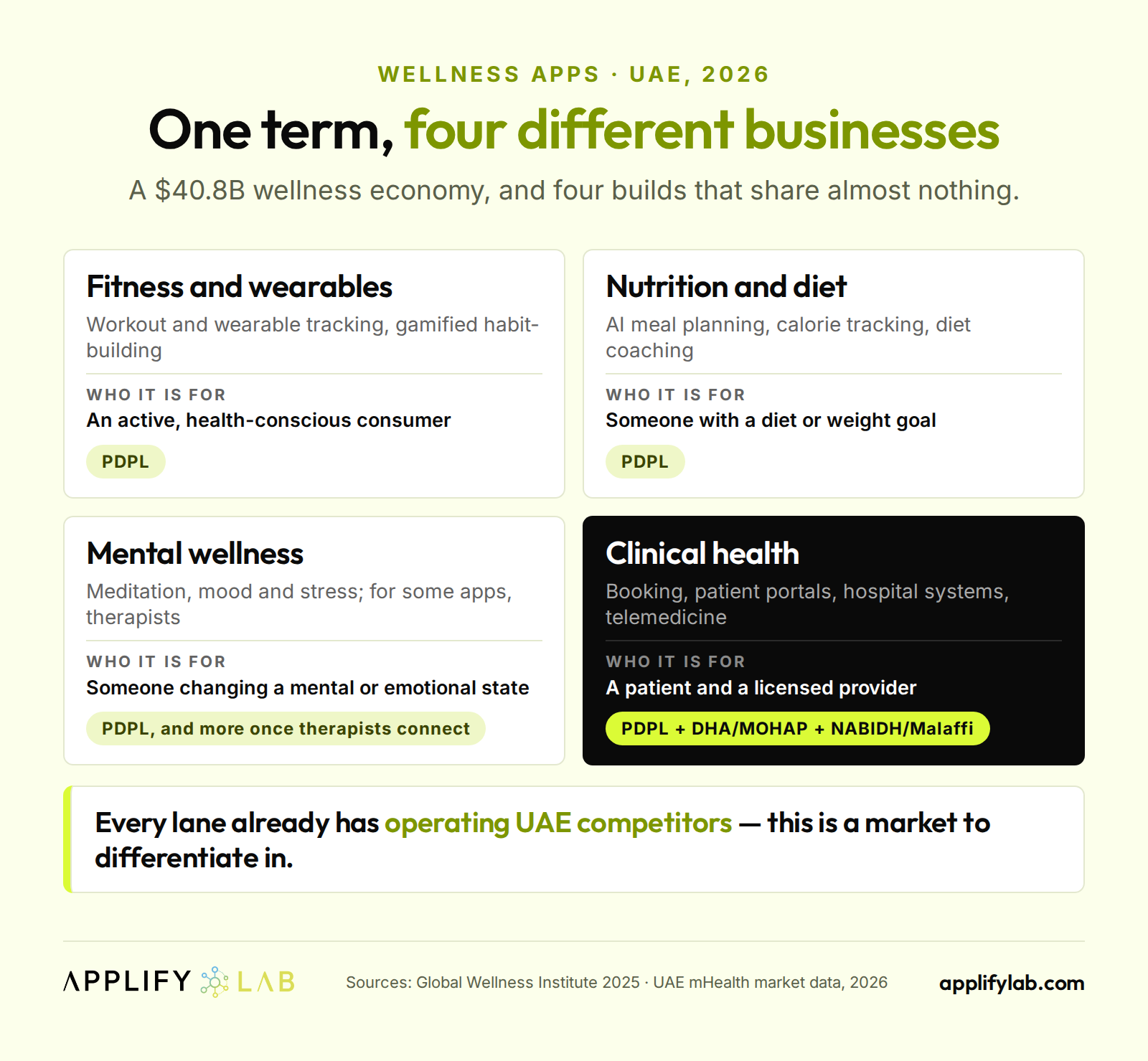
"Wellness app" is really four different businesses — pick your lane before you build.
"Wellness app" is really four different businesses
Real, operating apps in each of these categories already exist in the UAE — the field already has real competitors in every lane. Knowing which lane you're actually in changes your features, your compliance obligations, and who you're really competing with.
1 · Fitness & wearables
Workout tracking, wearable integration, gamified habit-building. The UAE has the world's highest smartwatch adoption rate, and real players like ClassPass, GymNation, and Fittpass already compete here — see our fitness tracking app guide for the full market picture, wearable-integration priorities, and real costs.
2 · Nutrition & diet
AI-driven meal planning, calorie tracking, diet coaching. UAE-specific differentiation (halal, Gulf-adapted recipes) already has a real competitor — see our AI nutrition app guide for what genuine differentiation looks like here.
3 · Mental wellness & meditation
Guided meditation, mood tracking, stress management, and — for some apps — actual therapist connections. Real regional apps already span a genuine secular-to-faith-integrated spectrum, which is a positioning decision to make deliberately — see our mental wellness & meditation app guide.
4 · Clinical and compliance-heavy health
Anything touching actual patient care — clinic booking and patient portals, hospital management systems, telemedicine and remote patient monitoring — sits under DHA/MOHAP oversight and, in many cases, mandatory NABIDH or Malaffi integration. This is a materially different build from the three categories above. Start with our digital health compliance guide for the rules, then go to the specific guide for your case: clinic appointment & patient portal apps, hospital management systems, or telemedicine & remote patient monitoring.
The four categories at a glance
Category | What it does | User | Compliance | Deep-dive |
|---|---|---|---|---|
Fitness & wearables | Workout + wearable tracking, gamified habits | Active/health-conscious consumer | PDPL | |
Nutrition & diet | AI meal planning, calorie tracking, coaching | Diet/weight-goal consumer | PDPL | |
Mental wellness | Meditation, mood, stress; sometimes therapists | Someone changing a mental/emotional state | PDPL (+ more if therapist-connected) | |
Clinical / health | Booking, portals, hospital systems, telemedicine | Patient / licensed provider | PDPL + DHA/MOHAP + NABIDH/Malaffi |
Unsure which category your idea actually falls into?
Tell us what you're picturing and we'll help you figure out which lane it's really in before you scope features for the wrong one.
How to tell which category you're actually in
A few honest questions settle this faster than a feature list:
Are you tracking wellbeing, or delivering care? If users log data and get guidance (fitness, nutrition, meditation), you're in consumer wellness. If you're booking real appointments, exchanging clinical data, or connecting users to licensed providers, you're in the clinical category — a different compliance tier entirely.
Who's the user, and what are they trying to change? A body metric (weight, activity, sleep) usually points to fitness or nutrition. A mental/emotional state points to mental wellness. A specific diagnosed condition points to clinical.
Does your idea assume a single focus, or does it want to do all four? Most successful apps in this space start narrow and expand later — our fitness tracking guide covers how fitness apps commonly grow into full wellness platforms once they've proven the core loop. Starting narrow means doing one thing well; starting broad on day one usually means doing all four at a mediocre level.
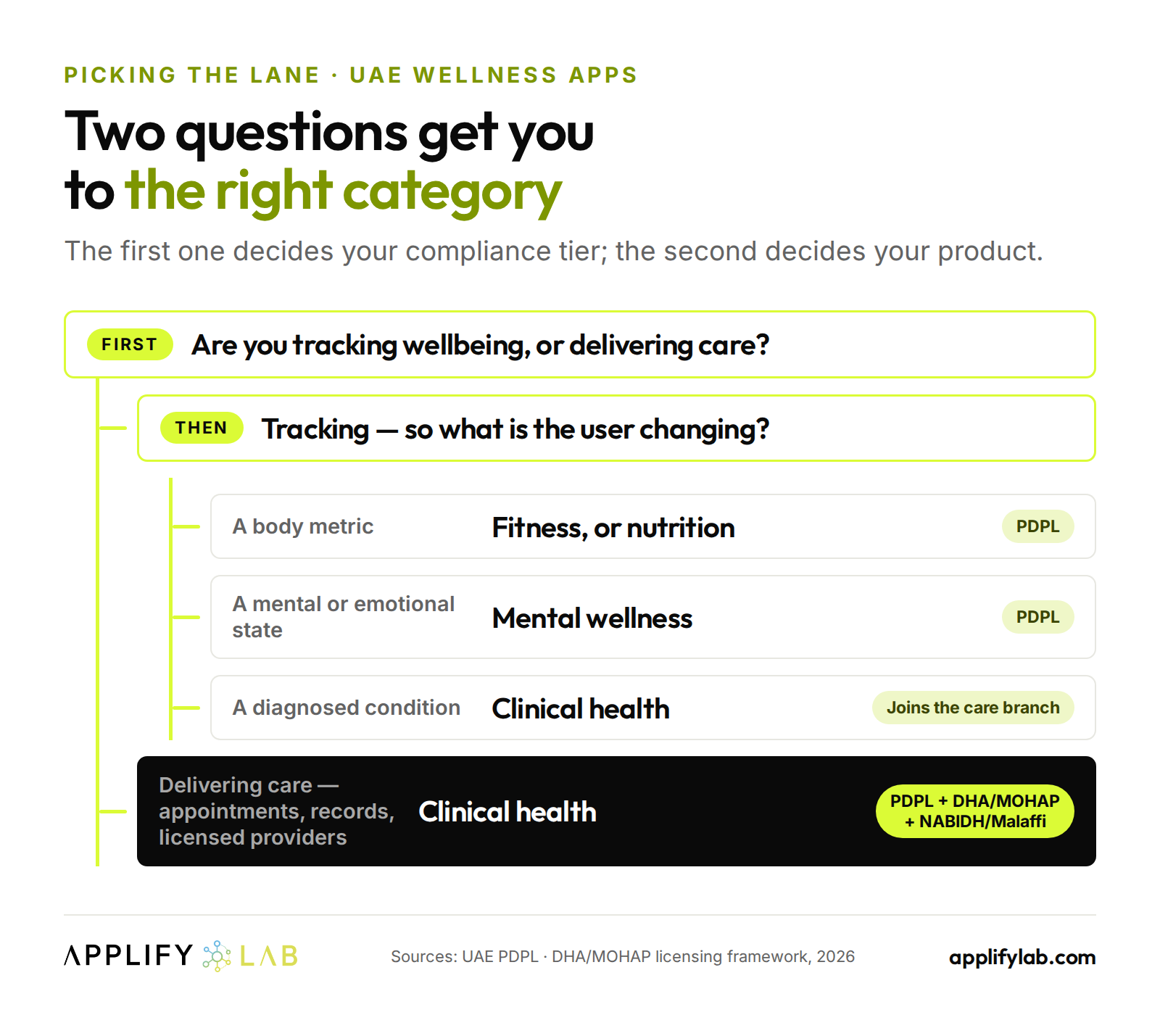
Which category are you in? Two questions get you to the right lane.
What it costs, by category
Real ranges vary meaningfully by category — enough that a single flat number for "a wellness app" is close to meaningless. Full breakdowns live in each category's dedicated post; here's the shape of it:
Fitness tracking: roughly AED 73,000–900,000+, scaling mainly with wearable-integration complexity. Full breakdown.
Nutrition/diet: roughly AED 73,000–920,000+, scaling mainly with AI recommendation complexity. Full breakdown.
Mental wellness/meditation: roughly AED 110,000–2,200,000+, with content production (voice talent, audio/video) as a real, separate cost line most software-only guides miss. Full breakdown.
Clinical/compliance-heavy: starts around AED 183,500 for a consumer-facing app with light compliance needs, and scales into the high six and seven figures once NABIDH/Malaffi integration, EMR connectivity, or hospital-wide systems enter scope. Full breakdown.
The single biggest driver of where you land in any of these ranges is how much you build on day one versus scoping a real MVP and expanding once you've proven demand — more than the category itself.
Compliance: the rule that applies everywhere, and the one that's category-specific
Every app in this space handles personal data, so the UAE's PDPL applies regardless of category — encryption, access controls, and transparency about data usage are the baseline for every category. What changes by category is whether DHA/MOHAP licensing and NABIDH/Malaffi integration apply on top of that: they generally don't for a pure fitness, nutrition, or meditation app, and they generally do the moment you're booking real appointments, exchanging clinical records, or connecting users to licensed practitioners. Our digital health compliance guide covers exactly where that line sits.
Questions worth asking any partner
Have they built in your specific category before (a fitness app and a hospital management system are entirely different builds), how do they scope compliance so your compliance scope matches your category rather than paying for NABIDH-level architecture a consumer wellness app has no use for, and how do they handle the possibility that your app expands into a second category later. You should own 100% of the code once it's built, with no proprietary lock-in — confirm this directly.
FAQ
How much does a wellness app cost to build in Dubai?
It depends heavily on which category: roughly AED 73,000 at the low end for fitness or nutrition apps, up to the high six and seven figures for clinical systems requiring NABIDH/Malaffi integration. See the cost breakdown above for the range by category, and the linked deep-dive post for the full detail on yours.
What's the difference between a wellness app and a health app for compliance purposes?
A pure wellness app (fitness, nutrition, meditation — tracking and guidance, no clinical care) generally only needs to satisfy PDPL. A health app that books real appointments, exchanges clinical data, or connects users to licensed providers moves into DHA/MOHAP-licensed territory and, in many cases, mandatory NABIDH or Malaffi integration.
Which wellness app category is already the most competitive in the UAE?
All four have real, operating competitors — every category already has real players. Fitness has ClassPass, GymNation, and Fittpass; nutrition has OptimealHealth; mental wellness has Takalam, Labayh, and Muraqaba; clinical has established platforms like Okadoc and hospital systems running InterSystems TrakCare. See each category's dedicated post for the full competitive picture.
I have an idea that spans more than one category — what should I do?
Pick the core problem you're solving first and build that well, rather than launching all four at once. Our fitness tracking guide covers the common pattern of a single-category app expanding into a broader platform once it's proven — usually a stronger path than starting broad.
Ready to figure out which category fits your idea?
Book a discovery call — bring what you're picturing and we'll help you scope the right category before you build the wrong one.
Related guides
The UAE's wellness economy is worth $40.8 billion — the largest in the Middle East, growing faster than anywhere else in the region. But "wellness app" covers four different products, and treating it as one is the fastest way to end up with something that serves no one clearly.
A fitness-tracking app, a nutrition coach, a meditation platform, and a clinic booking app solve genuinely different problems, for different users, under different rules.
This post help you pick the right one before you build anything — then send you to the guide that actually covers your category in depth.
Key takeaways
"Wellness app" is really four businesses: fitness & wearables, nutrition & diet, mental wellness & meditation, and clinical/compliance-heavy health. Each has different features, users, competitors, and rules.
Every lane already has real UAE competitors — this is a market to differentiate in, not an open field.
The dividing question is tracking wellbeing vs. delivering care. Tracking/guidance (fitness, nutrition, meditation) stays consumer wellness under PDPL; booking appointments or exchanging clinical data moves you into DHA/MOHAP + NABIDH/Malaffi territory.
Start narrow. Most successful apps prove one category's core loop, then expand — starting broad usually means doing four things at a mediocre level.
Cost varies by category (fitness/nutrition lower, clinical highest) — but MVP scope drives where you land more than the category label.
"Wellness app" is really four different businesses — pick your lane before you build.
"Wellness app" is really four different businesses
Real, operating apps in each of these categories already exist in the UAE — the field already has real competitors in every lane. Knowing which lane you're actually in changes your features, your compliance obligations, and who you're really competing with.
1 · Fitness & wearables
Workout tracking, wearable integration, gamified habit-building. The UAE has the world's highest smartwatch adoption rate, and real players like ClassPass, GymNation, and Fittpass already compete here — see our fitness tracking app guide for the full market picture, wearable-integration priorities, and real costs.
2 · Nutrition & diet
AI-driven meal planning, calorie tracking, diet coaching. UAE-specific differentiation (halal, Gulf-adapted recipes) already has a real competitor — see our AI nutrition app guide for what genuine differentiation looks like here.
3 · Mental wellness & meditation
Guided meditation, mood tracking, stress management, and — for some apps — actual therapist connections. Real regional apps already span a genuine secular-to-faith-integrated spectrum, which is a positioning decision to make deliberately — see our mental wellness & meditation app guide.
4 · Clinical and compliance-heavy health
Anything touching actual patient care — clinic booking and patient portals, hospital management systems, telemedicine and remote patient monitoring — sits under DHA/MOHAP oversight and, in many cases, mandatory NABIDH or Malaffi integration. This is a materially different build from the three categories above. Start with our digital health compliance guide for the rules, then go to the specific guide for your case: clinic appointment & patient portal apps, hospital management systems, or telemedicine & remote patient monitoring.
The four categories at a glance
Category | What it does | User | Compliance | Deep-dive |
|---|---|---|---|---|
Fitness & wearables | Workout + wearable tracking, gamified habits | Active/health-conscious consumer | PDPL | |
Nutrition & diet | AI meal planning, calorie tracking, coaching | Diet/weight-goal consumer | PDPL | |
Mental wellness | Meditation, mood, stress; sometimes therapists | Someone changing a mental/emotional state | PDPL (+ more if therapist-connected) | |
Clinical / health | Booking, portals, hospital systems, telemedicine | Patient / licensed provider | PDPL + DHA/MOHAP + NABIDH/Malaffi |
Unsure which category your idea actually falls into?
Tell us what you're picturing and we'll help you figure out which lane it's really in before you scope features for the wrong one.
How to tell which category you're actually in
A few honest questions settle this faster than a feature list:
Are you tracking wellbeing, or delivering care? If users log data and get guidance (fitness, nutrition, meditation), you're in consumer wellness. If you're booking real appointments, exchanging clinical data, or connecting users to licensed providers, you're in the clinical category — a different compliance tier entirely.
Who's the user, and what are they trying to change? A body metric (weight, activity, sleep) usually points to fitness or nutrition. A mental/emotional state points to mental wellness. A specific diagnosed condition points to clinical.
Does your idea assume a single focus, or does it want to do all four? Most successful apps in this space start narrow and expand later — our fitness tracking guide covers how fitness apps commonly grow into full wellness platforms once they've proven the core loop. Starting narrow means doing one thing well; starting broad on day one usually means doing all four at a mediocre level.
Which category are you in? Two questions get you to the right lane.
What it costs, by category
Real ranges vary meaningfully by category — enough that a single flat number for "a wellness app" is close to meaningless. Full breakdowns live in each category's dedicated post; here's the shape of it:
Fitness tracking: roughly AED 73,000–900,000+, scaling mainly with wearable-integration complexity. Full breakdown.
Nutrition/diet: roughly AED 73,000–920,000+, scaling mainly with AI recommendation complexity. Full breakdown.
Mental wellness/meditation: roughly AED 110,000–2,200,000+, with content production (voice talent, audio/video) as a real, separate cost line most software-only guides miss. Full breakdown.
Clinical/compliance-heavy: starts around AED 183,500 for a consumer-facing app with light compliance needs, and scales into the high six and seven figures once NABIDH/Malaffi integration, EMR connectivity, or hospital-wide systems enter scope. Full breakdown.
The single biggest driver of where you land in any of these ranges is how much you build on day one versus scoping a real MVP and expanding once you've proven demand — more than the category itself.
Compliance: the rule that applies everywhere, and the one that's category-specific
Every app in this space handles personal data, so the UAE's PDPL applies regardless of category — encryption, access controls, and transparency about data usage are the baseline for every category. What changes by category is whether DHA/MOHAP licensing and NABIDH/Malaffi integration apply on top of that: they generally don't for a pure fitness, nutrition, or meditation app, and they generally do the moment you're booking real appointments, exchanging clinical records, or connecting users to licensed practitioners. Our digital health compliance guide covers exactly where that line sits.
Questions worth asking any partner
Have they built in your specific category before (a fitness app and a hospital management system are entirely different builds), how do they scope compliance so your compliance scope matches your category rather than paying for NABIDH-level architecture a consumer wellness app has no use for, and how do they handle the possibility that your app expands into a second category later. You should own 100% of the code once it's built, with no proprietary lock-in — confirm this directly.
FAQ
How much does a wellness app cost to build in Dubai?
It depends heavily on which category: roughly AED 73,000 at the low end for fitness or nutrition apps, up to the high six and seven figures for clinical systems requiring NABIDH/Malaffi integration. See the cost breakdown above for the range by category, and the linked deep-dive post for the full detail on yours.
What's the difference between a wellness app and a health app for compliance purposes?
A pure wellness app (fitness, nutrition, meditation — tracking and guidance, no clinical care) generally only needs to satisfy PDPL. A health app that books real appointments, exchanges clinical data, or connects users to licensed providers moves into DHA/MOHAP-licensed territory and, in many cases, mandatory NABIDH or Malaffi integration.
Which wellness app category is already the most competitive in the UAE?
All four have real, operating competitors — every category already has real players. Fitness has ClassPass, GymNation, and Fittpass; nutrition has OptimealHealth; mental wellness has Takalam, Labayh, and Muraqaba; clinical has established platforms like Okadoc and hospital systems running InterSystems TrakCare. See each category's dedicated post for the full competitive picture.
I have an idea that spans more than one category — what should I do?
Pick the core problem you're solving first and build that well, rather than launching all four at once. Our fitness tracking guide covers the common pattern of a single-category app expanding into a broader platform once it's proven — usually a stronger path than starting broad.
Ready to figure out which category fits your idea?
Book a discovery call — bring what you're picturing and we'll help you scope the right category before you build the wrong one.