Telemedicine App Development in Dubai for Chronic Disease Management
9.3% of UAE adults have diabetes — the world's second-highest national rate, more than double the global average — and the UAE's remote patient monitoring market is growing at 12.7% a year toward $1.6B by 2031.
That's the real market case for a chronic-care telemedicine app, and it's already working here: Cleveland Clinic Abu Dhabi's RPM program monitors 5,000+ patients and has cut readmissions 25%.
This guide covers what actually makes a chronic-care app different from a general telehealth app, what it costs, and where the compliance requirements genuinely differ.
Key takeaways
The market case is real and large: 19.3% of UAE adults have diabetes (world's 2nd-highest); the RPM market is heading to $1.6B by 2031; CCAD's RPM program monitors 5,000+ patients with 25% fewer readmissions.
A chronic-care app is fundamentally different from general telehealth — continuous monitoring (wearables, condition-specific tracking, trend views), not one-off consults.
Wearable/IoT integration is the biggest cost driver — each device ecosystem is its own integration, not a checkbox.
One compliance addition: MOHAP prohibits autonomous AI from replacing clinical judgment — AI must support a clinician's decision, not make it.
Already operating a clinic/hospital? The RPM add-on guide fits you better than this build-from-scratch post (linked below).
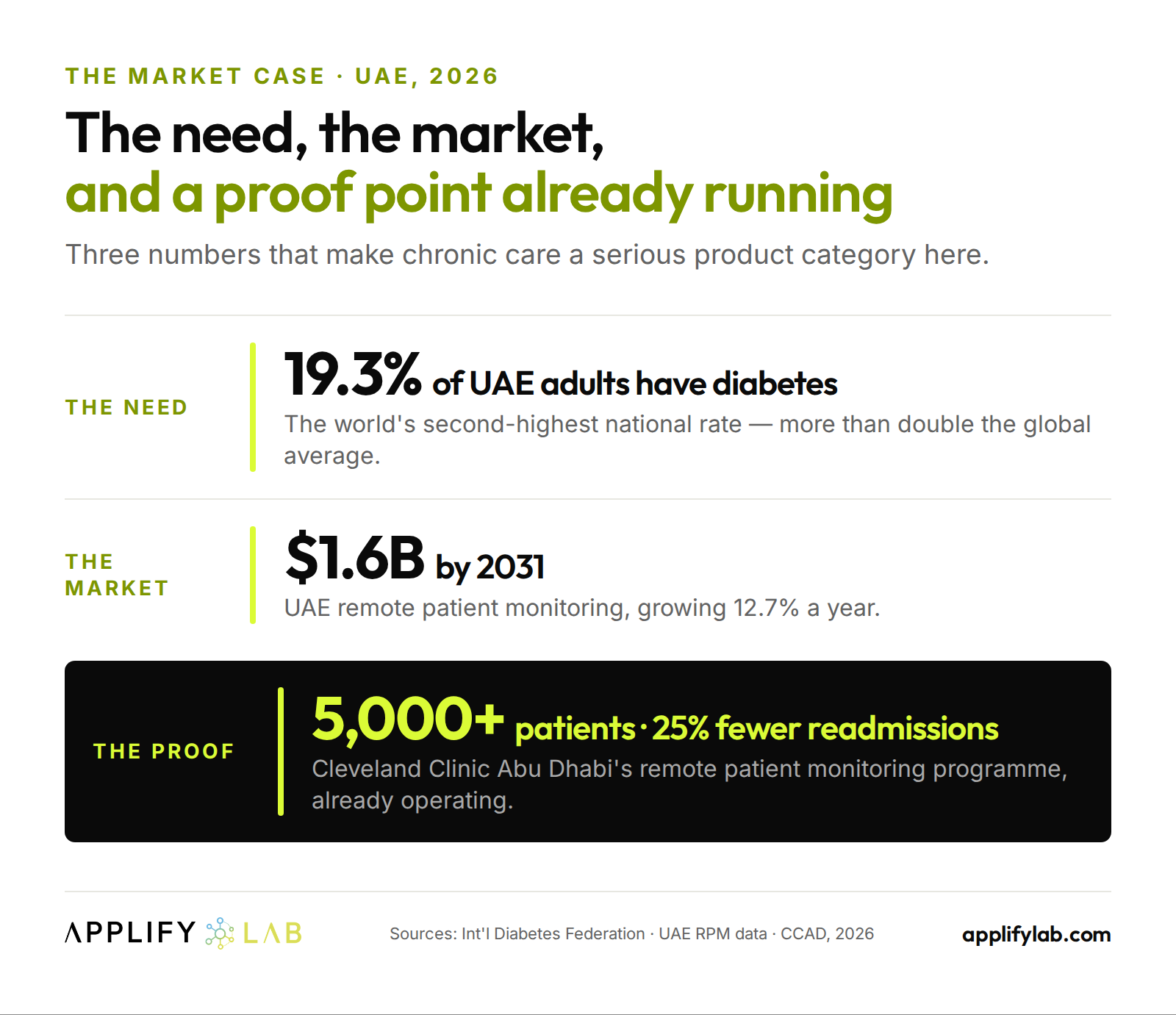
The need, the market growth, and a real UAE proof point — the three numbers that make this a serious category.
Already running a clinic or hospital, not building fresh?
This post is for building a chronic-care product from scratch. If you already operate a clinic or hospital and want to add remote patient monitoring to what you're running, see our remote patient monitoring guide for UAE clinics & hospitalsinstead — it covers integrating into existing systems, an AI-agent engagement layer, and the real ROI and friction of adding this to an operating practice.
What makes this different from a general telemedicine app
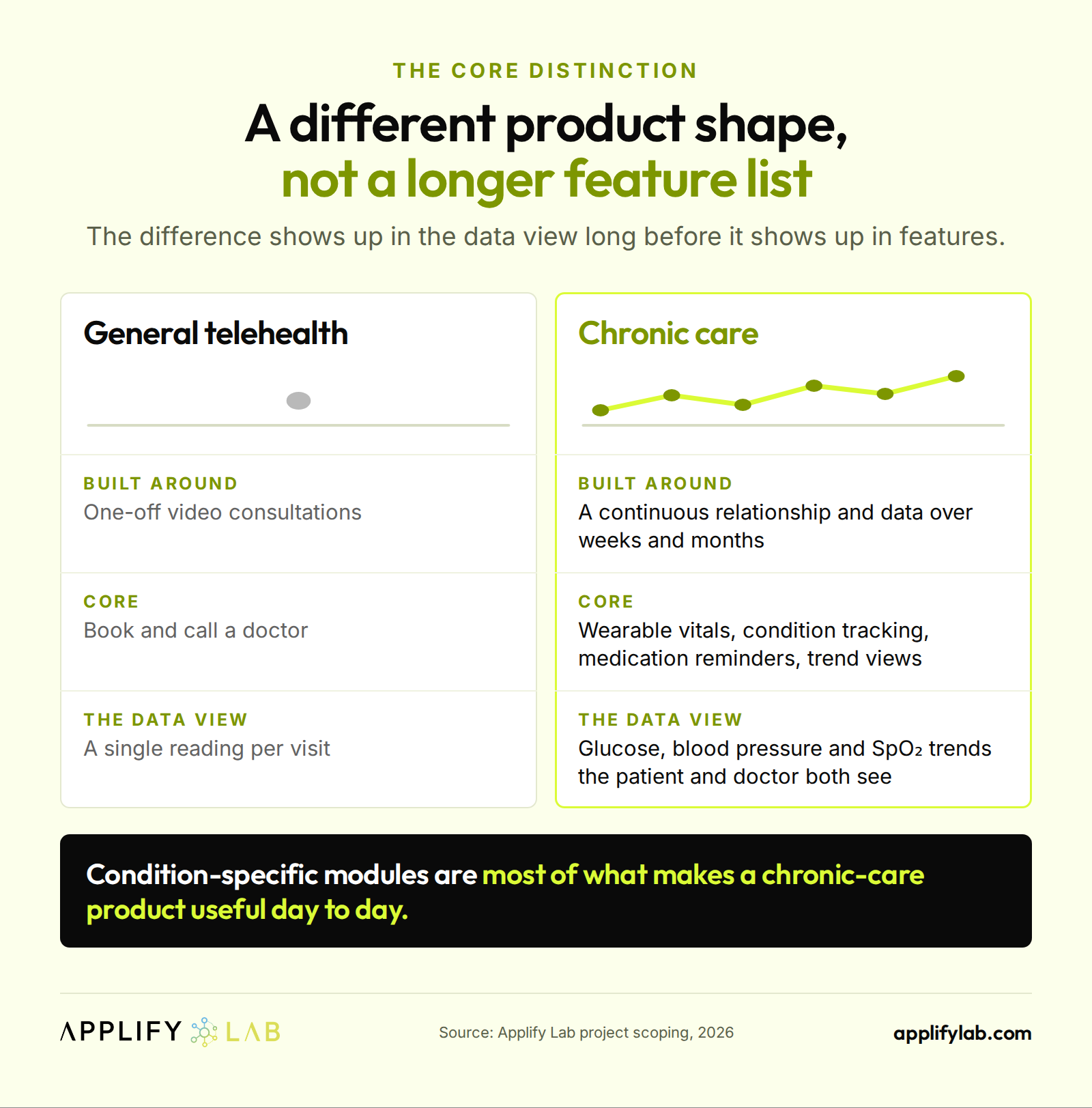
The difference isn't a longer feature list — it's a different product shape: one-off consult vs continuous relationship and data.
General telehealth app | Chronic-care app | |
|---|---|---|
Built around | One-off video consultations | A continuous relationship + data over weeks/months |
Core | Book and call a doctor | Wearable vitals, condition-specific tracking, medication reminders, trend views |
The data view | A single reading per visit | Glucose / BP / SpO₂ trends the patient and doctor can see |
A general telehealth app is built around one-off consultations. A chronic disease management app is built around continuous relationship and data: syncing with wearables for real-time vitals, tracking condition-specific metrics over weeks and months (glucose, blood pressure, oxygen saturation), sending medication reminders, and giving both patient and doctor a trend view.
If your product is really "book a video call with a doctor," you want our general digital health guide instead — this one is specifically for the continuous-monitoring, condition-specific product.
Core features
Patient dashboard — health metrics (glucose, blood pressure), medication schedule, upcoming appointments, alerts for abnormal readings.
Doctor interface — patient data trends over time, history, prescribing, teleconsultation tools.
Video and chat consultations — secure, real-time.
Condition-specific modules — diabetes (glucose tracking + diet logging), cardiac (heart rate/blood pressure monitoring), respiratory (oxygen saturation tracking). This is the part a generic telehealth app doesn't have, and it's most of what makes a chronic-care product actually useful day to day.
Wearable and IoT integration — real-time vitals from smartwatches and health monitors, which is what makes continuous monitoring possible instead of relying on patients to self-report.
Secure EHR storage and analytics — encrypted records, trend reporting for both patient and provider.
Not sure how much wearable integration your app actually needs on day one?
Tell us which conditions you're targeting and we'll tell you honestly which features are core to your MVP versus a later phase. Message us on WhatsApp
Compliance: mostly the same rules, one real addition
The core requirements are the same as any UAE digital health app — DHA/DoH/MOHAP oversight, PDPL data handling, NABIDH/Malaffi if you're exchanging clinical records with facilities — covered in full in our digital health compliance guide rather than repeated here.
One addition specific to this category: MOHAP's federal guidance explicitly prohibits autonomous AI systems from replacing clinical judgment. If "AI-powered insights" or automated risk flagging is on your roadmap, it needs to support a clinician's decision, not make one — worth designing around from the start, not a later legal review item. Wearable and device data also falls under the same PDPL handling requirements as any other patient data, even though it's collected passively rather than entered directly.
What it costs
Real ranges, not the two conflicting breakdowns you'll find in most generic guides:
Basic (video/chat consultations, EHR access, basic dashboard): roughly AED 110,000–220,000.
Mid-tier (condition-specific modules, medication reminders, wearable integration for one or two device types): roughly AED 220,000–440,000.
Advanced (multi-condition support, broad wearable/IoT integration, predictive analytics): AED 440,000–900,000+.
Wearable and IoT integration is the line item that moves a build between tiers fastest — each additional device ecosystem (Apple Health, a specific glucose monitor brand, a cardiac wearable) is its own integration, not a checkbox. We'd rather scope which devices your actual target patients use than build broad, generic compatibility you don't need yet.
Questions worth asking any partner
Skip "have you built healthcare apps before." Ask instead: have they integrated real wearable/IoT data sources, how do they handle the PDPL requirements around passively-collected device data specifically, and how would they scope your MVP if you're targeting one condition versus several. You own 100% of the code once it's built, with no proprietary lock-in — confirm this directly, since it varies by provider.
FAQ
How is a chronic disease app different from a regular telemedicine app?
A general telehealth app is built around one-off video consultations. A chronic-care app is built around continuous monitoring — wearable data, condition-specific tracking, medication reminders, and trend views over time, not a single appointment.
How much does a chronic disease management app cost in the UAE?
Roughly AED 110,000–220,000 for a basic version, up to AED 440,000–900,000+ for a fully-featured multi-condition platform with broad wearable integration. Wearable/IoT integration is the biggest cost driver beyond the base build.
Can our app use AI to flag health risks automatically?
It can support a clinician's decision-making, but MOHAP's federal guidance prohibits autonomous AI from replacing clinical judgment — design any AI feature as a flag for a human to review, not an automated diagnosis.
Is this a real market opportunity in the UAE, or a niche one?
Real and large — the UAE has the world's second-highest diabetes prevalence (19.3% of adults) and a remote patient monitoring market growing at 12.7% annually. Cleveland Clinic Abu Dhabi's RPM program already monitors 5,000+ patients with real outcomes (25% fewer readmissions).
How long does development take?
Typically 4-8 months for an MVP with core monitoring features, longer if you're integrating multiple wearable ecosystems or building multi-condition support from day one.
Ready to scope your chronic-care app?
Book a discovery call — bring the conditions you're targeting and whether wearable integration is core to your MVP or a later phase.