Health & Wellness
AI Receptionist for Clinics in Dubai: Costs and Rules

By
Anh Nguyen, Founder
·
11 min

An AI receptionist answers your clinic's patients on WhatsApp, web chat or the phone, at any hour: it answers from the information you give it, offers real slots, books and moves appointments, and passes anything medical to a person. It takes over the repetitive messages so your front desk spends its time on the patients in the clinic.
Key takeaways
It answers and books at any hour. It works from the information you give it and the free slots in your calendar, on WhatsApp, web chat or the phone.
Your front desk keeps the patients. The agent takes the repeated messages; the welcome, the check-in and the care at the desk stay with your team.
It gives no medical answers. Symptoms, medication, results, risks and side effects go to a person, and so do pain, distress and complaints.
Patient records stay out of its reach. It sees free slots and your published information, and health data stays in the UAE under Federal Law No. 2 of 2019.
Write the rules first. Seven rules, written before launch, decide what the agent says, does and passes on.
Building a health or wellness product in the UAE? See how we build healthcare and wellness apps.

Seven rules, written in about an hour, decide what your clinic's agent may say, do and pass on.
What does an AI receptionist do for a clinic?
An AI receptionist answers patients' messages and calls at any hour, books and moves appointments, sends reminders, and passes anything it shouldn't handle to your team.
It works on the channels your patients already use: WhatsApp, the chat on your website, and the phone when it has a voice. It answers from the information you give it, and with your booking calendar connected it can offer a real free slot and confirm it in the same conversation.
An agent that only replies is a politer version of an unanswered message. Its value comes from what it can do inside the conversation: book, move, cancel and remind. On WhatsApp, Meta's rules and message fees apply, and our guide to the WhatsApp Business API in the UAE covers both.
The point is your team's time. Every question about opening hours, parking or the price of a cleaning that the agent answers gives your front desk that time back for the patient standing in front of it.
What does an AI receptionist cost for a clinic in the UAE?
Ready-made AI receptionist plans mostly cost USD 109–299 a month, about AED 400–1,100, and a clinic agent connected to its calendar, in Arabic and English, is priced on what it has to do.
A comparison of AI receptionist providers' published prices puts most small businesses at USD 109–299 a month, with setup fees from nothing to USD 500 (updated August 2026). Those plans are mostly phone answering for US businesses. In the UAE, one WhatsApp AI receptionist service lists AED 1,500 a month plus AED 1,000 for setup (October 2026).
What moves the price:
Cost driver | What it changes |
|---|---|
Channels | WhatsApp and web chat run on messages; a voice agent on the phone adds a charge per minute, typically USD 0.65–2.25 once a plan's minutes run out |
Connection to your calendar | Booking, moving and cancelling need the agent connected to your booking system, and that is where most of the setup goes |
Languages | Information written and tested in Arabic and English |
Message volume | On WhatsApp, Meta charges per message beyond the free allowance |
Data rules | Where conversations are stored and who can read them, which matters for health data |
These are market ranges; Applify Lab scopes every project after a diagnosis. A fixed price before we know your channels, your calendar and your patients' questions would mean selling features you don't need, or leaving out the one that matters.
Measure it in time. An AI receptionist can't welcome a patient, take a payment at the desk or calm someone who is nervous before a procedure, so your clinic keeps its front desk during opening hours. What the agent takes is the stream of messages, during the day and after closing, which frees your team for the work patients notice.

The agent takes the repeated messages; the welcome, the check-in and the care stay with your team.
To see what that is worth for your clinic, count for one week how many messages your front desk answers, and how many of them ask the same few things.
What can an AI receptionist handle on its own?
It can handle anything that comes from the information you give it and the free slots in your calendar.
What it can answer:
Practical questions. Opening hours, location, parking, the insurers you accept and what to bring.
Your services. What each treatment involves, how long it takes, the steps of a procedure and the prices you publish.
What it can do:
Book, move and cancel. With your calendar connected, it offers a real slot and confirms it in the chat.
Remind and follow up. It sends reminders before the appointment and a follow-up after it. Our guide to clinic no-shows in Dubai sets out the reminder schedule.
Tell patients they are writing to an AI assistant. The Dubai Health Authority's AI policy for healthcare asks providers to disclose which functions are AI-enabled (DHA, 2021). Say it in the agent's first message, in both languages.
What must an AI receptionist never say, and when does it hand over?
It must never give a medical answer, and it hands the conversation to a person as soon as a message moves from logistics to health.
What it must never say:
A diagnosis, or anything close to one. When a patient describes symptoms, the agent offers an appointment or a call from the clinic in reply.
Medication advice or test results. Both stay with your clinicians.
Risks and side effects of a treatment. Questions about what could go wrong with a procedure go to a person.
Whether someone should be worried. Reassurance and alarm are both medical judgements.
Write real examples of each. "Is this rash serious?", "Can I take ibuprofen before my extraction?", "Are my blood results normal?" A list of real questions teaches the agent where the line is far more clearly than a principle.
When it hands over to a person:
Pain or distress. Any message that describes either.
A complaint. About a treatment, a bill or a member of staff.
Anything about a child. Parents get a person.
An unusual request. Anything outside the information it was given.
Three failed attempts to understand. The patient shouldn't have to try a fourth time.
The handover reaches your team where they work. The conversation lands in your team's inbox, or as an email to the clinic, and the agent tells the patient who will contact them and when.
Emergencies get one answer. If a message sounds like an emergency, the agent replies with the UAE ambulance number, 998, and alerts your team at once.
One person can switch it off. One button, at any hour, for the day something goes wrong.
Planning an AI receptionist for your clinic?
Tell us which messages take up most of your front desk's day, and we'll talk through where an agent fits.
Where does patient data live, and which UAE rules apply?
The agent should see your free slots and the information you publish, and never the patient record; the conversations themselves fall under the UAE's health data law.
We never let an agent read or change a patient's record. It needs the calendar's free slots to book, and nothing from the file behind them.
Health data has its own law in the UAE. Federal Law No. 2 of 2019 covers electronic health data, including a patient's name with consultation and treatment details, and it applies to the IT companies that handle that data as well as to clinics (Taylor Wessing, 2021). It requires health data to be stored and processed inside the UAE, with exceptions listed in Ministerial Resolution No. 51 of 2021, kept for at least 25 years after the patient's last treatment, and it sets fines of AED 500,000 to 700,000 for data held abroad without permission.
The general personal data law, Federal Decree-Law No. 45 of 2021, leaves out health data regulated by the 2019 law (Clyde & Co, 2021). For a clinic, the health data law is the one that sets the rules.
The Dubai Health Authority adds its own principles for AI. Its policy on AI in healthcare (2021) asks that AI tools are supervised by the people who use them, that their decisions can be overridden, that access to patient information has clear limits, and that they comply with the health data law.
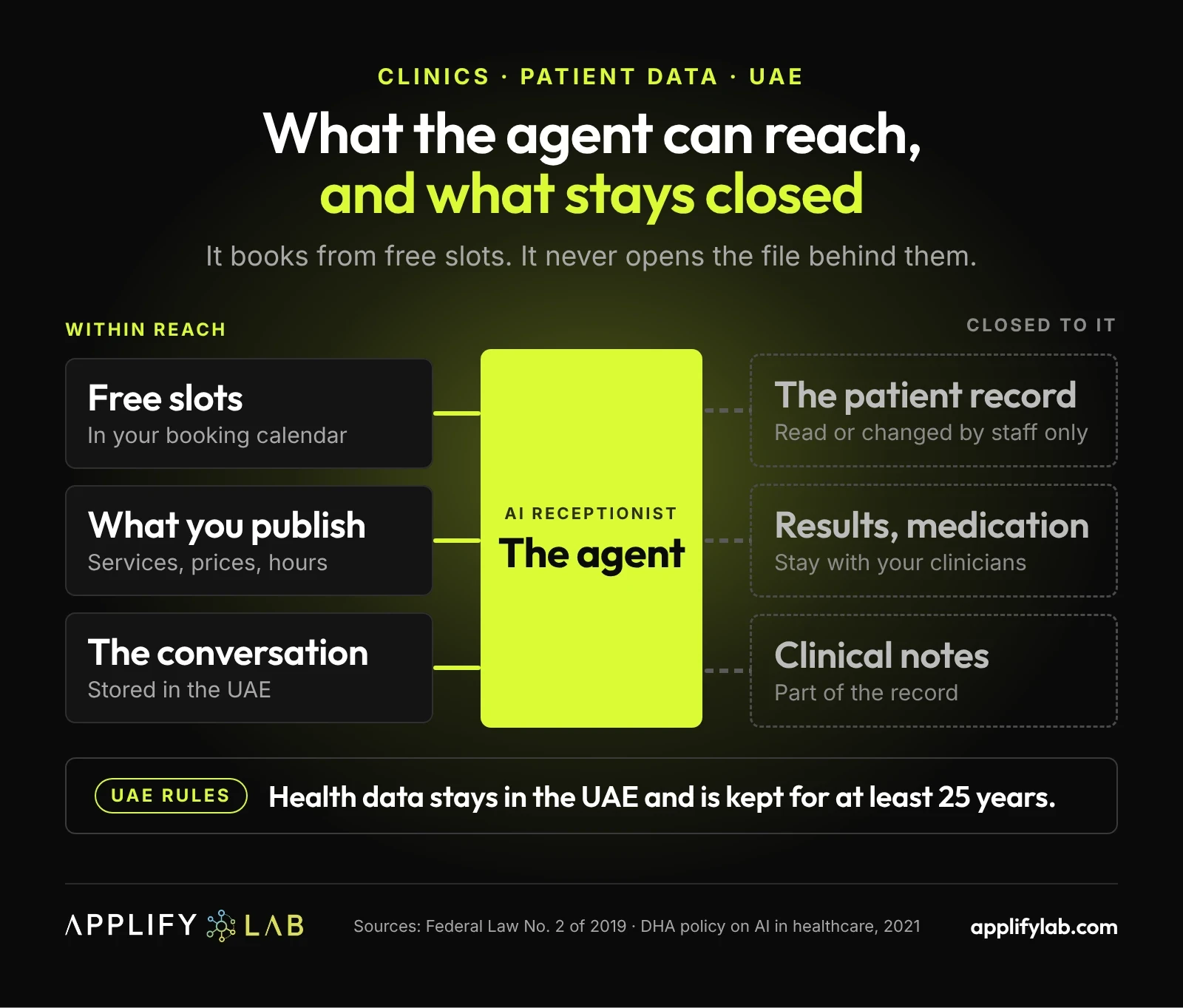
The agent sees the free slots and what you publish; the patient record stays closed to it.
Questions to ask any provider:
Where are the conversations stored? In which country, and on whose servers.
Who can read them, and for how long? The people with access, and how long conversations are kept.
What can the agent reach? The calendar's free slots should be the limit.
This is general information, not legal advice; a UAE lawyer can confirm what applies to your clinic.
Does an AI receptionist work in Arabic and English?
Yes: a well-built agent answers in the language the patient writes in, and switches when they do.
Patients in the UAE often move between Arabic and English in the same conversation, and a message at 10:31 PM asking whether a female doctor is available can arrive in either. The agent answers best when its information is written in both languages and checked by native speakers, and Gulf dialect needs testing on real patient messages before launch.
What should you measure in the first month?
Measure what the agent handled, what it booked, what it passed on, and what it couldn't answer.
Six numbers for the first month:
Messages handled after closing. The questions that used to wait for the morning.
Bookings made out of hours. Appointments confirmed while the clinic was closed.
Conversations handed to a person. And how quickly your team picked them up.
Questions it couldn't answer. Each one is a line to add to its information.
Messages your team still answers by hand. The difference is the time handed back to the front desk.
Your no-show rate. Reminders that patients can answer at any hour move it, and the no-show guide shows how to track it.
Start with one channel and one service. For most clinics that means WhatsApp and bookings first; the phone and the rest follow once the first month's numbers are in.
FAQ
How much does an AI receptionist cost for a clinic in the UAE?
Ready-made AI receptionist plans mostly cost USD 109–299 a month, about AED 400–1,100, with setup fees up to USD 500, and one UAE WhatsApp service lists AED 1,500 a month plus AED 1,000 setup. A clinic agent connected to its calendar in Arabic and English is priced on its channels and volume. These are market ranges; Applify Lab scopes every project after a diagnosis.
Can an AI receptionist book appointments into my clinic system?
Yes, when it is connected to your booking calendar. It reads the free slots, offers one to the patient, and books, moves or cancels the appointment in the same conversation. It needs only the calendar's free slots to do this, so it can work without any access to patient records, which should stay closed to it.
Is it allowed to use AI with patients in Dubai?
Yes, within rules. The Dubai Health Authority's AI policy asks that AI tools are supervised, that their decisions can be overridden, that patient information has clear access limits, and that they comply with Federal Law No. 2 of 2019 on health data. An agent kept to logistics, with medical questions passed to a person, stays within those principles. This is general information, not legal advice.
What happens when a patient sends an urgent message?
The agent passes it to a person straight away. Messages about pain, distress or a child go to your team's inbox or by email, and the agent tells the patient who will contact them. If a message sounds like an emergency, the agent replies with the UAE ambulance number, 998, and alerts your team at once.
Will an AI receptionist replace my front desk?
No. It takes over the repeated messages and the bookings that arrive after closing, and your front desk keeps the work only people can do: welcoming patients, checking them in, taking payments and caring for anyone nervous or unwell. The aim is to give your team's time back to the patients in the clinic.
To go further
See what our AI agents for UAE businesses can take off your front desk.
Explore how we build healthcare and wellness apps for UAE clinics.
See how we built a chronic-care companion app.
An AI receptionist answers your clinic's patients on WhatsApp, web chat or the phone, at any hour: it answers from the information you give it, offers real slots, books and moves appointments, and passes anything medical to a person. It takes over the repetitive messages so your front desk spends its time on the patients in the clinic.
Key takeaways
It answers and books at any hour. It works from the information you give it and the free slots in your calendar, on WhatsApp, web chat or the phone.
Your front desk keeps the patients. The agent takes the repeated messages; the welcome, the check-in and the care at the desk stay with your team.
It gives no medical answers. Symptoms, medication, results, risks and side effects go to a person, and so do pain, distress and complaints.
Patient records stay out of its reach. It sees free slots and your published information, and health data stays in the UAE under Federal Law No. 2 of 2019.
Write the rules first. Seven rules, written before launch, decide what the agent says, does and passes on.
Building a health or wellness product in the UAE? See how we build healthcare and wellness apps.
Seven rules, written in about an hour, decide what your clinic's agent may say, do and pass on.
What does an AI receptionist do for a clinic?
An AI receptionist answers patients' messages and calls at any hour, books and moves appointments, sends reminders, and passes anything it shouldn't handle to your team.
It works on the channels your patients already use: WhatsApp, the chat on your website, and the phone when it has a voice. It answers from the information you give it, and with your booking calendar connected it can offer a real free slot and confirm it in the same conversation.
An agent that only replies is a politer version of an unanswered message. Its value comes from what it can do inside the conversation: book, move, cancel and remind. On WhatsApp, Meta's rules and message fees apply, and our guide to the WhatsApp Business API in the UAE covers both.
The point is your team's time. Every question about opening hours, parking or the price of a cleaning that the agent answers gives your front desk that time back for the patient standing in front of it.
What does an AI receptionist cost for a clinic in the UAE?
Ready-made AI receptionist plans mostly cost USD 109–299 a month, about AED 400–1,100, and a clinic agent connected to its calendar, in Arabic and English, is priced on what it has to do.
A comparison of AI receptionist providers' published prices puts most small businesses at USD 109–299 a month, with setup fees from nothing to USD 500 (updated August 2026). Those plans are mostly phone answering for US businesses. In the UAE, one WhatsApp AI receptionist service lists AED 1,500 a month plus AED 1,000 for setup (October 2026).
What moves the price:
Cost driver | What it changes |
|---|---|
Channels | WhatsApp and web chat run on messages; a voice agent on the phone adds a charge per minute, typically USD 0.65–2.25 once a plan's minutes run out |
Connection to your calendar | Booking, moving and cancelling need the agent connected to your booking system, and that is where most of the setup goes |
Languages | Information written and tested in Arabic and English |
Message volume | On WhatsApp, Meta charges per message beyond the free allowance |
Data rules | Where conversations are stored and who can read them, which matters for health data |
These are market ranges; Applify Lab scopes every project after a diagnosis. A fixed price before we know your channels, your calendar and your patients' questions would mean selling features you don't need, or leaving out the one that matters.
Measure it in time. An AI receptionist can't welcome a patient, take a payment at the desk or calm someone who is nervous before a procedure, so your clinic keeps its front desk during opening hours. What the agent takes is the stream of messages, during the day and after closing, which frees your team for the work patients notice.
The agent takes the repeated messages; the welcome, the check-in and the care stay with your team.
To see what that is worth for your clinic, count for one week how many messages your front desk answers, and how many of them ask the same few things.
What can an AI receptionist handle on its own?
It can handle anything that comes from the information you give it and the free slots in your calendar.
What it can answer:
Practical questions. Opening hours, location, parking, the insurers you accept and what to bring.
Your services. What each treatment involves, how long it takes, the steps of a procedure and the prices you publish.
What it can do:
Book, move and cancel. With your calendar connected, it offers a real slot and confirms it in the chat.
Remind and follow up. It sends reminders before the appointment and a follow-up after it. Our guide to clinic no-shows in Dubai sets out the reminder schedule.
Tell patients they are writing to an AI assistant. The Dubai Health Authority's AI policy for healthcare asks providers to disclose which functions are AI-enabled (DHA, 2021). Say it in the agent's first message, in both languages.
What must an AI receptionist never say, and when does it hand over?
It must never give a medical answer, and it hands the conversation to a person as soon as a message moves from logistics to health.
What it must never say:
A diagnosis, or anything close to one. When a patient describes symptoms, the agent offers an appointment or a call from the clinic in reply.
Medication advice or test results. Both stay with your clinicians.
Risks and side effects of a treatment. Questions about what could go wrong with a procedure go to a person.
Whether someone should be worried. Reassurance and alarm are both medical judgements.
Write real examples of each. "Is this rash serious?", "Can I take ibuprofen before my extraction?", "Are my blood results normal?" A list of real questions teaches the agent where the line is far more clearly than a principle.
When it hands over to a person:
Pain or distress. Any message that describes either.
A complaint. About a treatment, a bill or a member of staff.
Anything about a child. Parents get a person.
An unusual request. Anything outside the information it was given.
Three failed attempts to understand. The patient shouldn't have to try a fourth time.
The handover reaches your team where they work. The conversation lands in your team's inbox, or as an email to the clinic, and the agent tells the patient who will contact them and when.
Emergencies get one answer. If a message sounds like an emergency, the agent replies with the UAE ambulance number, 998, and alerts your team at once.
One person can switch it off. One button, at any hour, for the day something goes wrong.
Planning an AI receptionist for your clinic?
Tell us which messages take up most of your front desk's day, and we'll talk through where an agent fits.
Where does patient data live, and which UAE rules apply?
The agent should see your free slots and the information you publish, and never the patient record; the conversations themselves fall under the UAE's health data law.
We never let an agent read or change a patient's record. It needs the calendar's free slots to book, and nothing from the file behind them.
Health data has its own law in the UAE. Federal Law No. 2 of 2019 covers electronic health data, including a patient's name with consultation and treatment details, and it applies to the IT companies that handle that data as well as to clinics (Taylor Wessing, 2021). It requires health data to be stored and processed inside the UAE, with exceptions listed in Ministerial Resolution No. 51 of 2021, kept for at least 25 years after the patient's last treatment, and it sets fines of AED 500,000 to 700,000 for data held abroad without permission.
The general personal data law, Federal Decree-Law No. 45 of 2021, leaves out health data regulated by the 2019 law (Clyde & Co, 2021). For a clinic, the health data law is the one that sets the rules.
The Dubai Health Authority adds its own principles for AI. Its policy on AI in healthcare (2021) asks that AI tools are supervised by the people who use them, that their decisions can be overridden, that access to patient information has clear limits, and that they comply with the health data law.
The agent sees the free slots and what you publish; the patient record stays closed to it.
Questions to ask any provider:
Where are the conversations stored? In which country, and on whose servers.
Who can read them, and for how long? The people with access, and how long conversations are kept.
What can the agent reach? The calendar's free slots should be the limit.
This is general information, not legal advice; a UAE lawyer can confirm what applies to your clinic.
Does an AI receptionist work in Arabic and English?
Yes: a well-built agent answers in the language the patient writes in, and switches when they do.
Patients in the UAE often move between Arabic and English in the same conversation, and a message at 10:31 PM asking whether a female doctor is available can arrive in either. The agent answers best when its information is written in both languages and checked by native speakers, and Gulf dialect needs testing on real patient messages before launch.
What should you measure in the first month?
Measure what the agent handled, what it booked, what it passed on, and what it couldn't answer.
Six numbers for the first month:
Messages handled after closing. The questions that used to wait for the morning.
Bookings made out of hours. Appointments confirmed while the clinic was closed.
Conversations handed to a person. And how quickly your team picked them up.
Questions it couldn't answer. Each one is a line to add to its information.
Messages your team still answers by hand. The difference is the time handed back to the front desk.
Your no-show rate. Reminders that patients can answer at any hour move it, and the no-show guide shows how to track it.
Start with one channel and one service. For most clinics that means WhatsApp and bookings first; the phone and the rest follow once the first month's numbers are in.
FAQ
How much does an AI receptionist cost for a clinic in the UAE?
Ready-made AI receptionist plans mostly cost USD 109–299 a month, about AED 400–1,100, with setup fees up to USD 500, and one UAE WhatsApp service lists AED 1,500 a month plus AED 1,000 setup. A clinic agent connected to its calendar in Arabic and English is priced on its channels and volume. These are market ranges; Applify Lab scopes every project after a diagnosis.
Can an AI receptionist book appointments into my clinic system?
Yes, when it is connected to your booking calendar. It reads the free slots, offers one to the patient, and books, moves or cancels the appointment in the same conversation. It needs only the calendar's free slots to do this, so it can work without any access to patient records, which should stay closed to it.
Is it allowed to use AI with patients in Dubai?
Yes, within rules. The Dubai Health Authority's AI policy asks that AI tools are supervised, that their decisions can be overridden, that patient information has clear access limits, and that they comply with Federal Law No. 2 of 2019 on health data. An agent kept to logistics, with medical questions passed to a person, stays within those principles. This is general information, not legal advice.
What happens when a patient sends an urgent message?
The agent passes it to a person straight away. Messages about pain, distress or a child go to your team's inbox or by email, and the agent tells the patient who will contact them. If a message sounds like an emergency, the agent replies with the UAE ambulance number, 998, and alerts your team at once.
Will an AI receptionist replace my front desk?
No. It takes over the repeated messages and the bookings that arrive after closing, and your front desk keeps the work only people can do: welcoming patients, checking them in, taking payments and caring for anyone nervous or unwell. The aim is to give your team's time back to the patients in the clinic.
To go further
See what our AI agents for UAE businesses can take off your front desk.
Explore how we build healthcare and wellness apps for UAE clinics.
See how we built a chronic-care companion app.
Ready to write your clinic's rules?
In a 30-minute call, we'll go through the seven rules with you, from what the agent may say to who it hands over to. Book 30 minutes about your clinic's agent
RELATED GUIDES

AI Agents & AI Automation
WhatsApp Business API in the UAE: Cost and Setup (2026)
16 min

Health & Wellness
Clinic No-Shows in Dubai: The Real Cost and the Fix (2026)
9 min

AI Agents & AI Automation
AI Automation for UAE Clinics & Retail Stores: What It Actually Means
6 min

Health & Wellness
Digital Health App Development in UAE: Costs, Features & Compliance
6 min

Health & Wellness
Clinic Appointment & Patient Portal App Development in Dubai
7 min