Ramadan Considerations for App Development in the UAE & GCC
If you're building an app for the UAE or GCC market, Ramadan is a month every year where usage patterns, UI expectations, payment behavior, and infrastructure load all shift in specific, well-documented ways — far more than a marketing afterthought to bolt on later.
UAE ecommerce app growth reached +101% during Ramadan 2026, one of the highest seasonal spikes of any market tracked globally.
Building around this from your MVP is cheaper than retrofitting it after launch, and a few of these decisions (localization architecture, payment gateway, infrastructure scaling) are genuinely harder to bolt on after the fact than others.
Key takeaways
Usage concentrates into three windows, not one evening: ~24% pre-fast morning, 48% post-Iftar, 38% post-Taraweeh — architecture-level, not just marketing.
Separate two things: general UAE requirements (RTL architecture, local payment gateway) are needed year-round; the Ramadan-specific layer (window timing, cultural tone, seasonal scaling) is a seasonal addition.
Cultural UI beyond translation: RTL built from week one, muted tone and no food imagery in fasting hours, native Gulf Arabic tone.
The GCC is several markets. Decide UAE-only vs. multi-market before you build — Dubai and Riyadh don't automatically resonate the same.
Infrastructure is where under-built apps fail — autoscale around the three windows; Stripe's limited UAE coverage means a local gateway from the MVP.
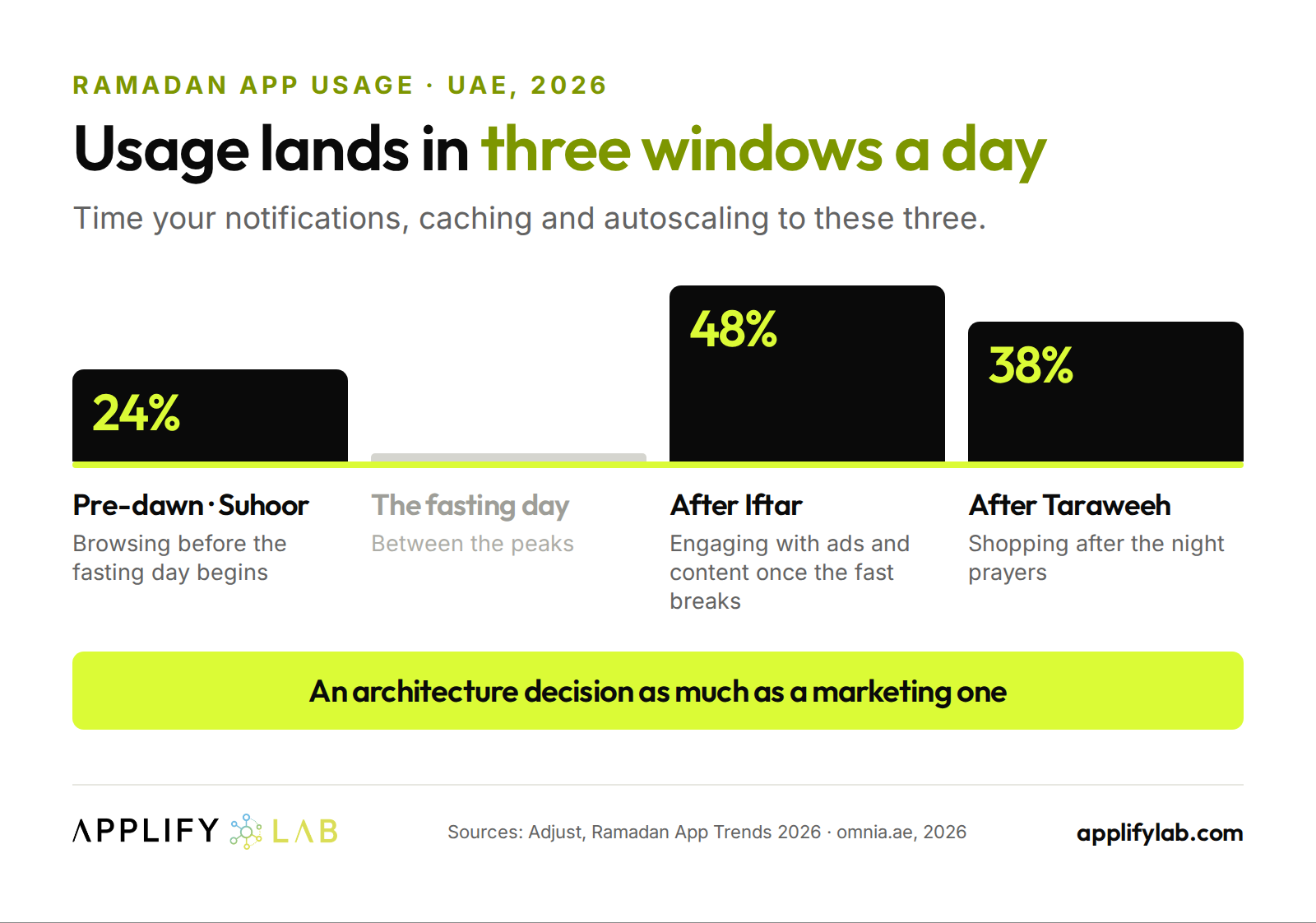
Usage moves to three specific windows — time notifications, caching and scaling to these three.
Usage goes up and moves to three specific windows
Ramadan splits into three distinct windows rather than one generic "evening peak." Real 2026 data shows three windows tied to prayer and meal times:
roughly 24% of users browse early morning before the fasting day begins,
48% engage with ads and content after Iftar (the fast-breaking meal),
and 38% shop specifically after Taraweeh prayers (the night prayers that follow Iftar by a couple of hours).
If your app's notification logic, caching, or content scheduling assumes a Western "prime time evening" pattern, it will be timed wrong for all three of these UAE-specific windows.
This matters at the architecture level as much as the marketing level — your backend needs to handle real traffic concentrated into these windows specifically.
Two different things are getting bundled under "Ramadan considerations" — worth separating
Only some of what follows is actually about Ramadan. RTL architecture and your payment gateway choice are general UAE-market requirements — you need them whether or not Ramadan exists, because your users are Arabic-first and Stripe barely covers the UAE regardless of season.
Ramadan is when they get stress-tested by real concentrated load and cultural expectations — the reason to have them is year-round.
The genuinely Ramadan-specific decisions are the three usage windows above, cultural tone/imagery during fasting hours, and seasonal infrastructure scaling.
Knowing which is which matters for sequencing: get the general UAE requirements right in v1 regardless of your launch date, and treat the Ramadan-specific layer as a seasonal addition you can time to when you'll actually need it.
Foundational (v1) vs. Ramadan-specific (phase in)
Build now (foundational, expensive to retrofit) | Phase in (Ramadan-specific, lighter) |
|---|---|
RTL architecture (built alongside English UI from week one) | Ramadan UI theming (muted tone, no fasting-hour food imagery) |
Local payment gateway (Telr / PayTabs / Network International) | Notification timing tuned to the three windows |
Infrastructure that can autoscale to concentrated load | Seasonal content and campaigns |
Native Gulf Arabic tone (cultural + linguistic localization) | — |
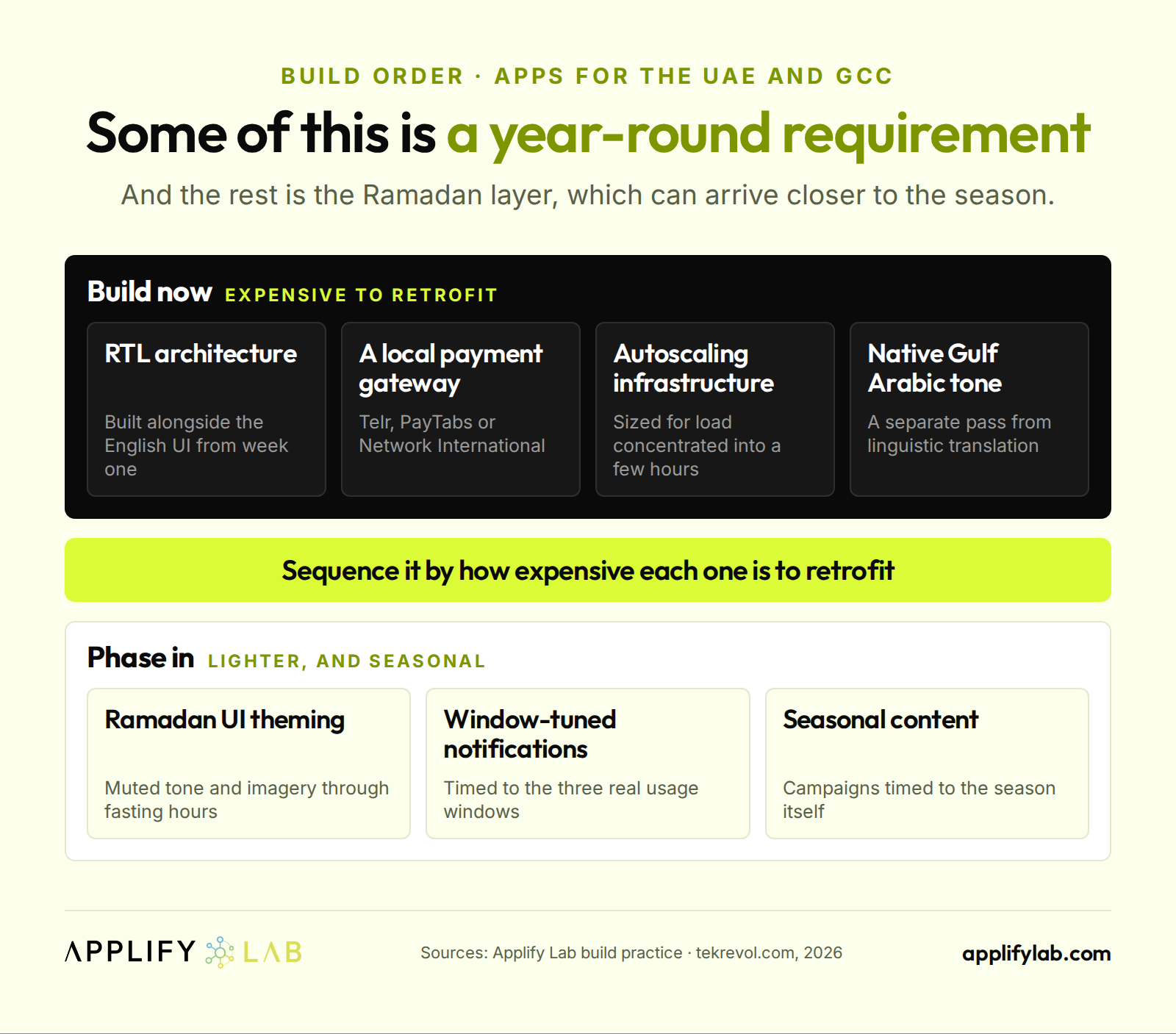
What belongs in v1 versus what can wait — sequence by how expensive it is to retrofit.
Cultural UI, beyond Arabic translation
Localization for the UAE means more than translating strings to Arabic — and doing it well is a genuine differentiator, well beyond busywork.
Alif Play, an Arabic-first education platform for MENA, is a real example of what this looks like done properly: bilingual architecture and culturally-native UX built in from the start measurably improved engagement and retention with Arabic-speaking users.
That's the standard worth building to, well beyond "we added an Arabic toggle":
RTL layout has to be built alongside your English UI from week one, ahead of any post-launch retrofit — it affects navigation direction, button placement, form fields, and icon alignment throughout the entire app, well beyond the text. Retrofitting RTL into an app architected only for LTR is a significant rebuild, far more than a translation pass.
Tone and imagery shift during Ramadan specifically. Muted colors, respectful messaging, and no food imagery during fasting hours are real, expected conventions — an app that keeps showing generic food/product photography through the day during Ramadan comes across as tone-deaf to UAE users rather than neutral.
Gulf Arabic tone and formality matter beyond grammar. Correct grammar and sounding native are two different things — cultural localization (imagery, color, references, religious sensitivity) is a distinct pass from linguistic localization, and skipping it is a common gap in apps built by teams without local context.
The GCC is several markets — decide your actual scope before you build
A common and costly assumption: build once for "the GCC" and it works everywhere. In practice it won't. Cultural norms, dialect, and business etiquette differ meaningfully between markets — what resonates in Dubai can fall flat in Riyadh.
If your real target is the UAE specifically, scope and localize for the UAE; if you genuinely need multi-market GCC reach, that's a bigger localization and testing commitment than a single "Arabic version" — decide which one you're actually building for before committing engineering time, rather than after.
Scoping your MVP and unsure how much of this to build now vs. later?
Tell us your target market (UAE only, or wider GCC) and your timeline, and we'll tell you honestly which of these need to be in your MVP and which can be phased in after launch.
Payments: build the local gateway in from the start
Stripe's UAE coverage is limited — an app architected only around Stripe will hit a real gap at launch, well beyond Ramadan. Plan for a local gateway (Telr, PayTabs, or Network International) from the MVP stage.
UAE finance app sessions rise roughly 8% during Ramadan specifically, driven by increased digital payments and donation activity — if your app has any payment or giving component, this seasonal load is real and measurable.
See our full payments integration guide for how gateway selection actually works by transaction volume.
Infrastructure: this is where under-built apps actually fail
Ramadan (and the Hajj season) has produced real, documented cases of donation and Zakat-processing platforms crashing under legitimate traffic surges because they were architected only for average load — the UAE's newly-launched National Zakat Platform is exactly the kind of concentrated-load system this risk applies to, processing donations from across the country in the same compressed windows this post covers.
This is the clearest argument for treating infrastructure scaling as a build-time decision: plan for autoscaling around the three real usage windows above, rather than a flat average-load assumption, and queue background tasks (notifications, order processing) so a spike in one leaves the core app experience running.
What actually needs to be in your MVP vs. what can wait
Not everything above carries equal urgency. RTL architecture and your payment gateway choice are foundational — expensive to retrofit, and worth getting right in v1 regardless of whether you launch before or during Ramadan.
Ramadan-specific UI theming, notification timing tuned to the three windows, and seasonal content are real but lighter-weight additions that can reasonably be phased in closer to the season itself.
We'd rather tell you honestly which of these earns a place in your MVP and which is a fast follow-up than sell you a bigger build than your launch actually needs.
FAQ
Do I need to build Ramadan-specific features into my UAE app from day one?
Not all of them. RTL layout and your payment gateway choice are foundational and expensive to retrofit — build those in from the MVP. Ramadan-specific theming and notification timing can reasonably be phased in later, closer to the season.
Is Ramadan app behavior the same across the GCC, or just the UAE?
The broad prayer/meal-time pattern (pre-fast browsing, post-Iftar, post-Taraweeh) holds across the region, though cultural tone, dialect, and business etiquette differ between markets — treating "the GCC" as one uniform build target is a common mistake. Scope your actual target market before committing to a multi-country build.
What happens to app traffic in the UAE during Ramadan?
It rises sharply and concentrates into specific windows rather than spreading evenly — UAE ecommerce app growth reached +101% in 2026, with real usage peaks around early morning (pre-fast), post-Iftar, and post-Taraweeh specifically, well beyond a generic "evening."
Do payment gateways work differently during Ramadan in the UAE?
The gateways themselves stay the same, though load rises — finance and payment app usage grows during Ramadan as digital payments and donations increase. Stripe's limited UAE coverage means most UAE-market apps need a local gateway (Telr, PayTabs, Network International) regardless of season.
Already running a business rather than building a new app?
This post is about what to architect for before launch. If you already have a running app and are deciding how to capture Ramadan sales or engagement this season — including whether an AI agent that knows the right timing to communicate makes sense — see our Ramadan ecommerce strategy guide for established businesses instead.
Ready to scope your MVP for the UAE or GCC market?
Book a discovery call — bring your target market and timeline, and we'll map out what belongs in v1 versus what can wait.
Related guides
If you're building an app for the UAE or GCC market, Ramadan is a month every year where usage patterns, UI expectations, payment behavior, and infrastructure load all shift in specific, well-documented ways — far more than a marketing afterthought to bolt on later.
UAE ecommerce app growth reached +101% during Ramadan 2026, one of the highest seasonal spikes of any market tracked globally.
Building around this from your MVP is cheaper than retrofitting it after launch, and a few of these decisions (localization architecture, payment gateway, infrastructure scaling) are genuinely harder to bolt on after the fact than others.
Key takeaways
Usage concentrates into three windows, not one evening: ~24% pre-fast morning, 48% post-Iftar, 38% post-Taraweeh — architecture-level, not just marketing.
Separate two things: general UAE requirements (RTL architecture, local payment gateway) are needed year-round; the Ramadan-specific layer (window timing, cultural tone, seasonal scaling) is a seasonal addition.
Cultural UI beyond translation: RTL built from week one, muted tone and no food imagery in fasting hours, native Gulf Arabic tone.
The GCC is several markets. Decide UAE-only vs. multi-market before you build — Dubai and Riyadh don't automatically resonate the same.
Infrastructure is where under-built apps fail — autoscale around the three windows; Stripe's limited UAE coverage means a local gateway from the MVP.
Usage moves to three specific windows — time notifications, caching and scaling to these three.
Usage goes up and moves to three specific windows
Ramadan splits into three distinct windows rather than one generic "evening peak." Real 2026 data shows three windows tied to prayer and meal times:
roughly 24% of users browse early morning before the fasting day begins,
48% engage with ads and content after Iftar (the fast-breaking meal),
and 38% shop specifically after Taraweeh prayers (the night prayers that follow Iftar by a couple of hours).
If your app's notification logic, caching, or content scheduling assumes a Western "prime time evening" pattern, it will be timed wrong for all three of these UAE-specific windows.
This matters at the architecture level as much as the marketing level — your backend needs to handle real traffic concentrated into these windows specifically.
Two different things are getting bundled under "Ramadan considerations" — worth separating
Only some of what follows is actually about Ramadan. RTL architecture and your payment gateway choice are general UAE-market requirements — you need them whether or not Ramadan exists, because your users are Arabic-first and Stripe barely covers the UAE regardless of season.
Ramadan is when they get stress-tested by real concentrated load and cultural expectations — the reason to have them is year-round.
The genuinely Ramadan-specific decisions are the three usage windows above, cultural tone/imagery during fasting hours, and seasonal infrastructure scaling.
Knowing which is which matters for sequencing: get the general UAE requirements right in v1 regardless of your launch date, and treat the Ramadan-specific layer as a seasonal addition you can time to when you'll actually need it.
Foundational (v1) vs. Ramadan-specific (phase in)
Build now (foundational, expensive to retrofit) | Phase in (Ramadan-specific, lighter) |
|---|---|
RTL architecture (built alongside English UI from week one) | Ramadan UI theming (muted tone, no fasting-hour food imagery) |
Local payment gateway (Telr / PayTabs / Network International) | Notification timing tuned to the three windows |
Infrastructure that can autoscale to concentrated load | Seasonal content and campaigns |
Native Gulf Arabic tone (cultural + linguistic localization) | — |
What belongs in v1 versus what can wait — sequence by how expensive it is to retrofit.
Cultural UI, beyond Arabic translation
Localization for the UAE means more than translating strings to Arabic — and doing it well is a genuine differentiator, well beyond busywork.
Alif Play, an Arabic-first education platform for MENA, is a real example of what this looks like done properly: bilingual architecture and culturally-native UX built in from the start measurably improved engagement and retention with Arabic-speaking users.
That's the standard worth building to, well beyond "we added an Arabic toggle":
RTL layout has to be built alongside your English UI from week one, ahead of any post-launch retrofit — it affects navigation direction, button placement, form fields, and icon alignment throughout the entire app, well beyond the text. Retrofitting RTL into an app architected only for LTR is a significant rebuild, far more than a translation pass.
Tone and imagery shift during Ramadan specifically. Muted colors, respectful messaging, and no food imagery during fasting hours are real, expected conventions — an app that keeps showing generic food/product photography through the day during Ramadan comes across as tone-deaf to UAE users rather than neutral.
Gulf Arabic tone and formality matter beyond grammar. Correct grammar and sounding native are two different things — cultural localization (imagery, color, references, religious sensitivity) is a distinct pass from linguistic localization, and skipping it is a common gap in apps built by teams without local context.
The GCC is several markets — decide your actual scope before you build
A common and costly assumption: build once for "the GCC" and it works everywhere. In practice it won't. Cultural norms, dialect, and business etiquette differ meaningfully between markets — what resonates in Dubai can fall flat in Riyadh.
If your real target is the UAE specifically, scope and localize for the UAE; if you genuinely need multi-market GCC reach, that's a bigger localization and testing commitment than a single "Arabic version" — decide which one you're actually building for before committing engineering time, rather than after.
Scoping your MVP and unsure how much of this to build now vs. later?
Tell us your target market (UAE only, or wider GCC) and your timeline, and we'll tell you honestly which of these need to be in your MVP and which can be phased in after launch.
Payments: build the local gateway in from the start
Stripe's UAE coverage is limited — an app architected only around Stripe will hit a real gap at launch, well beyond Ramadan. Plan for a local gateway (Telr, PayTabs, or Network International) from the MVP stage.
UAE finance app sessions rise roughly 8% during Ramadan specifically, driven by increased digital payments and donation activity — if your app has any payment or giving component, this seasonal load is real and measurable.
See our full payments integration guide for how gateway selection actually works by transaction volume.
Infrastructure: this is where under-built apps actually fail
Ramadan (and the Hajj season) has produced real, documented cases of donation and Zakat-processing platforms crashing under legitimate traffic surges because they were architected only for average load — the UAE's newly-launched National Zakat Platform is exactly the kind of concentrated-load system this risk applies to, processing donations from across the country in the same compressed windows this post covers.
This is the clearest argument for treating infrastructure scaling as a build-time decision: plan for autoscaling around the three real usage windows above, rather than a flat average-load assumption, and queue background tasks (notifications, order processing) so a spike in one leaves the core app experience running.
What actually needs to be in your MVP vs. what can wait
Not everything above carries equal urgency. RTL architecture and your payment gateway choice are foundational — expensive to retrofit, and worth getting right in v1 regardless of whether you launch before or during Ramadan.
Ramadan-specific UI theming, notification timing tuned to the three windows, and seasonal content are real but lighter-weight additions that can reasonably be phased in closer to the season itself.
We'd rather tell you honestly which of these earns a place in your MVP and which is a fast follow-up than sell you a bigger build than your launch actually needs.
FAQ
Do I need to build Ramadan-specific features into my UAE app from day one?
Not all of them. RTL layout and your payment gateway choice are foundational and expensive to retrofit — build those in from the MVP. Ramadan-specific theming and notification timing can reasonably be phased in later, closer to the season.
Is Ramadan app behavior the same across the GCC, or just the UAE?
The broad prayer/meal-time pattern (pre-fast browsing, post-Iftar, post-Taraweeh) holds across the region, though cultural tone, dialect, and business etiquette differ between markets — treating "the GCC" as one uniform build target is a common mistake. Scope your actual target market before committing to a multi-country build.
What happens to app traffic in the UAE during Ramadan?
It rises sharply and concentrates into specific windows rather than spreading evenly — UAE ecommerce app growth reached +101% in 2026, with real usage peaks around early morning (pre-fast), post-Iftar, and post-Taraweeh specifically, well beyond a generic "evening."
Do payment gateways work differently during Ramadan in the UAE?
The gateways themselves stay the same, though load rises — finance and payment app usage grows during Ramadan as digital payments and donations increase. Stripe's limited UAE coverage means most UAE-market apps need a local gateway (Telr, PayTabs, Network International) regardless of season.
Already running a business rather than building a new app?
This post is about what to architect for before launch. If you already have a running app and are deciding how to capture Ramadan sales or engagement this season — including whether an AI agent that knows the right timing to communicate makes sense — see our Ramadan ecommerce strategy guide for established businesses instead.
Ready to scope your MVP for the UAE or GCC market?
Book a discovery call — bring your target market and timeline, and we'll map out what belongs in v1 versus what can wait.