Retail & E-commerce
Ramadan Ecommerce App Strategies for UAE Brands

By
Anh Nguyen, Founder
·
7 min

UAE ecommerce app growth hit +101% during Ramadan 2026 — one of the sharpest seasonal spikes tracked anywhere globally, on top of purchases rising 40%+ and spiking 76% at Eid.
If you're already running an app, the real decision is how you capture this specific surge, more than whether to run a Ramadan campaign: update your app's own features, hand the timing-sensitive part (knowing exactly when to reach out and what to say) to an AI agent, or both.
Key takeaways
The surge is real and concentrated: +101% app growth, +40% purchases, +76% at Eid — clustered into three windows (24% pre-fast, 48% post-Iftar, 38% post-Taraweeh).
Three ways to capture it: update your app's features, deploy an AI agent that knows the right timing, or both phased.
The AI-agent path is credible here: 79% of UAE consumers are comfortable letting an AI complete a purchase; 64% trust an AI shopping agent more than family — far above US/UK.
Timing is everything. Every feature and message is only as good as how precisely it hits the three windows; a generic "evening send" misses all three.
Anchor to the calendar: awareness now → engagement from Feb 18 → conversion Mar 10-20 → retention after.
Planning a shopping, marketplace or loyalty app? See how we build e-commerce and retail apps for UAE brands.
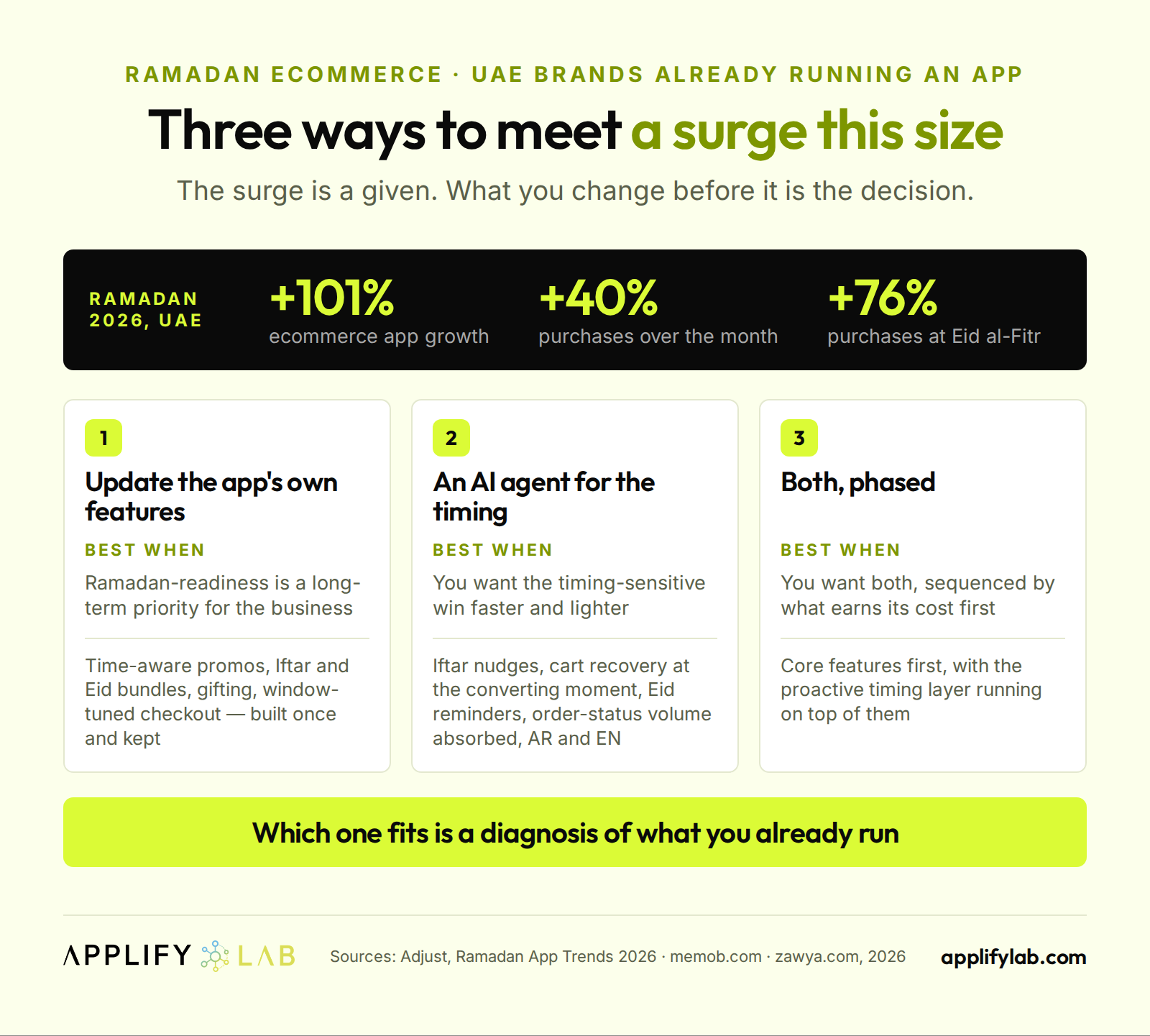
Three ways to capture the surge — a feature build, an AI agent that knows the timing, or both.
The timing this all depends on
Ramadan concentrates into three distinct windows tied to prayer and meal times, rather than one generic evening peak — real 2026 data shows roughly 24% of users browse early morning before the fasting day begins, 48% engage with ads and content after Iftar, and 38% shop specifically after Taraweeh prayers.
Every feature, campaign, and message below is only as good as how precisely it's timed to these three windows — a generic "evening send" misses all of them; one timed to the real data lands.
Three ways to actually act on this
1 · Update the app's own features.
Time-aware promotions, Iftar/Suhoor/Eid bundles, gifting flows, checkout tuned to the three windows above — permanent capabilities you build once and keep.
Worth the investment if Ramadan-readiness is a long-term priority for your business, beyond a one-season push.
See our custom ecommerce app guide for how a feature build like this gets scoped and costed.
2 · An AI agent that knows the right timing to communicate.
Rather than hardcoding time-aware logic into the app, an AI customer-engagement agent handles the "when to reach out and what to say" job conversationally — nudging customers before their local Iftar time, recovering an abandoned cart at the moment it's actually likely to convert, sending Eid reminders, and absorbing FAQ/order-status volume during the three peak windows while your team stays the same size.
That trust is a safe assumption in the UAE specifically:
79% of UAE consumers say they're comfortable letting an AI complete a purchase for them, and
64% say they'd trust an AI shopping agent more than their own family — both dramatically higher than the US or UK.
That data is about AI-driven shopping generally rather than Ramadan messaging specifically, and it's the honest answer to the real objection ("is an AI agent actually trusted for something this personal"), grounded in real data.
Closer to home for Ramadan specifically: automated instant greetings during high-volume periods are already a documented tactic among UAE SMBs on WhatsApp Business, and 800Flowers uses automated messaging to keep customers informed of Ramadan-adjusted delivery schedules — a real, narrow example of the same idea already working.
Pricing for our version depends on which channels and how much conversation volume you need — scoped on a call rather than a fixed number here. More on this option, including the fuller build-vs-agent framework, in our loyalty and retention guide.
3 · Both, phased.
Build the core app features and let an AI agent run the proactive, timing-sensitive communication layer on top — ship whichever piece earns its cost fastest first, then extend, rather than a single big-bang build.
Which of these fits comes down to whether Ramadan-readiness is a permanent priority or a seasonal push, and how much of your current setup already handles it — a diagnosis rather than a template answer.
The three paths at a glance
Path | Best when | What it delivers |
|---|---|---|
Update app features | Ramadan-readiness is a long-term priority | Time-aware promos, bundles, gifting, window-tuned checkout — built once, kept |
AI agent (timing layer) | You want the timing-sensitive win faster and lighter | Iftar nudges, cart recovery, Eid reminders, FAQ/order-status volume absorbed, AR/EN |
Both, phased | You want both, sequenced by ROI | Core features + a proactive agent on top; highest-ROI piece first |
Updating features, deploying an agent, or unsure which fits your business?
Tell us what you're already running and we'll tell you honestly whether this year's plan is a feature build, an agent, or both.
If you're updating features: what's proven, what's still emerging
If you've run Ramadan campaigns before, treat this as a checklist to confirm nothing's stale rather than a from-scratch list — the value this year is usually in the one or two you haven't built yet, or the timing on the ones you have.
Iftar/Suhoor and Eid bundles (if it's still outstanding). Curated meal sets or gift packs with a one-tap "add bundle" flow reduce decision friction and lift average order value — the single highest-leverage, lowest-risk feature on this list.
Time-and-location-aware promotions. A push 20 minutes before local Iftar time, using device timezone and location rather than one blanket send time.
Social and gifting features. Shared wishlists, a "buy for family" flow, and scheduled Eid-morning delivery — gifting drives a meaningful share of Ramadan volume, and most apps leave it more frictionful than it needs to be.
Personalization tied to local preference. A short preference questionnaire (family size, dietary needs, budget) that actually shapes what a user sees earns more here than in a generic season.
Live commerce — real, still emerging, a bet rather than a sure thing. Live-streamed demos with in-stream buy buttons work well for specific categories (food, fashion try-ons), though they're a genuinely different investment than the features above — worth a small pilot (2-3 sessions) before a full build.
Charity/CSR at checkout, done transparently. A round-up donation or a checkbox with a named, verified charity partner and visible receipts fits UAE Ramadan culture genuinely — best done with transparent mechanics throughout.
The campaign calendar, anchored to real 2026 dates
Now through early January (awareness): a "Ramadan Ready" landing page, early-bird coupons — also when to decide your path (feature build, agent, or both) for this year.
Early-to-mid Ramadan (Feb 18 onward — engagement): Suhoor/Iftar content tied to products; if you're running the agent path, this is when timing-aware nudges start earning their keep.
Last 10 days into Eid (March 10-20 — conversion): Eid gift packs, same-day delivery, countdown timers.
Post-Ramadan (after March 20 — retention): convert Ramadan buyers into retained customers — see our loyalty and retention guide for the fuller framework.

The campaign calendar, anchored to real 2026 dates — awareness, engagement, conversion, retention.
Operational readiness — regardless of which path you choose
Scaling: autoscale for the three real windows above, and queue order-processing and notification tasks so a spike leaves checkout running.
Inventory: real-time sync across channels, with throttling on flash sales to prevent overselling.
Payments: local gateways with AED settlement and tokenized saved cards — full breakdown in our payments integration guide. Cash-on-delivery is declining in the UAE as digital wallets and BNPL take share, including during Ramadan specifically.
What to actually measure
Conversion rate by window (each window, rather than "the evening" broadly), average order value split by bundles vs. single items, push or agent-message CTR by send time, D7/D30 retention of Ramadan buyers, and refund/chargeback rate.
Set these up as a live dashboard — the value of tracking by window is catching a mistimed message on night one, well before an April retrospective.
Tone and messaging
Respectful, family-first, value-forward — gentle urgency ("limited tonight, ends after Maghrib") rather than scarcity language that reads as exploiting a religious observance.
Real examples worth adapting: a message timed to "Iftar in 20 minutes" with a same-evening delivery offer; a banner naming the actual charity partner rather than a vague "donate a portion" claim.
Test small before betting on a full build
A grocery app testing whether pre-built Suhoor bundles lift AOV; a fashion app testing whether scheduled Eid delivery plus gift-wrap lifts conversion; a food app testing whether a small live-commerce pilot moves basket size.
If you're weighing the feature route against the agent route, the agent is usually the lighter test — faster to stand up for one season than a permanent feature, and it tells you whether the timing-aware approach earns its keep before you build it in permanently.
FAQ
Should I update my app's features or use an AI agent for Ramadan?
Depends on whether Ramadan-readiness is a long-term priority (update the features) or you want a faster, lighter way to act on the same timing this season specifically (an agent). Many businesses use both, phased.
Is an AI agent actually trusted for something like Ramadan shopping in the UAE?
Yes, more than in most markets — 79% of UAE consumers say they're comfortable letting an AI complete a purchase, and 64% trust an AI shopping agent more than their own family, both well above US/UK levels.
What features should a Ramadan ecommerce app include?
Time-aware bundles, one-tap checkout with local payment methods, genuine Arabic localization, and transparent charity options are the proven ones. Live commerce is real but still emerging.
When should we start preparing for Ramadan?
Ramadan starts mid February in 2026, early February in 2027. Start scoping your path in early December to make sure to finalise for early January— finalizing with only 2-3 weeks left to the start means launching mid-surge.
Is live commerce actually worth building for a UAE Ramadan campaign?
It can be, for the right category, though it's a bigger and less proven investment than bundles or time-aware pushes. Worth testing with 2-3 sessions before a full build.
Building a new app rather than updating an existing one?
This post is about optimizing a business you're already running. If you're still building your app and want to know what Ramadan means for the UAE/GCC market culturally and technically, see our Ramadan considerations for app development guide instead.
To go further
UAE ecommerce app growth hit +101% during Ramadan 2026 — one of the sharpest seasonal spikes tracked anywhere globally, on top of purchases rising 40%+ and spiking 76% at Eid.
If you're already running an app, the real decision is how you capture this specific surge, more than whether to run a Ramadan campaign: update your app's own features, hand the timing-sensitive part (knowing exactly when to reach out and what to say) to an AI agent, or both.
Key takeaways
The surge is real and concentrated: +101% app growth, +40% purchases, +76% at Eid — clustered into three windows (24% pre-fast, 48% post-Iftar, 38% post-Taraweeh).
Three ways to capture it: update your app's features, deploy an AI agent that knows the right timing, or both phased.
The AI-agent path is credible here: 79% of UAE consumers are comfortable letting an AI complete a purchase; 64% trust an AI shopping agent more than family — far above US/UK.
Timing is everything. Every feature and message is only as good as how precisely it hits the three windows; a generic "evening send" misses all three.
Anchor to the calendar: awareness now → engagement from Feb 18 → conversion Mar 10-20 → retention after.
Planning a shopping, marketplace or loyalty app? See how we build e-commerce and retail apps for UAE brands.
Three ways to capture the surge — a feature build, an AI agent that knows the timing, or both.
The timing this all depends on
Ramadan concentrates into three distinct windows tied to prayer and meal times, rather than one generic evening peak — real 2026 data shows roughly 24% of users browse early morning before the fasting day begins, 48% engage with ads and content after Iftar, and 38% shop specifically after Taraweeh prayers.
Every feature, campaign, and message below is only as good as how precisely it's timed to these three windows — a generic "evening send" misses all of them; one timed to the real data lands.
Three ways to actually act on this
1 · Update the app's own features.
Time-aware promotions, Iftar/Suhoor/Eid bundles, gifting flows, checkout tuned to the three windows above — permanent capabilities you build once and keep.
Worth the investment if Ramadan-readiness is a long-term priority for your business, beyond a one-season push.
See our custom ecommerce app guide for how a feature build like this gets scoped and costed.
2 · An AI agent that knows the right timing to communicate.
Rather than hardcoding time-aware logic into the app, an AI customer-engagement agent handles the "when to reach out and what to say" job conversationally — nudging customers before their local Iftar time, recovering an abandoned cart at the moment it's actually likely to convert, sending Eid reminders, and absorbing FAQ/order-status volume during the three peak windows while your team stays the same size.
That trust is a safe assumption in the UAE specifically:
79% of UAE consumers say they're comfortable letting an AI complete a purchase for them, and
64% say they'd trust an AI shopping agent more than their own family — both dramatically higher than the US or UK.
That data is about AI-driven shopping generally rather than Ramadan messaging specifically, and it's the honest answer to the real objection ("is an AI agent actually trusted for something this personal"), grounded in real data.
Closer to home for Ramadan specifically: automated instant greetings during high-volume periods are already a documented tactic among UAE SMBs on WhatsApp Business, and 800Flowers uses automated messaging to keep customers informed of Ramadan-adjusted delivery schedules — a real, narrow example of the same idea already working.
Pricing for our version depends on which channels and how much conversation volume you need — scoped on a call rather than a fixed number here. More on this option, including the fuller build-vs-agent framework, in our loyalty and retention guide.
3 · Both, phased.
Build the core app features and let an AI agent run the proactive, timing-sensitive communication layer on top — ship whichever piece earns its cost fastest first, then extend, rather than a single big-bang build.
Which of these fits comes down to whether Ramadan-readiness is a permanent priority or a seasonal push, and how much of your current setup already handles it — a diagnosis rather than a template answer.
The three paths at a glance
Path | Best when | What it delivers |
|---|---|---|
Update app features | Ramadan-readiness is a long-term priority | Time-aware promos, bundles, gifting, window-tuned checkout — built once, kept |
AI agent (timing layer) | You want the timing-sensitive win faster and lighter | Iftar nudges, cart recovery, Eid reminders, FAQ/order-status volume absorbed, AR/EN |
Both, phased | You want both, sequenced by ROI | Core features + a proactive agent on top; highest-ROI piece first |
Updating features, deploying an agent, or unsure which fits your business?
Tell us what you're already running and we'll tell you honestly whether this year's plan is a feature build, an agent, or both.
If you're updating features: what's proven, what's still emerging
If you've run Ramadan campaigns before, treat this as a checklist to confirm nothing's stale rather than a from-scratch list — the value this year is usually in the one or two you haven't built yet, or the timing on the ones you have.
Iftar/Suhoor and Eid bundles (if it's still outstanding). Curated meal sets or gift packs with a one-tap "add bundle" flow reduce decision friction and lift average order value — the single highest-leverage, lowest-risk feature on this list.
Time-and-location-aware promotions. A push 20 minutes before local Iftar time, using device timezone and location rather than one blanket send time.
Social and gifting features. Shared wishlists, a "buy for family" flow, and scheduled Eid-morning delivery — gifting drives a meaningful share of Ramadan volume, and most apps leave it more frictionful than it needs to be.
Personalization tied to local preference. A short preference questionnaire (family size, dietary needs, budget) that actually shapes what a user sees earns more here than in a generic season.
Live commerce — real, still emerging, a bet rather than a sure thing. Live-streamed demos with in-stream buy buttons work well for specific categories (food, fashion try-ons), though they're a genuinely different investment than the features above — worth a small pilot (2-3 sessions) before a full build.
Charity/CSR at checkout, done transparently. A round-up donation or a checkbox with a named, verified charity partner and visible receipts fits UAE Ramadan culture genuinely — best done with transparent mechanics throughout.
The campaign calendar, anchored to real 2026 dates
Now through early January (awareness): a "Ramadan Ready" landing page, early-bird coupons — also when to decide your path (feature build, agent, or both) for this year.
Early-to-mid Ramadan (Feb 18 onward — engagement): Suhoor/Iftar content tied to products; if you're running the agent path, this is when timing-aware nudges start earning their keep.
Last 10 days into Eid (March 10-20 — conversion): Eid gift packs, same-day delivery, countdown timers.
Post-Ramadan (after March 20 — retention): convert Ramadan buyers into retained customers — see our loyalty and retention guide for the fuller framework.
The campaign calendar, anchored to real 2026 dates — awareness, engagement, conversion, retention.
Operational readiness — regardless of which path you choose
Scaling: autoscale for the three real windows above, and queue order-processing and notification tasks so a spike leaves checkout running.
Inventory: real-time sync across channels, with throttling on flash sales to prevent overselling.
Payments: local gateways with AED settlement and tokenized saved cards — full breakdown in our payments integration guide. Cash-on-delivery is declining in the UAE as digital wallets and BNPL take share, including during Ramadan specifically.
What to actually measure
Conversion rate by window (each window, rather than "the evening" broadly), average order value split by bundles vs. single items, push or agent-message CTR by send time, D7/D30 retention of Ramadan buyers, and refund/chargeback rate.
Set these up as a live dashboard — the value of tracking by window is catching a mistimed message on night one, well before an April retrospective.
Tone and messaging
Respectful, family-first, value-forward — gentle urgency ("limited tonight, ends after Maghrib") rather than scarcity language that reads as exploiting a religious observance.
Real examples worth adapting: a message timed to "Iftar in 20 minutes" with a same-evening delivery offer; a banner naming the actual charity partner rather than a vague "donate a portion" claim.
Test small before betting on a full build
A grocery app testing whether pre-built Suhoor bundles lift AOV; a fashion app testing whether scheduled Eid delivery plus gift-wrap lifts conversion; a food app testing whether a small live-commerce pilot moves basket size.
If you're weighing the feature route against the agent route, the agent is usually the lighter test — faster to stand up for one season than a permanent feature, and it tells you whether the timing-aware approach earns its keep before you build it in permanently.
FAQ
Should I update my app's features or use an AI agent for Ramadan?
Depends on whether Ramadan-readiness is a long-term priority (update the features) or you want a faster, lighter way to act on the same timing this season specifically (an agent). Many businesses use both, phased.
Is an AI agent actually trusted for something like Ramadan shopping in the UAE?
Yes, more than in most markets — 79% of UAE consumers say they're comfortable letting an AI complete a purchase, and 64% trust an AI shopping agent more than their own family, both well above US/UK levels.
What features should a Ramadan ecommerce app include?
Time-aware bundles, one-tap checkout with local payment methods, genuine Arabic localization, and transparent charity options are the proven ones. Live commerce is real but still emerging.
When should we start preparing for Ramadan?
Ramadan starts mid February in 2026, early February in 2027. Start scoping your path in early December to make sure to finalise for early January— finalizing with only 2-3 weeks left to the start means launching mid-surge.
Is live commerce actually worth building for a UAE Ramadan campaign?
It can be, for the right category, though it's a bigger and less proven investment than bundles or time-aware pushes. Worth testing with 2-3 sessions before a full build.
Building a new app rather than updating an existing one?
This post is about optimizing a business you're already running. If you're still building your app and want to know what Ramadan means for the UAE/GCC market culturally and technically, see our Ramadan considerations for app development guide instead.
To go further
Ready to scope your specific Ramadan strategy?
Book a discovery call — bring your current setup and we'll map out whether this year's plan is a feature build, an agent, or both.
RELATED GUIDES

Retail & E-commerce
Loyalty Program App Development for Ramadan Ecommerce
7 min

Retail & E-commerce
Mobile Payment Integration for Ecommerce Apps in the UAE (2026)
8 min

Retail & E-commerce
Custom Ecommerce App Development in Dubai: What It Actually Costs in 2026
10 min

Retail & E-commerce
Ramadan Considerations for App Development in the UAE & GCC
7 min