Health & Wellness
Remote Patient Monitoring Apps in UAE: Use Cases & Development Guide

By
Anh Nguyen, Founder
·
6 min

Cleveland Clinic Abu Dhabi just became the first hospital in Abu Dhabi to implant a wireless remote-monitoring sensor for chronic heart failure patients — real, current evidence that RPM adoption here has moved past experimental, into where a major provider is actively investing.
If you're already running a clinic or hospital, the real question is how to add remote patient monitoring to what you're already running — its reality here is settled (the UAE market is growing at 12.7% a year toward $1.6B by 2031, and DHA already has 70% of chronic patients enrolled in some form of it).
The three real paths: integrate it into your existing systems, layer an AI agent on top for patient engagement, or both.
Key takeaways
RPM adoption here is real now — CCAD's July 2026 implant program, 12.7% market growth toward $1.6B by 2031, 70% of DHA chronic patients already enrolled.
Three ways to add it: integrate into your existing systems, an AI agent for the patient-engagement layer, or both phased.
The honest picture is ROI + friction: ~2-3x ROI, set against inconsistent engagement, legacy EHR integration, and billing/coding complexity.
Integrate, don't rebuild. Proven RPM platforms handle device ingestion; custom work earns its cost on your practice-specific layer (alert routing, your patient app, engagement).
One compliance addition: MOHAP prohibits autonomous AI replacing clinical judgment — engagement-layer AI escalates to a clinician for the decision.
Building a health or wellness product in the UAE? See how we build healthcare and wellness apps.

Adding RPM to what you already run — three real paths, each entering a different layer.
What CCAD's move actually shows
Cleveland Clinic Abu Dhabi's new program implants a tiny wireless sensor that continuously tracks pulmonary artery pressure in chronic heart failure patients, sending data to the care team so physicians can catch warning signs before a patient needs hospitalization.
It's a real, dated example (July 2026) of an established provider expanding remote monitoring specifically because it changes outcomes and reduces avoidable admissions — a deliberate program, beyond a quiet pilot.
If a hospital with CCAD's scale is investing here, it's a reasonable signal that patients and regulators increasingly expect this, well beyond a speculative bet.
Real ROI, and the real friction — both, honestly
Typical RPM programs see 2-3x ROI, and that improves as adoption scales — a real, if global (not UAE-specific), industry benchmark.
The same research is also honest about where programs actually struggle, and we'd rather tell you this upfront than pitch you the upside alone: patient engagement stays inconsistent unless the reminder/check-in layer is genuinely well-designed, integrating with legacy EHR systems is real work, and billing/coding for RPM services adds administrative complexity most clinics underestimate going in.
Each of these is a real scoping question that determines whether your rollout looks like CCAD's or an expensive pilot nobody uses, rather than a reason to avoid RPM.
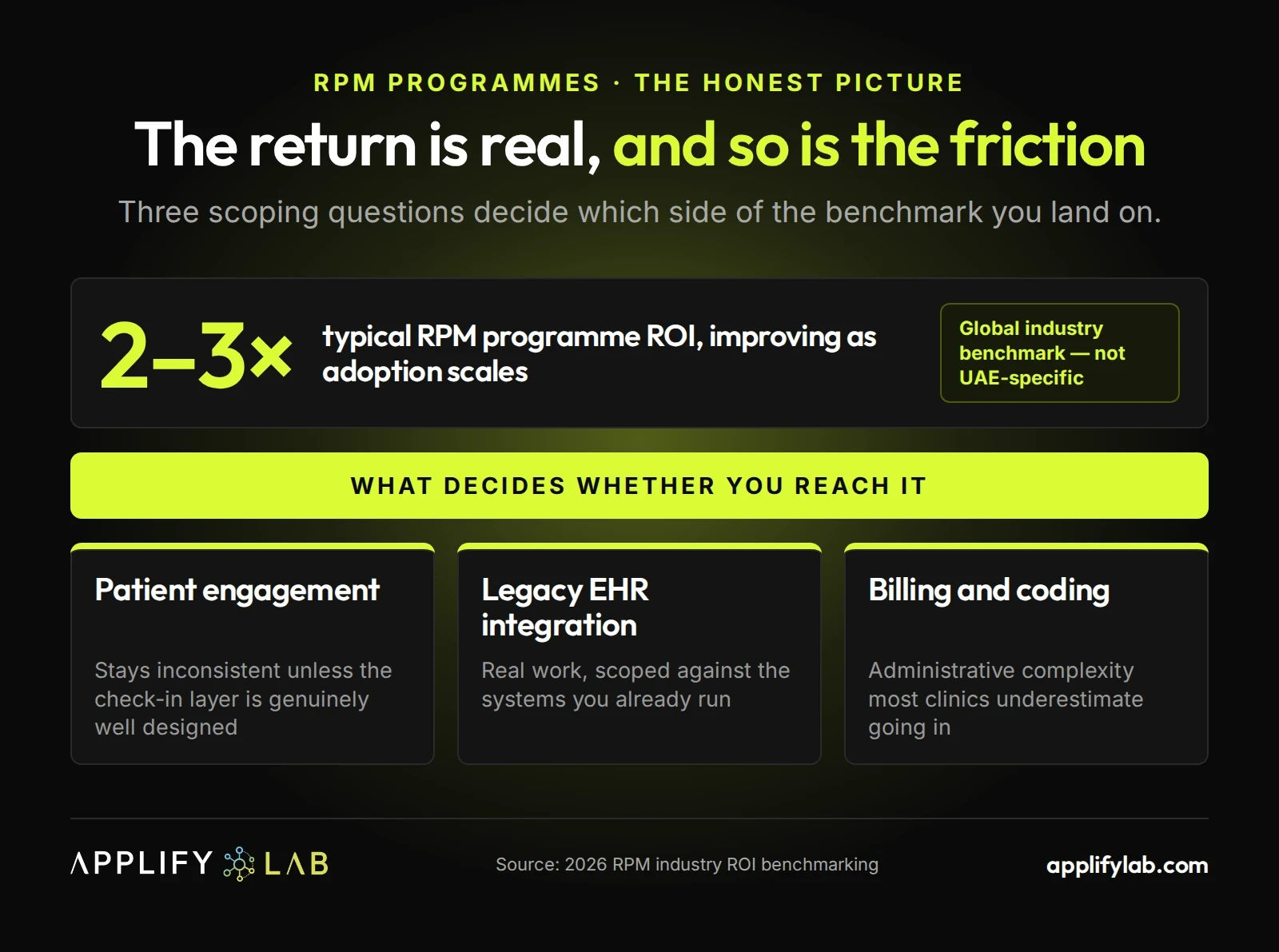
The honest view: 2-3x ROI, and the three friction points that decide whether you reach it.
Two ways to actually add this
Integrate RPM into your existing systems. Device/wearable data ingestion, EMR-tied dashboards, and automated alerts when a reading crosses a threshold — scoped against what you already run, well short of a rebuild. This is the right path if you want RPM as a permanent clinical capability integrated into how your doctors already work.
An AI agent for the patient engagement layer. Rather than building reminder logic and check-in UX from scratch, an AI agent can message enrolled patients about symptom check-ins, medication adherence, and readings due — in Arabic and English — and escalate to a clinician the moment a response or reading crosses a concerning threshold. It's a genuinely faster way to address the "inconsistent patient engagement" friction point above without a full systems integration project first. Pricing depends on your patient volume and which channels you need — scoped on a call rather than a fixed number here.
Both, phased. Stand up the engagement layer first to prove patients will actually participate, then invest in deeper EMR/device integration once you know the program has real uptake.
The three paths at a glance
Path | Best when | What it delivers |
|---|---|---|
Integrate into existing systems | You want RPM as a permanent clinical capability | Device ingestion, EMR-tied dashboards, threshold alerts |
AI agent (engagement layer) | You want to fix inconsistent engagement fast | Check-ins, adherence, readings-due nudges in AR/EN; escalation to a clinician |
Both, phased | You want proof of uptake before deep integration | Engagement layer first, then EMR/device integration |
Unsure whether integration or an AI-agent layer gets you there faster?
Tell us your patient volume, which conditions you're targeting, and what your current systems look like, and we'll tell you honestly which path earns its cost first.
Build custom, or integrate an established RPM platform?
For most operating clinics and hospitals, the honest answer mirrors what we tell hospital-wide system buyers: you're almost always better served integrating a proven RPM platform's device-data layer than building device ingestion and wearable integration from scratch.
Proven RPM platforms already handle that layer reliably.
Where custom work genuinely earns its cost is the layer specific to your practice — how alerts route to your specific clinicians, how it ties into your existing patient app or portal, and the patient-facing engagement experience (including an AI agent, if that's your path).
We'd rather scope which parts of this are genuinely worth building custom than sell you a full custom RPM platform when integrating an established one gets you compliant and running faster.
Compliance: mostly what you already know, one addition
If you're already DHA/DoH/MOHAP-licensed and NABIDH- or Malaffi-integrated, the core compliance groundwork is done — see our digital health compliance guide for the full picture if any of that is still outstanding.
The one addition specific to RPM: MOHAP's federal guidance prohibits autonomous AI from replacing clinical judgment, so any AI-driven alerting or risk-flagging needs to support your clinicians' decisions rather than make them — design any engagement-layer AI agent around this from the start, ahead of a later compliance review.
What it costs
Since you're adding to a system you already run, cost is scoped to what's new, well short of a full platform rebuild:
Engagement layer only (AI agent for reminders, check-ins, escalation, layered onto your existing app or portal): setup scoped to your patient volume and channels, with a monthly retainer — priced on a call, not a fixed number here.
Device/EMR integration (wearable data ingestion, dashboards, threshold alerts tied into your existing clinical systems): roughly AED 183,000–440,000, depending on how many device types and how deep the EMR integration goes.
Full RPM rollout across multiple conditions or a hospital-wide program: AED 440,000–900,000+, closer to the enterprise tier covered in our hospital management guide if you're rolling this out across a full facility.
Questions worth asking any partner
Have they integrated RPM data into an existing EMR/HMS before (with real EMR/HMS integration, beyond a standalone monitoring app), how do they handle the PDPL requirements around passively-collected device data, and how would they sequence a rollout — engagement layer first or integration first — for your specific patient volume.
You should own 100% of the code on anything custom-built, with no proprietary lock-in — confirm this directly.
FAQ
We already run a clinic — do we need a whole new app for remote patient monitoring?
Not necessarily. Most operating clinics are better served integrating RPM into what they already run — an existing patient app or portal, plus device data flowing into your EMR — than building a separate monitoring app from scratch.
How much does it cost to add RPM to an existing clinic or hospital system?
Roughly AED 183,000–440,000 for device/EMR integration, up to AED 440,000–900,000+ for a full multi-condition or hospital-wide rollout. An AI-agent engagement layer alone is priced separately, scoped to your patient volume on a call.
Is RPM actually worth the investment, or is this hype?
Real: the UAE RPM market is growing at 12.7% a year toward $1.6B by 2031, DHA already has 70% of chronic patients enrolled in some form of remote monitoring, and Cleveland Clinic Abu Dhabi is actively expanding its own program as of July 2026, well beyond a quiet pilot.
What's the biggest reason RPM programs underperform?
Usually the friction is organizational rather than technical — inconsistent patient engagement, legacy EHR integration friction, and underestimated billing/coding complexity. Scoping for these upfront, rather than treating them as an afterthought, is what separates a program that gets real adoption from an expensive pilot.
Can an AI agent handle patient monitoring alerts on its own?
It can flag and escalate — MOHAP's guidance prohibits autonomous AI from replacing clinical judgment, so any AI-driven alerting needs to route to a clinician for the actual decision rather than make one independently.
To go further
Cleveland Clinic Abu Dhabi just became the first hospital in Abu Dhabi to implant a wireless remote-monitoring sensor for chronic heart failure patients — real, current evidence that RPM adoption here has moved past experimental, into where a major provider is actively investing.
If you're already running a clinic or hospital, the real question is how to add remote patient monitoring to what you're already running — its reality here is settled (the UAE market is growing at 12.7% a year toward $1.6B by 2031, and DHA already has 70% of chronic patients enrolled in some form of it).
The three real paths: integrate it into your existing systems, layer an AI agent on top for patient engagement, or both.
Key takeaways
RPM adoption here is real now — CCAD's July 2026 implant program, 12.7% market growth toward $1.6B by 2031, 70% of DHA chronic patients already enrolled.
Three ways to add it: integrate into your existing systems, an AI agent for the patient-engagement layer, or both phased.
The honest picture is ROI + friction: ~2-3x ROI, set against inconsistent engagement, legacy EHR integration, and billing/coding complexity.
Integrate, don't rebuild. Proven RPM platforms handle device ingestion; custom work earns its cost on your practice-specific layer (alert routing, your patient app, engagement).
One compliance addition: MOHAP prohibits autonomous AI replacing clinical judgment — engagement-layer AI escalates to a clinician for the decision.
Building a health or wellness product in the UAE? See how we build healthcare and wellness apps.
Adding RPM to what you already run — three real paths, each entering a different layer.
What CCAD's move actually shows
Cleveland Clinic Abu Dhabi's new program implants a tiny wireless sensor that continuously tracks pulmonary artery pressure in chronic heart failure patients, sending data to the care team so physicians can catch warning signs before a patient needs hospitalization.
It's a real, dated example (July 2026) of an established provider expanding remote monitoring specifically because it changes outcomes and reduces avoidable admissions — a deliberate program, beyond a quiet pilot.
If a hospital with CCAD's scale is investing here, it's a reasonable signal that patients and regulators increasingly expect this, well beyond a speculative bet.
Real ROI, and the real friction — both, honestly
Typical RPM programs see 2-3x ROI, and that improves as adoption scales — a real, if global (not UAE-specific), industry benchmark.
The same research is also honest about where programs actually struggle, and we'd rather tell you this upfront than pitch you the upside alone: patient engagement stays inconsistent unless the reminder/check-in layer is genuinely well-designed, integrating with legacy EHR systems is real work, and billing/coding for RPM services adds administrative complexity most clinics underestimate going in.
Each of these is a real scoping question that determines whether your rollout looks like CCAD's or an expensive pilot nobody uses, rather than a reason to avoid RPM.
The honest view: 2-3x ROI, and the three friction points that decide whether you reach it.
Two ways to actually add this
Integrate RPM into your existing systems. Device/wearable data ingestion, EMR-tied dashboards, and automated alerts when a reading crosses a threshold — scoped against what you already run, well short of a rebuild. This is the right path if you want RPM as a permanent clinical capability integrated into how your doctors already work.
An AI agent for the patient engagement layer. Rather than building reminder logic and check-in UX from scratch, an AI agent can message enrolled patients about symptom check-ins, medication adherence, and readings due — in Arabic and English — and escalate to a clinician the moment a response or reading crosses a concerning threshold. It's a genuinely faster way to address the "inconsistent patient engagement" friction point above without a full systems integration project first. Pricing depends on your patient volume and which channels you need — scoped on a call rather than a fixed number here.
Both, phased. Stand up the engagement layer first to prove patients will actually participate, then invest in deeper EMR/device integration once you know the program has real uptake.
The three paths at a glance
Path | Best when | What it delivers |
|---|---|---|
Integrate into existing systems | You want RPM as a permanent clinical capability | Device ingestion, EMR-tied dashboards, threshold alerts |
AI agent (engagement layer) | You want to fix inconsistent engagement fast | Check-ins, adherence, readings-due nudges in AR/EN; escalation to a clinician |
Both, phased | You want proof of uptake before deep integration | Engagement layer first, then EMR/device integration |
Unsure whether integration or an AI-agent layer gets you there faster?
Tell us your patient volume, which conditions you're targeting, and what your current systems look like, and we'll tell you honestly which path earns its cost first.
Build custom, or integrate an established RPM platform?
For most operating clinics and hospitals, the honest answer mirrors what we tell hospital-wide system buyers: you're almost always better served integrating a proven RPM platform's device-data layer than building device ingestion and wearable integration from scratch.
Proven RPM platforms already handle that layer reliably.
Where custom work genuinely earns its cost is the layer specific to your practice — how alerts route to your specific clinicians, how it ties into your existing patient app or portal, and the patient-facing engagement experience (including an AI agent, if that's your path).
We'd rather scope which parts of this are genuinely worth building custom than sell you a full custom RPM platform when integrating an established one gets you compliant and running faster.
Compliance: mostly what you already know, one addition
If you're already DHA/DoH/MOHAP-licensed and NABIDH- or Malaffi-integrated, the core compliance groundwork is done — see our digital health compliance guide for the full picture if any of that is still outstanding.
The one addition specific to RPM: MOHAP's federal guidance prohibits autonomous AI from replacing clinical judgment, so any AI-driven alerting or risk-flagging needs to support your clinicians' decisions rather than make them — design any engagement-layer AI agent around this from the start, ahead of a later compliance review.
What it costs
Since you're adding to a system you already run, cost is scoped to what's new, well short of a full platform rebuild:
Engagement layer only (AI agent for reminders, check-ins, escalation, layered onto your existing app or portal): setup scoped to your patient volume and channels, with a monthly retainer — priced on a call, not a fixed number here.
Device/EMR integration (wearable data ingestion, dashboards, threshold alerts tied into your existing clinical systems): roughly AED 183,000–440,000, depending on how many device types and how deep the EMR integration goes.
Full RPM rollout across multiple conditions or a hospital-wide program: AED 440,000–900,000+, closer to the enterprise tier covered in our hospital management guide if you're rolling this out across a full facility.
Questions worth asking any partner
Have they integrated RPM data into an existing EMR/HMS before (with real EMR/HMS integration, beyond a standalone monitoring app), how do they handle the PDPL requirements around passively-collected device data, and how would they sequence a rollout — engagement layer first or integration first — for your specific patient volume.
You should own 100% of the code on anything custom-built, with no proprietary lock-in — confirm this directly.
FAQ
We already run a clinic — do we need a whole new app for remote patient monitoring?
Not necessarily. Most operating clinics are better served integrating RPM into what they already run — an existing patient app or portal, plus device data flowing into your EMR — than building a separate monitoring app from scratch.
How much does it cost to add RPM to an existing clinic or hospital system?
Roughly AED 183,000–440,000 for device/EMR integration, up to AED 440,000–900,000+ for a full multi-condition or hospital-wide rollout. An AI-agent engagement layer alone is priced separately, scoped to your patient volume on a call.
Is RPM actually worth the investment, or is this hype?
Real: the UAE RPM market is growing at 12.7% a year toward $1.6B by 2031, DHA already has 70% of chronic patients enrolled in some form of remote monitoring, and Cleveland Clinic Abu Dhabi is actively expanding its own program as of July 2026, well beyond a quiet pilot.
What's the biggest reason RPM programs underperform?
Usually the friction is organizational rather than technical — inconsistent patient engagement, legacy EHR integration friction, and underestimated billing/coding complexity. Scoping for these upfront, rather than treating them as an afterthought, is what separates a program that gets real adoption from an expensive pilot.
Can an AI agent handle patient monitoring alerts on its own?
It can flag and escalate — MOHAP's guidance prohibits autonomous AI from replacing clinical judgment, so any AI-driven alerting needs to route to a clinician for the actual decision rather than make one independently.
To go further
Ready to scope this for your practice?
Book a discovery call — bring your patient volume, target conditions, and current systems, and we'll map out whether integration, an AI-agent layer, or both gets you there fastest.
RELATED GUIDES

Health & Wellness
Healthcare App Development UAE: DHA Rules and Costs (2026)
13 min

Health & Wellness
Hospital Management App Development in Dubai: Complete Breakdown
6 min

Health & Wellness
Telemedicine App Development in Dubai for Chronic Disease Management
5 min

Health & Wellness
Clinic Appointment & Patient Portal App Development in Dubai
7 min