Mental Wellness & Meditation App Development in the UAE
89% of UAE workforce survey respondents reported experiencing stress in the past year, and 99% reported at least one burnout symptom — a real, large need.
But it's not an open market either: Takalam, Labayh (which acquired the meditation app Nafas), and the explicitly Islamic app Muraqaba are all real, operating regional competitors.
The real question for a founder building a mental wellness app in Dubai is where your app sits on the secular-to-faith-integrated spectrum, because that's a genuine positioning decision.
Key takeaways
The need is real and large (89% report stress, 99% a burnout symptom) — but it is not an open market; real regional competitors already exist.
The core product decision is where you sit on the secular ↔ faith-integrated spectrum — decide it before you write a line of content.
This category lives on habit-building and trust; localization means adapting tone and terminology, not translating text.
Content production (voice talent, audio/video studio) is a real, separate cost line most software-only guides miss.
Compliance tiers differ: a content/tracking app sits at a lighter PDPL tier; the moment you connect users to licensed therapists, you're in DHA-licensed territory.
Already run a yoga, meditation, or wellness studio, not building fresh?
This post is for building a standalone consumer meditation/mental-wellness app. If you already run a studio or practice with real clients, see our AI agents & apps for UAE yoga, meditation & wellness studios guide instead — it covers adding an AI agent or app feature to reduce no-shows and improve client retention, without rebuilding what you already have.
Your positioning
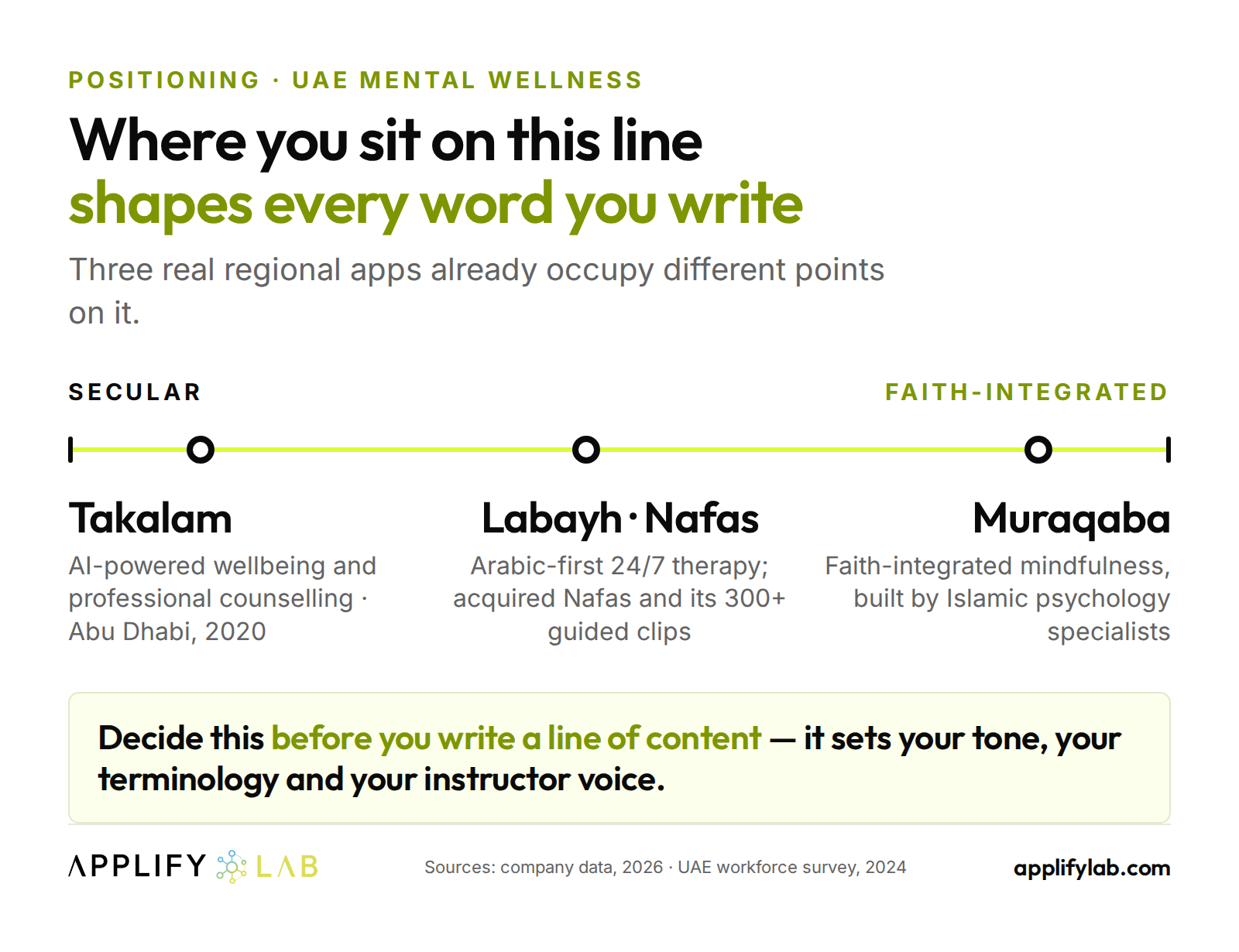
Real regional apps already occupy different points on this line — which is exactly why the choice has to be deliberate.
App | Where it sits | Note |
|---|---|---|
Takalam | Largely secular | AI-powered wellbeing + professional counseling (Abu Dhabi, 2020) |
Labayh / Nafas | Broad, Arabic-first access | 24/7 therapy; acquired the Nafas meditation app (300+ clips) |
Muraqaba | Explicitly Islamic | Faith-integrated mindfulness, built by Islamic psychology specialists |
Real regional apps already occupy different points on this line, and it matters: Takalam positions as a largely secular, AI-powered wellbeing platform with professional counseling; Labayh and Nafas lean into Arabic-first accessibility and broad meditation content; Muraqaba is built explicitly around Islamic psychology and faith-integrated mindfulness. None of these are wrong — they're targeting different users with different comfort levels around how mindfulness/meditation is framed.
Deciding this deliberately, before you write a line of content, shapes your tone, your instructor voice, your terminology, and who actually trusts your app enough to open it daily.
Who's actually using these apps
User group | What they're after |
|---|---|
Corporate professionals | Focus and stress relief that fits a packed schedule |
Young adults & students | Emotional balance, better sleep, focus — digitally native |
Wellness-focused individuals | A complementary tool alongside fitness, yoga, holistic health |
Health-adjacent users | Managing anxiety/sleep/lifestyle stress; value privacy and real results over gimmicks |
Core features
Guided meditation and mindfulness sessions — audio/video content for focus, relaxation, sleep, and stress relief.
Mood tracking and journaling — letting users record feelings and see progress over time.
AI-driven personalization — recommending sessions based on mood, usage patterns, and progress, not a static content library.
Wearable integration — sleep quality, heart rate variability, and stress indicators synced from Apple Health, Google Fit, or fitness trackers, giving users real data on whether the practice is working.
Community or therapist/counselor chat — connecting users with peers or licensed professionals, where relevant to your positioning.
Reminders and habit-building mechanics — daily streaks and prompts, since consistency is what actually drives outcomes in this category.
Localization-specific features that actually matter
Arabic and English audio, not just text — regionally relevant voices and tone, not a generic text-to-speech pass.
Neutral or faith-integrated terminology, chosen deliberately — tied directly to the positioning decision above, not an afterthought.
Customizable session lengths for busy schedules, and content that respects local customs and beliefs throughout, not just in a welcome screen.
Not sure where your app should sit on the secular-to-faith-integrated spectrum?
Tell us your target users and we'll help you think through the positioning decision before it's baked into your content and tone.
Compliance and trust
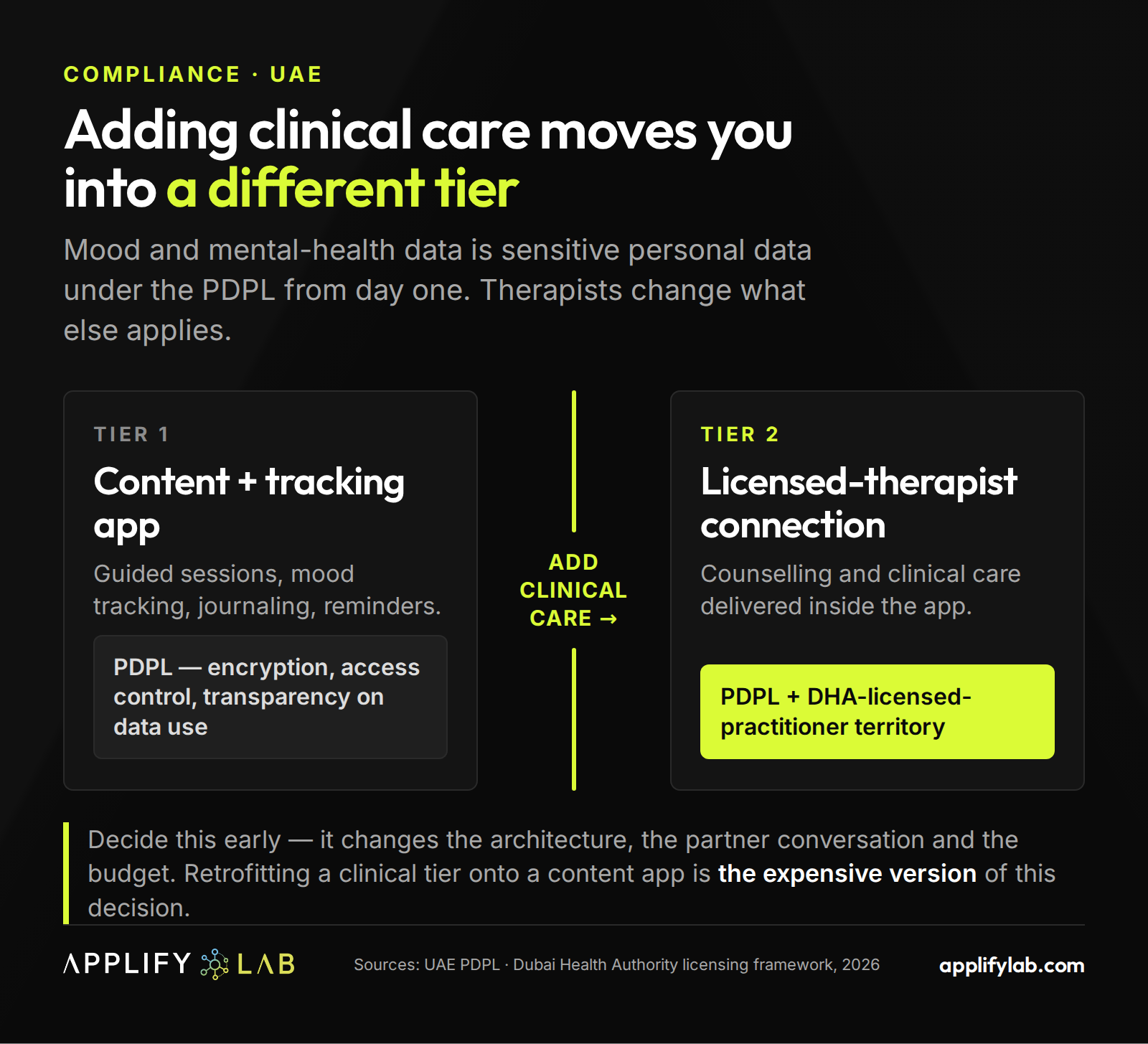
The line that changes your compliance tier is whether you connect users to actual licensed therapists — decide it early, it changes the build.
Mental health and mood data is sensitive personal data under the UAE's PDPL — not a vague "strict privacy laws" reference, but the specific law your architecture needs to satisfy: encryption, access controls, and transparency about data usage.
A pure mindfulness/meditation app (content and tracking, no clinical care) sits at a lighter compliance tier than one offering actual therapy or counseling — the moment you're connecting users with licensed therapists (like Labayh or Takalam do), you're in territory that involves DHA-licensed practitioners and a different regulatory conversation. See our digital health compliance guide if clinical-grade therapy is part of your roadmap.
What it costs
Real 2026 benchmarks, including the cost driver most software-only guides miss:
Basic (guided meditation library, mood tracking, reminders): roughly AED 110,000–294,000.
Mid-tier (AI personalization, wearable integration, community features): roughly AED 294,000–550,000.
Full platform (large produced content library, therapist/counselor connectivity, rivaling established apps):AED 1,100,000–2,200,000+.
Content production is a real, separate cost line. Professionally produced guided audio and video — voice talent, an audio studio, ongoing content refresh — is a distinct budget item beyond the software build, and it scales with how large a content library you're launching with. A smaller, well-produced library beats a large, low-quality one for this category specifically, since trust and voice quality matter more here than raw content volume.
Book a quick conversation with us to explain your project and get a real feedback on the price and scope you should start with.
Monetization
Freemium is the dominant model in this category (roughly 60-65% of the market runs free-tier access), with premium subscriptions unlocking deeper content and personalization. Corporate and enterprise wellness licensing is a genuinely strong UAE-specific angle given the real stress data above — selling into corporate wellness programs can be a faster path to scale than pure consumer acquisition against established regional players.
Ramadan: a seasonal sleep and content layer, not a separate app
Fasting genuinely disrupts sleep — research on Ramadan sleep patterns consistently finds reduced total sleep duration and reduced REM sleep during the fasting month compared to before and after, along with lower sleep efficiency (peer-reviewed sleep research, PMC-indexed studies 2013-2024).
That's real grounding for a seasonal feature: nap-timing guidance and wind-down content tuned to Suhoor/Iftar hours genuinely helps during Ramadan specifically. It also connects naturally to the positioning spectrum this post already covers — short dhikr, reflection, or Quran-recitation content during Ramadan is a real extension of the faith-integrated end of that spectrum (the territory Muraqaba already occupies).
Worth adding as a seasonal mode inside a mental wellness app you're already committed to.
Common mistakes worth avoiding
Treating localization as translation. Apps that don't adapt tone, terminology, and positioning for GCC users struggle with adoption regardless of content quality.
Weak habit-building design. This category lives or dies on consistency — poor reminder/streak UX leads to high churn even with excellent content.
Underestimating privacy expectations. Users are sharing genuinely sensitive emotional data; security shortcuts cost more in lost trust than they save in development time.
Not deciding the positioning question early. Retrofitting tone and terminology after launch is far more expensive than deciding secular-vs-faith-integrated before you write your first piece of content.
Questions worth asking any partner
Have they built habit-forming, content-heavy apps before (not just transactional ones)?
How do they think about the secular-vs-faith-integrated positioning question?
How do they scope content production separately from software development?
Confirm with them that you own 100% of the code once it's built, with no proprietary lock-in.
FAQ
How much does a mental wellness app cost to build in the UAE?
Roughly AED 110,000–294,000 for a basic version, up to AED 1.1M–2.2M+ for a full platform with a large produced content library. Content production (audio/video, voice talent) is a real, separate cost line beyond the software build. At Applify Lab, we usually discuss with you to understand what is your project and what is the most efficient MVP we can start with - to build your app step by step, sprint by sprint.
Is the UAE mental wellness app market still worth entering?
The figures say yes — 89% of surveyed UAE workers report stress and 99% report at least one burnout symptom, a real and large need. But real regional competitors already exist across a range of positioning (secular to explicitly Islamic), so differentiation has to be deliberate, not assumed.
Should our app be secular or faith-integrated?
That's a real product decision — real regional apps sit at different points on this spectrum successfully. Decide it early, since it shapes your tone, terminology, and instructor voice throughout. You can run a proper market research or consult marketing experts for product launch if - it can help you answer this question and take your decision.
Do we need DHA licensing to offer this?
A pure mindfulness/content app generally doesn't need DHA licensing. But the moment you connect users with actual therapists or counselors for clinical care, you're in DHA-licensed-practitioner territory — that's a different regulatory conversation than a meditation/tracking app.
Ready to scope your wellness app?
Book a discovery call — bring your target users and where you're thinking of positioning on the secular-to-faith-integrated spectrum.
Related guides
AI Agents & Apps for UAE Yoga, Meditation & Wellness Studios
Wellness App Development in Dubai: Which Category Should You Build?
Digital Health App Development in UAE: Costs, Features & Compliance
Discover our solutions for founders
89% of UAE workforce survey respondents reported experiencing stress in the past year, and 99% reported at least one burnout symptom — a real, large need.
But it's not an open market either: Takalam, Labayh (which acquired the meditation app Nafas), and the explicitly Islamic app Muraqaba are all real, operating regional competitors.
The real question for a founder building a mental wellness app in Dubai is where your app sits on the secular-to-faith-integrated spectrum, because that's a genuine positioning decision.
Key takeaways
The need is real and large (89% report stress, 99% a burnout symptom) — but it is not an open market; real regional competitors already exist.
The core product decision is where you sit on the secular ↔ faith-integrated spectrum — decide it before you write a line of content.
This category lives on habit-building and trust; localization means adapting tone and terminology, not translating text.
Content production (voice talent, audio/video studio) is a real, separate cost line most software-only guides miss.
Compliance tiers differ: a content/tracking app sits at a lighter PDPL tier; the moment you connect users to licensed therapists, you're in DHA-licensed territory.
Already run a yoga, meditation, or wellness studio, not building fresh?
This post is for building a standalone consumer meditation/mental-wellness app. If you already run a studio or practice with real clients, see our AI agents & apps for UAE yoga, meditation & wellness studios guide instead — it covers adding an AI agent or app feature to reduce no-shows and improve client retention, without rebuilding what you already have.
Your positioning
Real regional apps already occupy different points on this line — which is exactly why the choice has to be deliberate.
App | Where it sits | Note |
|---|---|---|
Takalam | Largely secular | AI-powered wellbeing + professional counseling (Abu Dhabi, 2020) |
Labayh / Nafas | Broad, Arabic-first access | 24/7 therapy; acquired the Nafas meditation app (300+ clips) |
Muraqaba | Explicitly Islamic | Faith-integrated mindfulness, built by Islamic psychology specialists |
Real regional apps already occupy different points on this line, and it matters: Takalam positions as a largely secular, AI-powered wellbeing platform with professional counseling; Labayh and Nafas lean into Arabic-first accessibility and broad meditation content; Muraqaba is built explicitly around Islamic psychology and faith-integrated mindfulness. None of these are wrong — they're targeting different users with different comfort levels around how mindfulness/meditation is framed.
Deciding this deliberately, before you write a line of content, shapes your tone, your instructor voice, your terminology, and who actually trusts your app enough to open it daily.
Who's actually using these apps
User group | What they're after |
|---|---|
Corporate professionals | Focus and stress relief that fits a packed schedule |
Young adults & students | Emotional balance, better sleep, focus — digitally native |
Wellness-focused individuals | A complementary tool alongside fitness, yoga, holistic health |
Health-adjacent users | Managing anxiety/sleep/lifestyle stress; value privacy and real results over gimmicks |
Core features
Guided meditation and mindfulness sessions — audio/video content for focus, relaxation, sleep, and stress relief.
Mood tracking and journaling — letting users record feelings and see progress over time.
AI-driven personalization — recommending sessions based on mood, usage patterns, and progress, not a static content library.
Wearable integration — sleep quality, heart rate variability, and stress indicators synced from Apple Health, Google Fit, or fitness trackers, giving users real data on whether the practice is working.
Community or therapist/counselor chat — connecting users with peers or licensed professionals, where relevant to your positioning.
Reminders and habit-building mechanics — daily streaks and prompts, since consistency is what actually drives outcomes in this category.
Localization-specific features that actually matter
Arabic and English audio, not just text — regionally relevant voices and tone, not a generic text-to-speech pass.
Neutral or faith-integrated terminology, chosen deliberately — tied directly to the positioning decision above, not an afterthought.
Customizable session lengths for busy schedules, and content that respects local customs and beliefs throughout, not just in a welcome screen.
Not sure where your app should sit on the secular-to-faith-integrated spectrum?
Tell us your target users and we'll help you think through the positioning decision before it's baked into your content and tone.
Compliance and trust
The line that changes your compliance tier is whether you connect users to actual licensed therapists — decide it early, it changes the build.
Mental health and mood data is sensitive personal data under the UAE's PDPL — not a vague "strict privacy laws" reference, but the specific law your architecture needs to satisfy: encryption, access controls, and transparency about data usage.
A pure mindfulness/meditation app (content and tracking, no clinical care) sits at a lighter compliance tier than one offering actual therapy or counseling — the moment you're connecting users with licensed therapists (like Labayh or Takalam do), you're in territory that involves DHA-licensed practitioners and a different regulatory conversation. See our digital health compliance guide if clinical-grade therapy is part of your roadmap.
What it costs
Real 2026 benchmarks, including the cost driver most software-only guides miss:
Basic (guided meditation library, mood tracking, reminders): roughly AED 110,000–294,000.
Mid-tier (AI personalization, wearable integration, community features): roughly AED 294,000–550,000.
Full platform (large produced content library, therapist/counselor connectivity, rivaling established apps):AED 1,100,000–2,200,000+.
Content production is a real, separate cost line. Professionally produced guided audio and video — voice talent, an audio studio, ongoing content refresh — is a distinct budget item beyond the software build, and it scales with how large a content library you're launching with. A smaller, well-produced library beats a large, low-quality one for this category specifically, since trust and voice quality matter more here than raw content volume.
Book a quick conversation with us to explain your project and get a real feedback on the price and scope you should start with.
Monetization
Freemium is the dominant model in this category (roughly 60-65% of the market runs free-tier access), with premium subscriptions unlocking deeper content and personalization. Corporate and enterprise wellness licensing is a genuinely strong UAE-specific angle given the real stress data above — selling into corporate wellness programs can be a faster path to scale than pure consumer acquisition against established regional players.
Ramadan: a seasonal sleep and content layer, not a separate app
Fasting genuinely disrupts sleep — research on Ramadan sleep patterns consistently finds reduced total sleep duration and reduced REM sleep during the fasting month compared to before and after, along with lower sleep efficiency (peer-reviewed sleep research, PMC-indexed studies 2013-2024).
That's real grounding for a seasonal feature: nap-timing guidance and wind-down content tuned to Suhoor/Iftar hours genuinely helps during Ramadan specifically. It also connects naturally to the positioning spectrum this post already covers — short dhikr, reflection, or Quran-recitation content during Ramadan is a real extension of the faith-integrated end of that spectrum (the territory Muraqaba already occupies).
Worth adding as a seasonal mode inside a mental wellness app you're already committed to.
Common mistakes worth avoiding
Treating localization as translation. Apps that don't adapt tone, terminology, and positioning for GCC users struggle with adoption regardless of content quality.
Weak habit-building design. This category lives or dies on consistency — poor reminder/streak UX leads to high churn even with excellent content.
Underestimating privacy expectations. Users are sharing genuinely sensitive emotional data; security shortcuts cost more in lost trust than they save in development time.
Not deciding the positioning question early. Retrofitting tone and terminology after launch is far more expensive than deciding secular-vs-faith-integrated before you write your first piece of content.
Questions worth asking any partner
Have they built habit-forming, content-heavy apps before (not just transactional ones)?
How do they think about the secular-vs-faith-integrated positioning question?
How do they scope content production separately from software development?
Confirm with them that you own 100% of the code once it's built, with no proprietary lock-in.
FAQ
How much does a mental wellness app cost to build in the UAE?
Roughly AED 110,000–294,000 for a basic version, up to AED 1.1M–2.2M+ for a full platform with a large produced content library. Content production (audio/video, voice talent) is a real, separate cost line beyond the software build. At Applify Lab, we usually discuss with you to understand what is your project and what is the most efficient MVP we can start with - to build your app step by step, sprint by sprint.
Is the UAE mental wellness app market still worth entering?
The figures say yes — 89% of surveyed UAE workers report stress and 99% report at least one burnout symptom, a real and large need. But real regional competitors already exist across a range of positioning (secular to explicitly Islamic), so differentiation has to be deliberate, not assumed.
Should our app be secular or faith-integrated?
That's a real product decision — real regional apps sit at different points on this spectrum successfully. Decide it early, since it shapes your tone, terminology, and instructor voice throughout. You can run a proper market research or consult marketing experts for product launch if - it can help you answer this question and take your decision.
Do we need DHA licensing to offer this?
A pure mindfulness/content app generally doesn't need DHA licensing. But the moment you connect users with actual therapists or counselors for clinical care, you're in DHA-licensed-practitioner territory — that's a different regulatory conversation than a meditation/tracking app.
Ready to scope your wellness app?
Book a discovery call — bring your target users and where you're thinking of positioning on the secular-to-faith-integrated spectrum.
Related guides
AI Agents & Apps for UAE Yoga, Meditation & Wellness Studios
Wellness App Development in Dubai: Which Category Should You Build?
Digital Health App Development in UAE: Costs, Features & Compliance
Discover our solutions for founders