Retail & E-commerce
Loyalty Program App Development for Ramadan Ecommerce

By
Anh Nguyen, Founder
·
7 min

Ramadan is far more than a seasonal sales bump for UAE ecommerce — it's a $16.4B economy this year, with average order values up roughly 10% and Eid purchases spiking 76% above the yearly average.
Every brand running a Ramadan discount campaign captures a slice of that. The real question for a business that's already running is whether a one-off promotion is all you capture, or whether you walk away from Ramadan with customers who keep buying in May.
That's a loyalty decision, and there are now two real ways to build it: a dedicated loyalty program feature, or an AI agent that runs the retention work for you.
Key takeaways
Ramadan is a retention moment, not just a sales bump: $16.4B economy, ~46% more shopping activity, 48%+ of movement after Iftar, +76% Eid spike.
Discounts get the first sale; loyalty gets the tenth. Loyalty members are ~5x more likely to repurchase and spend ~3.1x more when they redeem. Build tiers in — they see ~1.8x higher ROI.
Three ways to build it: a dedicated loyalty program feature, an AI customer-engagement agent, or both phased — the right one is a diagnosis of your business, not a default.
Ramadan-specific loyalty details matter: reward timing around Iftar/Suhoor, dark mode, bilingual by default, and gamification that rides the existing daily habit.
Build to the UAE's PDPL (GDPR only if you have EU customers). Start prep 2-3 months ahead.
Planning a shopping, marketplace or loyalty app? See how we build e-commerce and retail apps for UAE brands.
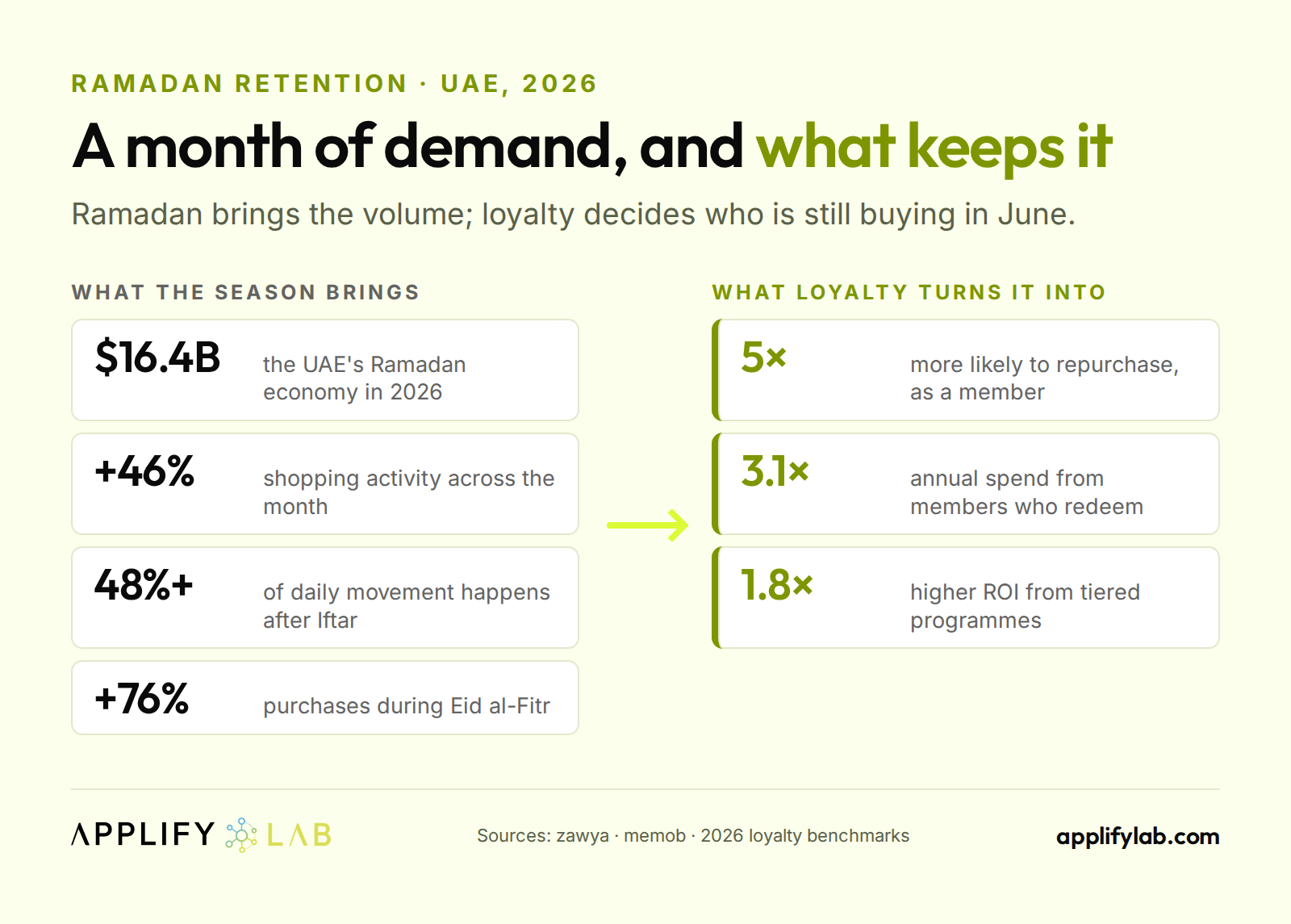
Why Ramadan is the highest-leverage retention moment — and what loyalty converts it into.
Why Ramadan is the highest-leverage moment to invest in retention
The behavioral shift during Ramadan is real and measurable: more than 48% of daily consumer movement in the GCC happens after Iftar during Ramadan, versus 18-22% on a normal day — shopping activity overall rises roughly 46%, concentrated into those night hours.
That's exactly the kind of concentrated, repeat-heavy behavior loyalty mechanics are built for: loyalty members are roughly 5x more likely to repurchase and 4x more likely to refer others, and members who actually redeem rewards spend about 3.1x more annually.
Ramadan brings more shoppers, and it also brings the specific behavior (frequent, nighttime, routine-driven purchasing) that a loyalty mechanism turns from a one-time Ramadan discount-hunter into a repeat customer.
Discounts get the first sale. Loyalty gets the tenth.
Combine both rather than choosing — Ramadan promotions are genuinely effective at pulling in first-time and lapsed customers, and they're well worth running.
A discount alone fades once the campaign ends; a loyalty mechanism (points, tiers, rewards that carry into Eid and beyond) is what determines whether those customers are still buying from you in June.
Tiered programs specifically see roughly 1.8x higher ROI than flat, non-tiered ones — worth building tiers in from the start rather than a single flat point system.
Two ways to actually build this — a loyalty app, an AI retention agent, or both
This is the decision that actually matters, and it's more layered than it first looks.
Our own approach here is to diagnose your business, your model, and your actual retention gap before proposing either — a German-engineered discipline, in the sense of precise, no-waste scoping: we build only the loyalty-app features you'll use, and configure an AI agent only for the problems you actually have.
The options below are the two real paths; which one (or which combination) fits is a diagnosis:
A dedicated loyalty program feature — points, tiers, a rewards dashboard, Ramadan-specific timing (bonus points around Iftar/Suhoor, pre-Eid campaigns), and (if you run physical stores too) POS-to-app sync so rewards work the same whether someone shops online or in person. This is the bigger, more permanent investment, and it's the right one if loyalty and repeat engagement are core to your brand long-term, beyond a single Ramadan tactic.
An AI customer-engagement agent — a service we build that welcomes, answers, and follows up with customers on WhatsApp, Instagram, email, and web, in Arabic and English, 24/7. It can specifically handle abandoned-cart recovery and re-order reminders — the same retention job a loyalty app's push notifications do, run conversationally instead. Pricing depends on which channels and how much conversation volume you need, scoped on a call rather than a fixed number here. It's a genuinely lighter, faster way to capture much of the same Ramadan retention value if a full loyalty app is more than you need yet.
Both together, phased rather than all at once. If you already have (or are building) a loyalty program, an AI agent can run inside that relationship — proactively messaging members about points and expiring rewards, answering redemption questions instantly instead of making someone dig through an app, and re-engaging lapsed Ramadan shoppers after Eid without anyone on your team having to do it manually. We typically plan this as a priority-first roadmap: build and ship whichever piece earns its cost fastest for your specific business first, then extend into the rest over subsequent phases, planned as phases rather than a single big-bang build that tries to do everything on day one.
The three paths at a glance
Path | Best when | What it does |
|---|---|---|
Loyalty program feature | Loyalty is a long-term brand priority | Points, tiers, rewards dashboard, Ramadan timing, POS-to-app sync |
AI engagement agent | You want retention value faster and lighter this Ramadan | Conversational welcome/answer/follow-up in AR/EN, 24/7, cart recovery + re-order nudges |
Both, phased | You have (or are building) a program and want it worked proactively | Agent runs inside the loyalty relationship; build the highest-ROI piece first, extend later |
Unsure which of these fits your business right now?
Tell us whether you're building fresh or already have a loyalty program in place, and we'll help you work out whether a full feature build, an AI engagement agent, or both makes sense for this Ramadan.

The decision that actually matters — a loyalty feature, an AI agent, or both, matched to your business by diagnosis.
What actually matters if you build the loyalty app route
Skip the generic feature list — these are the details that are genuinely Ramadan- and UAE-specific:
Reward timing tied to real routine. Bonus points around Iftar and Suhoor hours, and dedicated pre-Eid campaigns, match when your customers are actually active rather than running on a flat 24-hour cycle.
Dark mode is functional here, well beyond a nice-to-have. With the bulk of activity happening after Iftar and before dawn, a dark, low-glare interface is a genuine usability point.
Bilingual by default, built in from the start. Arabic and English across the whole app — redemption flows, notifications, and support included, beyond the homepage.
Gamification that fits the routine. Daily check-ins or streaks work specifically because Ramadan already creates a daily app-opening habit (checking prayer/Iftar times, browsing before Suhoor) — the mechanic rides behavior that's already happening rather than trying to create it from nothing.
Cost: why we won't give you a fixed number here, on purpose
A loyalty feature added to an existing ecommerce app is typically a smaller scope than a full app build — see our full cost breakdown for the general ranges by build type, since a loyalty module scales with the same drivers (backend complexity, integrations). An AI customer-engagement agent is priced differently, based on which channels and how much conversation volume you actually need.
That "it depends" is the point rather than a dodge. A fixed, off-the-shelf price for either option means one of two things: you're paying for features you won't use, or you're getting a build scoped for a business that isn't quite yours.
We diagnose the actual need first — your model, your existing setup, your realistic Ramadan volume — and propose what earns the highest ROI for that specific business, then plan the rest as a phased roadmap rather than trying to sell you everything on day one.
FAQ
Is a loyalty program better than Ramadan discounts?
They do different jobs — discounts bring in first-time and lapsed customers; loyalty mechanics are what keep them buying after Ramadan ends. Loyalty program members are roughly 5x more likely to repurchase, which discounts alone don't achieve.
Should I build a full loyalty app feature or start with an AI agent?
Depends on whether loyalty is a long-term brand priority (build the feature) or whether you want a faster, lighter way to capture retention value this Ramadan specifically (an AI engagement agent, especially its abandoned-cart recovery and re-order reminders). They work well together — many businesses use both.
What does an AI customer-engagement agent cost?
It depends on how many channels and how much conversation volume you actually need — and deliberately so. A single published price would mean selling every business the same configuration whether they need it or not; we scope it to your actual retention gap instead, which is also why we build only the features you'll use.
Does a UAE loyalty app need to comply with GDPR?
Only if you have EU customers. The primary regulation to build around is the UAE's PDPL (Personal Data Protection Law) — a distinction worth getting right, since GDPR and PDPL aren't the same thing despite often being lumped together in generic guides.
How early should I start preparing for next Ramadan?
2-3 months ahead for development, testing, and campaign planning — later than that and you're launching mid-season rather than ready for the after-Iftar surge from day one.
To go further, Discover our AI Agents solutions
Ramadan is far more than a seasonal sales bump for UAE ecommerce — it's a $16.4B economy this year, with average order values up roughly 10% and Eid purchases spiking 76% above the yearly average.
Every brand running a Ramadan discount campaign captures a slice of that. The real question for a business that's already running is whether a one-off promotion is all you capture, or whether you walk away from Ramadan with customers who keep buying in May.
That's a loyalty decision, and there are now two real ways to build it: a dedicated loyalty program feature, or an AI agent that runs the retention work for you.
Key takeaways
Ramadan is a retention moment, not just a sales bump: $16.4B economy, ~46% more shopping activity, 48%+ of movement after Iftar, +76% Eid spike.
Discounts get the first sale; loyalty gets the tenth. Loyalty members are ~5x more likely to repurchase and spend ~3.1x more when they redeem. Build tiers in — they see ~1.8x higher ROI.
Three ways to build it: a dedicated loyalty program feature, an AI customer-engagement agent, or both phased — the right one is a diagnosis of your business, not a default.
Ramadan-specific loyalty details matter: reward timing around Iftar/Suhoor, dark mode, bilingual by default, and gamification that rides the existing daily habit.
Build to the UAE's PDPL (GDPR only if you have EU customers). Start prep 2-3 months ahead.
Planning a shopping, marketplace or loyalty app? See how we build e-commerce and retail apps for UAE brands.
Why Ramadan is the highest-leverage retention moment — and what loyalty converts it into.
Why Ramadan is the highest-leverage moment to invest in retention
The behavioral shift during Ramadan is real and measurable: more than 48% of daily consumer movement in the GCC happens after Iftar during Ramadan, versus 18-22% on a normal day — shopping activity overall rises roughly 46%, concentrated into those night hours.
That's exactly the kind of concentrated, repeat-heavy behavior loyalty mechanics are built for: loyalty members are roughly 5x more likely to repurchase and 4x more likely to refer others, and members who actually redeem rewards spend about 3.1x more annually.
Ramadan brings more shoppers, and it also brings the specific behavior (frequent, nighttime, routine-driven purchasing) that a loyalty mechanism turns from a one-time Ramadan discount-hunter into a repeat customer.
Discounts get the first sale. Loyalty gets the tenth.
Combine both rather than choosing — Ramadan promotions are genuinely effective at pulling in first-time and lapsed customers, and they're well worth running.
A discount alone fades once the campaign ends; a loyalty mechanism (points, tiers, rewards that carry into Eid and beyond) is what determines whether those customers are still buying from you in June.
Tiered programs specifically see roughly 1.8x higher ROI than flat, non-tiered ones — worth building tiers in from the start rather than a single flat point system.
Two ways to actually build this — a loyalty app, an AI retention agent, or both
This is the decision that actually matters, and it's more layered than it first looks.
Our own approach here is to diagnose your business, your model, and your actual retention gap before proposing either — a German-engineered discipline, in the sense of precise, no-waste scoping: we build only the loyalty-app features you'll use, and configure an AI agent only for the problems you actually have.
The options below are the two real paths; which one (or which combination) fits is a diagnosis:
A dedicated loyalty program feature — points, tiers, a rewards dashboard, Ramadan-specific timing (bonus points around Iftar/Suhoor, pre-Eid campaigns), and (if you run physical stores too) POS-to-app sync so rewards work the same whether someone shops online or in person. This is the bigger, more permanent investment, and it's the right one if loyalty and repeat engagement are core to your brand long-term, beyond a single Ramadan tactic.
An AI customer-engagement agent — a service we build that welcomes, answers, and follows up with customers on WhatsApp, Instagram, email, and web, in Arabic and English, 24/7. It can specifically handle abandoned-cart recovery and re-order reminders — the same retention job a loyalty app's push notifications do, run conversationally instead. Pricing depends on which channels and how much conversation volume you need, scoped on a call rather than a fixed number here. It's a genuinely lighter, faster way to capture much of the same Ramadan retention value if a full loyalty app is more than you need yet.
Both together, phased rather than all at once. If you already have (or are building) a loyalty program, an AI agent can run inside that relationship — proactively messaging members about points and expiring rewards, answering redemption questions instantly instead of making someone dig through an app, and re-engaging lapsed Ramadan shoppers after Eid without anyone on your team having to do it manually. We typically plan this as a priority-first roadmap: build and ship whichever piece earns its cost fastest for your specific business first, then extend into the rest over subsequent phases, planned as phases rather than a single big-bang build that tries to do everything on day one.
The three paths at a glance
Path | Best when | What it does |
|---|---|---|
Loyalty program feature | Loyalty is a long-term brand priority | Points, tiers, rewards dashboard, Ramadan timing, POS-to-app sync |
AI engagement agent | You want retention value faster and lighter this Ramadan | Conversational welcome/answer/follow-up in AR/EN, 24/7, cart recovery + re-order nudges |
Both, phased | You have (or are building) a program and want it worked proactively | Agent runs inside the loyalty relationship; build the highest-ROI piece first, extend later |
Unsure which of these fits your business right now?
Tell us whether you're building fresh or already have a loyalty program in place, and we'll help you work out whether a full feature build, an AI engagement agent, or both makes sense for this Ramadan.
The decision that actually matters — a loyalty feature, an AI agent, or both, matched to your business by diagnosis.
What actually matters if you build the loyalty app route
Skip the generic feature list — these are the details that are genuinely Ramadan- and UAE-specific:
Reward timing tied to real routine. Bonus points around Iftar and Suhoor hours, and dedicated pre-Eid campaigns, match when your customers are actually active rather than running on a flat 24-hour cycle.
Dark mode is functional here, well beyond a nice-to-have. With the bulk of activity happening after Iftar and before dawn, a dark, low-glare interface is a genuine usability point.
Bilingual by default, built in from the start. Arabic and English across the whole app — redemption flows, notifications, and support included, beyond the homepage.
Gamification that fits the routine. Daily check-ins or streaks work specifically because Ramadan already creates a daily app-opening habit (checking prayer/Iftar times, browsing before Suhoor) — the mechanic rides behavior that's already happening rather than trying to create it from nothing.
Cost: why we won't give you a fixed number here, on purpose
A loyalty feature added to an existing ecommerce app is typically a smaller scope than a full app build — see our full cost breakdown for the general ranges by build type, since a loyalty module scales with the same drivers (backend complexity, integrations). An AI customer-engagement agent is priced differently, based on which channels and how much conversation volume you actually need.
That "it depends" is the point rather than a dodge. A fixed, off-the-shelf price for either option means one of two things: you're paying for features you won't use, or you're getting a build scoped for a business that isn't quite yours.
We diagnose the actual need first — your model, your existing setup, your realistic Ramadan volume — and propose what earns the highest ROI for that specific business, then plan the rest as a phased roadmap rather than trying to sell you everything on day one.
FAQ
Is a loyalty program better than Ramadan discounts?
They do different jobs — discounts bring in first-time and lapsed customers; loyalty mechanics are what keep them buying after Ramadan ends. Loyalty program members are roughly 5x more likely to repurchase, which discounts alone don't achieve.
Should I build a full loyalty app feature or start with an AI agent?
Depends on whether loyalty is a long-term brand priority (build the feature) or whether you want a faster, lighter way to capture retention value this Ramadan specifically (an AI engagement agent, especially its abandoned-cart recovery and re-order reminders). They work well together — many businesses use both.
What does an AI customer-engagement agent cost?
It depends on how many channels and how much conversation volume you actually need — and deliberately so. A single published price would mean selling every business the same configuration whether they need it or not; we scope it to your actual retention gap instead, which is also why we build only the features you'll use.
Does a UAE loyalty app need to comply with GDPR?
Only if you have EU customers. The primary regulation to build around is the UAE's PDPL (Personal Data Protection Law) — a distinction worth getting right, since GDPR and PDPL aren't the same thing despite often being lumped together in generic guides.
How early should I start preparing for next Ramadan?
2-3 months ahead for development, testing, and campaign planning — later than that and you're launching mid-season rather than ready for the after-Iftar surge from day one.
To go further, Discover our AI Agents solutions
Ready to scope this for your specific business?
Bring your current setup (loyalty program, POS, existing app) and we'll map out what's actually worth building this Ramadan.


