Hospital Management App Development in Dubai: Complete Breakdown
NABIDH integration isn't optional for a Dubai hospital — it's a condition of holding your DHA license, with no exemption by size, under a 2026 mandate that applies the same obligation to a single-doctor clinic and a 600-bed hospital.
Major UAE hospital groups (Mediclinic Middle East, Al Zahra Hospital Dubai, Medcare) are already running unified systems like InterSystems TrakCare. And the real cost of a compliant, multi-module hospital system is materially higher than most guides state — realistically AED 110,000 for a narrow single-facility system up to AED 2.5M+ for a full enterprise platform, not the $40K-350K range you'll see quoted elsewhere.
Key takeaways
NABIDH integration is mandatory for every DHA-licensed facility — no size exemption. Non-compliance risks fines, operational suspension, and license non-renewal.
What's actually running at scale here is InterSystems TrakCare (Mediclinic, Al Zahra, Medcare) — that's what "compliant and interoperable" looks like in practice.
The decision most guides skip: build custom vs license an established, already-NABIDH-integrated platform — usually license the core clinical system, build custom only on top.
Real cost: AED 110k (narrow) → AED 2.5M+ (full enterprise); a 150-bed hospital's median first-year cost was ~$687k. Figures far below this mean a narrower scope.
Timeline reality: NABIDH integration alone can take 12-18 months for a large hospital — plan around it, not just the build.
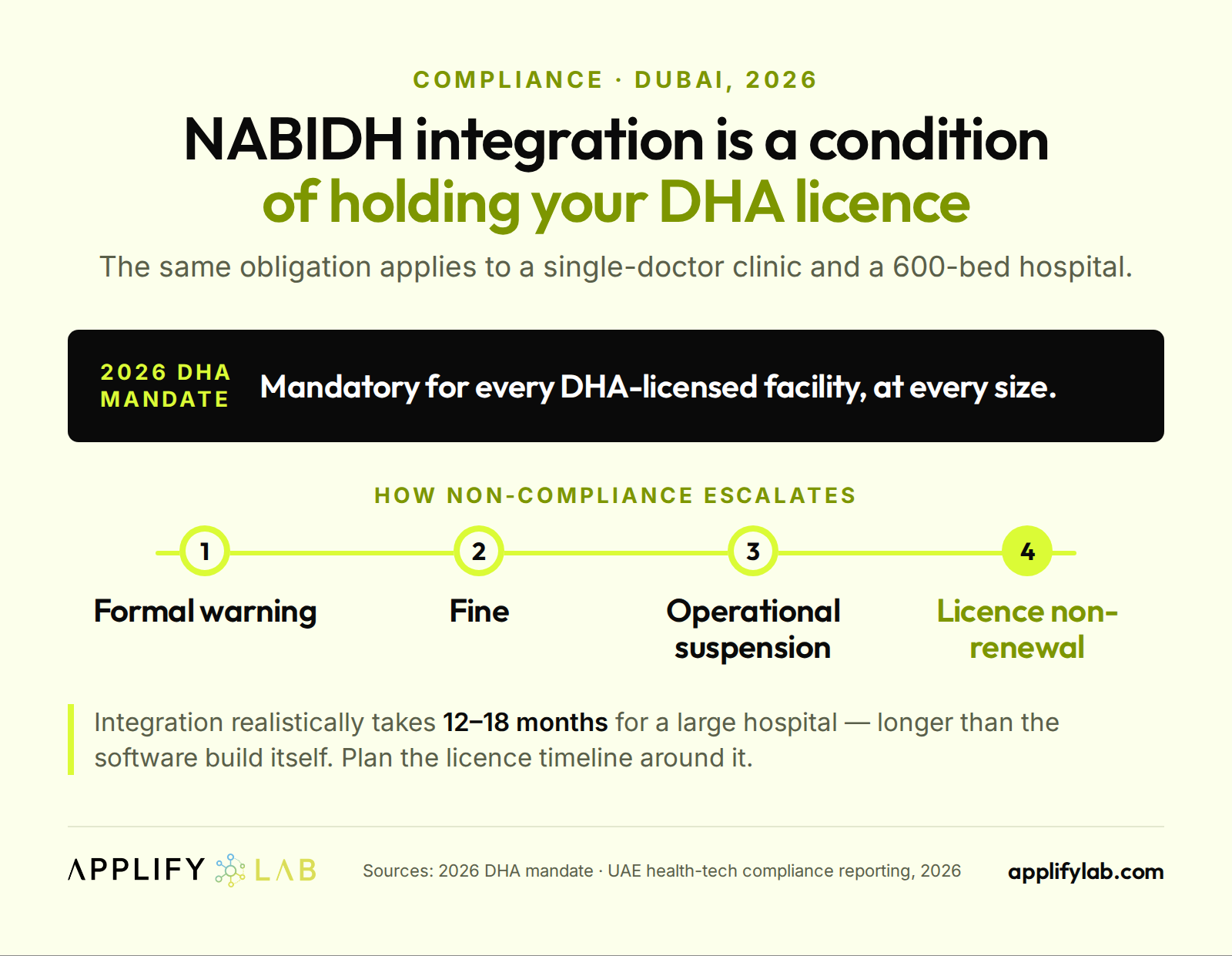
No exemption by size, and the penalties escalate to a lost license — which is why this decision starts with compliance, not features.
What UAE hospitals are actually running
InterSystems TrakCare is the real, verifiable pattern among major UAE private hospital groups: Mediclinic Middle East is deploying it across its UAE hospitals and clinics, Al Zahra Hospital Dubai selected it as its EMR platform (hosted in the UAE), Medcare is rolling it out across 4 hospitals and 16 medical centers, and Mediclinic Welcare Hospital has implemented it as well.
This matters for your own decision — it tells you what "compliant and interoperable" actually looks like at scale in this market, not just in theory.
Should you build custom, or license an established platform?
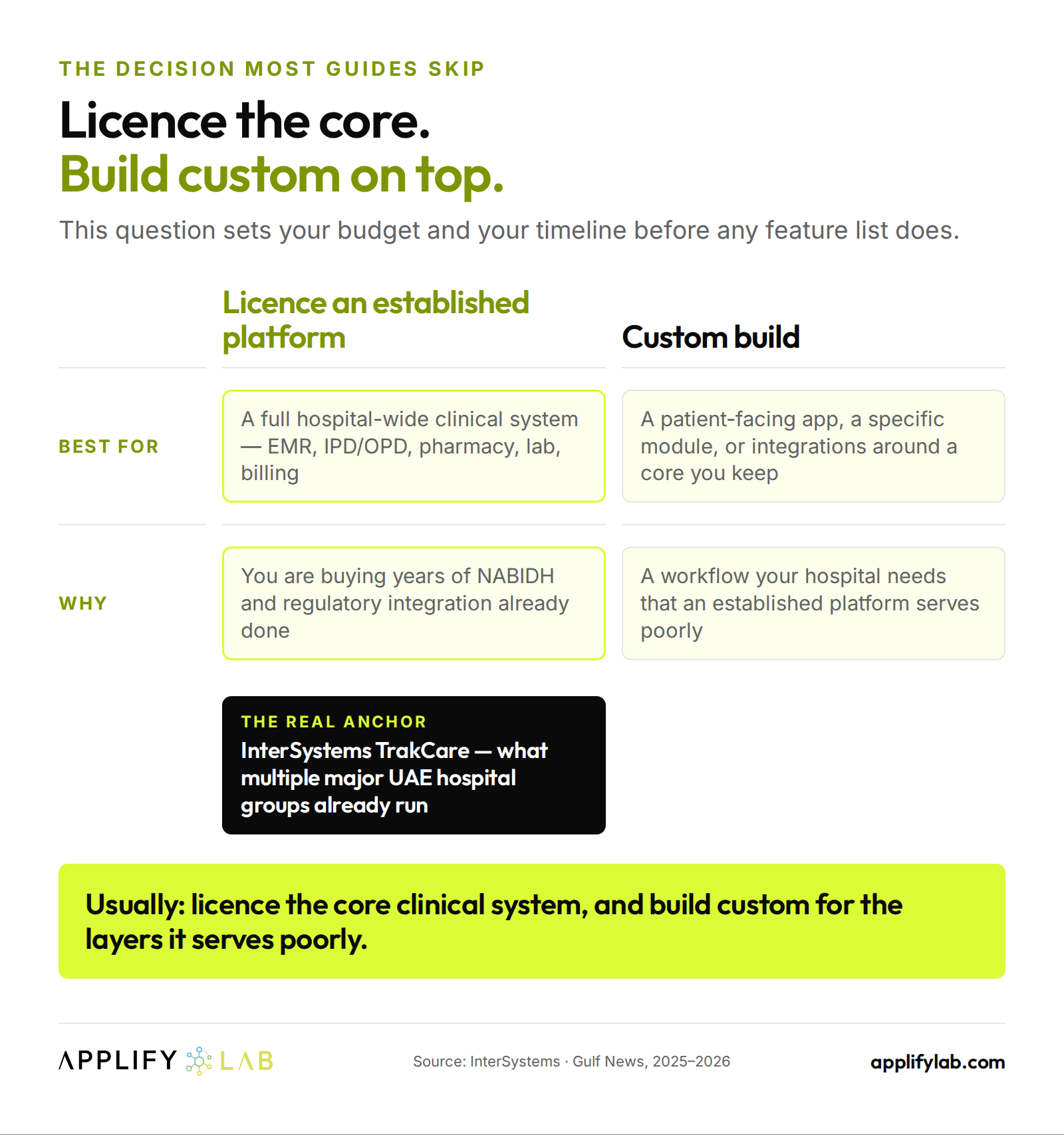
Usually: license the core clinical system, build custom only for the layers an established platform can't serve.
License an established platform | Custom build | |
|---|---|---|
Best for | A full hospital-wide clinical system (EMR, IPD/OPD, pharmacy, lab, billing) | A patient-facing app, a specific module, or integrations around a core you keep |
Why | You're buying years of NABIDH/regulatory integration already done | A workflow your hospital needs that an established platform doesn't serve well |
This is the question most guides skip, and it's the one that actually determines your budget and timeline. For a full hospital-wide clinical system — EMR, IPD/OPD, pharmacy, lab, billing — licensing an established, already NABIDH-integrated platform (like TrakCare, which multiple UAE hospital groups already run on) is very often the pragmatic choice over building one from scratch. You're not just buying software; you're buying years of regulatory integration work already done.
Custom development makes more sense in a few specific situations:
a patient-facing app layered on top of your existing HMS,
a module or workflow your specific hospital needs that an established platform doesn't serve well,
or integrating a broader digital ecosystem (appointment app, AI-driven patient engagement, a specific specialty workflow) around a core system you're keeping.
We'd rather tell you honestly which of these is your actual situation than sell you a full custom build when licensing gets you compliant faster and cheaper — that diagnosis is the first real conversation.
A six or seven-figure decision deserves more than a quick quote
Bring your current systems (if any), bed count, and department scope, and we'll help you work out whether you need a custom build, a licensed platform, or a hybrid. Book a discovery call
Core modules
Patient registration & OPD — digital registration, appointment scheduling, queue management, demographics and history.
Inpatient (IPD) management — bed/ward allocation, admission-transfer-discharge (ADT), ICU and specialty unit coordination.
EMR/EHR — doctor notes, diagnoses, lab results, imaging reports, treatment plans, prescriptions, and interoperability with NABIDH/Malaffi.
Doctor & staff management — scheduling, shift management, credential/license tracking, role-based access.
Pharmacy — e-prescriptions, drug inventory, expiry/batch tracking, drug interaction alerts.
Laboratory & diagnostics — test ordering and tracking, automated result uploads, equipment integration.
Billing & insurance — automated billing, insurance claim processing, coding compliance, payment gateway integration.
Inventory & asset management — medical supply tracking, procurement, asset lifecycle, stock forecasting.
Reporting & analytics — operational dashboards, financial reports, clinical KPIs, compliance/audit reports.
Not every hospital needs all nine on day one — see the cost section below for why prioritizing matters as much as the module list itself.
Compliance: higher stakes than a standalone clinic app
Everything in our digital health compliance guide applies here, plus real hospital-specific stakes: NABIDH (Dubai) or Malaffi (Abu Dhabi) integration is mandatory for a facility license — not conditional the way it can be for a lighter consumer app — under a 2026 DHA mandate with no size exemption.
Non-compliance carries real penalties: formal warnings, fines, operational suspension, and license non-renewal. Implementation realistically takes 12-18 months for a large hospital, materially longer than the software build itself — plan your license and integration timeline around this, not just your development timeline.
What it actually costs
Real 2026 benchmarks, not the lowball figures common in generic guides:
Basic, single-facility (3-4 modules — registration, scheduling, billing, basic reporting): roughly AED 110,000–294,000.
Standard (6-7 modules, mobile apps, HL7 integration): roughly AED 294,000–734,000.
Full system (all core modules, FHIR R4, multiple HL7/NABIDH interfaces): roughly AED 1,762,000–2,753,000.
Enterprise, AI-assisted (predictive analytics, population health, multi-hospital network): AED 2,570,000–4,040,000+.
For context: the median total first-year cost for a 150-bed hospital HMS deployment (engineering, licensing, implementation, compliance) was $687,000 (~AED 2.5M). Legacy data migration typically adds AED 73,000–294,000 separately, and each additional system integration (an external lab system, a second EHR) adds roughly AED 110,000–294,000.
The width of this range is the build-vs-license question above, plus how many modules you actually need first. We scope to your specific department priorities and existing systems rather than pricing a generic 9-module build — start with whichever module earns its cost fastest (usually registration/OPD or billing), then extend in phases, rather than a single all-at-once rollout.
Timelines
Basic HMS: 4-6 months.
Full-scale hospital platform: 9-15 months. NABIDH integration specifically can extend this — plan for 12-18 months if you're a large facility integrating for the first time, independent of how long the software itself takes to build.
Choosing a partner for this
Ask directly:
Have they implemented NABIDH or Malaffi integration before?
Do they know when to recommend a licensed platform over a custom build?
How do they price a phased rollout versus a single fixed number?
Confirm with any partner that you own 100% of the code on anything custom-built, with no proprietary lock-in — since it varies.
FAQ
Is NABIDH integration really mandatory for every hospital?
Yes — it's a condition of holding a DHA facility license, with no exemption by size, under a 2026 mandate. Non-compliance risks warnings, fines, operational suspension, or license non-renewal.
Should we build a custom hospital management system or license an established one?
For a full clinical system, licensing an established, already NABIDH-integrated platform is often the pragmatic choice — several major UAE hospital groups run InterSystems TrakCare for exactly this reason. Custom development fits better for a specific module, a patient-facing layer on top, or a workflow an established platform doesn't serve well.
How much does a hospital management system actually cost?
Realistically AED 110,000 for a narrow single-facility system up to AED 2.5M+ for a full enterprise platform with AI-assisted analytics — a 150-bed hospital's median first-year cost was $687,000 (~AED 2.5M) in recent benchmarking. Figures well below this range usually mean a narrower scope than a full compliant system.
How long does implementation take?
4-6 months for a basic system, 9-15 months for a full platform — but NABIDH integration alone can take 12-18 months for a large hospital, independent of the software build timeline.
What modules should we build first?
Registration/OPD and billing typically earn their cost fastest and are the most common starting point — a phased rollout prioritized by your actual operational pain point, not a flat nine-module build, is usually the right approach.