Fitness Tracking App Development in UAE with Wearables (2026)
The UAE has the world's highest smartwatch adoption rate — 33.4% of the population aged 16-64 — and wearable use among Dubai's fitness participants jumped from 18% to 30% since 2020. That's a real, large, and growing base of users ready to sync data into a fitness app. The market is real but already contested: ClassPass, GymNation, and Fittpass are all operating UAE fitness businesses already competing for these users. The real question is what makes your app worth building against that, and getting the compliance question right — which, despite what you'll read elsewhere, is the UAE's PDPL rather than HIPAA.
Key takeaways
The demand is real and wearable-driven. 33.4% smartwatch adoption (world's highest); Dubai fitness wearable use up from 18% to 30% since 2020; UAE wearable revenue ~$1.08B (2024) → ~$2.57B (2030).
The market is competitive, not open. ClassPass, GymNation, and Fittpass already operate here — all booking/marketplace models, which leaves room for a differentiated, tracking-first product.
Build wearable integrations in priority order. Apple HealthKit, Google Fit, and Fitbit SDK first; each extra platform is ~AED 18k-55k, so prioritize by what your users actually own.
It's PDPL, not HIPAA. HIPAA is a US regulation and doesn't bind you here — build to the UAE PDPL (encryption, access controls, audit trails) for health-adjacent data.
Cost tracks ambition: ~AED 73k-183k basic, ~AED 183k-400k mid-tier, AED 400k-900k+ advanced with AI coaching and multiple ecosystems.
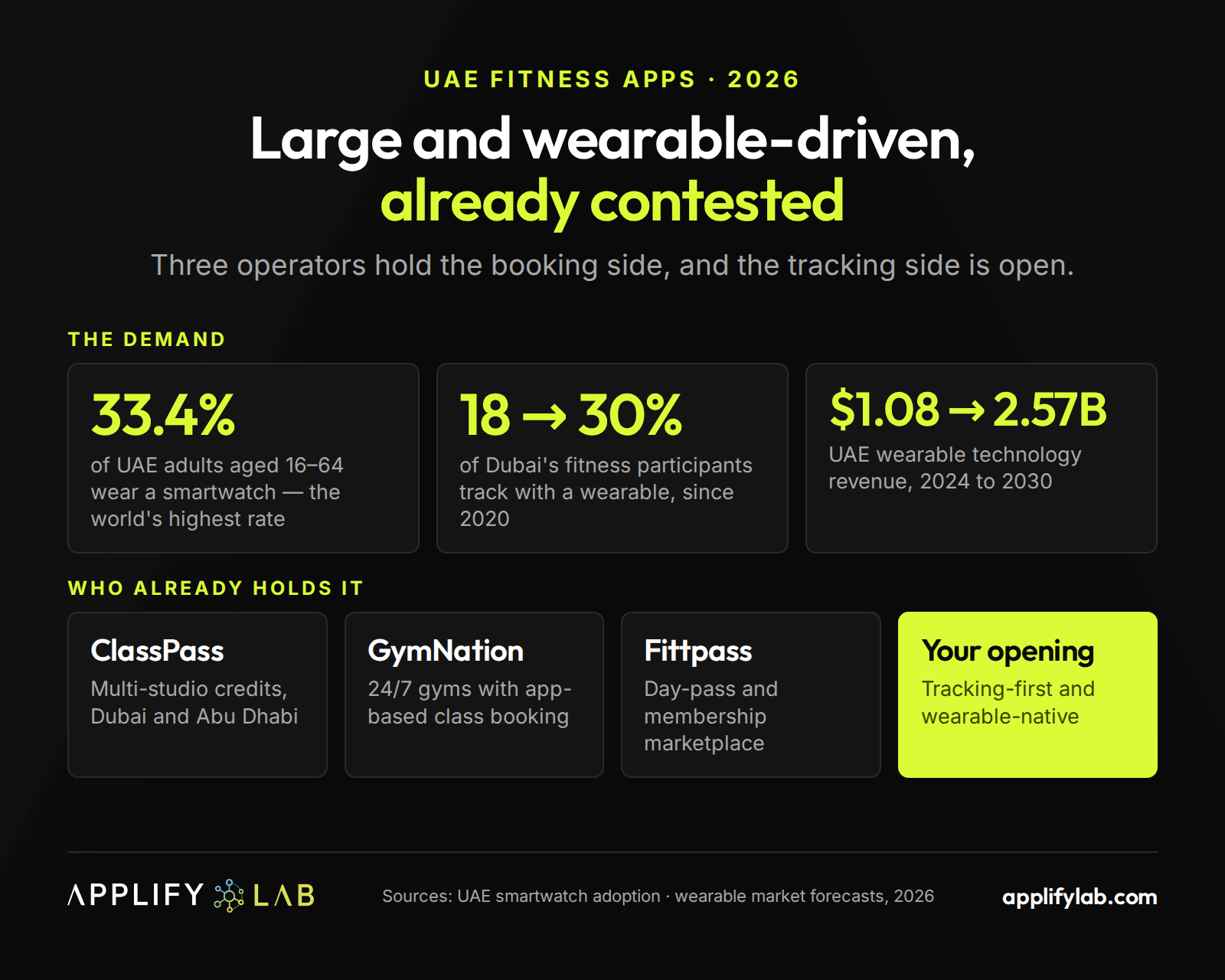
A large, wearable-driven market — and an already-competitive one.
The market is real, and already competitive
Wearable revenue in the UAE is forecast to grow from ~$1.08B (2024) to ~$2.57B by 2030, and the fitness app category globally is growing at 17.6% CAGR.
That growth is exactly why real players are already here: ClassPass runs a multi-studio credits model with real Dubai and Abu Dhabi presence, GymNation offers 24/7 gyms with app-based booking, and Fittpass runs a day-pass/membership marketplace.
Each of them is a booking or marketplace model rather than a pure tracking-and-wearables app — which is where a genuinely differentiated tracking-first product still has real room, built well rather than as a generic feature checklist.
Who's already here, and where the gap is
Player | Model | Where the room is |
|---|---|---|
ClassPass | Multi-studio credits (Dubai/Abu Dhabi) | Booking-first, not tracking-first |
GymNation | 24/7 gyms + app-based class booking | Gym-tied; wearable tracking is secondary |
Fittpass | Day-pass / membership marketplace | Marketplace, not a personal tracking product |
Your opening | Tracking-first, wearable-native | A differentiated, well-built tracker still has room |
Core features
Personalized workout plans — tailored to goals, fitness level, and preferences.
Real-time health metrics — steps, calories, heart rate, sleep, synced automatically from wearables.
Goal setting and progress dashboards — visual tracking over time, beyond a daily snapshot.
Social and community features — challenges, shared achievements, connecting with other users.
Trainer dashboards and admin panels — for gyms or studios building beyond individual consumers.
Video-based and live workout sessions — for home fitness and digital coaching use cases specifically.
Reminders and habit-building mechanics — this category lives on consistency, and repeat engagement is the whole game.
Who's actually using these apps
Gym members and studio users — workout plans, trainer interaction, performance tracking.
Home fitness and digital coaching users — on-demand and live sessions, personalized programs.
Corporate wellness participants — enrolled through employer-sponsored programs, a genuinely strong UAE-specific channel given how much large enterprises here invest in wellness benefits.
Health-adjacent users — managing weight, mobility, rehabilitation, or lifestyle conditions, who value data accuracy and privacy over gamification.
Wearable integration: what to prioritize
Build for Apple HealthKit, Google Fit, and Fitbit SDK first — these cover the large majority of consumer wearable data globally, and each additional platform beyond your first is its own integration to budget for (typically AED 18,000–55,000 each).
Prioritize based on which devices your actual target users own rather than building broad compatibility speculatively.
Unsure which wearable integrations your MVP actually needs?
Tell us your target users and we'll help you prioritize which device ecosystems are worth building for first.
When fitness data becomes health data — and what that actually requires
As fitness apps collect more than step counts — heart rate, sleep, stress indicators, chronic-condition-related insights — the logic that security needs to scale up holds. Where a lot of generic guides get this wrong for a UAE audience: they point to HIPAA, a US regulation, as the relevant standard.
The binding law for UAE health-adjacent data is the PDPL, and that's what your architecture needs to satisfy: encryption at rest and in transit, secure authentication, role-based access, and audit trails.
If your app is genuinely integrating with healthcare providers or handling clinical data, see our digital health compliance guide for the fuller DHA/MOHAP/PDPL picture — most fitness-tracking apps stay below that level, and the security substance still matters regardless.
Ramadan: a seasonal feature worth planning for, not a separate app
UAE fitness apps see a real behavior shift during Ramadan — training windows compress into the hours around Iftar, and energy management becomes the actual design problem. GymNation's own published UAE guidance: light activity is safest in the hour before Iftar, while higher-intensity training is best delayed to at least three hours after Iftar, once the body has refueled and rehydrated (gymnation.com, "Ramadan Exercise Timing"). Building a Ramadan-adjusted workout schedule and energy-aware training suggestions into your app for a few weeks a year is a legitimate feature to plan for. A standalone "Ramadan fitness app" rarely works, though — the retention math falls apart for a product that's only differentiated one month in twelve, which is exactly why we didn't ship a separate post for that idea.
Fitness apps that scale often become wellness platforms
A pattern worth planning for from the start: successful fitness apps frequently expand into mental wellness and stress management, nutrition and diet tracking, and sleep/recovery insights — turning a single-purpose tracker into a full lifestyle platform with higher retention and lifetime value. If that's part of your roadmap, our nutrition app guide and mental wellness app guide cover those specific builds in depth rather than repeating them here — worth reading before you scope a "fitness app" that's really planning to become three products.
What it costs
Real 2026 benchmarks, presented as tiers rather than a single flat range:
Basic (step/calorie tracking, single wearable integration, simple UI): roughly AED 73,000–183,000.
Mid-tier (personalized plans, multi-wearable sync, social/community features): roughly AED 183,000–400,000.
Advanced (AI-driven coaching, predictive insights, multiple wearable ecosystems): AED 400,000–900,000+.
Each additional wearable platform beyond your first adds roughly AED 18,000–55,000 — worth scoping deliberately rather than building broad compatibility you don't need yet.
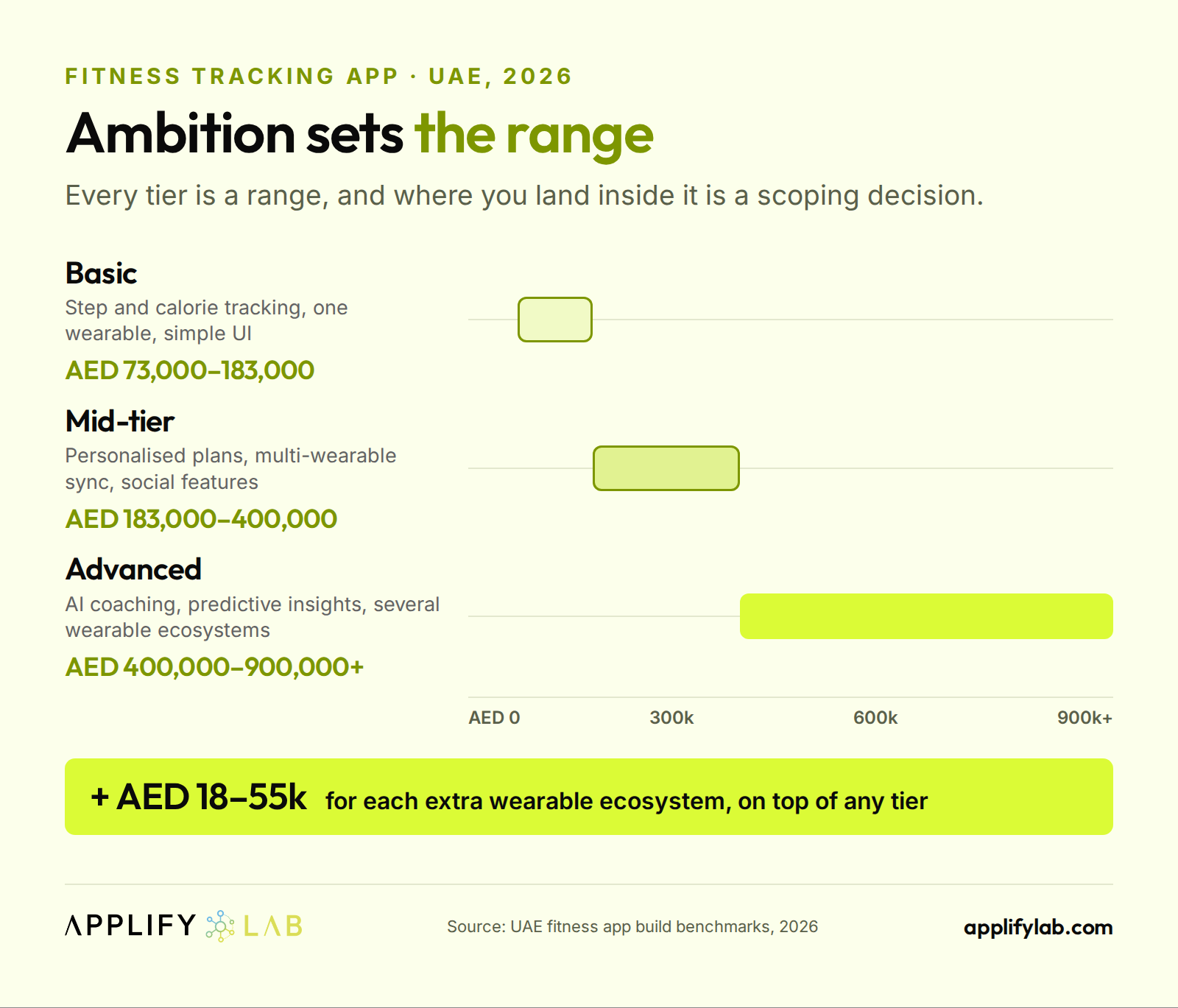
What a fitness tracking app costs, by ambition — plus the per-wearable add-on to budget for.
Monetization
Subscription plans (monthly/annual, tiered access, corporate wellness packages) remain the most effective model. Freemium, in-app purchases, and trainer marketplaces (letting independent trainers sell sessions through your platform) are real additional revenue streams. Partnerships with gyms, wellness centers, and wearable brands can extend reach faster than paid acquisition alone in a market this competitive.
Common mistakes worth avoiding
Treating compliance as a launch-week checklist item. Retrofitting security and data-handling architecture after launch is expensive and risky — plan for PDPL from day one, ahead of your first enterprise client asking about it.
Underestimating retention design. Fitness apps live and die on habit formation — strong features with weak UX still produce high churn.
Choosing a team that treats health-adjacent data as ordinary data, even when your app isn't a "medical" product — the data sensitivity is real regardless of classification.
Questions worth asking any partner
Have they built apps with real wearable integrations before (a working integration, beyond a generic API mention), how do they handle PDPL compliance specifically for biometric data, and have they built anything that scaled from single-purpose fitness into a broader wellness platform. You own 100% of the code once it's built, with no proprietary lock-in — confirm this directly.
FAQ
Does a UAE fitness app need to be HIPAA-compliant?
No — HIPAA is a US regulation and doesn't apply here. The binding law is the UAE's PDPL. The underlying security practices (encryption, access controls, secure authentication) are similar in substance, but PDPL is the actual legal requirement to build to.
How much does a fitness tracking app cost in the UAE?
Roughly AED 73,000–183,000 for a basic version, up to AED 400,000–900,000+ for an advanced platform with AI coaching and multiple wearable integrations. Each additional wearable platform beyond your first adds AED 18,000–55,000.
Which wearables should we integrate with first?
Apple HealthKit, Google Fit, and Fitbit SDK cover the large majority of consumer wearable users — prioritize based on what your actual target users own before expanding to niche device ecosystems.
Is the UAE fitness app market too crowded to enter?
It's competitive, not closed — real players like ClassPass, GymNation, and Fittpass already operate here, mostly as booking/marketplace models. A genuinely well-built, tracking-first product still has real room when it's differentiated rather than a generic feature checklist.
Should we plan for our fitness app to expand into wellness later?
Many successful fitness apps do — nutrition tracking, mental wellness, and sleep/recovery are common expansions that increase retention and lifetime value. Worth architecting for extensibility from the start if that's a realistic path for your product.
Ready to scope your fitness app?
Book a discovery call — bring your target users and which wearable ecosystems matter most, and we'll map out what your MVP actually needs.
Related guides
The UAE has the world's highest smartwatch adoption rate — 33.4% of the population aged 16-64 — and wearable use among Dubai's fitness participants jumped from 18% to 30% since 2020. That's a real, large, and growing base of users ready to sync data into a fitness app. The market is real but already contested: ClassPass, GymNation, and Fittpass are all operating UAE fitness businesses already competing for these users. The real question is what makes your app worth building against that, and getting the compliance question right — which, despite what you'll read elsewhere, is the UAE's PDPL rather than HIPAA.
Key takeaways
The demand is real and wearable-driven. 33.4% smartwatch adoption (world's highest); Dubai fitness wearable use up from 18% to 30% since 2020; UAE wearable revenue ~$1.08B (2024) → ~$2.57B (2030).
The market is competitive, not open. ClassPass, GymNation, and Fittpass already operate here — all booking/marketplace models, which leaves room for a differentiated, tracking-first product.
Build wearable integrations in priority order. Apple HealthKit, Google Fit, and Fitbit SDK first; each extra platform is ~AED 18k-55k, so prioritize by what your users actually own.
It's PDPL, not HIPAA. HIPAA is a US regulation and doesn't bind you here — build to the UAE PDPL (encryption, access controls, audit trails) for health-adjacent data.
Cost tracks ambition: ~AED 73k-183k basic, ~AED 183k-400k mid-tier, AED 400k-900k+ advanced with AI coaching and multiple ecosystems.
A large, wearable-driven market — and an already-competitive one.
The market is real, and already competitive
Wearable revenue in the UAE is forecast to grow from ~$1.08B (2024) to ~$2.57B by 2030, and the fitness app category globally is growing at 17.6% CAGR.
That growth is exactly why real players are already here: ClassPass runs a multi-studio credits model with real Dubai and Abu Dhabi presence, GymNation offers 24/7 gyms with app-based booking, and Fittpass runs a day-pass/membership marketplace.
Each of them is a booking or marketplace model rather than a pure tracking-and-wearables app — which is where a genuinely differentiated tracking-first product still has real room, built well rather than as a generic feature checklist.
Who's already here, and where the gap is
Player | Model | Where the room is |
|---|---|---|
ClassPass | Multi-studio credits (Dubai/Abu Dhabi) | Booking-first, not tracking-first |
GymNation | 24/7 gyms + app-based class booking | Gym-tied; wearable tracking is secondary |
Fittpass | Day-pass / membership marketplace | Marketplace, not a personal tracking product |
Your opening | Tracking-first, wearable-native | A differentiated, well-built tracker still has room |
Core features
Personalized workout plans — tailored to goals, fitness level, and preferences.
Real-time health metrics — steps, calories, heart rate, sleep, synced automatically from wearables.
Goal setting and progress dashboards — visual tracking over time, beyond a daily snapshot.
Social and community features — challenges, shared achievements, connecting with other users.
Trainer dashboards and admin panels — for gyms or studios building beyond individual consumers.
Video-based and live workout sessions — for home fitness and digital coaching use cases specifically.
Reminders and habit-building mechanics — this category lives on consistency, and repeat engagement is the whole game.
Who's actually using these apps
Gym members and studio users — workout plans, trainer interaction, performance tracking.
Home fitness and digital coaching users — on-demand and live sessions, personalized programs.
Corporate wellness participants — enrolled through employer-sponsored programs, a genuinely strong UAE-specific channel given how much large enterprises here invest in wellness benefits.
Health-adjacent users — managing weight, mobility, rehabilitation, or lifestyle conditions, who value data accuracy and privacy over gamification.
Wearable integration: what to prioritize
Build for Apple HealthKit, Google Fit, and Fitbit SDK first — these cover the large majority of consumer wearable data globally, and each additional platform beyond your first is its own integration to budget for (typically AED 18,000–55,000 each).
Prioritize based on which devices your actual target users own rather than building broad compatibility speculatively.
Unsure which wearable integrations your MVP actually needs?
Tell us your target users and we'll help you prioritize which device ecosystems are worth building for first.
When fitness data becomes health data — and what that actually requires
As fitness apps collect more than step counts — heart rate, sleep, stress indicators, chronic-condition-related insights — the logic that security needs to scale up holds. Where a lot of generic guides get this wrong for a UAE audience: they point to HIPAA, a US regulation, as the relevant standard.
The binding law for UAE health-adjacent data is the PDPL, and that's what your architecture needs to satisfy: encryption at rest and in transit, secure authentication, role-based access, and audit trails.
If your app is genuinely integrating with healthcare providers or handling clinical data, see our digital health compliance guide for the fuller DHA/MOHAP/PDPL picture — most fitness-tracking apps stay below that level, and the security substance still matters regardless.
Ramadan: a seasonal feature worth planning for, not a separate app
UAE fitness apps see a real behavior shift during Ramadan — training windows compress into the hours around Iftar, and energy management becomes the actual design problem. GymNation's own published UAE guidance: light activity is safest in the hour before Iftar, while higher-intensity training is best delayed to at least three hours after Iftar, once the body has refueled and rehydrated (gymnation.com, "Ramadan Exercise Timing"). Building a Ramadan-adjusted workout schedule and energy-aware training suggestions into your app for a few weeks a year is a legitimate feature to plan for. A standalone "Ramadan fitness app" rarely works, though — the retention math falls apart for a product that's only differentiated one month in twelve, which is exactly why we didn't ship a separate post for that idea.
Fitness apps that scale often become wellness platforms
A pattern worth planning for from the start: successful fitness apps frequently expand into mental wellness and stress management, nutrition and diet tracking, and sleep/recovery insights — turning a single-purpose tracker into a full lifestyle platform with higher retention and lifetime value. If that's part of your roadmap, our nutrition app guide and mental wellness app guide cover those specific builds in depth rather than repeating them here — worth reading before you scope a "fitness app" that's really planning to become three products.
What it costs
Real 2026 benchmarks, presented as tiers rather than a single flat range:
Basic (step/calorie tracking, single wearable integration, simple UI): roughly AED 73,000–183,000.
Mid-tier (personalized plans, multi-wearable sync, social/community features): roughly AED 183,000–400,000.
Advanced (AI-driven coaching, predictive insights, multiple wearable ecosystems): AED 400,000–900,000+.
Each additional wearable platform beyond your first adds roughly AED 18,000–55,000 — worth scoping deliberately rather than building broad compatibility you don't need yet.
What a fitness tracking app costs, by ambition — plus the per-wearable add-on to budget for.
Monetization
Subscription plans (monthly/annual, tiered access, corporate wellness packages) remain the most effective model. Freemium, in-app purchases, and trainer marketplaces (letting independent trainers sell sessions through your platform) are real additional revenue streams. Partnerships with gyms, wellness centers, and wearable brands can extend reach faster than paid acquisition alone in a market this competitive.
Common mistakes worth avoiding
Treating compliance as a launch-week checklist item. Retrofitting security and data-handling architecture after launch is expensive and risky — plan for PDPL from day one, ahead of your first enterprise client asking about it.
Underestimating retention design. Fitness apps live and die on habit formation — strong features with weak UX still produce high churn.
Choosing a team that treats health-adjacent data as ordinary data, even when your app isn't a "medical" product — the data sensitivity is real regardless of classification.
Questions worth asking any partner
Have they built apps with real wearable integrations before (a working integration, beyond a generic API mention), how do they handle PDPL compliance specifically for biometric data, and have they built anything that scaled from single-purpose fitness into a broader wellness platform. You own 100% of the code once it's built, with no proprietary lock-in — confirm this directly.
FAQ
Does a UAE fitness app need to be HIPAA-compliant?
No — HIPAA is a US regulation and doesn't apply here. The binding law is the UAE's PDPL. The underlying security practices (encryption, access controls, secure authentication) are similar in substance, but PDPL is the actual legal requirement to build to.
How much does a fitness tracking app cost in the UAE?
Roughly AED 73,000–183,000 for a basic version, up to AED 400,000–900,000+ for an advanced platform with AI coaching and multiple wearable integrations. Each additional wearable platform beyond your first adds AED 18,000–55,000.
Which wearables should we integrate with first?
Apple HealthKit, Google Fit, and Fitbit SDK cover the large majority of consumer wearable users — prioritize based on what your actual target users own before expanding to niche device ecosystems.
Is the UAE fitness app market too crowded to enter?
It's competitive, not closed — real players like ClassPass, GymNation, and Fittpass already operate here, mostly as booking/marketplace models. A genuinely well-built, tracking-first product still has real room when it's differentiated rather than a generic feature checklist.
Should we plan for our fitness app to expand into wellness later?
Many successful fitness apps do — nutrition tracking, mental wellness, and sleep/recovery are common expansions that increase retention and lifetime value. Worth architecting for extensibility from the start if that's a realistic path for your product.
Ready to scope your fitness app?
Book a discovery call — bring your target users and which wearable ecosystems matter most, and we'll map out what your MVP actually needs.