Fashion Ecommerce App Development in Dubai: UX & Growth Tips
A fashion app in Dubai lives or dies on two numbers: how many orders come back, and how much each basket is worth. Online apparel is returned at 20–40% versus 5–9% in-store, and over half of those returns are size or fit (Richpanel, 2026). So the real job of a fashion app here isn't "look premium" — it's to help people buy the right size the first time, and to make paying easy enough that they add one more item. Everything below is organised around that.
Key takeaways
The differentiator isn't features, it's fewer returns + higher order value. Build for those two numbers first.
Returns are mostly size/fit — the highest-ROI features are honest size guides, rich media, real reviews, and (where it earns its cost) AR try-on.
Order value climbs with local payments: BNPL (Tabby, Tamara) lifts fashion AOV ~25–35% in the GCC and is now ~14% of UAE checkout.
Pick a business model before features — single-brand, marketplace (Namshi/Ounass), or membership. They're different products.
Shopify (headless) is a fast, sensible backend for most single-brand fashion apps; you own 100% of the app code either way.
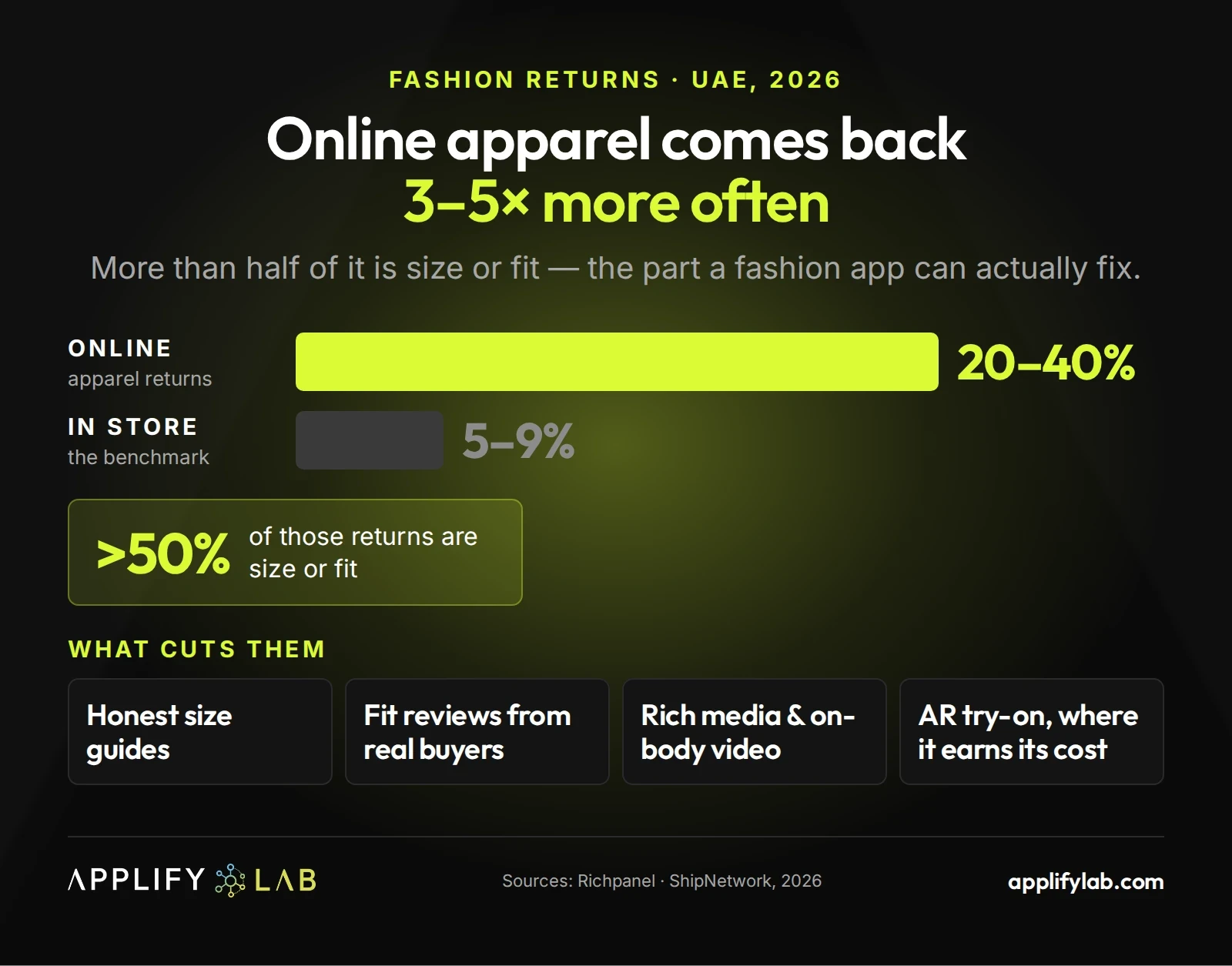
Online apparel comes back 3–5× more often than in-store — and it's mostly size and fit. That's the problem a good fashion app is built to solve.
Why build a fashion app in Dubai at all?
Because the market is large and still growing, and fashion shoppers here are app-first. UAE e-commerce is about USD 12.3B in 2026 and forecast to reach USD 21B by 2031 (Mordor Intelligence), and fashion is one of the deepest categories in it.
But "the market is big" is a weak reason to build — plenty of fashion apps launch and stall. The strong reason is that a dedicated app gives you the two things a mobile website can't: push-driven repeat visits, and a checkout you fully control.
If you can't see how your app will earn back its cost through repeat purchase or higher basket size, that's worth resolving before you build, not after.
What are the real must-have features? (Start with the ones that cut returns)
The features that pay for themselves are the ones that reduce returns and lift order value. Everything else is secondary. In priority order:
Honest size and fit help. Detailed size guides, garment measurements (not just S/M/L), "runs small/large" notes, and fit reviews from real buyers. More than half of returns are size/fit — this is the single highest-leverage area.
Rich product media. Zoom, multiple angles, on-body video, fabric close-ups. The gap between the photo and the fitting room is where returns are born; close it.
Real reviews with photos. Social proof plus fit feedback ("I'm 5'7", took a M, fits true").
A checkout built for the UAE (its own section below) — this is where order value is won or lost.
AR / virtual try-on — where it earns its cost. It genuinely reduces returns for the right catalogue (eyewear, footwear, some apparel). Reported uplifts from brands like Princess Polly and Gobi Cashmere are global case data, not UAE-specific, and AR is a real build cost — so it belongs in a later phase for most brands, not the MVP. We'd scope it only if your return rate and margins justify it.
That last point is the whole approach: we diagnose what your specific catalogue and margins need, then build that — not a feature checklist you'll pay for and never use.
Not sure which features are worth it for your catalogue?
That's exactly the call we help founders make before a line of code — which features cut your returns, and which are just cost.
Which business model? (Decide this before anything else)
Pick your model before features, because it changes what you build, how you make money, and how hard it is to launch. There are three, and they're genuinely different products:
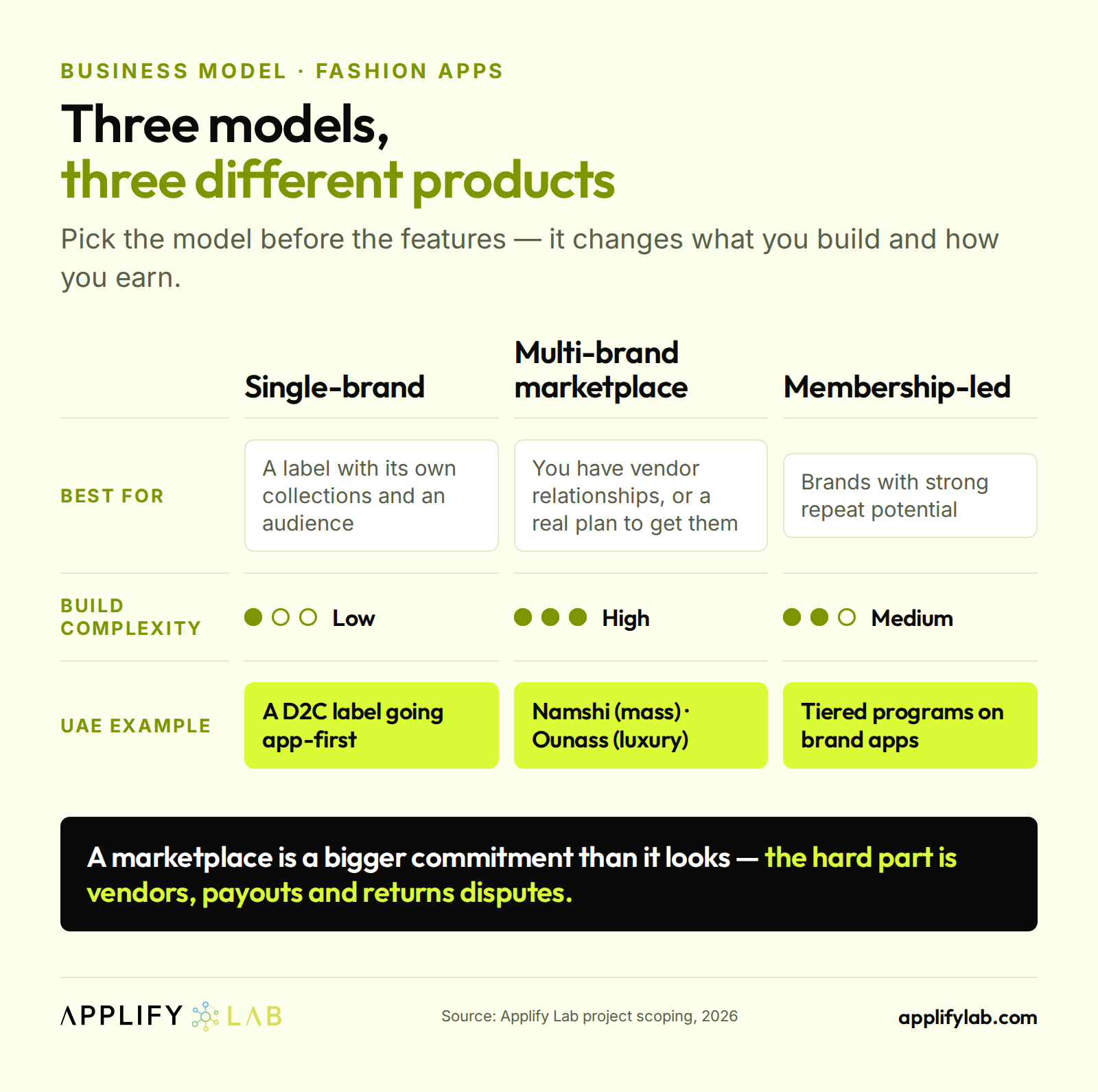
Namshi and Ounass are both UAE marketplaces — but one is mass fast-fashion and one is luxury. The model you pick shapes the whole build.
Model | What it is | Best for | Build complexity | UAE example |
|---|---|---|---|---|
Single-brand app | Your own label, your own app | A brand with its own collections and an audience | Lowest — one catalogue, one checkout | A boutique or D2C label going app-first |
Multi-brand marketplace | You host other brands and take a cut | You have vendor relationships (or a real plan to get them) | Highest — vendor onboarding, payouts, disputes | Namshi (mass), Ounass (luxury) |
Membership / loyalty-led | Perks, early access, rewards drive repeat | Brands with strong repeat potential | Medium — layered on either model above | Tiered programs on existing brand apps |
A marketplace is a much bigger commitment than it looks — the hard part isn't the app, it's the vendors, the payouts, and the returns disputes. If that's genuinely your business, we cover it in depth in our marketplace app guide. If you're a single brand, keep it simple and go deep on your own experience.
What does a UAE fashion checkout need? (This is where order value is won)
Local payment options, in the right order, in AED, in Arabic and English. Get this wrong and you lose the sale at the last step; get it right and baskets get bigger.
Cards + Apple Pay / Google Pay — table stakes for one-tap checkout.
BNPL: Tabby and Tamara. This is the big one for fashion. BNPL is now ~14% of UAE checkout, Tabby and Tamara together process around USD 6B a year across ~30,000 merchants, and split-payment has been shown to lift fashion AOV by ~25–35% in the GCC (UAE BNPL report, 2026). For anything above ~AED 300, offering it visibly on the product page matters, not just at checkout.
Cash on delivery — still offer it, but expect it to shrink. COD is still offered by about 71.2% of UAE retailers, but its share of volume is falling as wallets and BNPL take over. Support it for first-time and lower-price buyers; don't build the whole experience around it.
A local gateway (Telr, PayTabs, or Network International) for AED settlement and local support.
One correction worth making: older guides (and the posts this one replaces) list STC Pay as a UAE option. It's a Saudi wallet — not a UAE payment method. If you see it on a "UAE fashion app" checklist, that guide wasn't written for this market.
For the full gateway-by-volume breakdown, see our UAE payments guide.
Should you build on Shopify? (For most single-brand fashion apps, yes)
For a single-brand fashion app, a headless Shopify setup is usually the fastest sensible route — Shopify runs the commerce engine (catalogue, inventory, checkout, orders) while your custom app is the storefront your customers actually see and feel.
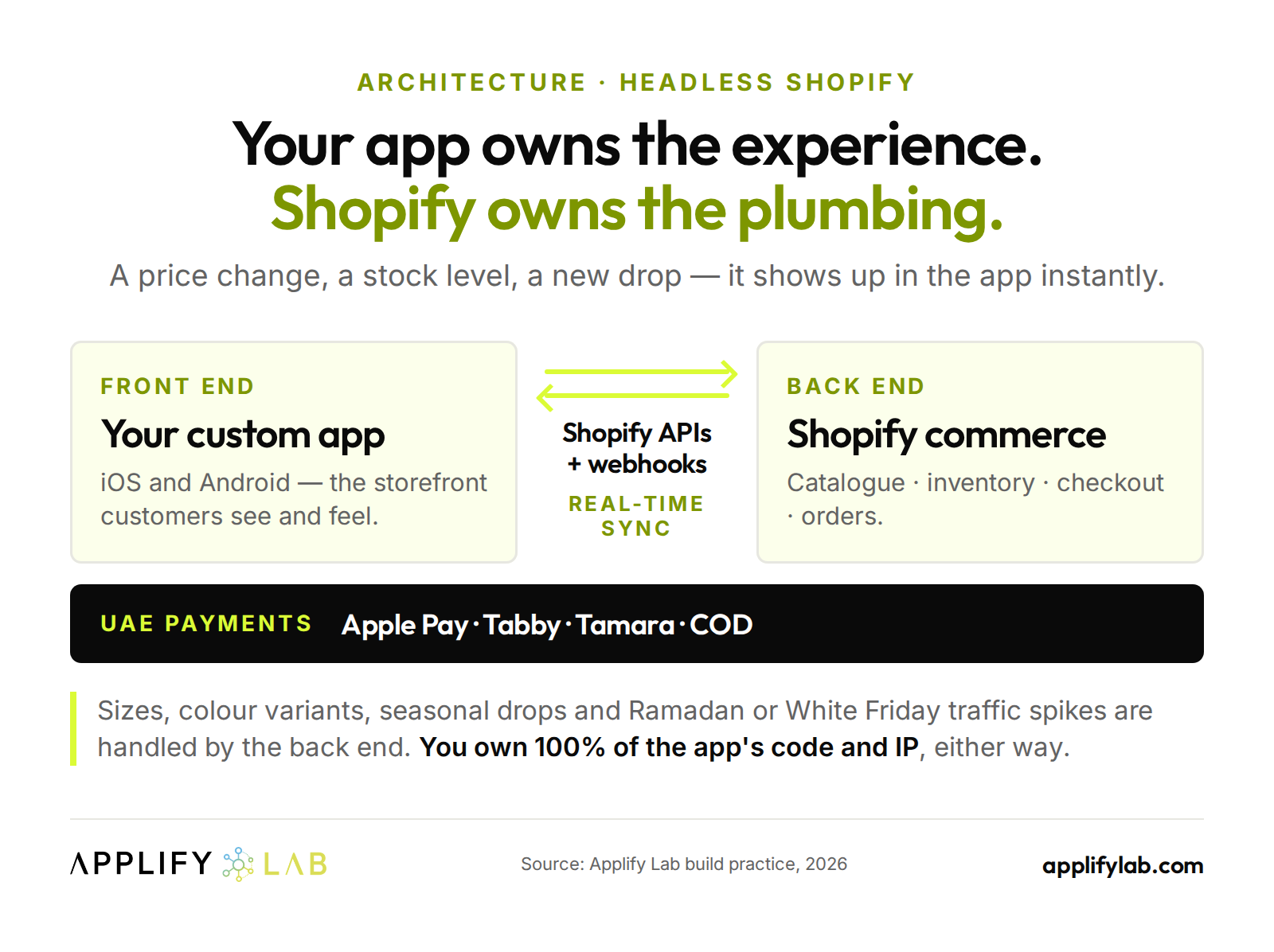
Headless Shopify: you own the look and feel of the app; Shopify handles the commerce plumbing and stays in sync in real time.
"Headless" just means your app is the front end and Shopify is the back end, connected through Shopify's APIs and webhooks so a change in Shopify (a price, a stock level, a new drop) shows up in the app instantly. The advantages for fashion specifically:
Handles the messy parts of fashion inventory — sizes, colour variants, seasonal collections, limited drops — out of the box.
Holds up during spikes — Ramadan, Eid, Dubai Shopping Festival, White Friday — without you building scaling infrastructure.
Lets designers own the experience while Shopify owns the commerce reliability.
When wouldn't we recommend it? If you're building a true multi-vendor marketplace with complex payouts, or you have unusual back-office needs Shopify can't model — then a custom backend (or a different platform) may fit better. That's a diagnosis. We compare the options honestly in our Salla vs Zid vs Shopify vs custom guide.
Whichever route you take with us, you own 100% of the app's code and IP. No lock-in to us, no proprietary black box.
What does a fashion app cost in Dubai?
There's no honest single price, because the right build depends on your catalogue, your model, and which return-cutting features you actually need.
As a working range, a straightforward single-brand fashion app starts around AED 70,000–150,000, and one with AR try-on, AI recommendations and full bilingual depth runs AED 200,000–400,000+. (Shopify's own subscription is on top, but a headless Shopify build costs far less than engineering a commerce backend from scratch.)
We don't quote a fixed number before understanding your business — not to be evasive, but because a generic price means either selling you features you won't use or underscoping the ones you need. We diagnose first, then propose the build with the highest return for your specific case, and plan it in phases so the piece that earns its cost ships first. For the full cost breakdown and what drives each tier, see our custom e-commerce cost guide, or book a 30 mn conversation with us.
FAQ
How much does a fashion e-commerce app cost in Dubai?
A single-brand fashion app typically starts around AED 70,000–150,000; adding AR try-on, AI recommendations and full Arabic/English depth pushes it to AED 200,000–400,000+. The real figure depends on your catalogue and which features genuinely reduce your returns — which is what we scope on a call before quoting.
Is Shopify good enough for a fashion app in the UAE?
For most single-brand fashion apps, yes — a headless Shopify setup handles sizes, variants, seasonal drops and traffic spikes well, and lets a custom app own the look and feel. A true multi-vendor marketplace is the main case where a different backend may fit better.
What payment methods should a UAE fashion app support?
Cards, Apple Pay and Google Pay, plus BNPL (Tabby and Tamara — big for fashion), a local gateway for AED settlement, and cash on delivery for first-time buyers. Note: STC Pay is a Saudi wallet, not a UAE one.
How do I reduce returns on a fashion app?
Most returns are size and fit, so the highest-impact features are honest size guides with real measurements, fit reviews from actual buyers, rich product media, and — where the catalogue and margins justify it — AR/virtual try-on.
Do I own the app after it's built?
With Applify Lab, yes — you own 100% of the code and IP. No lock-in and no proprietary stack you can't leave.
How long does it take to build?
A focused first version is typically a few weeks to a few months depending on scope. We plan in phases so the features that earn their cost ship first, rather than waiting for one big launch.
Ready to scope your fashion app?
Bring your catalogue, your model, and your return rate if you have it — 30 minutes is enough to map what's worth building first. Book 30 minutes with us
Related guides
A fashion app in Dubai lives or dies on two numbers: how many orders come back, and how much each basket is worth. Online apparel is returned at 20–40% versus 5–9% in-store, and over half of those returns are size or fit (Richpanel, 2026). So the real job of a fashion app here isn't "look premium" — it's to help people buy the right size the first time, and to make paying easy enough that they add one more item. Everything below is organised around that.
Key takeaways
The differentiator isn't features, it's fewer returns + higher order value. Build for those two numbers first.
Returns are mostly size/fit — the highest-ROI features are honest size guides, rich media, real reviews, and (where it earns its cost) AR try-on.
Order value climbs with local payments: BNPL (Tabby, Tamara) lifts fashion AOV ~25–35% in the GCC and is now ~14% of UAE checkout.
Pick a business model before features — single-brand, marketplace (Namshi/Ounass), or membership. They're different products.
Shopify (headless) is a fast, sensible backend for most single-brand fashion apps; you own 100% of the app code either way.
Online apparel comes back 3–5× more often than in-store — and it's mostly size and fit. That's the problem a good fashion app is built to solve.
Why build a fashion app in Dubai at all?
Because the market is large and still growing, and fashion shoppers here are app-first. UAE e-commerce is about USD 12.3B in 2026 and forecast to reach USD 21B by 2031 (Mordor Intelligence), and fashion is one of the deepest categories in it.
But "the market is big" is a weak reason to build — plenty of fashion apps launch and stall. The strong reason is that a dedicated app gives you the two things a mobile website can't: push-driven repeat visits, and a checkout you fully control.
If you can't see how your app will earn back its cost through repeat purchase or higher basket size, that's worth resolving before you build, not after.
What are the real must-have features? (Start with the ones that cut returns)
The features that pay for themselves are the ones that reduce returns and lift order value. Everything else is secondary. In priority order:
Honest size and fit help. Detailed size guides, garment measurements (not just S/M/L), "runs small/large" notes, and fit reviews from real buyers. More than half of returns are size/fit — this is the single highest-leverage area.
Rich product media. Zoom, multiple angles, on-body video, fabric close-ups. The gap between the photo and the fitting room is where returns are born; close it.
Real reviews with photos. Social proof plus fit feedback ("I'm 5'7", took a M, fits true").
A checkout built for the UAE (its own section below) — this is where order value is won or lost.
AR / virtual try-on — where it earns its cost. It genuinely reduces returns for the right catalogue (eyewear, footwear, some apparel). Reported uplifts from brands like Princess Polly and Gobi Cashmere are global case data, not UAE-specific, and AR is a real build cost — so it belongs in a later phase for most brands, not the MVP. We'd scope it only if your return rate and margins justify it.
That last point is the whole approach: we diagnose what your specific catalogue and margins need, then build that — not a feature checklist you'll pay for and never use.
Not sure which features are worth it for your catalogue?
That's exactly the call we help founders make before a line of code — which features cut your returns, and which are just cost.
Which business model? (Decide this before anything else)
Pick your model before features, because it changes what you build, how you make money, and how hard it is to launch. There are three, and they're genuinely different products:
Namshi and Ounass are both UAE marketplaces — but one is mass fast-fashion and one is luxury. The model you pick shapes the whole build.
Model | What it is | Best for | Build complexity | UAE example |
|---|---|---|---|---|
Single-brand app | Your own label, your own app | A brand with its own collections and an audience | Lowest — one catalogue, one checkout | A boutique or D2C label going app-first |
Multi-brand marketplace | You host other brands and take a cut | You have vendor relationships (or a real plan to get them) | Highest — vendor onboarding, payouts, disputes | Namshi (mass), Ounass (luxury) |
Membership / loyalty-led | Perks, early access, rewards drive repeat | Brands with strong repeat potential | Medium — layered on either model above | Tiered programs on existing brand apps |
A marketplace is a much bigger commitment than it looks — the hard part isn't the app, it's the vendors, the payouts, and the returns disputes. If that's genuinely your business, we cover it in depth in our marketplace app guide. If you're a single brand, keep it simple and go deep on your own experience.
What does a UAE fashion checkout need? (This is where order value is won)
Local payment options, in the right order, in AED, in Arabic and English. Get this wrong and you lose the sale at the last step; get it right and baskets get bigger.
Cards + Apple Pay / Google Pay — table stakes for one-tap checkout.
BNPL: Tabby and Tamara. This is the big one for fashion. BNPL is now ~14% of UAE checkout, Tabby and Tamara together process around USD 6B a year across ~30,000 merchants, and split-payment has been shown to lift fashion AOV by ~25–35% in the GCC (UAE BNPL report, 2026). For anything above ~AED 300, offering it visibly on the product page matters, not just at checkout.
Cash on delivery — still offer it, but expect it to shrink. COD is still offered by about 71.2% of UAE retailers, but its share of volume is falling as wallets and BNPL take over. Support it for first-time and lower-price buyers; don't build the whole experience around it.
A local gateway (Telr, PayTabs, or Network International) for AED settlement and local support.
One correction worth making: older guides (and the posts this one replaces) list STC Pay as a UAE option. It's a Saudi wallet — not a UAE payment method. If you see it on a "UAE fashion app" checklist, that guide wasn't written for this market.
For the full gateway-by-volume breakdown, see our UAE payments guide.
Should you build on Shopify? (For most single-brand fashion apps, yes)
For a single-brand fashion app, a headless Shopify setup is usually the fastest sensible route — Shopify runs the commerce engine (catalogue, inventory, checkout, orders) while your custom app is the storefront your customers actually see and feel.
Headless Shopify: you own the look and feel of the app; Shopify handles the commerce plumbing and stays in sync in real time.
"Headless" just means your app is the front end and Shopify is the back end, connected through Shopify's APIs and webhooks so a change in Shopify (a price, a stock level, a new drop) shows up in the app instantly. The advantages for fashion specifically:
Handles the messy parts of fashion inventory — sizes, colour variants, seasonal collections, limited drops — out of the box.
Holds up during spikes — Ramadan, Eid, Dubai Shopping Festival, White Friday — without you building scaling infrastructure.
Lets designers own the experience while Shopify owns the commerce reliability.
When wouldn't we recommend it? If you're building a true multi-vendor marketplace with complex payouts, or you have unusual back-office needs Shopify can't model — then a custom backend (or a different platform) may fit better. That's a diagnosis. We compare the options honestly in our Salla vs Zid vs Shopify vs custom guide.
Whichever route you take with us, you own 100% of the app's code and IP. No lock-in to us, no proprietary black box.
What does a fashion app cost in Dubai?
There's no honest single price, because the right build depends on your catalogue, your model, and which return-cutting features you actually need.
As a working range, a straightforward single-brand fashion app starts around AED 70,000–150,000, and one with AR try-on, AI recommendations and full bilingual depth runs AED 200,000–400,000+. (Shopify's own subscription is on top, but a headless Shopify build costs far less than engineering a commerce backend from scratch.)
We don't quote a fixed number before understanding your business — not to be evasive, but because a generic price means either selling you features you won't use or underscoping the ones you need. We diagnose first, then propose the build with the highest return for your specific case, and plan it in phases so the piece that earns its cost ships first. For the full cost breakdown and what drives each tier, see our custom e-commerce cost guide, or book a 30 mn conversation with us.
FAQ
How much does a fashion e-commerce app cost in Dubai?
A single-brand fashion app typically starts around AED 70,000–150,000; adding AR try-on, AI recommendations and full Arabic/English depth pushes it to AED 200,000–400,000+. The real figure depends on your catalogue and which features genuinely reduce your returns — which is what we scope on a call before quoting.
Is Shopify good enough for a fashion app in the UAE?
For most single-brand fashion apps, yes — a headless Shopify setup handles sizes, variants, seasonal drops and traffic spikes well, and lets a custom app own the look and feel. A true multi-vendor marketplace is the main case where a different backend may fit better.
What payment methods should a UAE fashion app support?
Cards, Apple Pay and Google Pay, plus BNPL (Tabby and Tamara — big for fashion), a local gateway for AED settlement, and cash on delivery for first-time buyers. Note: STC Pay is a Saudi wallet, not a UAE one.
How do I reduce returns on a fashion app?
Most returns are size and fit, so the highest-impact features are honest size guides with real measurements, fit reviews from actual buyers, rich product media, and — where the catalogue and margins justify it — AR/virtual try-on.
Do I own the app after it's built?
With Applify Lab, yes — you own 100% of the code and IP. No lock-in and no proprietary stack you can't leave.
How long does it take to build?
A focused first version is typically a few weeks to a few months depending on scope. We plan in phases so the features that earn their cost ship first, rather than waiting for one big launch.
Ready to scope your fashion app?
Bring your catalogue, your model, and your return rate if you have it — 30 minutes is enough to map what's worth building first. Book 30 minutes with us