B2B Ecommerce App Development in the UAE: Complete Guide (2026)
A B2B ecommerce app is a different build from a B2C storefront with bulk pricing bolted on — it needs net payment terms, quote-to-order workflows, and a connection to whatever system already runs your invoicing and inventory, or it becomes a second system your team manually reconciles with the first.
Before any feature list, the real questions are whether you actually need to build this yourself rather than sell through an existing UAE B2B marketplace, and — if you do build — whether your development partner understands B2B mechanics specifically, beyond ecommerce in general.
Key takeaways
Build vs. Tradeling is the first decision. Sell through an established B2B marketplace to test demand; build your own when pricing, ERP, or the direct relationship demand it.
Three signals to build: account-specific contract pricing, a need to tie into your own ERP/accounting system, and wanting the direct customer relationship and data.
Five features make it B2B, not B2C: net terms (Net 30/60/90), PO-number + credit limits, RFQ-to-order, account-based contract pricing, and multi-tier approval roles.
ERP integration is where builds go wrong. An app that syncs with your ERP cuts work; one that doesn't just adds a second system to reconcile by hand.
Build in VAT-compliant invoicing and PDPL from the start — and note that "Noon B2B" is a fulfillment option within Noon, not a Tradeling rival.
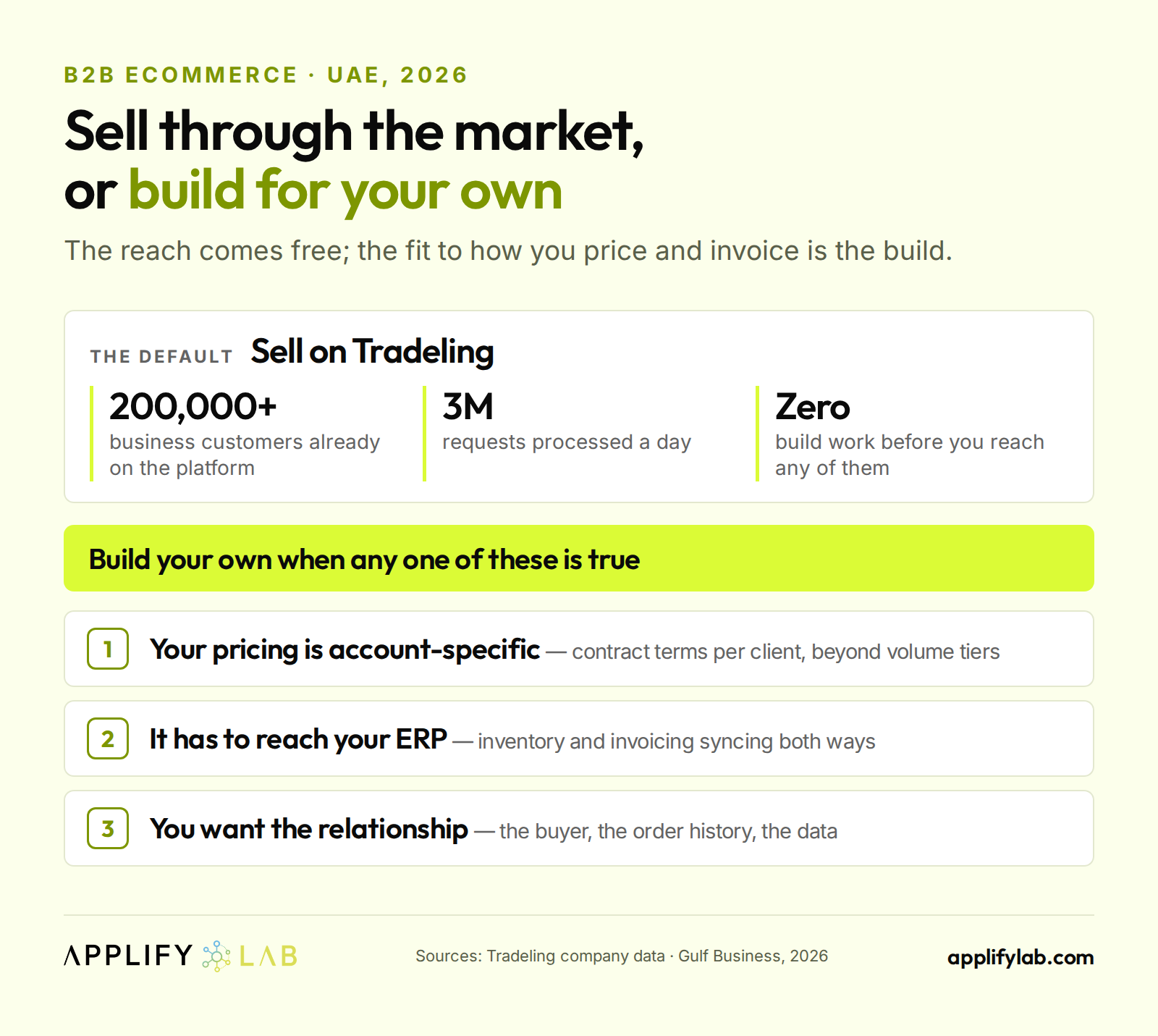
Sell on Tradeling, or build your own — and the three signals that tip it toward building.
Sell on an existing B2B marketplace, or build your own?
Tradeling, the UAE's dominant B2B e-marketplace, has scaled to 200,000+ business customers and processes 3 million daily requests — it's real, it's growing, and it's a legitimate place to reach buyers without building anything. (One correction worth making here: some older guides list "Noon B2B" as a separate competing marketplace — it isn't.
It's a fulfillment option within regular Noon, where sellers manage their own storage and delivery instead of using Noon's fulfillment network. Tradeling is the real UAE B2B marketplace to know.)
A few signals that building your own app is worth it rather than selling through Tradeling or a similar marketplace:
Your pricing is genuinely account-specific — different contract terms per client relationship, beyond simple volume tiers, which a marketplace's standard pricing tools model poorly.
You need it tied to your own ERP or accounting system. A system you control syncs with your internal inventory and invoicing in a way a marketplace listing can't.
You want the direct customer relationship and data — a marketplace intermediates that the same way a consumer marketplace does, just at wholesale scale.
If none of those apply yet, selling through an established marketplace first is a reasonable way to test demand before committing to a custom build.
This is worth a proper 30-minute call
Bring your ERP system, your pricing model, and your actual order volume — we'll tell you plainly whether building makes sense yet, or whether staying on a marketplace a while longer is the smarter call. Book 30 minutes with us
What actually makes a B2B app different from a B2C storefront
This is where most generic guides thin out into a feature list that could describe any ecommerce app. The features that genuinely separate B2B from B2C are specific and worth knowing before you scope anything:
Net payment terms (Net 30/60/90). Business buyers often order on credit against agreed terms rather than paying at checkout, which means your app needs to track what's owed and when, beyond processing a single transaction.
PO number entry and credit-limit management. Buyers need to attach a purchase order number at checkout, and your system needs to know (and enforce) how much credit each account actually has.
RFQ (request-for-quote) workflows. A buyer submits a product list and quantity, gets a custom quote back, and converts it to an order in one click — standard for B2B purchasing, and absent from almost every B2C platform.
Account-based, contract pricing — pricing negotiated per client relationship, beyond volume tiers, visible only to that account.
Multi-tier user roles. Buyer, approver, and admin accounts on the client side, beyond a single login — larger UAE businesses often require a purchase to be approved by someone other than the person who requested it.
Bulk ordering and a wholesale price list — the two features most generic B2B guides lead with — are true but secondary; a B2C app can already approximate both. The five above are what actually make an app a B2B app.
B2B vs. B2C: what's genuinely different
Capability | B2C storefront | B2B app |
|---|---|---|
Payment | Pay at checkout | Net 30/60/90 on credit, tracked over time |
Checkout | Card + wallet | PO number + credit-limit enforcement |
Quoting | Fixed price | RFQ → custom quote → one-click order |
Pricing | List / volume tiers | Account-based contract pricing, per client |
Users | Single login | Buyer / approver / admin roles |
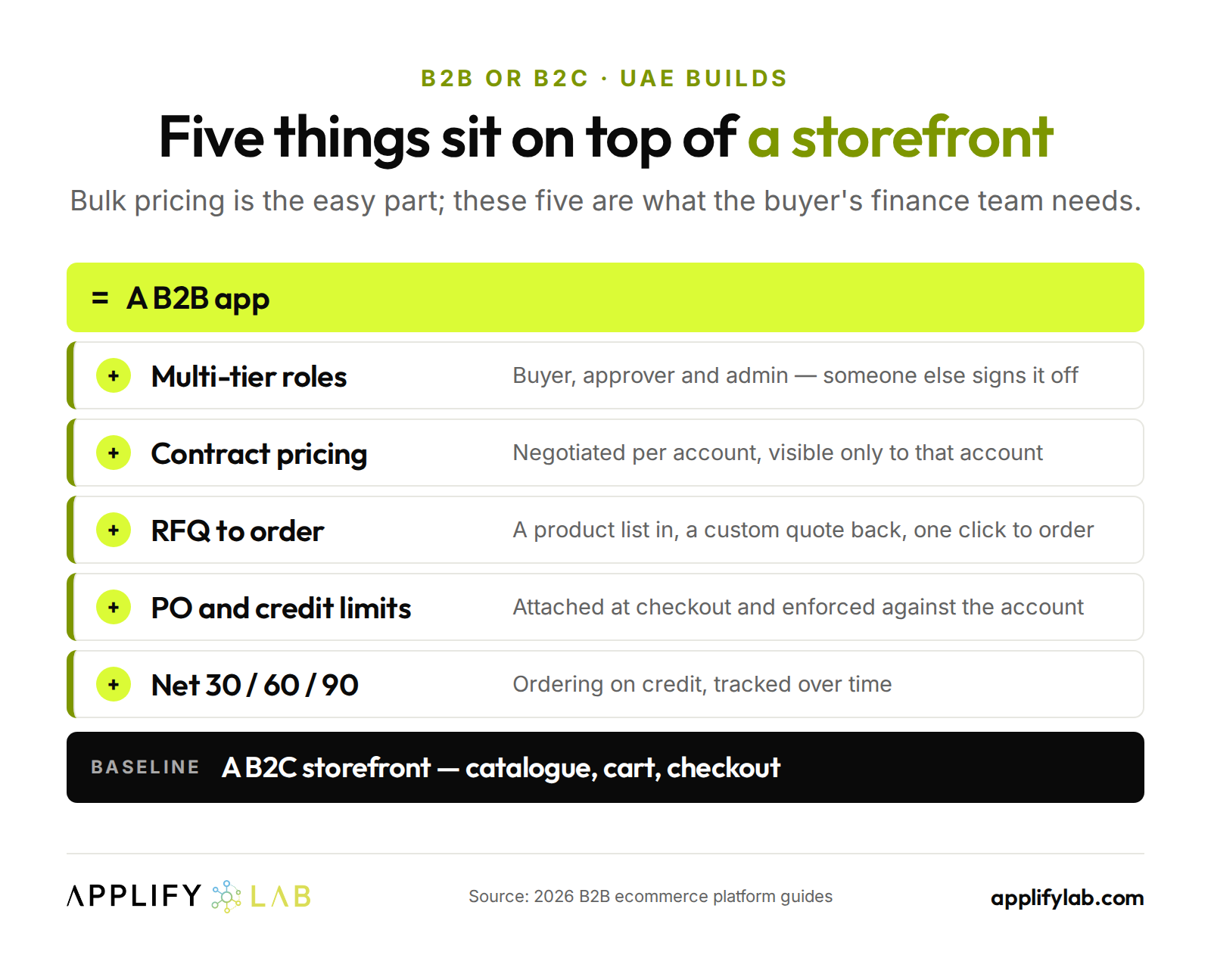
The five features that actually make an app B2B — added on top of a storefront.
ERP and system integration — where most B2B builds actually go wrong
An app connected to your existing ERP or accounting system reduces your operational work; one left unconnected adds a second system your team has to keep in sync manually — which is where errors, delays, and double-entry frustration actually come from. This is worth asking any development partner about directly and specifically: which ERP/accounting systems have they actually integrated with before, and what did that integration handle (inventory sync, invoicing, customer records) versus what stayed manual? A vague answer here is a bigger risk signal for a B2B build than it would be for a simpler B2C app, because the whole point of digitizing is to stop running parallel systems.
UAE-specific compliance
VAT-compliant invoicing generated automatically at the point of sale, and PDPL (the UAE's federal data protection law) compliance for how customer and order data is stored and handled — both need to be built in from the start, ahead of a client or regulator asking about them.
Payments
Business buyers still need the standard local stack — cards, Apple Pay, Google Pay — and net-terms invoicing (pay later, against agreed terms) matters more here than the checkout-moment payment method choice that dominates B2C. For the full local payment-gateway breakdown, see our payments integration guide. (One correction worth flagging: some older UAE app guides list "STC Pay" as a supported option — that's a Saudi payment method, not a UAE one.)
If you're actually running a multi-vendor B2B marketplace
Some B2B platforms are one company selling to many business buyers (the more common case above); others are genuinely multi-vendor, connecting multiple suppliers with buyers the way Tradeling does.
If that's your model, the vendor-onboarding, commission, and dispute mechanics are the same ones covered in our marketplace app guide — worth reading alongside this one rather than assuming a single-seller B2B build covers what you need.
Cost: the short version
B2B builds tend to land at the mid-to-upper end of the general custom ecommerce range, mainly because of ERP integration work and the account/approval logic described above — both add backend complexity a standard B2C app doesn't have.
For exact 2026 AED ranges by build type, see our full cost breakdown.
FAQ
Should I sell on Tradeling or build my own B2B app?
Depends on whether your pricing is genuinely account-specific, whether you need it tied to your own ERP, and whether owning the direct customer relationship matters to your business. If you're still validating demand, an established marketplace like Tradeling is a reasonable place to start.
What makes a B2B ecommerce app different from a regular ecommerce app?
Net payment terms, RFQ-to-order workflows, credit-limit management, account-based contract pricing, and multi-tier approval roles — beyond bulk ordering and wholesale pricing, which most B2C apps can already approximate.
Do I need ERP integration for a B2B app?
If you're already running an ERP or accounting system, yes — without integration, the app becomes a second system your team manually reconciles with the first, which defeats much of the point of digitizing.
How much does a B2B ecommerce app cost in the UAE?
It follows the same cost drivers as any custom ecommerce build, and typically lands at the mid-to-upper end because of ERP integration and account/approval logic — see our full cost guide for exact 2026 ranges.
Is "Noon B2B" a real alternative to Tradeling?
Not as a separate marketplace — "Noon B2B" refers to a fulfillment choice for sellers already on Noon (managing your own storage/delivery), rather than a distinct wholesale platform. Tradeling is the real UAE B2B marketplace benchmark to evaluate against building your own.
Have one quick question before you're ready to book?
That's fine too — send it on WhatsApp and we'll give you a straight answer, no pressure to schedule anything yet.
Related guides
A B2B ecommerce app is a different build from a B2C storefront with bulk pricing bolted on — it needs net payment terms, quote-to-order workflows, and a connection to whatever system already runs your invoicing and inventory, or it becomes a second system your team manually reconciles with the first.
Before any feature list, the real questions are whether you actually need to build this yourself rather than sell through an existing UAE B2B marketplace, and — if you do build — whether your development partner understands B2B mechanics specifically, beyond ecommerce in general.
Key takeaways
Build vs. Tradeling is the first decision. Sell through an established B2B marketplace to test demand; build your own when pricing, ERP, or the direct relationship demand it.
Three signals to build: account-specific contract pricing, a need to tie into your own ERP/accounting system, and wanting the direct customer relationship and data.
Five features make it B2B, not B2C: net terms (Net 30/60/90), PO-number + credit limits, RFQ-to-order, account-based contract pricing, and multi-tier approval roles.
ERP integration is where builds go wrong. An app that syncs with your ERP cuts work; one that doesn't just adds a second system to reconcile by hand.
Build in VAT-compliant invoicing and PDPL from the start — and note that "Noon B2B" is a fulfillment option within Noon, not a Tradeling rival.
Sell on Tradeling, or build your own — and the three signals that tip it toward building.
Sell on an existing B2B marketplace, or build your own?
Tradeling, the UAE's dominant B2B e-marketplace, has scaled to 200,000+ business customers and processes 3 million daily requests — it's real, it's growing, and it's a legitimate place to reach buyers without building anything. (One correction worth making here: some older guides list "Noon B2B" as a separate competing marketplace — it isn't.
It's a fulfillment option within regular Noon, where sellers manage their own storage and delivery instead of using Noon's fulfillment network. Tradeling is the real UAE B2B marketplace to know.)
A few signals that building your own app is worth it rather than selling through Tradeling or a similar marketplace:
Your pricing is genuinely account-specific — different contract terms per client relationship, beyond simple volume tiers, which a marketplace's standard pricing tools model poorly.
You need it tied to your own ERP or accounting system. A system you control syncs with your internal inventory and invoicing in a way a marketplace listing can't.
You want the direct customer relationship and data — a marketplace intermediates that the same way a consumer marketplace does, just at wholesale scale.
If none of those apply yet, selling through an established marketplace first is a reasonable way to test demand before committing to a custom build.
This is worth a proper 30-minute call
Bring your ERP system, your pricing model, and your actual order volume — we'll tell you plainly whether building makes sense yet, or whether staying on a marketplace a while longer is the smarter call. Book 30 minutes with us
What actually makes a B2B app different from a B2C storefront
This is where most generic guides thin out into a feature list that could describe any ecommerce app. The features that genuinely separate B2B from B2C are specific and worth knowing before you scope anything:
Net payment terms (Net 30/60/90). Business buyers often order on credit against agreed terms rather than paying at checkout, which means your app needs to track what's owed and when, beyond processing a single transaction.
PO number entry and credit-limit management. Buyers need to attach a purchase order number at checkout, and your system needs to know (and enforce) how much credit each account actually has.
RFQ (request-for-quote) workflows. A buyer submits a product list and quantity, gets a custom quote back, and converts it to an order in one click — standard for B2B purchasing, and absent from almost every B2C platform.
Account-based, contract pricing — pricing negotiated per client relationship, beyond volume tiers, visible only to that account.
Multi-tier user roles. Buyer, approver, and admin accounts on the client side, beyond a single login — larger UAE businesses often require a purchase to be approved by someone other than the person who requested it.
Bulk ordering and a wholesale price list — the two features most generic B2B guides lead with — are true but secondary; a B2C app can already approximate both. The five above are what actually make an app a B2B app.
B2B vs. B2C: what's genuinely different
Capability | B2C storefront | B2B app |
|---|---|---|
Payment | Pay at checkout | Net 30/60/90 on credit, tracked over time |
Checkout | Card + wallet | PO number + credit-limit enforcement |
Quoting | Fixed price | RFQ → custom quote → one-click order |
Pricing | List / volume tiers | Account-based contract pricing, per client |
Users | Single login | Buyer / approver / admin roles |
The five features that actually make an app B2B — added on top of a storefront.
ERP and system integration — where most B2B builds actually go wrong
An app connected to your existing ERP or accounting system reduces your operational work; one left unconnected adds a second system your team has to keep in sync manually — which is where errors, delays, and double-entry frustration actually come from. This is worth asking any development partner about directly and specifically: which ERP/accounting systems have they actually integrated with before, and what did that integration handle (inventory sync, invoicing, customer records) versus what stayed manual? A vague answer here is a bigger risk signal for a B2B build than it would be for a simpler B2C app, because the whole point of digitizing is to stop running parallel systems.
UAE-specific compliance
VAT-compliant invoicing generated automatically at the point of sale, and PDPL (the UAE's federal data protection law) compliance for how customer and order data is stored and handled — both need to be built in from the start, ahead of a client or regulator asking about them.
Payments
Business buyers still need the standard local stack — cards, Apple Pay, Google Pay — and net-terms invoicing (pay later, against agreed terms) matters more here than the checkout-moment payment method choice that dominates B2C. For the full local payment-gateway breakdown, see our payments integration guide. (One correction worth flagging: some older UAE app guides list "STC Pay" as a supported option — that's a Saudi payment method, not a UAE one.)
If you're actually running a multi-vendor B2B marketplace
Some B2B platforms are one company selling to many business buyers (the more common case above); others are genuinely multi-vendor, connecting multiple suppliers with buyers the way Tradeling does.
If that's your model, the vendor-onboarding, commission, and dispute mechanics are the same ones covered in our marketplace app guide — worth reading alongside this one rather than assuming a single-seller B2B build covers what you need.
Cost: the short version
B2B builds tend to land at the mid-to-upper end of the general custom ecommerce range, mainly because of ERP integration work and the account/approval logic described above — both add backend complexity a standard B2C app doesn't have.
For exact 2026 AED ranges by build type, see our full cost breakdown.
FAQ
Should I sell on Tradeling or build my own B2B app?
Depends on whether your pricing is genuinely account-specific, whether you need it tied to your own ERP, and whether owning the direct customer relationship matters to your business. If you're still validating demand, an established marketplace like Tradeling is a reasonable place to start.
What makes a B2B ecommerce app different from a regular ecommerce app?
Net payment terms, RFQ-to-order workflows, credit-limit management, account-based contract pricing, and multi-tier approval roles — beyond bulk ordering and wholesale pricing, which most B2C apps can already approximate.
Do I need ERP integration for a B2B app?
If you're already running an ERP or accounting system, yes — without integration, the app becomes a second system your team manually reconciles with the first, which defeats much of the point of digitizing.
How much does a B2B ecommerce app cost in the UAE?
It follows the same cost drivers as any custom ecommerce build, and typically lands at the mid-to-upper end because of ERP integration and account/approval logic — see our full cost guide for exact 2026 ranges.
Is "Noon B2B" a real alternative to Tradeling?
Not as a separate marketplace — "Noon B2B" refers to a fulfillment choice for sellers already on Noon (managing your own storage/delivery), rather than a distinct wholesale platform. Tradeling is the real UAE B2B marketplace benchmark to evaluate against building your own.
Have one quick question before you're ready to book?
That's fine too — send it on WhatsApp and we'll give you a straight answer, no pressure to schedule anything yet.